AMC vs CMC for Water Treatment Plants: Which Should You Choose?
Oct 26, 2026
uploads/blogs/blog_6adf2198a3b1e.png
Water treatment plants play an important role in providing safe water, maintaining industrial processes, and treating wastewater before discharge or reuse. However, installing a water treatment plant is only the first step. Regular maintenance is essential to ensure consistent performance, reduce unexpected breakdowns, and extend equipment life.
Whether you operate a Reverse Osmosis (RO) plant, Effluent Treatment Plant (ETP), Sewage Treatment Plant (STP), Demineralisation (DM) plant, or water softener plant, choosing the right maintenance contract can make a significant difference to your operating costs.
Two common maintenance options are Annual Maintenance Contracts (AMC) and Comprehensive Maintenance Contracts (CMC). Although both aim to keep equipment in working condition, they can differ in the services provided, spare-parts coverage, repair responsibilities, and overall costs.
In this blog, we will explain the difference between AMC and CMC, their benefits, and how to choose the right option for your water treatment plant.
What Is an AMC (Annual Maintenance Contract)?
An Annual Maintenance Contract is an agreement between a customer and a service provider for maintaining equipment over a specified period, usually one year.
An AMC generally focuses on scheduled inspections, preventive maintenance, routine servicing, and troubleshooting, according to the agreed scope. It helps identify potential faults before they develop into major equipment failures.
For water treatment plants, AMC services may include checking pumps and motors, inspecting pipelines and valves, cleaning filters, monitoring operating pressure, and checking system performance.
However, spare parts, consumables, major repairs, and emergency visits may be charged separately unless specifically included in the agreement.
Key Benefits of AMC
Scheduled preventive maintenance: Regular inspections help identify developing problems.
Lower initial contract cost: Basic maintenance packages can be more economical.
Better equipment monitoring: Routine checks help track operating conditions.
Flexible repair arrangements: Customers may choose to purchase spare parts separately.
Suitable for in-house maintenance teams: Facilities with their own technicians can manage repairs that fall outside the contract.
AMC is often suitable for facilities that require regular servicing but can independently manage spare parts and additional repair expenses.
What Is a CMC (Comprehensive Maintenance Contract)?
A Comprehensive Maintenance Contract covers a broader range of maintenance services than a basic AMC, depending on the agreement.
In addition to routine servicing, a CMC may include breakdown repairs, service labour, and specified spare parts. This can make maintenance planning easier for facilities that depend on continuous water supply or uninterrupted industrial operations.
For example, a CMC for an industrial RO plant may cover scheduled servicing, pump inspection, troubleshooting, and replacement of certain agreed components. The exact coverage depends on the contract.
Customers should always check whether membranes, filter cartridges, chemicals, major equipment, and other consumables are included or excluded.
Key Benefits of CMC
Broader maintenance coverage: More repair activities may be covered under one agreement.
Improved cost predictability: Expenses for covered repairs are easier to plan.
Simplified maintenance management: One service provider coordinates the agreed activities.
Support for critical equipment: Useful where equipment failures can interrupt production.
Better maintenance planning: Scheduled servicing and service records help monitor plant condition.
CMC may be appropriate for facilities that need comprehensive service support and want to reduce uncertainty around covered repair costs.
Why Is Maintenance Important for Water Treatment Plants?
Water treatment plants operate through interconnected equipment such as pumps, filters, membranes, chemical dosing systems, pipelines, control panels, and treatment tanks. A fault in one component can affect the performance of the entire system.
Without regular maintenance, equipment may experience reduced efficiency, higher energy consumption, inconsistent water quality, and frequent breakdowns. In wastewater treatment plants, poor maintenance can also affect treated-water quality and compliance with applicable discharge requirements.
A well-planned maintenance programme helps detect problems early, schedule repairs, maintain equipment performance, and minimise avoidable downtime.
Common Problems That Require Regular Maintenance
Different water treatment systems have different maintenance requirements.
1. RO Water Treatment Plants: Membrane fouling, scaling, high differential pressure, reduced permeate flow, and abnormal TDS levels can indicate a need for inspection and corrective action.
2. Effluent Treatment Plants (ETPs): Poor COD or BOD removal, excessive sludge accumulation, chemical dosing problems, and pump failures can affect treatment performance.
3. Sewage Treatment Plants (STPs): Unpleasant odour, excessive foam, poor aeration, sludge bulking, and inconsistent treated-water quality may indicate operational or maintenance issues.
4. Water Softener Plants: Hardness breakthrough, resin exhaustion, regeneration failure, and brine-system problems can reduce softening efficiency.
5. Demineralisation (DM) Plants: High outlet conductivity, exhausted ion-exchange resins, and regeneration problems can affect the quality of treated water.
Regular inspection and timely troubleshooting help identify the root cause before the problem leads to prolonged downtime or expensive repairs.
AMC vs CMC: Which Is Better for an RO Plant?
The choice between AMC and CMC depends on the RO plant's capacity, operating hours, water quality, and the cost of downtime.
For a small commercial RO plant with an in-house technician, an AMC may be sufficient if the primary requirement is scheduled servicing and basic troubleshooting.
For a large industrial RO plant supplying process water to a factory, a CMC may be more suitable if it includes the components and repairs that commonly cause operational interruptions.
RO membranes, pumps, pre-treatment filters, and other components have different replacement requirements. Before choosing a contract, confirm which parts are covered and whether membrane cleaning, replacement, and consumables are included.
AMC vs CMC for ETP and STP Plants
ETPs and STPs often require a combination of mechanical, electrical, and process-related maintenance. Pumps, blowers, aeration systems, dosing equipment, sludge-handling units, and control systems must work together to achieve the required treatment performance.
An AMC may be appropriate where the facility has trained operators and mainly needs periodic inspections, preventive maintenance, and technical support.
A CMC may be preferable where the facility needs broader breakdown support, specified spare-parts coverage, and coordinated maintenance services.
It is important to remember that neither contract automatically guarantees compliance with discharge standards. Reliable treatment also depends on influent characteristics, plant design, operating conditions, trained personnel, and regular water-quality testing.
Factors to Consider Before Choosing a Maintenance Contract
Before selecting an AMC or CMC for your water treatment plant, evaluate these important factors:
1. Plant Capacity and Application: Maintenance requirements differ between small commercial systems and large industrial plants.
2. Operating Hours: Plants operating continuously may need more frequent inspections and faster breakdown support.
3. Equipment Condition: Older equipment or systems with recurring faults may require a more comprehensive maintenance arrangement.
4. Spare-Parts Coverage: Check which pumps, valves, filters, membranes, motors, and electrical components are included.
5. Service Response Time: Confirm the expected response time for routine requests and emergency breakdowns.
6. Maintenance Frequency: Clarify whether service visits are monthly, quarterly, or scheduled according to operating conditions.
7. Total Annual Cost: Compare the contract price with expected repair expenses, replacement costs, and the potential impact of downtime.
8. Service Documentation: Ensure that inspection reports, maintenance records, replaced components, and recommendations are properly documented.
A carefully evaluated contract helps avoid misunderstandings and ensures that the maintenance arrangement matches the plant's actual requirements.
How Can AMC and CMC Help Reduce Operating Costs?
Maintenance costs are not limited to the annual contract price. Unplanned breakdowns can also lead to production interruptions, emergency purchases, increased energy consumption, and inconsistent treated-water quality.
Preventive maintenance helps identify developing faults, while a clearly defined CMC may make the cost of covered repairs easier to predict. An AMC can also be cost-effective when the facility has the expertise and resources to manage additional repairs independently.
For the best result, maintain records of breakdown frequency, spare-parts consumption, energy usage, water production, and service expenses. These records help determine whether the existing contract is delivering value and where improvements are needed.
The goal should not simply be to select the lowest-priced contract. It should be to achieve dependable plant performance at a reasonable total operating cost.
Why Choose a Professional Water Treatment Maintenance Provider?
A professional maintenance provider can help plan servicing according to the plant's design, equipment condition, operating requirements, and treatment objectives.
Important services may include preventive inspections, breakdown troubleshooting, pump and motor servicing, filter maintenance, membrane performance checks, chemical dosing-system inspections, and recommendations for improving operating efficiency.
For industrial facilities, hospitals, commercial buildings, institutions, and manufacturing units, a suitable maintenance plan can support dependable water availability and efficient plant operation.
Before finalising a service provider, review their technical capabilities, service coverage, response commitments, and experience with the type of water treatment system installed at your facility.
Conclusion:
Both AMC and CMC can help maintain water treatment equipment and improve maintenance planning. The right choice depends on your plant's operational needs, available technical staff, equipment condition, and budget.
An AMC is often suitable when routine servicing is the main requirement and additional repairs can be managed separately. A CMC may be a better fit when broader repair and spare-parts coverage is important.
Before signing any agreement, review the scope of work, exclusions, service frequency, emergency response time, and replacement-part conditions.
A well-planned maintenance contract is an investment in equipment reliability, operational efficiency, and long-term plant performance.
Need AMC or CMC Support for Your Water Treatment Plant?
Srishti Polytech provides water treatment solutions and maintenance support for industrial and commercial requirements, including RO plants, ETPs, STPs, DM plants, and water softener systems.
Contact our team to discuss your plant's requirements and explore a suitable maintenance arrangement.
Contact Details
Srishti Polytech
Address: Pandey Niwas, Gopal Nagar, Manaitand, Dhanbad, Jharkhand – 826001
Phone: +91 6206289736 | +91 7488581814
Email: srishtipolytech@gmail.com
Website: https://www.srishtipolytech.com
Keywords:
#AMCvsCMC #WaterTreatmentPlant #WaterTreatment #ROPlantMaintenance #ETPMaintenance #STPMaintenance #IndustrialWaterTreatment #AnnualMaintenanceContract #ComprehensiveMaintenanceContract #PreventiveMaintenance #PlantMaintenance #WaterTreatmentSolutions #SrishtiPolytech

Oct 26, 2026
AMC vs CMC for Water Treatment Plants: Which Should You Choose?
Water treatment plants play an important role in providing safe water, maintaining industrial processes, and treating wastewater before discharge or...
Boiler Feed Water Treatment: Preventing Scaling, Corrosion and Equipment Damage
Oct 24, 2026
uploads/blogs/blog_6adc547685fd2.png
Boilers play a critical role in industrial operations by generating steam for heating, power generation, manufacturing, and various process applications. However, the performance, efficiency, and service life of a boiler depend significantly on the quality of its feed water.
Untreated or improperly treated feed water can introduce dissolved minerals, suspended solids, dissolved gases, and other impurities into the boiler system. These contaminants can lead to scale formation, corrosion, reduced heat transfer efficiency, increased fuel consumption, and costly equipment failures.
Boiler feed water treatment is an essential process that helps maintain water quality, protect boiler components, and support safe and efficient industrial operations. Selecting the appropriate treatment system can reduce maintenance requirements and improve long-term operational reliability.
What Is Boiler Feed Water Treatment?
Boiler feed water treatment is the process of conditioning water before it enters a boiler to control impurities that may affect its performance.
Depending on the source water quality, boiler operating pressure, and industrial requirements, treatment may include:
Filtration: Removes suspended particles and turbidity.
Water softening: Reduces calcium and magnesium hardness that can cause scale formation.
Reverse Osmosis (RO): Reduces dissolved salts and other contaminants.
Demineralization (DM): Removes dissolved ionic impurities when higher-purity water is required.
Chemical treatment: Helps control residual hardness, corrosion, oxygen, and other water chemistry issues as appropriate.
Deaeration: Reduces dissolved oxygen and carbon dioxide that can contribute to corrosion.
A suitable treatment process should be designed according to feed water analysis and the boiler manufacturer's operating requirements.
1. Preventing Scale Formation in Boilers
Scale formation is one of the most common problems associated with poor boiler water quality. It occurs when dissolved minerals precipitate and form hard deposits on internal heat-transfer surfaces.
Calcium and magnesium compounds, along with other deposits depending on water chemistry, can reduce heat transfer and cause localized overheating.
Common Problems Caused by Scaling
Reduced heat transfer efficiency.
Increased fuel consumption.
Overheating of boiler tubes.
Restricted water circulation.
Higher maintenance and cleaning costs.
Increased risk of tube failure in severe cases.
How Water Treatment Helps
Water softeners can reduce hardness in suitable applications, while RO and demineralization systems can reduce dissolved salts. Internal boiler-water treatment and controlled blowdown may also be required to manage residual impurities.
The correct combination depends on the boiler pressure, water chemistry, and steam quality requirements.
2. Preventing Corrosion in Boiler Systems
Corrosion occurs when water chemistry and operating conditions cause metal surfaces to deteriorate. Dissolved oxygen, carbon dioxide, unsuitable pH, and other chemical conditions can contribute to corrosion in boiler feed lines, condensate systems, and boiler components.
Effects of Corrosion
Pitting and thinning of metal surfaces.
Leakage in pipes and boiler tubes.
Contamination of steam and condensate.
Unexpected equipment shutdowns.
Increased repair and replacement expenses.
Corrosion Prevention Measures
Effective corrosion control may include deaeration, appropriate chemical oxygen scavenging, pH and alkalinity control, condensate management, and regular water chemistry monitoring.
A properly designed treatment system helps control the conditions that contribute to corrosion and supports the long-term reliability of boiler equipment.
3. Improving Boiler Efficiency and Reducing Operating Costs
Poor feed water quality can increase operating expenses by reducing heat-transfer efficiency and increasing the frequency of maintenance interventions.
Deposits on heat-transfer surfaces act as an insulating layer, preventing efficient transfer of heat from combustion gases to boiler water. As a result, the boiler may require more fuel to generate the same amount of steam.
A properly selected feed water treatment system can help industries:
Improve heat-transfer performance.
Reduce scale-related maintenance.
Control corrosion-related damage.
Minimize unplanned downtime.
Support consistent steam production.
Improve the overall reliability of industrial utilities.
Actual energy savings depend on the initial water quality, boiler condition, operating practices, and treatment-system performance.
4. Choosing the Right Boiler Feed Water Treatment System
Every industrial facility has different water quality conditions and steam requirements. Therefore, a treatment system should not be selected based only on its capacity.
Important factors include:
Raw water quality: Test hardness, TDS, alkalinity, silica, iron, turbidity, and other relevant parameters.
Boiler operating pressure: Higher-pressure boilers generally require more stringent feed water quality control.
Required water purity: Determine whether softening, RO, demineralization, or a combination of technologies is appropriate.
Daily water demand: Calculate feed water requirements based on steam production, condensate return, and blowdown.
Operating costs: Consider electricity, chemicals, filter replacement, membrane maintenance, and routine servicing.
Monitoring and maintenance: Provide suitable instruments and a preventive maintenance plan to maintain consistent performance.
Professional assessment of these factors helps determine the appropriate treatment configuration for each application.
5. Industrial Applications of Boiler Feed Water Treatment
Boiler feed water treatment systems are widely used in industries that depend on steam for heating, processing, or production.
Common applications include:
Manufacturing industries: Steam generation for production processes.
Food and beverage plants: Process heating and utility steam, with water quality matched to the application.
Pharmaceutical facilities: Utility systems requiring controlled water quality.
Textile industries: Steam for dyeing, finishing, and processing.
Hospitals: Boiler systems for laundry, heating, and other utilities.
Power plants: Feed water conditioning for steam generation.
Chemical and petrochemical industries: Process steam and industrial heating.
Each installation should follow the applicable water quality specifications, equipment requirements, and relevant safety standards.
6. Importance of Regular Monitoring and Preventive Maintenance
Installing a treatment plant is only one part of effective boiler water management. Regular monitoring is necessary to ensure that the system continues to operate as intended.
Recommended monitoring activities may include:
Testing raw water and treated water quality.
Monitoring hardness and conductivity.
Checking RO membrane performance where applicable.
Inspecting softener regeneration and chemical dosing.
Monitoring boiler-water chemistry and blowdown.
Inspecting pumps, valves, filters, and instruments.
Maintaining treatment and boiler operating records.
A planned maintenance schedule helps identify problems early, maintain consistent water quality, and reduce the likelihood of unexpected equipment failures.
Conclusion
Boiler feed water treatment is a vital part of industrial boiler operation. Proper control of hardness, dissolved salts, suspended impurities, dissolved gases, and water chemistry helps prevent scaling, corrosion, and heat-transfer problems.
By selecting a suitable combination of filtration, softening, RO, demineralization, deaeration, and chemical treatment, industries can improve boiler reliability and support efficient steam generation.
Srishti Polytech provides water treatment solutions for industrial applications, including RO plants, water softening systems, and customized water treatment projects. Selecting the right system begins with understanding your raw water quality and operational requirements.
Contact our team to discuss a suitable water treatment solution for your facility.
Contact Srishti Polytech
Srishti Polytech — OEM Manufacturer – Water, Wastewater & Environmental Solutions
Address: Pandey Niwas, Gopal Nagar, Manaitand, Dhanbad, Jharkhand – 826001, India
Phone: +91 6206289736 | +91 7488581814
Email: srishtipolytech@gmail.com
Website: https://www.srishtipolytech.com/
Keywords
#BoilerFeedWaterTreatment #BoilerWaterTreatment #IndustrialWaterTreatment #WaterTreatmentPlant #IndustrialROPlant #WaterSoftener #ReverseOsmosis #ScalePrevention #CorrosionPrevention #BoilerEfficiency #Demineralization #IndustrialWaterSolutions #WaterQuality #SrishtiPolytech #SustainableIndustry

Oct 24, 2026
Boiler Feed Water Treatment: Preventing Scaling, Corrosion and Equipment Damage
Boilers play a critical role in industrial operations by generating steam for heating, power generation, manufacturing, and various process applications....
Common Problems Caused by High Iron Content in Water and How to Solve Them
Oct 23, 2026
uploads/blogs/blog_6adb325a32047.png
Water is essential for daily life, industrial operations, and commercial applications. However, water containing excessive iron can create several problems, including reddish-brown stains, unpleasant taste, pipe blockages, and reduced efficiency of water treatment systems. These issues are particularly common in groundwater and borewell water supplies.
An Iron Removal Plant is an effective water treatment solution designed to reduce excess iron and improve water quality. Understanding the common problems caused by high iron content can help industries, institutions, hospitals, and residential facilities choose the right treatment system.
Common Problems Caused by High Iron Content in Water
1. Reddish-Brown Stains on Surfaces
High iron content can cause reddish-brown stains on bathroom fixtures, sinks, toilets, floors, and laundry. When dissolved iron comes into contact with oxygen, it can oxidize and form visible deposits.
Solution: Install a properly designed Iron Removal Plant to reduce iron concentration and prevent staining caused by excessive iron.
2. Unpleasant Taste and Odour
Water containing elevated iron levels may develop a metallic taste and, under certain conditions, an unpleasant odour. This can affect the acceptability of drinking water and water used for cooking.
Solution: Test the raw water and select a suitable iron removal treatment system. Additional treatment may be required if other contaminants are present.
3. Blockage in Pipes and Plumbing Systems
Iron deposits can accumulate inside pipelines, valves, taps, and plumbing equipment. Over time, these deposits may restrict water flow and increase maintenance requirements.
Solution: Use an appropriate iron filtration system and maintain it through regular inspection and backwashing, as recommended by the manufacturer.
4. Reduced Efficiency of Industrial Equipment
High iron content can interfere with industrial water treatment processes and contribute to fouling of filters, membranes, and other equipment. This may increase downtime and operating costs.
Solution: Install suitable pretreatment, such as an Iron Removal Plant, before downstream treatment equipment where water analysis indicates that iron removal is necessary.
5. Problems in RO Water Treatment Systems
Excess iron can foul reverse osmosis membranes, particularly when iron oxidizes and deposits on the membrane surface. This may reduce water production, increase pressure requirements, and shorten membrane service life.
Solution: Assess the raw water quality and provide appropriate iron removal pretreatment before the RO system. The treatment design should consider iron concentration, pH, and the presence of other contaminants.
6. Discoloration of Water
Water with high iron content may appear yellow, orange, or reddish-brown, especially after exposure to air. This discoloration can affect the appearance and acceptability of water used in homes, commercial buildings, and industries.
Solution: A properly selected oxidation and filtration process can remove iron particles and improve water clarity.
7. Increased Maintenance and Operating Costs
Iron deposits can lead to frequent filter cleaning, plumbing maintenance, equipment servicing, and replacement of affected components. These recurring expenses can become significant for industrial facilities.
Solution: Choose an Iron Removal Plant based on actual water quality and daily demand. Regular servicing, timely backwashing, and periodic water testing can help maintain treatment performance.
How Does an Iron Removal Plant Work?
An Iron Removal Plant treats water through a combination of processes selected according to the characteristics of the raw water.
Oxidation: Dissolved iron is converted into a form that can be separated through filtration, where required.
Filtration: Suitable filter media retain oxidized iron particles and other targeted suspended impurities.
Backwashing: The filter media are cleaned periodically to remove accumulated deposits and maintain filtration efficiency.
Treated Water Supply: The treated water is supplied for its intended application, subject to testing and any additional treatment requirements.
The exact process depends on the iron concentration, pH, flow rate, and other water quality parameters.
Where Are Iron Removal Plants Used?
Iron Removal Plants are commonly considered for:
Industrial manufacturing units and factories
Hospitals and healthcare facilities
Schools, colleges, and institutional buildings
Hotels, commercial complexes, and residential projects
Borewell and groundwater treatment applications
RO plants and other water treatment installations requiring iron removal pretreatment
Why Choose the Right Iron Removal Plant?
Every water source has different treatment requirements. Selecting a plant without analysing the raw water may result in poor performance or unnecessary operating expenses.
Before choosing a system, consider the iron concentration, water hardness, pH, turbidity, manganese content, daily water demand, and intended use of the treated water. A laboratory water analysis helps determine the most appropriate treatment process and plant capacity.
Regular maintenance and periodic testing of treated water are also important for reliable long-term operation.
Conclusion
High iron content in water can cause staining, discoloration, unpleasant taste, pipeline deposits, and operational problems in industrial water treatment systems. The right Iron Removal Plant can help address these issues, protect downstream equipment, and improve water quality for the intended application.
Srishti Polytech offers water treatment solutions tailored to project requirements. Contact our team to discuss your raw water quality, treatment capacity, and iron removal requirements.
Contact Srishti Polytech
Srishti Polytech – Water Treatment Plant Manufacturer
Address: Pandey Niwas, Gopal Nagar, Manaitand, Dhanbad, Jharkhand – 826001
Phone: +91 6206289736 | +91 7488581814
Email: srishtipolytech@gmail.com
Website: https://www.srishtipolytech.com
For industrial, commercial, and institutional water treatment requirements, contact Srishti Polytech for suitable Iron Removal Plant solutions.
Keywords
#IronRemovalPlant #IronRemovalFilter #HighIronContentInWater #WaterTreatmentPlant #IndustrialWaterTreatment #IronRemovalSystem #BorewellWaterTreatment #GroundwaterTreatment #WaterPurification #ROPlant #WaterFiltrationSystem #IndustrialROPlant #WaterQuality #WaterTreatmentSolutions #SrishtiPolytech #WaterTreatmentManufacturer #IronFilterPlant #WaterTreatmentTechnology #CleanWaterSolutions #IndustrialWaterPurification

Oct 23, 2026
Common Problems Caused by High Iron Content in Water and How to Solve Them
Water is essential for daily life, industrial operations, and commercial applications. However, water containing excessive iron can create several problems,...
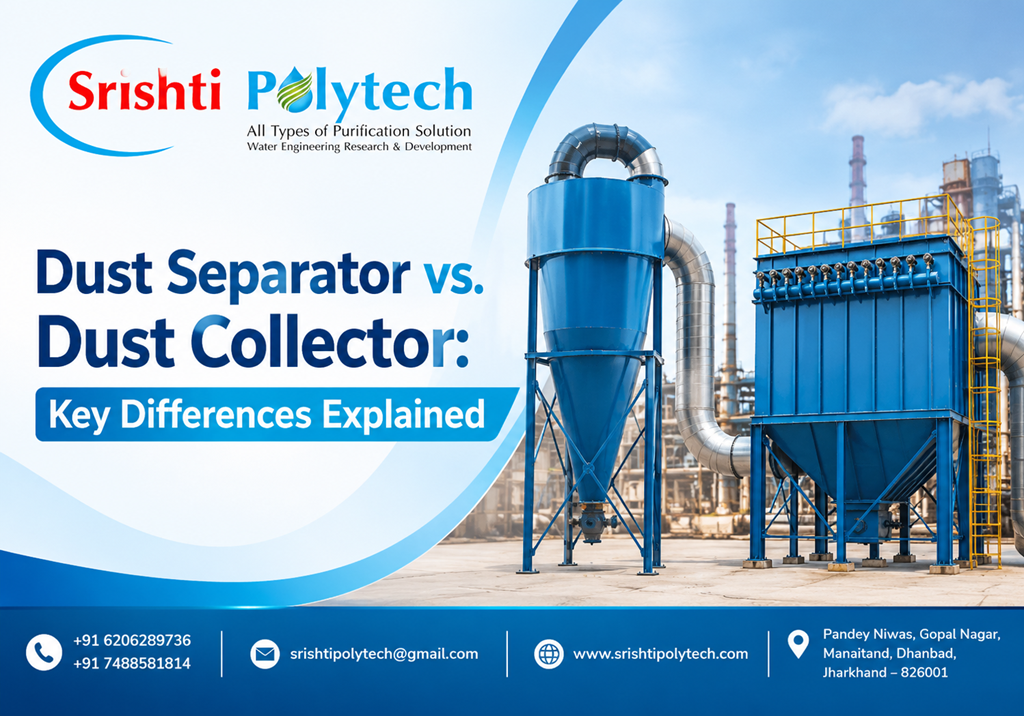
Dust Separator vs. Dust Collector: Key Differences Explained
Oct 22, 2026
uploads/blogs/blog_6ad9e3fe623e6.png
Dust control is an important requirement in modern industries, including cement manufacturing, steel production, pharmaceuticals, woodworking, food processing, and chemical industries. Industrial processes often generate dust, fine particles, and airborne pollutants that can affect workplace cleanliness, equipment performance, product quality, and air quality.
To manage these challenges, industries use dust separation and dust collection systems. Two commonly discussed solutions are dust separators and dust collectors. Although both are designed to help control dust, they differ in their working principles, applications, and particle removal capabilities.
Understanding the difference between a dust separator and a dust collector helps industries choose the right equipment according to their operational requirements, dust characteristics, airflow capacity, and environmental control objectives.
What Is a Dust Separator?
A dust separator is equipment designed to separate dust particles from an air or gas stream. It is commonly used as a preliminary separation stage to remove larger or heavier particles before the air enters a more advanced filtration system.
Many industrial dust separators use centrifugal force, gravity, or other separation mechanisms to remove particles from the airflow. A cyclone dust separator, for example, creates a rotating air movement that pushes heavier particles toward the outer wall, allowing them to fall into a collection hopper.
Dust separators are particularly useful in applications where processes generate large quantities of coarse dust, sawdust, cement particles, metal particles, or other dry materials.
Key Benefits of Dust Separators
Help remove larger dust particles from industrial airflow.
Reduce the dust load entering downstream filters.
Can improve the service life of secondary filtration equipment.
Suitable for many continuous industrial operations.
Cyclone-type designs generally have no filter media to replace.
Can be integrated into industrial ventilation and dust control systems.
However, conventional cyclone separators may not effectively remove very fine particles on their own. Their performance depends on particle size, airflow, separator design, and operating conditions.
What Is a Dust Collector?
A dust collector is a system designed to capture and retain airborne dust generated during industrial operations. It commonly draws dust-laden air through a filtration or separation mechanism and collects the removed particles in a hopper, bin, or other designated container.
Industrial dust collectors are available in several types, including baghouse dust collectors, cartridge dust collectors, wet dust collectors, and electrostatic precipitators. Each type is suitable for particular operating conditions and dust characteristics.
For example, a baghouse dust collector uses filter bags to capture dust particles, while a cartridge dust collector uses specialized filter cartridges. Wet dust collectors use liquid to help capture particles, whereas electrostatic precipitators use electrical forces to remove particulate matter.
Key Benefits of Dust Collectors
Capture airborne dust at designated collection points.
Help improve workplace cleanliness and air quality.
Reduce the release of particulate matter when properly designed and maintained.
Protect machinery and other equipment from dust accumulation.
Support industrial ventilation and environmental management systems.
Offer different filtration options for different industrial requirements.
The effectiveness of a dust collector depends on the filtration technology, filter condition, dust properties, airflow, and the overall design of the system.
How Does a Dust Separator Work?
The working principle depends on the separator design. In a cyclone dust separator, dust-laden air enters a cylindrical or conical chamber, producing a rotating flow.
As the air rotates, centrifugal forces move heavier dust particles toward the chamber wall. These particles lose momentum and move downward into a collection hopper. The relatively cleaner air exits through the outlet.
This process can reduce the amount of coarse dust entering downstream filters. However, fine particles may remain in the airflow, which is why additional filtration may be necessary when high dust-removal efficiency is required.
How Does a Dust Collector Work?
A typical industrial dust collection system draws contaminated air from the dust-generating point through ducts or hoods. The air then passes through a collection or filtration unit, where dust is separated from the air.
In a baghouse or cartridge collector, dust accumulates on the filter surface while cleaned air passes through the filter media. The collected dust is periodically removed through a cleaning mechanism and discharged into a hopper or collection container.
The cleaned air may be returned to the workplace or discharged outdoors, depending on the system design, dust characteristics, and applicable environmental requirements. Certain hazardous dusts require specialized containment and disposal procedures.
Industrial Applications of Dust Separators and Dust Collectors
Both types of equipment have important applications across different industries.
1. Cement and Construction Industry
Cement handling, crushing, mixing, and material transfer can generate considerable quantities of dust. Separators can remove coarse particles, while suitable dust collectors help control airborne emissions at transfer points and processing equipment.
2. Steel and Metal Processing
Grinding, cutting, polishing, and material handling can produce metal dust and fine particulate matter. Appropriate collection systems help manage these contaminants and maintain cleaner production areas.
3. Woodworking Industry
Sawing, sanding, and cutting generate sawdust and wood particles. Dust separators can remove larger particles, while filtration systems capture finer airborne dust. Wood dust may present fire or explosion hazards, so system design and safety measures are essential.
4. Pharmaceutical and Chemical Industries
Powder handling, mixing, and packaging can release fine particles into the air. Properly selected dust collection systems help maintain process cleanliness and control exposure, with specialized designs where hazardous or combustible powders are involved.
5. Food Processing Industry
Processes such as grain handling, flour production, and powdered ingredient transfer may generate dust. Suitable collection equipment helps maintain cleanliness and control airborne particles, while hygienic design and combustible-dust precautions remain important.
Can a Dust Separator and Dust Collector Be Used Together?
Yes. In many industrial applications, using a dust separator and a dust collector together can be an effective solution.
A cyclone separator can be installed before a baghouse or cartridge dust collector. The cyclone removes a portion of the larger particles, reducing the dust load entering the filter unit. The downstream collector then captures the remaining particles according to its filtration capability.
This arrangement may reduce filter loading and improve overall system operation. However, the actual benefits depend on the dust characteristics, system sizing, operating conditions, and maintenance practices.
For industries that generate both coarse and fine dust, a combined system may provide better control than relying on a basic separator alone.
How to Choose the Right Dust Control System
Selecting the right equipment requires careful consideration of the industrial process and the type of dust being generated.
Particle size: Determine whether the dust consists mainly of coarse particles, fine particles, or a mixture.
Airflow capacity: Calculate the required airflow based on the number of collection points and the process conditions.
Dust characteristics: Consider density, moisture content, abrasiveness, temperature, and chemical properties.
Required efficiency: Establish the desired particle removal efficiency and applicable emission limits.
Maintenance requirements: Evaluate filter cleaning, replacement intervals, hopper discharge, and inspection needs.
Safety considerations: Identify combustible, explosive, toxic, or otherwise hazardous dust and specify appropriate protection measures.
Operating cost: Consider energy consumption, pressure drop, filter replacement, waste handling, and routine maintenance.
Consulting an experienced industrial equipment manufacturer or system designer can help determine the most suitable solution for a particular application.
Conclusion
Dust separators and dust collectors both play important roles in industrial dust management, but they serve different purposes. A dust separator is often used to remove larger particles from an air stream, while a dust collector is designed to capture and retain dust through appropriate collection or filtration technology.
For many industries, the most effective solution may involve combining both systems to manage coarse and fine particles efficiently. Proper equipment selection, professional installation, routine maintenance, and suitable safety measures are essential for reliable performance.
Srishti Polytech provides industrial water and environmental treatment solutions for a range of applications. For your industrial requirements, contact our team to discuss suitable equipment and system solutions.
Contact Srishti Polytech
Srishti Polytech
Pandey Niwas, Gopal Nagar, Manaitand, Dhanbad, Jharkhand – 826001, India
Phone: +91 6206289736 | +91 7488581814
Email: srishtipolytech@gmail.com
Website: https://www.srishtipolytech.com
Contact our team to discuss your industrial equipment and environmental treatment requirements.
Keywords
#DustSeparator #DustCollector #DustSeparatorVsDustCollector #IndustrialDustSeparator #IndustrialDustCollector #CycloneDustSeparator #DustCollectionSystem #IndustrialDustControl #DustSeparationEquipment #AirPollutionControl #DustFiltrationSystem #BaghouseDustCollector #CartridgeDustCollector #IndustrialAirFiltration #IndustrialEquipment #DustRemovalSystem #EnvironmentalProtection #IndustrialSafety #ManufacturingIndustry #SrishtiPolytech #IndustrialSolutions #DustCollectorManufacturerIndia #IndustrialDustControlSolutions #AirQualityManagement #PollutionControlEquipment
Oct 22, 2026
Dust Separator vs. Dust Collector: Key Differences Explained
Dust control is an important requirement in modern industries, including cement manufacturing, steel production, pharmaceuticals, woodworking, food processing, and chemical...
Mineral Water Plant vs RO Water Plant: What Is the Difference?
Oct 15, 2026
uploads/blogs/blog_6ad0c52a3a110.png
Clean and safe drinking water is essential for human health, commercial activities, and industrial development. With increasing demand for purified drinking water, mineral water plants and Reverse Osmosis (RO) water plants have become important solutions for water treatment and packaged drinking water production.
However, many people use the terms mineral water plant and RO water plant interchangeably. Although both are associated with drinking water purification, they are not exactly the same. An RO plant is a water treatment system that uses a membrane to reduce dissolved salts and other contaminants, while a mineral water plant generally refers to a complete production facility designed to prepare water for a particular mineral-water or packaged-drinking-water product.
Understanding the difference between these systems is important for entrepreneurs, hotels, hospitals, commercial establishments, industries, and businesses planning to establish a drinking water production unit.
In this blog, we will explain how mineral water plants and RO water plants work, their major differences, equipment requirements, applications, advantages, and the factors to consider when selecting the right system.
What Is a Mineral Water Plant?
A mineral water plant is a facility designed to process, handle, and package water according to the applicable product category and quality requirements.
The term is often used commercially for packaged drinking water production plants that include purification equipment, storage tanks, disinfection systems, and bottle-filling machinery. However, natural mineral water and packaged drinking water are different product categories.
Natural mineral water comes from a suitable protected underground source and has a characteristic mineral composition that remains relatively stable. Its treatment options are restricted because its essential mineral characteristics must be preserved.
Packaged drinking water, on the other hand, may be obtained from suitable sources such as groundwater or municipal supplies and treated using technologies including filtration, RO, disinfection, and remineralisation, where appropriate.
How Does a Mineral Water Plant Work?
The treatment process depends on the source water, its quality, and the product being manufactured. A typical packaged drinking water production line may include the following stages:
1. Raw Water Collection
Raw water is collected from a suitable source, such as a borewell or an approved water supply. Before selecting equipment, the water should be tested for parameters such as TDS, hardness, iron, turbidity, and microbiological contamination.
2. Pre-Treatment and Filtration
Depending on the raw water analysis, pre-treatment may include sand filtration, activated carbon filtration, iron removal, and cartridge filtration. These stages help remove suspended particles and certain unwanted substances and protect downstream equipment.
3. RO Purification, Where Required
For packaged drinking water, an RO system may be installed to reduce dissolved salts and other contaminants. The need for RO depends on the raw water quality and the required final product specifications.
4. Mineral Management
The mineral content of the final water must be appropriate for its product category. Where remineralisation is part of packaged drinking water treatment, suitable food-grade or pharmaceutical-grade ingredients must be used, and the final water must meet applicable requirements. Natural mineral water must retain its essential mineral characteristics.
5. Disinfection
Suitable disinfection methods, such as ultraviolet treatment or ozonation, may be used as part of a properly designed treatment and hygiene system.
6. Hygienic Storage and Packaging
Treated water is stored in suitable hygienic tanks and transferred to the filling section. Bottles or other approved containers are cleaned and handled appropriately before filling, sealing, labelling, and dispatch.
The complete system must be designed to minimise contamination and consistently produce water that meets the applicable quality standards.
What Is an RO Water Plant?
An RO water plant is a purification system that uses reverse osmosis technology to reduce dissolved salts and certain contaminants present in water.
In the RO process, water is pressurised and passed through a semi-permeable membrane. The membrane allows water to pass through while rejecting a significant proportion of dissolved substances. The exact removal performance depends on the membrane, operating conditions, and feed-water composition.
RO plants are widely used in commercial buildings, industries, hospitals, laboratories, drinking water facilities, and packaged drinking water production units.
How Does an RO Water Plant Work?
1. Raw Water Supply
Water enters the system from a suitable source. Its quality is assessed to determine the treatment requirements.
2. Pre-Treatment
Depending on the feed water, filters and other treatment equipment are used to reduce suspended solids, chlorine, hardness-related scaling risks, iron, or other substances that could damage the RO membrane.
3. High-Pressure Pumping
A high-pressure pump supplies the pressure required to push water through the RO membrane.
4. Reverse Osmosis Membrane Filtration
The membrane separates the incoming water into two streams: permeate, which is the treated water, and concentrate, which contains a higher proportion of the rejected dissolved substances.
5. Post-Treatment
Depending on the intended use, the treated water may require pH adjustment, remineralisation, UV treatment, or another suitable treatment stage.
6. Storage and Distribution
The finished water is stored in a suitable tank or supplied directly to the point of use. Storage and distribution arrangements must prevent recontamination.
RO plants can be designed in different capacities according to daily demand and feed-water conditions.
Major Equipment Required for a Mineral Water Production Plant
The equipment required depends on the water source, production capacity, packaging format, and applicable product requirements.
Common equipment may include:
Raw water storage tank
Feed-water transfer pump
Sand filter and activated carbon filter, where required
Cartridge filtration system
RO purification unit, where required
UV disinfection or ozonation equipment, where appropriate
Suitable treated-water storage tank
Hygienic pipelines and transfer pumps
Bottle rinsing, filling, and capping machine
Labelling and batch-coding equipment
Water quality testing instruments
Sanitation and cleaning arrangements
A complete plant should be designed as an integrated system rather than as a collection of unrelated machines. This helps improve process control, maintain hygiene, and support consistent production.
Major Equipment Required for an RO Water Plant
A typical commercial or industrial RO plant may contain the following components:
1. Pre-Treatment Filters: Reduce suspended particles and other substances that may affect the membrane.
2. Feed Pump: Transfers raw water through the treatment stages.
3. High-Pressure Pump: Provides the pressure required for membrane separation.
4. RO Membrane and Pressure Vessel: Form the main purification section.
5. Control Panel: Supports monitoring and control of operating parameters.
6. Flow Meters and Pressure Gauges: Help operators monitor feed flow, permeate flow, concentrate flow, and system pressure.
7. Chemical Dosing System, Where Required: Supports pH adjustment, antiscalant dosing, or other treatment needs based on water analysis.
8. Treated Water Tank: Stores the permeate for further use.
9. Post-Treatment Equipment: May include UV disinfection, remineralisation, or other suitable processes depending on the application.
The correct combination of components helps improve reliability, protect the membranes, and maintain the required treated-water quality.
Applications of Mineral Water Plants
Mineral water and packaged drinking water production facilities are used by businesses serving different customer segments.
Common applications include:
Packaged drinking water bottling businesses
Hotels, restaurants, and catering companies
Offices and commercial establishments
Retail drinking water brands
Institutional water supply operations
Hospitality and tourism facilities
The product category, production process, packaging arrangements, and regulatory requirements must be established before commissioning the facility.
Applications of RO Water Plants
RO systems are used in a much broader range of applications because their configuration can be adapted to different water quality requirements.
1. Commercial Drinking Water
RO plants can supply treated water to offices, educational institutions, hotels, and commercial buildings.
2. Industrial Water Treatment
Industries may use RO water for manufacturing, washing, rinsing, and other processes where reduced dissolved solids are required.
3. Hospitals and Laboratories
Suitable RO systems can provide treated water for selected laboratory, cleaning, and other applications. Medical applications require specialised system design and validation according to the intended use.
4. Food and Beverage Industries
RO plants may be used for ingredient water, process water, and other applications where the required water specifications justify membrane treatment.
5. Water Treatment and Packaging Facilities
RO can form one stage of a larger drinking water treatment system, together with pre-treatment, disinfection, storage, and packaging equipment.
Advantages of a Mineral Water Production Plant
A properly designed production facility offers several operational advantages.
1. Consistent Product Quality: A well-controlled process helps maintain the required water quality across production batches.
2. Scalable Production: Equipment and bottling lines can be selected according to expected production volumes and business requirements.
3. Integrated Operations: Purification, storage, filling, and packaging equipment can be coordinated within one facility.
4. Multiple Packaging Options: Depending on the business model and applicable requirements, production may involve bottles or other permitted packaging formats.
5. Quality Monitoring: Appropriate testing, hygienic handling, and process monitoring help identify deviations before products reach customers.
These advantages depend on correct plant design, trained operators, regular maintenance, and effective quality control.
Advantages of an RO Water Plant
1. Reduction of Dissolved Salts: RO can substantially reduce TDS and many dissolved ionic substances.
2. Adaptable Design: RO plants can be configured for a wide range of feed-water qualities and capacities.
3. Improved Water Quality for Specific Uses: Properly designed systems can help achieve required process-water specifications.
4. Integration With Other Technologies: RO can work alongside filtration, softening, disinfection, and other treatment processes.
5. Automated Monitoring Options: Modern systems may include conductivity monitoring, automatic controls, alarms, and protective shutdown features.
However, RO does not remove every contaminant under all conditions, and the permeate must be tested against its intended water quality requirements.
How to Choose the Right Plant for Your Business
Before investing in a mineral water production facility or an RO system, consider the following factors.
1. Identify Your Intended Product
First, determine whether you intend to manufacture packaged drinking water or natural mineral water. These are different categories with different source-water and processing requirements.
2. Test the Raw Water
Obtain a laboratory analysis of the source water. Parameters such as TDS, pH, hardness, iron, turbidity, and microbiological quality help determine the required treatment process.
3. Calculate Your Required Capacity
Estimate daily production, peak demand, operating hours, and expected future growth. RO capacity is commonly expressed in litres per hour (LPH), while bottling requirements also depend on the number and size of containers filled per hour.
4. Select the Correct Treatment Process
Not every water source needs the same equipment. Some applications may require filtration and disinfection, while others may need softening, iron removal, RO, or additional treatment stages.
5. Evaluate Space and Utilities
Consider the installation area, electricity supply, feed-water availability, drainage, storage capacity, and space for maintenance and packaging equipment.
6. Consider Operating Costs
Evaluate electricity consumption, membrane replacement, filter media, chemicals, cleaning, laboratory testing, labour, maintenance, and water recovery. The lowest initial purchase price does not necessarily result in the lowest long-term operating cost.
7. Check Regulatory Requirements
In India, packaged drinking water and natural mineral water are subject to applicable FSSAI requirements and product-specific standards. Verify current licensing, testing, labelling, inspection, and certification obligations before starting commercial production.
Why Proper Plant Design and Maintenance Matter
Even high-quality equipment cannot guarantee safe water if the plant is incorrectly designed or poorly maintained.
A reliable operation should include:
Regular raw-water and finished-water testing
Timely replacement of filter cartridges and membrane elements
Monitoring of pressure, flow, conductivity, and other relevant parameters
Cleaning and sanitisation of tanks and pipelines
Inspection of pumps, valves, and control systems
Proper management of RO concentrate and wastewater
Maintenance records and trained operating personnel
Routine monitoring can help identify membrane fouling, scaling, reduced production, and other problems before they lead to significant downtime.
Regulatory Considerations for Packaged Water in India
Businesses planning to sell packaged water must distinguish between natural mineral water and packaged drinking water when selecting their process and preparing product labels.
The Food Safety and Standards Authority of India (FSSAI) regulates food safety requirements for these products. The Bureau of Indian Standards (BIS) publishes separate product standards, including IS 13428 for packaged natural mineral water and IS 14543 for packaged drinking water.
Regulatory requirements have changed in recent years. Therefore, manufacturers should verify the latest applicable FSSAI licensing, inspection, testing, labelling, and BIS-related requirements before commencing production rather than relying solely on older guidance.
For reference, consult the official FSSAI website and BIS standards portal.
Why Choose Srishti Polytech for Water Treatment Solutions?
Srishti Polytech provides water treatment solutions for commercial and industrial requirements, including RO water purification systems and related treatment equipment.
When planning a new water treatment or packaged water production facility, it is important to choose equipment based on the source-water analysis, intended application, required capacity, and long-term operating needs.
Srishti Polytech can be contacted to discuss water treatment requirements and suitable plant configurations.
Conclusion
Mineral water plants and RO water plants serve related but different purposes. A mineral water production facility is designed around the requirements of the intended packaged water product, while an RO plant is a purification system that reduces dissolved salts and certain contaminants.
For businesses planning to manufacture packaged drinking water, an RO system may be one component of a complete production facility. For applications that require treated water for commercial or industrial use, a standalone RO plant or a customised water treatment system may be more appropriate.
The best choice depends on raw-water quality, intended use, production capacity, operating costs, and applicable regulations. Proper planning, suitable equipment selection, regular maintenance, and consistent water quality testing are essential for reliable operation.
Contact Srishti Polytech to discuss your water treatment requirements and identify a suitable solution for your business.
Contact Details – Srishti Polytech
Company: Srishti Polytech
Address: Pandey Niwas, Gopal Nagar, Manaitand, Dhanbad, Jharkhand – 826001
Phone: +91 6206289736 | +91 7488581814
Email: srishtipolytech@gmail.com
Website: https://www.srishtipolytech.com
Keywords
#MineralWaterPlant #ROWaterPlant #WaterTreatmentPlant #WaterPurification #ReverseOsmosis #PackagedDrinkingWater #MineralWaterPlantMachinery #IndustrialROPlant #WaterTreatmentSolutions #SrishtiPolytech

Oct 15, 2026
Mineral Water Plant vs RO Water Plant: What Is the Difference?
Clean and safe drinking water is essential for human health, commercial activities, and industrial development. With increasing demand for purified...
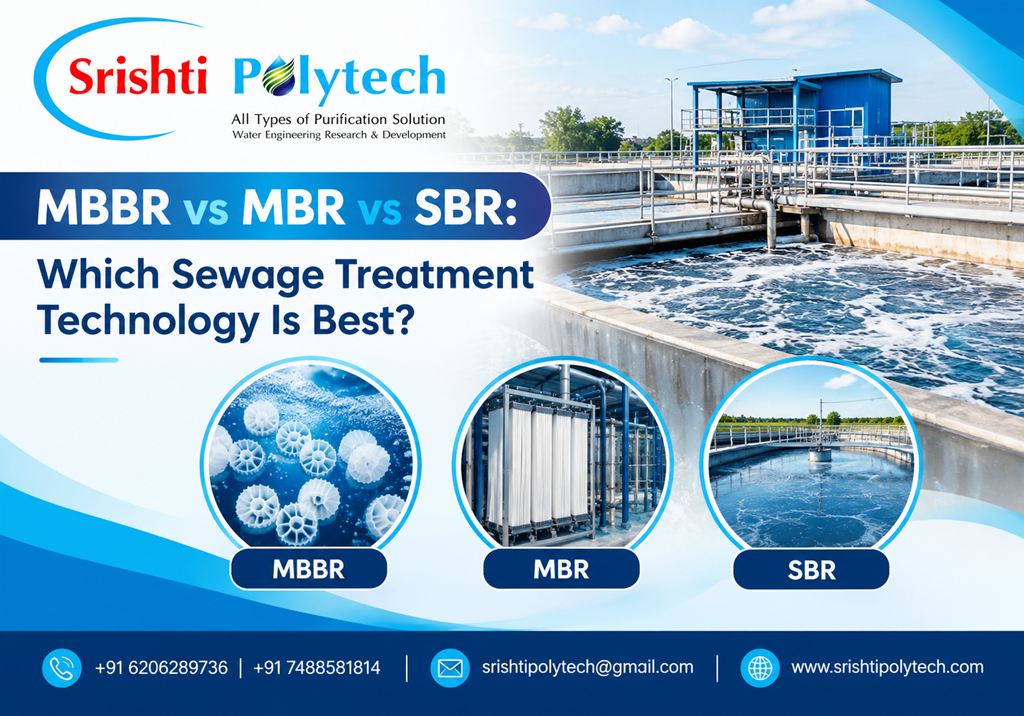
MBBR vs MBR vs SBR: Which Sewage Treatment Technology Is Best?
Oct 13, 2026
uploads/blogs/blog_6ace2788437e8.png
With increasing water pollution, growing water demand, and stricter environmental requirements, effective sewage treatment has become essential for industries, hospitals, hotels, residential societies, and commercial buildings. A Sewage Treatment Plant (STP) helps treat domestic wastewater so that it can be safely discharged or reused for suitable applications.
Among the most widely used sewage treatment technologies are MBBR (Moving Bed Biofilm Reactor), MBR (Membrane Bioreactor), and SBR (Sequencing Batch Reactor). Each technology has its own advantages, operating requirements, space requirements, and treatment capabilities.
Choosing the right technology depends on wastewater characteristics, plant capacity, available space, treated water quality requirements, budget, and maintenance needs.
In this blog, we will compare MBBR, MBR, and SBR technologies to help you select the right sewage treatment solution for your facility.
1. What Is MBBR Technology?
MBBR stands for Moving Bed Biofilm Reactor. It is a biological wastewater treatment technology that uses specially designed plastic media inside an aeration tank. Beneficial microorganisms grow on the surface of this media and help break down organic pollutants present in sewage.
Air supplied through an aeration system keeps the media moving and provides oxygen for biological treatment.
Key Benefits of MBBR
Compact design: Offers a relatively compact treatment system for many applications.
Reliable biological treatment: Microorganisms attached to the media help treat organic pollutants.
Flexible operation: Can accommodate variations in wastewater load when properly designed.
Lower risk of biomass washout: The biofilm remains attached to the media, although suspended biomass still needs to be managed.
Suitable for upgrades: Can be used to increase biological treatment capacity in some existing plants.
Applications of MBBR
MBBR technology is commonly used in residential complexes, hotels, hospitals, commercial buildings, and industrial facilities that generate suitable biodegradable wastewater.
2. What Is MBR Technology?
MBR stands for Membrane Bioreactor. It combines biological wastewater treatment with membrane filtration. The membranes separate treated water from suspended solids and much of the biomass, producing a high-quality effluent when the system is properly designed and operated.
MBR systems are especially useful where space is limited or where the treated water must meet demanding reuse requirements.
Key Benefits of MBR
High-quality treated water: Membrane filtration provides excellent removal of suspended solids and turbidity.
Compact footprint: Often requires less space than conventional treatment systems.
Effective solids separation: Membranes replace the need for a conventional secondary clarifier in many configurations.
Suitable for water reuse: The treated effluent may be suitable for applications such as toilet flushing, landscaping, and certain industrial uses, subject to the required water quality and any additional disinfection.
Consistent effluent quality: Proper membrane operation can provide reliable solids separation.
Limitations of MBR
Higher initial investment in many applications.
Membrane fouling requires monitoring, cleaning, and periodic maintenance.
Energy consumption can be higher because of membrane aeration, pumping, and cleaning requirements.
Membranes eventually require replacement.
Applications of MBR
MBR technology is commonly considered for hospitals, premium commercial buildings, hotels, residential developments, and facilities where space is limited and high-quality treated water is important.
3. What Is SBR Technology?
SBR stands for Sequencing Batch Reactor. It is an activated-sludge treatment process in which biological treatment and solids settling occur sequentially in the same tank.
Instead of continuously moving wastewater through separate aeration and settling tanks, an SBR operates in cycles. These typically include filling, aeration or reaction, settling, treated-water decanting, and idle time when required.
Key Benefits of SBR
Combined treatment functions: Biological treatment and settling take place in the same reactor.
Flexible operation: Treatment cycles can be adjusted to suit wastewater loads and effluent targets.
Good nutrient removal potential: With appropriate operating cycles and design, SBR can remove nitrogen and phosphorus.
Reduced need for separate settling tanks: The process integrates several treatment stages into one reactor.
Suitable for variable flows: Batch operation can accommodate variations when the system has sufficient equalization and capacity.
Limitations of SBR
Requires reliable controls and automated sequencing.
Decanting and settling performance must be monitored.
Peak flows and changes in wastewater characteristics must be considered during design.
Operators need to understand the treatment cycle and process requirements.
Which Sewage Treatment Technology Is Best?
There is no single technology that is best for every project. The most suitable option depends on the specific requirements of the facility.
Choose MBBR If:
You need a robust biological treatment process.
You want flexibility to handle variations in organic loading.
You are considering an upgrade to an existing sewage treatment plant.
You need a practical solution for residential, commercial, or industrial sewage.
Choose MBR If:
Available installation space is limited.
High-quality treated water is a major priority.
The project involves water reuse and has demanding suspended-solids requirements.
You can support membrane cleaning, monitoring, and replacement costs.
Choose SBR If:
You prefer a treatment process that operates in programmed cycles.
You want biological treatment and settling integrated into the same tank.
Flow patterns vary and can be managed through suitable cycle and tank design.
The facility can support the required automation and operating controls.
Before selecting a technology, assess daily sewage flow, peak flow, BOD, COD, suspended solids, nitrogen and phosphorus requirements, land availability, electricity costs, sludge disposal, and the required treated-water quality.
4. Factors to Consider Before Installing an STP
Selecting the right sewage treatment technology is only one part of planning an efficient Sewage Treatment Plant. Consider these important factors:
1. Plant capacity: Estimate sewage generation and peak flow accurately. Capacity is commonly expressed in KLD (kilolitres per day).
2. Wastewater characteristics: Test parameters such as BOD, COD, TSS, oil and grease, and nutrients where relevant.
3. Space availability: Compare the footprint of tanks, equipment, access areas, and sludge-handling facilities.
4. Treated water requirements: Determine whether the treated water will be discharged or reused for flushing, gardening, cooling, or other suitable purposes.
5. Installation and operating costs: Evaluate capital expenditure alongside electricity, chemicals, labour, sludge disposal, and replacement parts.
6. Maintenance and service support: Plan routine inspections, equipment servicing, cleaning, and operator training.
7. Compliance requirements: Design and operate the plant according to applicable pollution-control requirements and the standards relevant to the intended discharge or reuse.
5. Importance of Regular STP Maintenance
Even a well-designed sewage treatment plant may experience poor performance if it is not maintained properly. Routine maintenance helps protect treatment efficiency, reduce unexpected breakdowns, and improve equipment life.
Important maintenance activities include:
Inspecting pumps, blowers, pipelines, and valves.
Monitoring dissolved oxygen and other relevant process parameters.
Checking sludge levels and arranging appropriate sludge removal.
Cleaning membranes and monitoring transmembrane pressure in MBR systems.
Inspecting MBBR media retention screens and aeration systems.
Verifying SBR cycle timing, sensors, and decanter operation.
Testing treated water periodically to confirm that it meets the required standards.
A planned Annual Maintenance Contract (AMC) can help facilities schedule preventive servicing and identify potential issues before they cause major disruptions.
Conclusion
MBBR, MBR, and SBR are all valuable technologies for modern sewage treatment, but each serves different operational needs.
MBBR is a strong option for robust biological treatment and flexible applications. MBR is particularly attractive where space is limited and high-quality treated water is required. SBR is suitable where cycle-based operation and integrated treatment functions offer practical advantages.
The best choice is the one that meets your wastewater treatment targets while balancing installation cost, operating expenses, available space, maintenance requirements, and long-term reliability.
About Srishti Polytech
Srishti Polytech provides water and wastewater treatment solutions, including Sewage Treatment Plants (STPs), Effluent Treatment Plants (ETPs), and other water treatment systems for industrial and commercial applications.
If you are planning to install a new STP, upgrade an existing treatment facility, or explore suitable wastewater treatment technologies, contact our team to discuss your project requirements.
Contact Srishti Polytech
Address: Pandey Niwas, Gopal Nagar, Manaitand, Dhanbad, Jharkhand – 826001
Phone: +91 6206289736 / +91 7488581814
Email: srishtipolytech@gmail.com
Website: www.srishtipolytech.com
Keywords:
#SewageTreatmentPlant #STP #MBBR #MBR #SBR #WastewaterTreatment #WaterTreatment #IndustrialWastewater #WaterRecycling #EnvironmentalProtection #SrishtiPolytech
Oct 13, 2026
MBBR vs MBR vs SBR: Which Sewage Treatment Technology Is Best?
With increasing water pollution, growing water demand, and stricter environmental requirements, effective sewage treatment has become essential for industries, hospitals,...
Top Benefits of Installing an Iron Removal Filter Plant in Industries
Oct 12, 2026
uploads/blogs/blog_6accd60de14d7.png
Water is an essential resource for various industrial operations, including manufacturing, processing, equipment cleaning, boiler feed pretreatment, and other production activities. However, groundwater and borewell water often contain excessive iron, which can affect water quality, damage equipment, cause reddish-brown stains, and create operational challenges. An Iron Removal Filter Plant is an effective water treatment solution designed to reduce excess iron and improve water quality for suitable industrial applications.
Industries that depend on groundwater need to pay close attention to iron concentration before using water in their processes. Installing a properly designed iron removal system can help improve operational efficiency, protect downstream equipment, reduce maintenance requirements, and support consistent water quality.
Srishti Polytech provides water treatment solutions for industrial and commercial applications, helping businesses identify suitable filtration systems based on their water quality and treatment requirements.
What Is an Iron Removal Filter Plant?
An Iron Removal Filter Plant is a water treatment system designed to remove or reduce dissolved and suspended iron from water. High iron concentrations are commonly found in groundwater and borewell supplies. When this water comes into contact with air, dissolved iron may oxidize and form reddish-brown particles that cause discoloration, deposits, and staining.
An iron removal plant generally consists of a filtration vessel containing suitable filter media, a control valve or piping arrangement, and associated equipment required for filtration and backwashing. Depending on the raw water quality, some systems may also require aeration, chemical oxidation, or other pretreatment processes.
The selection of a suitable plant depends on several factors, including iron concentration, pH, flow rate, manganese content, turbidity, and the intended use of treated water.
How Does an Iron Removal Filter Plant Work?
The working process of an iron removal plant typically involves the following stages:
1. Raw Water Supply: Water from a borewell, groundwater source, or other supply is fed into the treatment system.
2. Oxidation: Where necessary, dissolved iron is oxidized using aeration or an appropriate oxidizing method. This converts dissolved iron into particles that can be filtered.
3. Filtration: Water passes through suitable filter media, which captures iron particles and other suspended impurities targeted by the selected treatment process.
4. Backwashing: The filter media is periodically cleaned by reversing the water flow or using the system's specified cleaning procedure to remove accumulated impurities.
5. Treated Water Supply: Filtered water is directed to the required industrial application or to additional treatment stages, if necessary.
The exact process varies according to the raw water analysis and plant design. Water testing is important to determine whether additional treatment is required.
Top Benefits of Installing an Iron Removal Filter Plant in Industries
1. Improves Water Quality
Excess iron can cause reddish-brown discoloration, unpleasant metallic taste, and visible deposits. An iron removal filter plant helps reduce iron levels and improve the appearance and quality of treated water when the system is correctly selected and operated.
Improved water quality is particularly valuable for industries that use groundwater for cleaning, washing, manufacturing support, and general utility purposes.
2. Protects Industrial Equipment and Pipelines
Iron deposits can accumulate inside pipes, storage tanks, valves, and other water-handling equipment. Over time, these deposits may restrict water flow and increase cleaning requirements.
By reducing iron before it enters the distribution network, an appropriately designed filtration system can help minimize iron-related deposits and protect downstream equipment.
3. Reduces Maintenance Requirements
Excessive iron in raw water may lead to frequent cleaning of tanks, pipelines, fixtures, and filtration equipment. It can also contribute to problems in downstream treatment systems.
An iron removal plant can help reduce these issues when the treatment process is matched to the actual water quality. Regular backwashing, inspection, and preventive maintenance remain necessary to keep the system operating efficiently.
4. Supports RO Plant Performance
Iron can contribute to fouling of Reverse Osmosis (RO) membranes, particularly when iron is oxidized and forms deposits. These deposits can reduce membrane performance and increase cleaning requirements.
Installing a suitable iron removal system before an RO plant can help reduce iron-related fouling and support more reliable operation. However, the pretreatment design must consider iron chemistry, suspended solids, and other feed-water parameters. Additional filtration or treatment may also be necessary.
5. Helps Maintain Consistent Production Quality
Industries that use water in manufacturing or product processing may need consistent water quality to meet operational specifications. Excess iron can cause staining, deposits, and other unwanted effects.
A properly designed iron removal plant helps control iron levels in the treated water, supporting more consistent industrial operations. Where the application has strict water-quality requirements, iron removal may need to be combined with other treatment processes.
6. Reduces Iron Staining
Iron-rich water can leave reddish-brown marks on floors, equipment, sanitary fixtures, washing areas, and containers. These stains can increase cleaning effort and affect the appearance of industrial facilities.
Removing excess iron before water is distributed can help reduce staining in areas where iron-containing water is used.
7. Supports Water Treatment System Efficiency
Iron removal is often an important pretreatment stage in a larger water treatment system. Depending on the application, treated water may subsequently pass through a water softener, activated carbon filter, RO plant, demineralization plant, or another treatment unit.
Reducing iron at the appropriate stage can help downstream equipment operate more effectively. The overall treatment sequence should be determined by the complete raw water analysis and the required treated-water quality.
8. Suitable for a Wide Range of Industrial Applications
Iron removal filter plants can be designed for a variety of industries and facilities, including:
Manufacturing and engineering units
Food and beverage processing, where the complete treatment system meets the required water-quality standards
Hospitals and healthcare facilities, with application-specific treatment and validation
Hotels, commercial buildings, and institutions
Textile and washing industries
Pharmaceutical and chemical industries, where additional purification may be required
Industrial RO and other water treatment installations
The plant capacity and filtration technology should be selected according to water demand, iron concentration, and the intended application.
9. Helps Optimize Operating Costs
Excess iron can contribute to equipment cleaning, filter maintenance, pipeline flushing, and downstream treatment problems. These activities can increase operating expenses and cause avoidable interruptions.
A correctly designed iron removal plant can help control iron-related maintenance and protect downstream equipment. Actual cost savings depend on raw water quality, plant capacity, energy and chemical requirements, and maintenance practices.
10. Supports Reliable Long-Term Water Treatment
Industrial facilities need dependable water treatment systems that can handle their operating requirements. A properly selected iron removal filter plant, supported by routine monitoring and timely servicing, can help maintain stable filtration performance.
Monitoring inlet and outlet iron levels, filter pressure, backwashing frequency, and overall water quality helps operators identify performance issues and plan maintenance before problems become more serious.
Applications of Iron Removal Filter Plants
Iron removal systems are commonly used wherever excess iron in raw water affects water quality or downstream treatment.
Industrial RO Pretreatment: Reduces iron entering an RO system and helps manage membrane fouling risks.
Factories and Manufacturing Units: Supports general utility water requirements and suitable process-water applications.
Hospitals and Institutions: Helps treat iron-containing source water before additional treatment appropriate to the intended use.
Hotels and Commercial Buildings: Helps reduce reddish-brown staining and iron deposits in water distribution systems.
Textile and Washing Units: Helps control iron-related staining that may affect washing processes and finished materials.
Borewell Water Treatment: Provides a treatment option for groundwater containing excessive iron, subject to water analysis and suitable system design.
How to Choose the Right Iron Removal Filter Plant
Before purchasing an iron removal filter plant, industries should evaluate the following parameters:
Iron concentration: Determine the total and dissolved iron levels through water testing.
Plant capacity: Select a flow rate that meets the required water demand, usually expressed in litres per hour (LPH) or kilolitres per day (KLD).
Raw water quality: Check pH, turbidity, manganese, hardness, and other relevant parameters.
Treatment technology: Determine whether filtration alone is sufficient or whether aeration, oxidation, or additional pretreatment is required.
Filter media: Select media suitable for the water chemistry and expected operating conditions.
Backwashing requirements: Consider water availability, drainage arrangements, and cleaning frequency.
Treated-water requirements: Identify whether the water will be used for utilities, washing, manufacturing, RO feed, or another application.
After-sales support: Consider installation, maintenance, availability of consumables, and technical assistance.
A water analysis report and an assessment of the application help ensure that the selected plant is suitable for the site.
Maintenance Tips for Better Performance
Regular maintenance is essential for reliable operation and long filter-media life.
Monitor inlet and outlet iron concentrations at suitable intervals.
Backwash the filter according to the manufacturer's recommendations and actual operating conditions.
Inspect valves, pipelines, pressure gauges, and connections for leaks or abnormal pressure.
Check filter media condition and replace or replenish it when required.
Keep the backwash drainage arrangement clear and functional.
Maintain service records, including water test results, backwashing frequency, and maintenance activities.
Review the system design if treated-water quality deteriorates or the required flow rate cannot be maintained.
Preventive maintenance helps identify problems early and supports consistent water treatment performance.
Why Choose Srishti Polytech for Water Treatment Solutions?
Srishti Polytech provides water treatment solutions for industrial and commercial requirements, including filtration and water purification systems. Choosing the right iron removal plant begins with understanding the source water, the required flow rate, and the quality standards of the intended application.
The appropriate filtration arrangement can help industries address excess iron, protect downstream equipment, and improve water quality as part of a comprehensive water treatment strategy.
For a suitable solution, businesses should evaluate their raw water test results and application requirements before finalizing the plant capacity and treatment configuration.
Conclusion
Installing an Iron Removal Filter Plant can provide important benefits for industries that rely on iron-rich groundwater or borewell water. From improving water appearance and reducing staining to protecting pipelines and supporting RO pretreatment, an appropriately designed system can contribute to more efficient water treatment operations.
However, successful iron removal depends on correct plant selection, proper installation, suitable operating conditions, and regular maintenance. Testing the raw water and understanding the required treated-water quality are essential steps before selecting a system.
Srishti Polytech can help businesses explore suitable water treatment solutions based on their industrial requirements. Investing in appropriate pretreatment is a practical step toward more reliable water quality and better protection of downstream treatment equipment.
Contact Srishti Polytech
Srishti Polytech – Industrial Water Treatment Solutions
Address: Pandey Niwas, Gopal Nagar, Manaitand, Dhanbad, Jharkhand – 826001
Phone: +91 6206289736 | +91 7488581814
Email: srishtipolytech@gmail.com
Website: https://www.srishtipolytech.com
Contact Srishti Polytech to discuss your iron removal filtration requirements and suitable water treatment solutions for your industry.
Keywords:
#IronRemovalFilterPlant #IronRemovalPlant #IndustrialWaterTreatment #IronRemovalFilter #BorewellWaterTreatment #GroundwaterTreatment #WaterFiltrationPlant #IndustrialWaterPurification #ROPlantPretreatment #WaterTreatmentPlantManufacturer #IronRemovalSystem #WaterTreatmentSolutions #SrishtiPolytech #IndustrialFiltration #WaterQualityManagement

Oct 12, 2026
Top Benefits of Installing an Iron Removal Filter Plant in Industries
Water is an essential resource for various industrial operations, including manufacturing, processing, equipment cleaning, boiler feed pretreatment, and other production...
Annual Maintenance Contract (AMC) for Water Treatment Plants: Why It Matters
Oct 10, 2026
uploads/blogs/blog_6aca2aaf8920d.png
Water treatment plants play a vital role in supplying treated water for industrial, commercial, and institutional applications. From Reverse Osmosis (RO) plants and water softeners to Effluent Treatment Plants (ETP) and Sewage Treatment Plants (STP), these systems require regular inspection, maintenance, and performance monitoring to operate efficiently.
However, installing a water treatment plant is only the first step. Maintaining it properly is equally important for ensuring consistent performance, reducing unexpected breakdowns, and extending equipment service life. This is where an Annual Maintenance Contract (AMC) for water treatment plants becomes valuable.
In this blog, we will explore what an AMC is, why it matters, its key benefits, and how businesses can choose the right maintenance service provider.
What Is an Annual Maintenance Contract (AMC) for Water Treatment Plants?
An Annual Maintenance Contract (AMC) is a service agreement between a customer and a maintenance service provider for the inspection, servicing, and upkeep of specified equipment over an agreed period, typically one year.
For water treatment plants, an AMC may include scheduled preventive maintenance, equipment inspections, cleaning, operational checks, troubleshooting, and technical support, depending on the agreed scope of work.
An AMC can be arranged for different types of water treatment systems, including:
Reverse Osmosis (RO) Plants
Water Purification Systems
Water Softener Plants
Demineralisation (DM) Plants
Effluent Treatment Plants (ETP)
Sewage Treatment Plants (STP)
Industrial Water Treatment Plants
Commercial Water Coolers and Filtration Systems
The exact services, frequency of visits, replacement parts, consumables, and emergency support should be clearly defined in the contract.
Why Is AMC Important for Water Treatment Plants?
Water treatment equipment operates under varying water quality, flow rates, pressure conditions, and operating schedules. Without regular maintenance, filters may become clogged, membranes may lose performance, pumps may develop faults, and treatment efficiency may decline.
A planned maintenance contract helps businesses manage these risks and maintain better control over plant operations.
1. Reduces Unexpected Equipment Breakdowns
Unexpected equipment failure can interrupt water supply and affect daily operations. Routine inspections help identify issues such as abnormal pump noise, leakage, pressure fluctuations, and damaged components before they develop into more serious problems.
Although an AMC cannot eliminate every breakdown, preventive maintenance can help reduce avoidable equipment failures.
2. Improves Water Treatment Performance
Water quality depends on the condition of treatment equipment and the quality of incoming water. Regular checks of filters, membranes, dosing systems, pumps, and other components can help maintain the intended treatment performance.
For RO plants, monitoring feed pressure, permeate flow, and treated water TDS can help identify declining performance. For ETP and STP systems, monitoring relevant process parameters supports effective wastewater treatment.
3. Helps Control Maintenance Costs
Unplanned repairs may involve emergency service visits, replacement components, and operational interruptions. An AMC helps businesses plan routine servicing and budget for maintenance expenses more effectively.
The actual cost savings depend on the plant's condition, usage, maintenance history, and the scope of the contract.
4. Extends Equipment Service Life
Pumps, motors, valves, membranes, filters, and electrical control panels need appropriate care. Regular servicing, cleaning, inspection, and timely replacement of worn components can help prevent avoidable damage and support longer equipment service life.
5. Supports Consistent Water Quality
Industrial processes and institutional operations may require water within specific quality limits. Regular inspection and testing help identify changes in treatment performance so that corrective action can be taken when necessary.
Where required, water quality should be verified through suitable testing and documented against the applicable standards or process requirements.
6. Provides Access to Technical Support
Water treatment plants can involve mechanical, electrical, chemical, and process-related challenges. An AMC may provide access to trained technicians who can inspect equipment, troubleshoot faults, and recommend appropriate corrective measures according to the agreed service terms.
Which Industries Benefit from Water Treatment Plant AMC Services?
An AMC can benefit organisations that depend on reliable water treatment for daily operations.
Manufacturing and Industrial Units: Regular maintenance helps support process water requirements and minimise avoidable interruptions.
Hospitals and Healthcare Facilities: Appropriate servicing helps maintain the performance of water treatment systems designed for specific healthcare applications.
Commercial Buildings and Offices: Maintenance of drinking water purification systems and water coolers supports reliable day-to-day use.
Hotels and Educational Institutions: Scheduled servicing helps manage water treatment equipment used by employees, guests, students, and visitors.
Wastewater Treatment Facilities: ETP and STP maintenance helps support the operation of pumps, aeration systems, filtration equipment, and other process components.
The required service schedule should be based on the equipment manufacturer's recommendations, operating conditions, water quality, and applicable compliance requirements.
How to Choose the Right AMC Service Provider
Selecting the right service provider is important for maintaining plant performance and ensuring clear accountability.
Consider these factors before signing an AMC:
Technical Experience: Check the provider's experience with your specific type and capacity of water treatment plant.
Clearly Defined Scope: Confirm the number of visits, inspection activities, servicing tasks, and response arrangements.
Qualified Technicians: Ensure that personnel have appropriate technical skills for the equipment being maintained.
Spare Parts Availability: Discuss the availability, quality, and cost of replacement components.
Transparent Pricing: Check whether labour, travel, consumables, chemicals, and spare parts are included or billed separately.
Service Documentation: Confirm that inspection reports, maintenance records, and recommendations will be provided.
Emergency Support: Understand the procedure for reporting breakdowns and the agreed response time.
Water Quality Monitoring: Determine which tests are included and whether external laboratory testing is required.
A well-defined AMC helps both the customer and service provider understand their responsibilities and expectations.
Why Choose Srishti Polytech for Water Treatment Solutions?
Srishti Polytech provides water treatment solutions for industrial, commercial, and institutional requirements. Its product range includes RO plants, water purification systems, water softeners, DM plants, ETPs, STPs, and other specialised water treatment equipment.
For organisations looking to maintain their water treatment infrastructure, choosing an appropriate maintenance plan is an important step toward reliable plant operation.
The right service arrangement should be based on plant capacity, equipment condition, operating hours, water quality requirements, and the desired level of technical support.
Contact the Srishti Polytech team to discuss your water treatment equipment and maintenance requirements.
Conclusion
An Annual Maintenance Contract for water treatment plants is an important part of responsible equipment management. Regular inspection, preventive servicing, performance monitoring, and timely troubleshooting can help reduce avoidable downtime, maintain treatment efficiency, and support equipment reliability.
Whether your facility operates an RO plant, water softener, DM plant, ETP, or STP, a clearly defined maintenance agreement can help you plan servicing requirements and manage operational costs more effectively.
Don't wait for a breakdown to think about maintenance. Plan ahead and keep your water treatment plant operating efficiently with a maintenance programme suited to your needs.
Contact Srishti Polytech
Address: Pandey Niwas, Gopal Nagar, Manaitand, Dhanbad, Jharkhand – 826001
Phone: +91 6206289736 | +91 7488581814
Email: srishtipolytech@gmail.com
Website: https://www.srishtipolytech.com
Keywords
#AnnualMaintenanceContract #WaterTreatmentPlant #WaterTreatmentPlantAMC #IndustrialWaterTreatment #ROPlantAMC #IndustrialROPlantMaintenance #ETPMaintenance #STPMaintenance #WaterPurification #PreventiveMaintenance #IndustrialWaterManagement #WaterTreatmentServices #ComprehensiveMaintenanceContract #ROPlantServicing #ETPPlant #STPPlant #WaterTreatmentEquipment #IndustrialWaterSolutions #SrishtiPolytech
Oct 10, 2026
Annual Maintenance Contract (AMC) for Water Treatment Plants: Why It Matters
Water treatment plants play a vital role in supplying treated water for industrial, commercial, and institutional applications. From Reverse Osmosis...
Hard Water Problems: How a Water Softener Plant Provides the Solution
Oct 05, 2026
uploads/blogs/blog_6ac389a5c198c.png
Water is an essential part of almost every industrial and commercial operation. It is used for boilers, cooling systems, manufacturing processes, cleaning, heating, and many other applications. However, when water contains excessive amounts of dissolved calcium and magnesium salts, it becomes hard water.
Hard water may not always be harmful for direct use, but it can create serious operational problems in industrial water systems. Scale formation, reduced heat-transfer efficiency, clogged pipelines, higher chemical consumption, and frequent equipment maintenance are some of the common issues associated with hard water.
A Water Softener Plant is one of the most effective solutions for reducing hardness and protecting water-using equipment. By using the ion-exchange process, a water softener replaces hardness-causing calcium and magnesium ions with sodium ions, producing softened water suitable for various industrial and commercial applications.
What Is Hard Water?
Hard water is water containing a high concentration of hardness-causing minerals, primarily:
- Calcium ions (Ca²⁺)
- Magnesium ions (Mg²⁺)
These minerals are naturally picked up by groundwater as it passes through rocks and soil. The hardness level can vary depending on the geographical location and the source of water.
Hard water can be classified broadly as:
- Temporary hardness– mainly caused by calcium and magnesium bicarbonates.
- Permanent hardness – generally associated with sulphates and chlorides of calcium and magnesium.
The total hardness of water is commonly expressed as mg/L or ppm as CaCO₃
Common Problems Caused by Hard Water
Hard water can gradually affect equipment and processes. Some of the most common problems include:
1. Scale Formation
One of the biggest problems caused by hard water is the formation of scale. When hard water is heated, calcium and magnesium can precipitate and form deposits on the internal surfaces of boilers, heat exchangers, heaters, pipelines, and other equipment.
Over time, these deposits can become thick and difficult to remove.
2. Reduced Heat Transfer Efficiency
Scale acts as an insulating layer. In boilers, heaters, and heat exchangers, this means more energy may be required to transfer the same amount of heat.
As scale builds up, the efficiency of the system can decrease and operating costs can increase.
3. Pipeline Blockages
Hard-water deposits can accumulate inside pipelines, valves, fittings, and other components. This can gradually reduce the effective diameter of the pipeline and restrict water flow.
In severe cases, deposits can contribute to blockages and increased pressure losses.
4. Increased Maintenance Requirements
Equipment affected by scale generally requires more frequent cleaning and maintenance. Descaling chemicals, manual cleaning, equipment shutdowns, and replacement of affected components can increase maintenance requirements.
5. Problems in Boilers and Steam Systems
Boiler systems are particularly sensitive to hardness. If untreated hard water is continuously supplied to a boiler, scale can accumulate on heat-transfer surfaces.
This can reduce boiler efficiency and may increase the risk of operational problems. Therefore, appropriate water treatment is important for boiler feed-water applications.
6. Higher Soap and Detergent Consumption
Hard water reacts with soap and can reduce cleaning efficiency. In commercial laundries, hotels, hospitals, and other facilities, this may result in higher consumption of cleaning chemicals.
7. Impact on Industrial Processes
Certain manufacturing processes require water with controlled hardness. Excessive hardness can interfere with process performance, cleaning operations, heating systems, and downstream water-treatment equipment.
For this reason, hardness control is an important part of many industrial water-treatment systems.
What Is a Water Softener Plant?
A Water Softener Plant is a water-treatment system designed to reduce hardness by removing calcium and magnesium ions from water.
The most common technology used in water softeners is **ion exchange**.
The system generally contains a softener vessel filled with specially designed cation-exchange resin. As hard water passes through the resin bed, calcium and magnesium ions are exchanged with sodium ions.
Simplified ion-exchange process:
Hard Water → Resin Bed → Calcium & Magnesium Removed → Softened Water
The softened water can then be supplied to boilers, heat exchangers, cooling systems, RO plants, industrial processes, and other applications where hardness reduction is required.
How Does a Water Softener Plant Work?
A typical water softener operates through several stages.
1. Service Cycle
During normal operation, hard water enters the softener vessel and passes through the resin bed.
The resin attracts calcium and magnesium ions and exchanges them with sodium ions.
The treated water leaving the vessel has significantly lower hardness.
2. Resin Exhaustion
Over time, the resin becomes saturated with calcium and magnesium ions.
At this stage, the resin loses its ability to effectively soften incoming water and requires regeneration.
3. Regeneration
A concentrated salt solution, commonly known as **brine**, is passed through the resin bed.
The sodium ions from the brine replace the accumulated calcium and magnesium ions on the resin.
4. Rinsing
After regeneration, the resin bed is rinsed with water to remove remaining brine and displaced hardness ions.
5. Return to Service
Once the regeneration and rinsing cycles are completed, the softener is ready to treat hard water again.
Depending on the design, regeneration can be controlled manually, semi-automatically, or automatically.
Main Components of a Water Softener Plant
A water softening system may include several important components depending on its capacity and application.
Softener Vessel
The vessel contains the ion-exchange resin and provides the required contact area for the softening process.
Cation Exchange Resin
This is the main treatment media responsible for exchanging hardness-causing calcium and magnesium ions.
Multiport Valve
The valve controls different operating stages such as service, backwash, brine, slow rinse, fast rinse, and regeneration, depending on the system configuration.
Brine Tank
The brine tank stores the salt solution used for resin regeneration.
Distribution System
Internal distributors help distribute water and regeneration chemicals properly throughout the resin bed.
Control System
Automatic systems can use timers, flow-based controls, or other mechanisms to initiate regeneration according to the operating requirements.
Benefits of a Water Softener Plant
Installing a suitable water softening system can provide several operational benefits.
Protects Equipment from Scale
Reducing hardness helps minimize the formation of calcium and magnesium scale in water-using equipment.
Improves Heat Transfer
Reduced scale accumulation helps maintain cleaner heat-transfer surfaces in boilers, heaters, and heat exchangers.
Supports Longer Equipment Life
Controlling hardness can reduce mineral deposition and help protect pipelines, valves, heaters, and other components from scale-related problems.
Reduces Maintenance
With better hardness control, the frequency and intensity of descaling and cleaning operations can be reduced.
Improves Downstream RO Performance
A water softener is often installed as part of RO pretreatment where hardness control is required. Reducing hardness before an RO membrane can help control the risk of scaling, although the complete pretreatment requirement depends on the raw-water chemistry and RO design.
Suitable for Different Capacities
Water softener plants can be designed for small commercial requirements as well as large industrial applications.
Water Softener Plant Applications
Water softeners are used across many industries and commercial facilities.
Boiler Feed Water
Softened water can be used as part of a suitable boiler-water treatment system to help control hardness-related scaling.
RO Pretreatment
Softening can be used before an RO system when hardness poses a scaling risk.
Hotels and Commercial Buildings
Softened water can help reduce scale in water heaters, plumbing systems, washing equipment, and other water-consuming facilities.
Hospitals
Water softening may be used in selected utility and process-water applications where hardness control is required.
Textile Industry
Water quality can influence several textile processes, making hardness control important for certain operations.
Food and Beverage Industry
Softened water can be used in utility and process applications where controlled water quality is required.
Chemical and Manufacturing Industries
Many industrial processes use softened water for boilers, cooling systems, cleaning, and other utility requirements.
Laundry Systems
Softened water can improve the effectiveness of cleaning operations and help reduce scale formation in washing equipment.
Water Softener vs RO Plant
A common misconception is that a water softener and an RO plant perform the same function. They do not.
A Water Softener primarily reduces hardness, particularly calcium and magnesium ions, through ion exchange.
An RO Plant uses a semi-permeable membrane to reduce a much broader range of dissolved salts and contaminants, depending on the membrane, feed-water quality, and system configuration.
Therefore, a water softener cannot simply be considered a replacement for an RO plant.
In many applications, both systems can work together:
Raw Water → Pretreatment → Water Softener → RO Plant → Treated Water
The exact treatment sequence should be selected based on raw-water analysis and the required treated-water quality.
How to Choose the Right Water Softener Plant?
Selecting the correct water softener requires more than simply choosing a plant based on water demand.
Important factors include:
1. Raw Water Hardness
The hardness concentration should be tested before selecting the system.
2. Water Consumption
The required flow rate and daily water requirement determine the appropriate softener capacity.
3. Required Soft Water Quality
Different applications may require different levels of hardness control.
4. Regeneration Frequency
The resin quantity and operating conditions should be selected to provide an appropriate service cycle before regeneration.
5. Resin Selection
The type and quality of ion-exchange resin can affect treatment performance and operating life.
6. Automation Level
Depending on the application, the plant can be designed with manual, semi-automatic, or automatic operation.
7. Space Availability
The vessel, brine tank, valves, piping, and associated equipment should be planned according to the available installation area.
Water Softener Plant Maintenance
Regular maintenance is important for consistent performance.
Some important maintenance activities include:
- Monitoring raw-water and treated-water hardness
- Maintaining the correct salt level in the brine tank
- Checking the condition of the resin
- Inspecting valves and piping
- Checking regeneration performance
- Cleaning the brine tank periodically
- Monitoring water flow and pressure
- Checking for leakage
- Following the manufacturer's recommended service schedule
Regular hardness testing is particularly important because it can indicate when the softener requires regeneration, adjustment, or maintenance.
Why Raw-Water Testing Matters
There is no single water-softener configuration suitable for every location.
Raw water may differ significantly in terms of hardness, TDS, iron, manganese, pH, turbidity, alkalinity, and other parameters.
Therefore, a proper water-treatment system should be designed after understanding the actual water quality and application requirements.
For industrial projects, a water analysis report can help determine:
- Required softener capacity
- Resin quantity
- Regeneration requirement
- Brine requirement
- Flow rate
- Pretreatment requirements
- Downstream RO requirements
- Expected operating conditions
Conclusion
Hard water may appear harmless, but continuous use can create significant problems in industrial and commercial water systems. Scale formation, reduced heat-transfer efficiency, pipeline restrictions, increased maintenance, and higher operating costs are some of the major challenges associated with uncontrolled hardness.
A properly designed Water Softener Plant provides an effective method of controlling hardness through ion-exchange technology. By supplying softened water to suitable applications, it can help protect equipment, support efficient operation, and reduce hardness-related maintenance problems.
For industries using boilers, RO plants, heat exchangers, cooling systems, washing equipment, or other water-intensive processes, understanding the hardness level of the incoming water is an important first step toward selecting the right treatment solution.
Srishti Polytech provides water-treatment solutions including industrial Water Softener Plants designed according to application requirements, water quality, capacity, and operating conditions.
For Water Softener Plant solutions and customized water-treatment systems, contact Srishti Polytech.
Contact Srishti Polytech
Srishti Polytech – Industrial Water Treatment Solutions
📞 Phone: +91 6206289736 | +91 7488581814
📧 Email: srishtipolytech@gmail.com
🌐 Website: www.srishtipolytech.com
For **Water Softener Plants, Industrial Water Treatment Plants, RO Plants, ETP, STP, WTP and customized water-treatment solutions**, contact our team.
Keywords
Water Softener Plant, Industrial Water Softener Plant, Water Softening Plant, Industrial Water Treatment Plant, Hard Water Treatment, Hard Water Solution, Water Softener System, Automatic Water Softener Plant, Ion Exchange Water Softener, Water Softener for Boiler, Boiler Feed Water Treatment, RO Pretreatment, Industrial Water Treatment Solutions, Water Treatment Plant Manufacturer, Water Softener Plant Manufacturer, Water Softener Supplier in India, Industrial Water Treatment Company, Hardness Removal Plant, Calcium and Magnesium Removal, Water Softening System Manufacturer, Water Treatment Solutions in India.
Hashtags
#WaterSoftenerPlant #WaterSoftening #HardWaterTreatment #WaterTreatmentPlant #IndustrialWaterTreatment #WaterTreatmentSolutions #WaterSoftener #IonExchange #ROPretreatment #BoilerWaterTreatment #IndustrialWaterTreatmentPlant #WaterTreatmentIndia #WaterTreatmentSystem #SrishtiPolytech

Oct 05, 2026
Hard Water Problems: How a Water Softener Plant Provides the Solution
Water is an essential part of almost every industrial and commercial operation. It is used for boilers, cooling systems, manufacturing...
How to Reduce COD, BOD and TSS in Industrial Effluent
Oct 03, 2026
uploads/blogs/blog_6ac0dcfe1cf10.png
Industrial wastewater can contain a complex mixture of organic matter, suspended solids, chemicals, oils, and other contaminants. If this effluent is not properly treated before discharge or reuse, it can affect receiving water bodies, soil, and overall environmental quality.
An Effluent Treatment Plant (ETP) is designed to treat industrial wastewater through a combination of physical, chemical, and biological treatment processes. Among the most important parameters monitored in industrial effluent are COD, BOD, and TSS.
Understanding what causes high COD, BOD, and TSS—and how an ETP can reduce them—is essential for achieving consistent treated-water quality.
What Are COD, BOD and TSS?
1. COD – Chemical Oxygen Demand
Chemical Oxygen Demand (COD) indicates the amount of oxygen required to chemically oxidize organic and oxidizable substances present in wastewater.
A high COD generally indicates a significant load of oxidizable pollutants in the effluent. Industries such as food processing, pharmaceuticals, chemicals, textiles, and manufacturing can generate wastewater with elevated COD levels.
Reducing COD is therefore an important part of industrial wastewater treatment.
2. BOD – Biochemical Oxygen Demand
Biochemical Oxygen Demand (BOD) represents the amount of dissolved oxygen consumed by microorganisms while breaking down biodegradable organic matter in wastewater.
High BOD means the wastewater contains a considerable amount of biodegradable organic material. If such wastewater enters a natural water body without adequate treatment, microorganisms can consume available oxygen, potentially affecting aquatic life.
Biological treatment is commonly used to reduce biodegradable organic matter and consequently lower BOD.
3. TSS – Total Suspended Solids
Total Suspended Solids (TSS) refers to solid particles suspended in wastewater. These may include:
- Soil and grit
- Organic particles
- Process solids
- Fibres
- Sludge particles
- Other suspended materials
High TSS can make wastewater cloudy and can interfere with downstream treatment processes if it is not removed effectively.
How Does an ETP Reduce COD, BOD and TSS?
An effective ETP normally uses multiple treatment stages, with each stage addressing different contaminants.
1. Screening and Preliminary Treatment
The first stage generally removes larger floating and suspended materials from incoming wastewater.
Screens, bar screens, collection systems, and grit-removal arrangements can help protect pumps and downstream equipment.
This stage reduces the physical load entering the subsequent treatment units.
2. Equalization Tank
Industrial wastewater quality and flow can change considerably throughout the day.
An equalization tank helps balance variations in:
- Flow
- pH
- Organic load
- Pollutant concentration
Mixing or aeration may also be provided depending on the wastewater characteristics.
A more consistent feed helps downstream treatment processes operate more effectively.
3. pH Correction and Chemical Treatment
Industrial effluent may be too acidic or too alkaline for biological treatment.
A pH correction system can be used to bring the wastewater into a suitable range for subsequent treatment.
Depending on the wastewater characteristics, coagulation and flocculation may also be used to convert fine suspended and colloidal particles into larger flocs that can be separated more easily.
This stage can significantly assist in reducing TSS and may also contribute to COD reduction when part of the COD is associated with suspended or colloidal matter.
4. Primary Clarification
After chemical treatment, the formed solids can be separated using a primary clarifier or settling tank.
Heavier flocs settle at the bottom while clarified water moves toward the next treatment stage.
Effective clarification helps reduce the solids load and protects biological treatment from excessive suspended matter.
5. Biological Treatment for BOD and Biodegradable COD
Biological treatment is one of the key stages for reducing BOD and biodegradable organic matter.
In an aeration tank, microorganisms are provided with suitable conditions to consume biodegradable pollutants present in the wastewater.
Common biological treatment approaches include:
- Activated sludge process
- Extended aeration
- MBBR
- SBR
- MBR
The appropriate technology depends on factors such as wastewater characteristics, flow rate, organic loading, available space, and required treated-water quality.
6. Secondary Clarification
After biological treatment, biological solids need to be separated from the treated water.
A secondary clarifier allows the biological flocs to settle, producing clearer water while a portion of the settled biomass may be returned to the biological treatment stage.
Proper sludge settling is important for maintaining good treated-water quality and controlling TSS.
7. Tertiary Treatment
When a higher level of treated-water quality is required, additional treatment can be provided after secondary treatment.
Depending on the application, tertiary treatment may include:
- Pressure sand filtration
- Activated carbon filtration
- Micron filtration
- Ultrafiltration
- Disinfection
- Reverse osmosis
These processes can further reduce remaining suspended particles, dissolved contaminants, colour, and other pollutants depending on the treatment configuration.
How to Reduce COD, BOD and TSS More Effectively
Simply installing an ETP is not enough. Proper design, operation, and monitoring are equally important.
1. Characterize the Incoming Effluent
Before selecting an ETP process, the wastewater should be tested for parameters such as:
- pH
- COD
- BOD
- TSS
- TDS
- Oil & grease
- Temperature
- Other industry-specific contaminants
The treatment process should be designed according to the actual wastewater characteristics.
2. Maintain Proper Aeration
Biological treatment requires suitable operating conditions. Insufficient or excessive aeration can affect treatment performance and energy consumption.
3. Control Sludge Properly
Poor sludge management can result in solids carryover and increased TSS in the treated water.
Regular monitoring of sludge characteristics, settling, and wasting is therefore important.
4. Monitor pH and Organic Loading
Sudden changes in pH or organic load can disturb biological treatment. Equalization and appropriate process control can help maintain stable operation.
5. Maintain Pumps, Blowers and Treatment Equipment
Regular maintenance helps prevent unexpected breakdowns and supports consistent ETP performance.
Why COD, BOD and TSS Reduction Matters
Effective reduction of these parameters helps industries produce better-quality treated effluent and supports compliance with applicable discharge or reuse requirements.
More importantly, an efficiently operated ETP can help industries:
- Improve wastewater management
- Reduce environmental impact
- Protect downstream treatment systems
- Support water reuse where technically suitable
- Maintain more consistent treatment performance
Conclusion
Reducing COD, BOD, and TSS requires more than a single treatment process. A properly designed ETP combines preliminary, physical, chemical, biological, clarification, and tertiary treatment stages according to the characteristics of the industrial effluent.
The most suitable treatment train depends on the industry, wastewater composition, flow rate, pollutant concentration, treated-water requirements, and intended discharge or reuse application.
A well-designed and properly maintained Effluent Treatment Plant can provide a systematic approach to managing industrial wastewater and achieving the required treated-water quality.
Contact Srishti Polytech
For industrial Effluent Treatment Plant (ETP) solutions, including design, manufacturing, installation, commissioning, and after-sales support, contact
Srishti Polytech.
Pandey Niwas, Gopal Nagar, Manaitand,
Dhanbad, Jharkhand – 826001, India
📞 +91 6206289736 | +91 7488581814
📧 srishtipolytech@gmail.com
🌐 www.srishtipolytech.com
Keywords
#EffluentTreatmentPlant #ETP #ETPPlant #IndustrialWastewaterTreatment #WastewaterTreatment #IndustrialEffluent #CODReduction #BODReduction #TSSReduction #EffluentTreatment #WaterTreatmentPlant #IndustrialWaterTreatment #ETPSolutions #WastewaterManagement #IndustrialWastewater #WaterTreatmentSolutions #ETPPlantManufacturer #IndustrialETP #SewageAndEffluentTreatment #SrishtiPolytech

Oct 03, 2026
How to Reduce COD, BOD and TSS in Industrial Effluent
Industrial wastewater can contain a complex mixture of organic matter, suspended solids, chemicals, oils, and other contaminants. If this effluent...
Mobile vs Fixed Fog Cannon: Applications, Features & Differences
Oct 02, 2026
uploads/blogs/blog_6abf798c8547d.png
Dust generated from mining, construction, quarrying, material handling, crushing, and stockpiling can spread across large working areas. Traditional water spraying may not always provide the required reach or targeted suppression. Fog cannons use fine water droplets projected through a powerful fan to help capture and suppress airborne dust. Environment Clearance
However, every site has different requirements. Some dust sources remain in one location for years, while others move as construction or mining activities progress. This is where the choice between a mobile fog cannon and a fixed fog cannon becomes important.
Both systems are designed for dust suppression, but their installation, mobility, applications, operation, and infrastructure requirements can differ significantly.
What Is a Fog Cannon?
A fog cannon, also known as a mist cannon, is a dust suppression machine that converts water into fine droplets and projects them toward a dust-generating area using a high-capacity fan.
When the droplets come into contact with airborne dust particles, they can help agglomerate the particles and bring them down from the air. Droplet size, spray distance, wind conditions, fan capacity, water pressure, and nozzle design all influence the performance of a fog cannon. Ecomine
Fog cannons are commonly used in:
- Mining areas
- Stone crushers
- Quarrying operations
- Construction sites
- Demolition projects
- Coal stockyards
- Material handling areas
- Cement plants
- Industrial yards
- Waste handling and recycling areas
- Ports and bulk material storage areas
What Is a Mobile Fog Cannon?
A mobile fog cannon is designed to be relocated according to changing site requirements. It may be mounted on a trailer, trolley, skid, or other movable platform depending on the application.
The biggest advantage of a mobile system is flexibility.
For example, in a construction project, today's major dust source may be an excavation area while the following month the active area may shift to material loading or road construction. Instead of installing separate permanent equipment at every location, a mobile fog cannon can be repositioned.
Key Features of Mobile Fog Cannons
- Easy relocation between work areas
- Suitable for temporary or changing dust sources
- Trailer/skid/trolley-mounted configurations
- Flexible positioning
- Useful for multiple dust-control zones
- Suitable for construction and mining applications
- Can be deployed where dust generation is currently highest
Mobile fog cannons are particularly useful where the work area changes frequently. chinageneratorset.com
What Is a Fixed Fog Cannon?
A fixed fog cannon is permanently installed at a selected location. It is generally connected to a dedicated water and electrical supply and positioned according to the dust source.
Fixed systems are particularly suitable when dust is repeatedly generated in the same location.
For example, a crusher plant may operate continuously at the same location. Installing a fixed fog cannon near the crusher allows the dust suppression system to remain focused on that area without requiring regular movement.
Key Features of Fixed Fog Cannons
- Permanent installation
- Stable positioning
- Dedicated water and power connections
- Suitable for continuous or regular operation
- Can be integrated with automation
- Suitable for permanent dust sources
- Designed around a specific site layout
Typical applications include fixed crushing plants, conveyor transfer points, stockyards, loading stations, and permanent material-processing areas. mistcannons.com
Applications of Fixed Fog Cannons
1. Crusher Plants
Crushing and screening areas can remain in the same location for long periods. A fixed fog cannon can therefore be positioned to target the primary dust-generating zone.
2. Conveyor Transfer Points
Material transfer points are common locations for airborne dust. A fixed unit can be installed at a suitable position and directed toward the transfer area.
3. Permanent Stockyards
Coal, minerals, aggregates, and other bulk materials may be stored in permanent stockyard areas. Fixed fog cannons can provide consistent coverage around established dust sources.
4. Industrial Processing Areas
Manufacturing and material-processing facilities with fixed layouts can benefit from permanently positioned dust suppression equipment.
Fixed systems can also be incorporated into more permanent control arrangements where site infrastructure allows. mistcannons.com
How to Choose Between Mobile and Fixed Fog Cannon?
The most important question is not simply “Which fog cannon has the longest range?”
Instead, start by understanding the site.
Consider these factors:
1. Is the dust source permanent or temporary?
If the dust source stays in one place, a fixed system may be suitable. If it changes regularly, mobility becomes more important.
2. How large is the dust-control area?
The required spray distance should be based on the actual distance between the equipment and the dust source.
3. How frequently will the equipment be moved?
If the equipment needs to be relocated frequently, a mobile configuration may provide greater operational flexibility.
4. Is water readily available?
Water supply and flow requirements should be considered during equipment selection.
5. What power supply is available?
The available electrical infrastructure can influence the appropriate fog cannon configuration.
6. What are the wind conditions?
Wind direction and speed can affect where the mist travels and therefore influence positioning and coverage. mining-fan.com
7. What type of dust is being generated?
Dust characteristics and particle size should be considered when designing a suitable suppression system.
Can a Site Use Both Mobile and Fixed Fog Cannons?
Yes. In some industrial and mining applications, using both systems together can provide flexibility.
For example:
- Fixed fog cannon: Crusher plant
- Fixed fog cannon: Conveyor transfer point
- Fixed fog cannon: Permanent stockyard
- Mobile fog cannon: Temporary stockpile
- Mobile fog cannon: Changing excavation area
- Mobile fog cannon: Temporary loading zone
This approach allows permanent dust sources to have dedicated suppression while mobile equipment can be deployed where conditions change.
A site should therefore not necessarily treat mobile and fixed fog cannons as competing technologies. They can serve different dust-control requirements within the same project. mistcannons.com
Why Spray Range Is Not the Only Selection Factor
A common mistake is selecting a fog cannon only by its advertised throw distance.
For example, a longer-range machine is not automatically the correct choice for every site.
Actual performance and coverage can be affected by:
- Distance to the dust source
- Wind direction
- Wind speed
- Installation height
- Fan capacity
- Nozzle configuration
- Water pressure
- Droplet characteristics
- Rotation and tilting range
- Site obstacles
- Position of the dust source
Therefore, the fog cannon should be selected according to the actual site conditions and dust-generating process. mining-fan.com
Mobile or Fixed Fog Cannon: Which One Does Your Site Need?
There is no single configuration suitable for every application.
A mobile fog cannon can be considered when flexibility, relocation, and changing work zones are important.
A fixed fog cannon can be considered when dust is consistently generated at established locations such as crushers, conveyors, processing areas, and permanent stockyards.
For larger projects, a combination of mobile and fixed fog cannons may be appropriate.
The right solution should be based on the site's dust sources, layout, required coverage, water availability, power infrastructure, operating schedule, and future changes in the work area.
Conclusion
Mobile and fixed fog cannons are both valuable dust suppression solutions, but they serve different operational requirements.
Mobile fog cannons focus on flexibility and relocation, making them useful for construction projects, changing mining areas, temporary stockpiles, and other dynamic work zones.
Fixed fog cannons focus on stable, repeatable coverage, making them suitable for permanent crushers, conveyor systems, processing plants, stockyards, and established industrial locations.
Before selecting a system, it is important to evaluate the complete application rather than focusing on a single specification such as spray distance. A properly planned fog cannon system can provide targeted dust suppression while being matched to the actual operating conditions of the site. mistcannons.com
Contact Srishti Polytech
Srishti Polytech – OEM & Industrial Water & Environmental Solutions
📍 Address: Pandey Niwas, Gopal Nagar, Manaitand, Dhanbad, Jharkhand – 826001
📞 Phone: +91 6206289736 | +91 7488581814
📧 Email: srishtipolytech@gmail.com
🌐 Website: www.srishtipolytech.com
For Fog Cannons, Dust Suppression Systems & Industrial Environmental Solutions, contact Srishti Polytech for application-based solutions.
Keywords
#FogCannon #MobileFogCannon #FixedFogCannon #DustSuppression #DustControl #DustSuppressionSystem #MiningDustControl #ConstructionDustControl #IndustrialDustSuppression #MiningEquipment #QuarryDustSuppression #StoneCrusher #DustControlSystem #MistCannon #IndustrialDustControl #MiningIndustry #ConstructionIndustry #EnvironmentalSolutions #AirPollutionControl #SrishtiPolytech

Oct 02, 2026
Mobile vs Fixed Fog Cannon: Applications, Features & Differences
Dust generated from mining, construction, quarrying, material handling, crushing, and stockpiling can spread across large working areas. Traditional water spraying...
RO + Alkaline Water Plant: Why Combine RO Purification with Alkaline Treatment?
Oct 01, 2026
uploads/blogs/blog_6abe3a6ed4fac.png
Water quality plays an important role in drinking water production, commercial water treatment, and packaged water applications. While Reverse Osmosis (RO) is highly effective for removing dissolved impurities, minerals, salts, and other contaminants, the treated water may require controlled mineral adjustment depending on the intended application.
This is where an RO + Alkaline Water Plant can be useful. By combining RO purification with an alkaline treatment stage, the system can produce purified water with controlled mineral content and an adjusted pH according to the required treatment specification.
What Is an RO + Alkaline Water Plant?
An RO + Alkaline Water Plant is a water treatment system that combines Reverse Osmosis purification with an additional alkaline/mineral adjustment stage.
The RO section primarily focuses on purification and reduction of dissolved solids and contaminants. After RO treatment, the water can pass through an alkaline or mineral enhancement stage designed to adjust its mineral composition and pH.
A typical treatment sequence may include:
Raw Water → Pre-Treatment → Micron Filtration → RO → Alkaline/Mineral Adjustment → Storage → Final Filtration/Disinfection → Distribution
The exact configuration depends on raw-water quality, desired water characteristics, capacity, and end-use requirements.
Why Combine RO with Alkaline Treatment?
RO is an efficient purification technology, but it also reduces many naturally occurring dissolved minerals along with unwanted contaminants. For applications where mineral adjustment is required after purification, an additional treatment stage can be incorporated.
Combining RO and alkaline treatment can provide:
Effective reduction of dissolved impurities
Controlled TDS after purification
Mineral adjustment according to application requirements
Controlled pH adjustment
Improved control over final-water characteristics
A flexible treatment system for commercial and industrial applications
The objective is not simply to increase pH, but to create a controlled treatment process that meets the required water-quality specifications.
How Does the RO + Alkaline Process Work?
1. Raw Water Pre-Treatment
Raw water first passes through appropriate pre-treatment equipment. Depending on the source-water quality, this may include sand filtration, activated carbon filtration, iron removal, softening, or other treatment stages.
Proper pre-treatment helps protect the RO membrane and improves overall plant performance.
2. Micron Filtration
Micron filters can be used to reduce suspended particles and fine impurities before the water enters the RO system.
3. Reverse Osmosis Treatment
The pre-treated water is pressurized through the RO membrane. The membrane reduces dissolved salts, minerals, and many other dissolved contaminants, producing purified permeate water.
4. Alkaline or Mineral Adjustment
After RO purification, the water can undergo an alkaline/mineral adjustment process. Depending on the plant design, this may involve controlled mineral addition or an alkaline media/stage.
This step is designed according to the required final-water parameters.
5. Final Filtration & Disinfection
Depending on the application, the treated water may undergo final filtration and/or disinfection before entering the storage or distribution system.
Key Components of an RO + Alkaline Water Plant
A typical plant may include:
Raw water feed system
Feed pump
Pressure sand filter
Activated carbon filter
Micron cartridge filter
RO high-pressure pump
RO membrane housing and membranes
Control panel
Flow and pressure instruments
Alkaline/mineral adjustment system
UV or other disinfection system, where required
Product-water storage tank
Piping and valves
Optional dosing system
The actual equipment configuration should be selected based on raw-water analysis, required capacity, and final-water specifications.
Applications of RO + Alkaline Water Plants
RO + Alkaline Water Plants can be designed for various commercial and industrial applications, including:
Packaged drinking water production
Bottled water applications
Hotels and restaurants
Commercial drinking-water systems
Institutions and offices
Residential projects
Food and beverage applications
Industrial drinking-water requirements
Customized water treatment projects
How to Choose the Right RO + Alkaline Water Plant?
Before selecting a plant, several factors should be evaluated:
Raw Water Quality
A detailed water analysis helps determine the required pre-treatment and RO configuration.
Required Capacity
Plant capacity should be selected according to daily or hourly water demand.
Required Final Water Quality
The desired TDS, pH, mineral profile, and other water-quality parameters should be clearly defined.
Source of Water
Borewell, municipal water, surface water, and other sources can have significantly different treatment requirements.
Application
A system intended for packaged drinking water may require a different configuration from a plant intended for general commercial use.
Automation Level
Depending on the project, the plant can be designed with manual, semi-automatic, or automatic controls.
Benefits of a Properly Designed RO + Alkaline Water Plant
A properly designed combined treatment system can provide:
Efficient Purification: RO provides a reliable method for reducing dissolved impurities.
Controlled Water Quality: Additional treatment stages allow the final water characteristics to be adjusted according to requirements.
Customized Treatment: Plant configuration can be designed according to source-water quality and application.
Scalable Capacity: Systems can be designed for different production requirements.
Better Process Control: Monitoring of pressure, flow, TDS, and other parameters can help maintain consistent operation.
Why Water Testing Is Important Before Plant Selection
There is no single RO + alkaline configuration suitable for every water source.
Raw water may contain different levels of TDS, hardness, iron, silica, turbidity, and other parameters. Therefore, water testing should be performed before finalizing the treatment design.
A proper water analysis helps determine:
Raw Water Quality → Pre-Treatment Requirement → RO Configuration → Alkaline/Mineral Adjustment → Final Water Quality
This approach helps avoid unnecessary equipment and ensures that the plant is designed around the actual water-treatment requirement.
Maintenance of an RO + Alkaline Water Plant
Regular maintenance is important for maintaining plant performance. Maintenance activities may include:
Cleaning or replacing pre-treatment media when required
Replacing cartridge filters
Monitoring RO membrane performance
Checking feed and operating pressure
Monitoring product-water TDS
Inspecting pumps and valves
Checking the alkaline/mineral adjustment stage
Cleaning storage tanks
Checking electrical and control systems
Maintaining proper sanitation and disinfection
The maintenance frequency depends on operating hours, raw-water quality, plant capacity, and system design.
Conclusion
An RO + Alkaline Water Plant combines effective RO purification with a controlled post-treatment stage for mineral and pH adjustment. This combination can be useful where purified water needs additional treatment to achieve specific final-water characteristics.
However, the right plant should always be selected based on water analysis, required capacity, application, and desired final-water parameters rather than using a standard configuration for every project.
For commercial and industrial water-treatment requirements, a customized RO + Alkaline Water Plant can provide a practical and scalable solution.
Looking for an RO + Alkaline Water Plant?
Srishti Polytech provides customized water-treatment solutions for commercial and industrial applications, including RO Plants, Alkaline Water Plants, Mineral Water Plants, DM Plants, Water Softeners, and other water-treatment systems.
Srishti Polytech – OEM / Manufacturer
📍 Pandey Niwas, Gopal Nagar, Manaitand, Dhanbad, Jharkhand – 826001
📞 +91 6206289736 | +91 7488581814
📧 srishtipolytech@gmail.com
🌐 www.srishtipolytech.com
For plant capacity, technical specifications, customization and project requirements, contact Srishti Polytech.
Keywords
#AlkalineWaterPlant #ROPlant #ROAlkalineWaterPlant #AlkalineWaterTreatment #ROWaterTreatment #AlkalineWaterSystem #WaterTreatmentPlant #IndustrialROPlant #CommercialROPlant #MineralWaterPlant #DrinkingWaterPlant #WaterPurificationPlant #AlkalineWaterPurifier #IndustrialWaterTreatment #WaterTreatmentSolutions #ROPlantManufacturer #AlkalineWaterPlantManufacturer #WaterTreatmentPlantManufacturer #SrishtiPolytech #WaterPurificationSolutions
Oct 01, 2026
RO + Alkaline Water Plant: Why Combine RO Purification with Alkaline Treatment?
Water quality plays an important role in drinking water production, commercial water treatment, and packaged water applications. While Reverse Osmosis...
Common Problems in ETP Plants and How to Solve Them
Sep 28, 2026
uploads/blogs/blog_6aba27770020c.png
An Effluent Treatment Plant (ETP) is an essential wastewater treatment system used in industries to treat contaminated effluent before discharge or reuse. Industries such as textiles, pharmaceuticals, chemicals, food processing, mining, engineering and manufacturing can generate wastewater containing suspended solids, oils, chemicals, organic matter and other pollutants.
Although an ETP is designed for continuous and reliable operation, improper operation, inadequate maintenance, changing wastewater characteristics and equipment problems can affect its performance. Identifying these problems early can help industries maintain treatment efficiency and reduce operating issues.
1. High TSS in Treated Water
Total Suspended Solids (TSS) may remain high in the treated effluent when clarification or filtration is not working properly.
Common Causes
Overloading of the clarifier
Improper coagulation or flocculation
Poor sludge settling
Damaged filter media
Excessive sludge accumulation
How to Solve It
Check the coagulation and flocculation process, maintain appropriate chemical dosing, remove excess sludge regularly and inspect the clarifier and filtration units. Filter media should also be cleaned or replaced when required.
2. High COD and BOD
High Chemical Oxygen Demand (COD) and Biochemical Oxygen Demand (BOD) indicate that organic pollutants are not being adequately removed.
Common Causes
Insufficient biological treatment
Shock loading
Low or excessive dissolved oxygen
Inadequate retention time
Poor microbial activity
How to Solve It
Monitor the biological treatment stage regularly. Maintain suitable aeration, sludge concentration and operating conditions. Sudden changes in wastewater flow or pollutant concentration should be controlled wherever possible.
3. pH Fluctuation
Industrial effluent can have highly acidic or alkaline characteristics. Significant pH variation can disturb chemical and biological treatment processes.
Common Causes
Inconsistent industrial discharge
Incorrect chemical dosing
Faulty pH sensors
Poor equalization
How to Solve It
Use an equalization tank to balance variations in wastewater characteristics and maintain a properly calibrated pH monitoring and dosing system. Chemical dosing should be adjusted according to actual wastewater conditions.
4. Excessive Sludge Production
Sludge is a normal by-product of ETP operation, but excessive sludge can increase handling and disposal requirements.
Common Causes
Excessive chemical dosing
High suspended solids in incoming effluent
Poor biological process control
Inefficient sludge dewatering
How to Solve It
Optimize chemical dosing, monitor the biological process and operate sludge dewatering equipment correctly. Regular sludge removal prevents accumulation in treatment tanks.
5. Poor Sludge Settling
Poor settling can cause suspended solids to carry over from the clarifier into subsequent treatment stages.
Possible Causes
Improper sludge concentration
Inadequate aeration
Sudden changes in wastewater characteristics
Biological process imbalance
How to Solve It
Regularly monitor sludge characteristics and dissolved oxygen. Check return activated sludge operation and maintain appropriate operating conditions in the biological treatment system.
6. Excessive Foam in the Aeration Tank
Foaming can occur in biological treatment systems and may indicate operational or biological issues.
Common Causes
Changes in wastewater composition
Excessive biological growth
Surfactants in the incoming effluent
Improper operating conditions
How to Solve It
Identify the source of the foam instead of relying only on chemical antifoam agents. Check influent characteristics, aeration conditions and biological process parameters.
7. Bad Odour from the ETP
Unpleasant odour is often associated with anaerobic conditions, accumulated sludge or untreated wastewater.
Common Causes
Sludge accumulation
Insufficient aeration
Stagnant wastewater
Poor housekeeping
Decomposition of organic matter
How to Solve It
Maintain adequate aeration, remove accumulated sludge and prevent stagnant conditions. Regular cleaning and proper ventilation can also help control odour.
8. Low Dissolved Oxygen in the Aeration Tank
The biological treatment process requires suitable oxygen availability for microbial activity.
Common Causes
Blower malfunction
Blocked diffusers
Insufficient aeration capacity
Excessive organic loading
How to Solve It
Inspect blowers, air pipelines and diffusers regularly. Clean or replace clogged diffusers and verify that the aeration system is providing adequate air according to the plant's design requirements.
9. High Energy Consumption
Blowers, pumps, mixers and other equipment can contribute significantly to ETP operating costs.
Common Causes
Oversized or inefficient equipment
Blocked pipelines or filters
Pump operating problems
Poor aeration control
Lack of preventive maintenance
How to Solve It
Monitor equipment performance, maintain pumps and blowers regularly and optimize aeration according to actual treatment requirements. Energy-efficient equipment and suitable automation can also help reduce unnecessary consumption.
10. RO Membrane Fouling After ETP
Where RO is installed as a tertiary treatment or water-reuse stage, membrane fouling can reduce permeate flow and increase operating pressure.
Common Causes
Inadequate pretreatment
High suspended solids
Scaling
Organic fouling
Improper operation
How to Solve It
Maintain proper pretreatment and filtration before RO. Monitor feed-water quality, pressure and flow, and carry out membrane cleaning according to the manufacturer's recommended procedure.
Importance of Regular ETP Maintenance
Many ETP problems can be prevented through systematic monitoring and preventive maintenance. Important parameters should be checked according to the plant design and applicable requirements.
A proper maintenance program should include:
Regular inspection of pumps and blowers
Calibration of pH and other instruments
Monitoring of flow and treatment performance
Timely sludge removal
Cleaning of filters and diffusers
Checking chemical dosing systems
Inspection of pipelines and valves
Preventive maintenance of electrical and control systems
Periodic laboratory testing of treated water
How to Improve Overall ETP Performance
ETP performance depends not only on individual equipment but on the complete treatment process. Industries should first understand their wastewater characteristics and then operate each treatment stage according to its intended purpose.
Equalization → pH Correction → Coagulation & Flocculation → Primary Treatment → Biological Treatment → Secondary Clarification → Filtration → Tertiary Treatment → RO/Reuse, where required
Regular monitoring, trained operators, appropriate chemical dosing, preventive maintenance and timely troubleshooting can help maintain stable plant operation.
Conclusion
An ETP can face several operational challenges, including high TSS, high COD/BOD, pH fluctuations, poor sludge settling, odour, excessive foam, low dissolved oxygen and membrane fouling. Most problems can be controlled by identifying their root causes rather than simply treating their symptoms.
A properly designed and maintained Effluent Treatment Plant helps industries manage wastewater effectively, meet applicable discharge or reuse requirements and improve the potential for treated-water reuse.
Srishti Polytech provides industrial wastewater treatment solutions including ETP, STP, RO, water treatment and related wastewater management systems, with solutions designed according to application, wastewater characteristics and required treatment capacity.
Contact Details
Srishti Polytech
Pandey Niwas, Gopal Nagar, Manaitand, Dhanbad, Jharkhand – 826001
📞 +91 6206289736 | +91 7488581814
📧 srishtipolytech@gmail.com
🌐 www.srishtipolytech.com
Keywords
#EffluentTreatmentPlant #ETP #ETPPlant #EffluentTreatment #WastewaterTreatment #IndustrialWastewaterTreatment #ETPMaintenance #ETPOperation #ETPTroubleshooting #IndustrialWaterTreatment #WastewaterManagement #WaterTreatmentPlant #IndustrialETP #ETPSystem #SewageAndEffluentTreatment #SrishtiPolytech

Sep 28, 2026
Common Problems in ETP Plants and How to Solve Them
An Effluent Treatment Plant (ETP) is an essential wastewater treatment system used in industries to treat contaminated effluent before discharge...
Complete Mineral Water Treatment Process: RO to Final Packaging
Sep 26, 2026
uploads/blogs/blog_6ab7bf37a1608.png
Producing safe and consistent packaged drinking water requires much more than simply passing water through an RO membrane. A modern mineral water treatment plant uses multiple stages of filtration, purification, disinfection, mineral adjustment and hygienic packaging to ensure that the final product is suitable for consumption.
The exact treatment process depends on the quality of the raw water, required production capacity and applicable regulatory requirements. In a typical packaged drinking water plant, water passes through several carefully controlled stages before it reaches the final bottle or container.
1. Raw Water Collection
The process begins with the collection of raw water from a suitable source such as a borewell, municipal supply or other approved source.
Before treatment, the raw water is generally tested for important parameters such as:
TDS
pH
Hardness
Turbidity
Iron
Chloride
Fluoride
Microbiological quality
Other relevant chemical parameters
This testing helps determine the appropriate treatment system for the plant.
2. Pre-Treatment
Pre-treatment protects the main purification equipment and improves the overall efficiency of the plant.
Depending on the raw water quality, pre-treatment may include:
Pressure Sand Filter
A pressure sand filter removes suspended particles, turbidity and other larger impurities from the incoming water.
Activated Carbon Filter
An activated carbon filter helps reduce chlorine, colour, odour and certain organic impurities, improving the quality and taste of the treated water.
Water Softener
Where hardness is high, a water softener may be incorporated to reduce hardness-causing minerals and protect downstream equipment.
Micron Filtration
Micron filters provide additional particle removal before the water enters the RO system.
3. Reverse Osmosis (RO)
Reverse Osmosis is one of the key purification stages in a modern water treatment plant.
During RO treatment, water is passed through a semi-permeable membrane under pressure. The membrane separates a significant portion of dissolved salts and other contaminants from the feed water.
RO helps control:
Dissolved solids
Excess salts
Hardness
Certain unwanted ions
Various dissolved contaminants
The RO system produces two streams: treated permeate water and reject/concentrate water. Proper system design and reject-water management are important for efficient plant operation.
4. UV Disinfection
After RO treatment, ultraviolet (UV) disinfection can be used as an additional microbial control stage.
UV treatment exposes the water to ultraviolet light, helping inactivate microorganisms without adding chemicals to the water.
This provides an additional barrier in the purification process.
5. Mineral Adjustment / Remineralization
RO treatment can reduce many dissolved minerals along with unwanted contaminants. Depending on the treatment design and required water characteristics, the treated water may undergo mineral adjustment or remineralization.
The objective is to achieve the required final water characteristics while maintaining consistency from batch to batch.
The mineral-treatment approach should be selected according to the source-water quality, product specifications and applicable standards.
6. Ozonation
Ozone may be used as a disinfection and preservation stage in packaged drinking water production.
Ozone is a powerful oxidizing agent and can help control microorganisms in treated water and within the water storage/distribution system.
The ozone dosage and contact conditions should be properly controlled according to the plant design and applicable requirements.
7. Treated Water Storage
After purification and disinfection, the treated water is transferred to a hygienically designed storage tank.
These tanks are commonly manufactured using suitable food-grade materials, such as stainless steel, depending on the plant design.
Proper tank design and hygienic handling are important to prevent recontamination after purification.
8. Bottle and Container Preparation
Before filling, bottles or containers need to be properly cleaned and prepared.
The exact cleaning and rinsing process depends on the type of packaging used, such as:
PET bottles
Jars
Pouches
Other approved food-contact containers
The packaging area should be maintained under appropriate hygienic conditions to reduce the possibility of contamination.
9. Bottle Filling
The treated water is then transferred to the filling machine.
Automated filling systems help maintain consistent filling volumes and reduce direct human contact with the product.
The filling equipment and production area should be designed to support hygienic operation.
10. Capping and Sealing
Immediately after filling, bottles are capped and sealed.
Proper capping helps protect the treated water from external contamination during storage, transportation and handling.
The sealing system should provide consistent closure and minimize leakage or contamination risks.
11. Labelling and Batch Coding
After filling and sealing, the bottles are labelled according to the product and packaging requirements.
Batch coding can be used to identify important production information such as:
Batch number
Manufacturing details
Relevant dates
Product information
Proper labelling supports product identification and traceability.
12. Final Quality Testing
Quality control does not end after RO treatment. The finished product should be checked according to the applicable quality and regulatory requirements.
Depending on the applicable standards and testing plan, quality checks may cover:
Physical parameters
Chemical parameters
Microbiological parameters
Packaging quality
Product consistency
Regular testing helps ensure that the finished product remains within the required specifications.
13. Final Packaging and Dispatch
Once the finished bottles have passed the required quality checks, they can be packed for storage and transportation.
Packaging may include shrink wrapping, cartons or other suitable secondary packaging.
The finished products should be stored in a clean and appropriate area before dispatch.
Complete Process Flow
A typical mineral water treatment and packaging process can be summarized as:
Raw Water → Pre-Treatment → Sand Filtration → Activated Carbon Filtration → Softening (If Required) → Micron Filtration → RO → UV → Mineral Adjustment → Ozonation → Treated Water Storage → Bottle Washing/Rinsing → Filling → Capping → Labelling → Quality Testing → Final Packaging → Dispatch
The actual process flow may vary depending on raw-water characteristics, plant capacity, treatment requirements and applicable regulations.
Why Proper Plant Design Matters
A mineral water plant is a combination of water-treatment, disinfection, storage and packaging systems. Selecting individual equipment without considering the complete process can affect plant performance.
A properly designed system should consider:
Raw-water quality
Required production capacity
Treatment stages
Membrane selection
Water recovery
Storage requirements
Packaging system
Hygiene and sanitation
Quality-control requirements
Applicable standards and regulations
For this reason, a detailed raw-water analysis should normally be carried out before finalizing the treatment configuration.
Choosing the Right Mineral Water Plant Capacity
Mineral water plants are available in different capacities to suit different production requirements.
Common capacities include:
250 LPH | 500 LPH | 1000 LPH | 2000 LPH | 3000 LPH | 5000 LPH and above
The appropriate capacity depends on factors such as daily production requirements, operating hours, packaging format, available space and future expansion plans.
Conclusion
The journey from raw water to packaged drinking water involves several carefully connected stages. Pre-treatment, RO purification, UV disinfection, mineral adjustment, ozonation, hygienic storage and automated packaging each contribute to the overall treatment and production process.
A well-designed mineral water plant helps maintain consistent water quality, efficient operation and hygienic production. Before installing a plant, businesses should evaluate their raw-water quality, required capacity and applicable regulatory requirements to determine the appropriate treatment configuration.
Srishti Polytech provides water treatment solutions including RO plants, mineral water plants and customized water treatment systems for different industrial and commercial requirements.
For Mineral Water Plant Solutions & Water Treatment Systems:
Contact Details:
Srishti Polytech
Pandey Niwas, Gopal Nagar, Manaitand, Dhanbad, Jharkhand – 826001
+91 6206289736 | +91 7488581814
srishtipolytech@gmail.com
www.srishtipolytech.com
Keywords
#MineralWaterPlant #MineralWaterTreatmentPlant #MineralWaterPlantProcess #WaterTreatmentPlant #PackagedDrinkingWaterPlant #BottledWaterPlant #ROPlant #IndustrialROPlant #CommercialROPlant #ReverseOsmosis #WaterPurificationPlant #WaterTreatment #WaterFiltration #UVWaterTreatment #Ozonation #WaterMineralization #Remineralization #WaterBottlingPlant #DrinkingWaterPlant #WaterPurificationSystem #WaterTreatmentEquipment #ROPlantManufacturer #MineralWaterPlantManufacturer #WaterTreatmentPlantManufacturer #250LPH #500LPH #1000LPH #2000LPH #5000LPH #PackagedDrinkingWater #WaterBottling #WaterPurificationSystem #SrishtiPolytech

Sep 26, 2026
Complete Mineral Water Treatment Process: RO to Final Packaging
Producing safe and consistent packaged drinking water requires much more than simply passing water through an RO membrane. A modern...
How Much Water Cooler Capacity Do You Need? 20L, 40L, 60L, 100L & More
Sep 25, 2026
uploads/blogs/blog_6ab6670eb9e7b.png
Choosing the right water cooler capacity is important for ensuring that everyone gets access to adequately cooled drinking water without unnecessary waiting or over-investing in a larger unit. A small office may only need a compact water cooler, while a school, hospital, factory, or industrial facility may require a much higher-capacity system.
But how do you determine the right capacity?
In this guide, we will explain 20L, 40L, 60L, 100L and larger water cooler capacities, their suitable applications, and the factors you should consider before making a purchase.
1. What Does Water Cooler Capacity Mean?
Water cooler capacity generally refers to the storage capacity of chilled drinking water available inside the cooler.
For example:
20 L water cooler – suitable for smaller requirements
40 L water cooler – suitable for small to medium groups
60 L water cooler – suitable for medium-footfall locations
100 L water cooler – suitable for larger institutions and workplaces
100 L+ water coolers – suitable for high-demand commercial and industrial applications
However, storage capacity alone does not determine how many people a water cooler can serve. Cooling capacity, usage pattern, water consumption and peak-hour demand are equally important.
2. 20 L Water Cooler – For Small Requirements
A 20 L water cooler can be suitable where the number of users is relatively low and drinking-water demand is moderate.
Suitable for:
Small offices
Shops
Small clinics
Reception areas
Small commercial establishments
Staff rooms
If the water demand is limited and the cooler is not being used continuously throughout the day, a compact capacity can be a practical choice.
3. 40 L Water Cooler – For Small & Medium Workplaces
A 40 L water cooler provides more chilled-water storage and can be considered for locations with a higher number of users.
Suitable for:
Offices
Coaching centres
Small schools
Clinics and healthcare facilities
Commercial establishments
Institutional areas
It can be particularly useful where several people may need drinking water during the same period.
4. 60 L Water Cooler – For Medium User Groups
A 60 L water cooler is suitable for locations where drinking-water demand is higher and regular throughout the day.
Suitable for:
Schools
Medium-sized offices
Workshops
Factories
Institutions
Training centres
Commercial facilities
For locations with busy periods, it is important to consider not only the storage capacity but also the cooling performance and recovery time of the cooler.
5. 100 L Water Cooler – For High-Demand Locations
A 100 L water cooler can be a suitable option for locations with a larger number of users and frequent drinking-water requirements.
Suitable for:
Large offices
Schools and colleges
Hospitals
Factories
Industrial facilities
Government institutions
Large commercial establishments
For high-footfall locations, a larger water storage capacity can help provide a more consistent supply of chilled drinking water.
6. What About Water Coolers Above 100 L?
For large facilities, water coolers may be required with higher storage capacities or higher cooling capacities depending on the application.
These may be considered for:
Large manufacturing plants
Mining sites
Industrial facilities
Large educational campuses
Hospitals
Railway and transport facilities
Large institutional buildings
For such applications, the requirement should be assessed based on total users, peak-hour consumption, operating hours and water source rather than selecting a capacity based on user count alone.
7. How to Calculate the Right Capacity?
Before purchasing a water cooler, consider these five factors:
Number of Users
Estimate how many people will regularly use the cooler.
Peak-Hour Demand
Consider the busiest period of the day. A facility may have moderate daily consumption but very high demand during lunch breaks or shift changes.
Daily Water Consumption
Estimate the approximate drinking-water requirement per person and multiply it by the expected number of users.
Operating Hours
A cooler operating for 8 hours in an office may have different requirements from one operating continuously in a factory.
Cooling Capacity
Storage capacity and cooling capacity are not the same thing. A larger storage tank does not automatically mean faster cooling.
8. Why Choosing the Right Capacity Matters
Selecting the appropriate water cooler capacity can help you:
Maintain a reliable supply of chilled drinking water
Reduce waiting during peak usage
Avoid unnecessary equipment costs
Match the cooler with actual site requirements
Improve convenience for employees, students, patients and visitors
Plan better for long-term operation
9. Final Thoughts
There is no single water cooler capacity that is suitable for every location. A 20 L cooler may be sufficient for a small office, while a 100 L or larger system may be more appropriate for a factory, hospital, school or large institution.
The right choice should be based on number of users, peak demand, daily consumption, operating hours and cooling capacity.
Before purchasing, evaluate the actual requirement of your location rather than choosing a model simply because it has a larger storage tank.
Contact Details
Srishti Polytech – OEM & Manufacturer of Water Treatment & Water Cooling Solutions
📍 Pandey Niwas, Gopal Nagar, Manaitand, Dhanbad, Jharkhand – 826001
📞 +91 6206289736 | +91 7488581814
📧 srishtipolytech@gmail.com
🌐 www.srishtipolytech.com
For Water Cooler Enquiries, Contact Srishti Polytech for suitable capacity and application-based solutions.
#WaterCooler #WaterCoolerCapacity #CommercialWaterCooler #IndustrialWaterCooler #DrinkingWaterCooler #StainlessSteelWaterCooler #20LWaterCooler #40LWaterCooler #60LWaterCooler #100LWaterCooler #LargeCapacityWaterCooler #WaterCoolerForOffice #WaterCoolerForSchool #WaterCoolerForHospital #WaterCoolerForFactory #WaterCoolerManufacturer #WaterCoolerSupplier #WaterCoolerManufacturerInIndia #CommercialWaterCoolerManufacturer #IndustrialWaterCoolerManufacturer #WaterCoolingSolutions #DrinkingWaterSolutions #SrishtiPolytech
Sep 25, 2026
How Much Water Cooler Capacity Do You Need? 20L, 40L, 60L, 100L & More
Choosing the right water cooler capacity is important for ensuring that everyone gets access to adequately cooled drinking water without...
250 LPH, 500 LPH, 1000 LPH & 2000 LPH Mineral Water Plants: Which One Do You Need?
Sep 21, 2026
uploads/blogs/blog_6ab124a5c2049.png
Choosing the right mineral water plant capacity is an important decision for any packaged drinking water or water processing business. The required capacity depends on factors such as daily water demand, production hours, storage capacity, available space, investment, and future expansion plans.
Mineral water plants are commonly available in different capacities, including 250 LPH, 500 LPH, 1000 LPH and 2000 LPH. Understanding the difference between these capacities can help businesses select a plant that matches their actual production requirements.
In this article, we will compare these four capacities and explain where each type can be suitable.
What Does LPH Mean in a Mineral Water Plant?
LPH means Litres Per Hour. It indicates the approximate quantity of purified water that a plant is designed to process in one hour.
For example:
250 LPH = approximately 250 litres/hour
500 LPH = approximately 500 litres/hour
1000 LPH = approximately 1,000 litres/hour
2000 LPH = approximately 2,000 litres/hour
Actual production can vary depending on the raw water quality, treatment process, plant configuration, operating conditions and other equipment connected to the system.
250 LPH Mineral Water Plant
A 250 LPH mineral water plant is generally suitable where the required water production is relatively moderate.
At a nominal capacity of 250 litres per hour, an 8-hour operating period would correspond to approximately 2,000 litres of treated water per day, before accounting for operating losses, downtime and other process requirements.
Suitable For
A 250 LPH plant may be considered for:
Small-scale water production
Limited-volume commercial requirements
Institutions and small establishments
Businesses starting with lower production requirements
Applications where future production demand is expected to remain moderate
The smaller capacity can also be useful where available installation space is limited.
500 LPH Mineral Water Plant
A 500 LPH mineral water plant provides approximately twice the nominal hourly capacity of a 250 LPH plant.
With 8 hours of operation, the theoretical processing capacity would be around 4,000 litres per day, subject to actual operating conditions.
Suitable For
A 500 LPH plant can be considered for:
Small and medium-scale packaged water businesses
Commercial water requirements
Institutions and facilities with higher consumption
Businesses requiring more production than a 250 LPH system
Applications where moderate expansion is expected
It can provide a balance between production capacity and plant size for businesses that do not require a high-volume system.
1000 LPH Mineral Water Plant
A 1000 LPH mineral water plant is designed for significantly higher production requirements.
At nominal capacity, an 8-hour operating period represents approximately 8,000 litres per day of processing capacity.
Suitable For
A 1000 LPH system may be suitable for:
Medium-scale packaged drinking water businesses
Commercial water production
Larger institutions
Hotels, hospitals and industrial establishments with substantial water requirements
Businesses planning for higher production volumes
When selecting a 1000 LPH plant, it is important to consider the capacity of associated equipment such as raw-water storage, treated-water storage, filtration, bottling and packaging systems.
2000 LPH Mineral Water Plant
A 2000 LPH mineral water plant is intended for higher-volume water processing applications.
At nominal capacity, operating for 8 hours could correspond to approximately 16,000 litres per day, although actual output depends on the complete process and operating conditions.
Suitable For
A 2000 LPH plant may be considered for:
Large-scale packaged water production
High-demand commercial applications
Large institutions and facilities
Bottling operations requiring higher water availability
Businesses planning significant production volumes
A higher-capacity plant generally requires appropriate space, utilities, storage and downstream bottling/packaging arrangements.
How to Choose the Right Mineral Water Plant Capacity?
Before selecting a plant, consider the following factors:
1. Daily Water Requirement
First calculate how much treated water you actually need every day. Avoid selecting a capacity only on the basis of the highest possible production requirement.
2. Operating Hours
If the plant will operate for more hours per day, a lower LPH system may potentially meet the required daily production. Conversely, shorter operating hours may require a higher-capacity plant.
3. Bottling Capacity
The water treatment capacity should be considered together with the capacity of your bottle filling and packaging equipment. A mismatch between treatment and bottling capacity can affect the overall production process.
4. Raw Water Quality
Raw water quality has a major influence on the treatment system. Parameters such as TDS, hardness, iron, turbidity and other contaminants should be tested before finalizing the treatment configuration.
5. Available Space
The complete system may include pretreatment filters, RO, UV, ozone, storage tanks, pumps, electrical panels and other components. Therefore, the available installation area should be considered.
6. Future Expansion
If production demand is expected to increase, it can be useful to consider future requirements while selecting the initial plant configuration.
Typical Treatment Process
Depending on the raw water quality and required water quality, a mineral water treatment system may include several stages such as:
Raw Water → Pre-Treatment → Filtration → RO → UV/Ozone → Remineralization/Mineral Adjustment → Treated Water Storage → Bottling & Packaging
The exact treatment process should be designed according to the raw water analysis and intended application.
Why Raw Water Testing Is Important
Capacity alone does not determine the design of a mineral water plant. Raw water quality testing is essential before finalizing the plant.
A water analysis can help determine the appropriate pretreatment and purification requirements. For example, high hardness, iron, turbidity or TDS may require additional treatment stages.
Therefore, two plants with the same LPH capacity may have different configurations depending on their source-water characteristics.
Which Capacity Should You Choose?
There is no single capacity that is suitable for every business.
Choose 250 LPH when your required production volume is relatively low.
Consider 500 LPH when you need moderate production capacity.
Consider 1000 LPH for medium-scale and higher commercial requirements.
Consider 2000 LPH when your operation requires substantially higher water processing capacity.
The final selection should be based on daily demand, operating hours, raw water quality, bottling capacity, available space and future production requirements.
Conclusion
Selecting between a 250 LPH, 500 LPH, 1000 LPH or 2000 LPH mineral water plant requires more than simply comparing hourly capacities. The right plant should match the complete production process and the quality of the available raw water.
A properly planned system can help maintain consistent water treatment performance while providing the production capacity required for your business.
Srishti Polytech provides water treatment solutions and mineral water plant systems in different capacities, designed according to application requirements and water quality.
Contact Srishti Polytech
Srishti Polytech
Pandey Niwas, Gopal Nagar, Manaitand, Dhanbad, Jharkhand – 826001
Phone: +91 6206289736 | +91 7488581814
Email: srishtipolytech@gmail.com
Website: www.srishtipolytech.com
Keywords
#MineralWaterPlant #250LPH #500LPH #1000LPH #2000LPH #MineralWaterPlantManufacturer #WaterTreatmentPlant #ROPlant #PackagedDrinkingWater #WaterPurificationPlant #MineralWaterBusiness #SrishtiPolytech

Sep 21, 2026
250 LPH, 500 LPH, 1000 LPH & 2000 LPH Mineral Water Plants: Which One Do You Need?
Choosing the right mineral water plant capacity is an important decision for any packaged drinking water or water processing business....
Packaged STP vs Conventional STP: Key Differences Explained
Sep 16, 2026
uploads/blogs/blog_6aaa478873b73.png
With increasing urbanization, commercial development, residential construction, and industrial expansion, effective sewage management has become an important part of modern infrastructure. Sewage Treatment Plants (STPs) are designed to treat wastewater generated from residential and commercial activities before the treated water is discharged or reused for suitable non-potable applications.
When planning an STP, one of the important decisions is choosing between a Packaged Sewage Treatment Plant and a Conventional Sewage Treatment Plant. Although both systems are designed for sewage treatment, their construction approach, installation method, space requirements, customization possibilities, and project suitability can be different.
Understanding these differences helps project owners, consultants, builders, institutions, and facility managers select an STP configuration according to their site and wastewater-treatment requirements.
What Is a Packaged Sewage Treatment Plant?
A Packaged Sewage Treatment Plant is a pre-engineered wastewater treatment system manufactured or fabricated as a compact treatment unit. Major treatment components are integrated into a single system or multiple interconnected modules.
Instead of constructing every treatment tank from scratch at the project site, the treatment equipment and tanks can be fabricated according to the approved design and then transported to the installation location.
Depending on the project requirement, packaged STPs may use technologies such as:
MBBR – Moving Bed Biofilm Reactor
SBR – Sequential Batch Reactor
MBR – Membrane Bioreactor
Other biological treatment processes
Packaged STPs are commonly considered for projects where space is limited, installation time needs to be controlled, or a compact treatment system is preferred.
What Is a Conventional Sewage Treatment Plant?
A Conventional STP is generally designed specifically for a particular project, with treatment tanks and associated infrastructure constructed at the site.
Depending on the treatment process, a conventional STP may include several stages such as:
Inlet chamber
Bar screen chamber
Grit removal
Equalization tank
Biological treatment tank
Secondary clarification
Filtration
Disinfection
Sludge handling
Treated-water storage
The exact configuration depends on the sewage characteristics, required treatment quality, plant capacity, available land, and intended use of the treated water.
Because the plant can be designed around the project, conventional STPs can provide considerable flexibility for larger or more complex wastewater-treatment requirements.
How Does a Packaged STP Work?
Although the exact process varies according to the selected technology, a packaged STP generally follows a series of treatment stages.
1. Preliminary Treatment
Incoming sewage first passes through screening arrangements that remove larger floating materials and solids. This helps protect pumps, pipelines, blowers, and downstream treatment equipment.
2. Equalization
The sewage may be collected in an equalization tank or chamber where variations in flow and wastewater characteristics are balanced before biological treatment.
This helps provide a more consistent flow to the treatment process.
3. Biological Treatment
Biological treatment is one of the most important stages of sewage treatment.
In technologies such as MBBR, microorganisms grow on specially designed media and help break down biodegradable organic matter present in sewage.
In SBR systems, biological treatment and settling can take place in a controlled sequence within the reactor.
In MBR systems, biological treatment is combined with membrane filtration to produce high-quality treated water.
4. Secondary Treatment and Clarification
Depending on the selected technology, solids are separated from the treated wastewater through settling or membrane-based separation.
5. Tertiary Treatment
Additional treatment such as filtration, UV disinfection, chlorination, or other processes may be incorporated when higher treated-water quality is required.
6. Treated Water
After completing the required treatment stages, the treated water can be directed toward an approved discharge point or suitable reuse application, subject to applicable requirements.
How Does a Conventional STP Work?
The fundamental purpose of a conventional STP is also to remove solids, organic matter, suspended particles, and other contaminants from sewage.
However, conventional systems may provide more flexibility in arranging individual treatment stages.
A typical system may begin with screening, followed by equalization and biological treatment. The biologically treated wastewater can then undergo settling, filtration, and disinfection depending on the required outlet quality.
Sludge generated during the treatment process is separately managed through appropriate sludge-handling arrangements.
The complete process is selected according to the project requirements rather than following one fixed configuration.
Packaged STP vs Conventional STP: Understanding the Major Differences
1. Difference in Construction
The biggest difference is often the way the treatment system is constructed.
A packaged STP is generally manufactured or fabricated as a pre-engineered unit before being transported to the project site. This can reduce the amount of construction work required at the installation location.
A conventional STP generally involves greater site-based civil construction. Tanks, chambers, pipelines, foundations, and other infrastructure may be constructed according to the project design.
Therefore, the construction approach can have a significant impact on project scheduling and site preparation.
2. Space Requirement
Space availability is an important factor when selecting an STP.
Packaged systems are generally designed with a compact footprint. This can make them useful for sites where the available area for wastewater treatment is restricted.
Conventional systems may require a larger dedicated treatment area because several tanks, chambers, equipment areas, sludge-management facilities, and access spaces may be required.
However, the actual footprint depends on the selected treatment technology and plant capacity.
3. Installation Time
A packaged STP can potentially reduce installation time because much of the fabrication and equipment integration can be completed before the system reaches the project site.
Once the required foundation and site infrastructure are ready, the plant can be positioned and connected with the required piping, electrical systems, and other services.
A conventional STP may require additional time because civil construction, curing, waterproofing, equipment installation, piping, electrical work, testing, and commissioning are generally carried out at the project location.
The actual project duration depends on capacity, design complexity, site conditions, and construction planning.
4. Customization
Customization is another important difference.
A conventional STP can be designed around the specific requirements of a project. Tank dimensions, treatment stages, hydraulic arrangements, equipment selection, and other components can be developed according to site conditions and process requirements.
Packaged STPs can also be customized, particularly in terms of capacity, treatment technology, equipment, automation, and configuration. However, their design is generally based on a more standardized modular approach.
For projects with unusual wastewater characteristics or highly specific treatment requirements, detailed process design becomes especially important.
5. Civil Work Requirements
Packaged STPs generally require comparatively less civil construction than fully site-constructed treatment plants. Depending on the design, the site may mainly require a suitable foundation, utility connections, inlet and outlet arrangements, and other supporting infrastructure.
Conventional STPs can require extensive civil works, including:
RCC tanks
Chambers
Foundations
Sludge-handling structures
Pumping arrangements
Interconnecting pipelines
Drainage arrangements
Equipment foundations
The civil work required depends on the selected design and whether tanks are constructed underground, partially underground, or above ground.
6. Flexibility in Plant Layout
Conventional STPs can offer considerable flexibility in terms of layout because the treatment infrastructure can be designed around the available land.
For example, the location of individual tanks, pump rooms, filtration units, sludge-handling areas, and electrical/control rooms can be planned according to the site.
Packaged STPs generally have a more compact and integrated configuration. This can simplify installation but may provide less freedom to change the physical arrangement after fabrication.
Therefore, accurate site planning before manufacturing is important for packaged systems.
7. Capacity Considerations
Both packaged and conventional STPs can be designed for different sewage-treatment capacities.
The required capacity should not be selected simply on the basis of the number of people or building size. Designers may consider:
Population or occupancy
Water consumption
Sewage generation
Peak flow
Daily flow variation
Future expansion
Nature of the wastewater
Required treated-water quality
For residential projects, commercial buildings, hotels, hospitals, institutions, and industrial facilities, the plant design should be based on the actual wastewater characteristics and project requirements.
8. Operation and Maintenance
Every STP requires proper operation and maintenance, regardless of whether it is packaged or conventional.
Regular activities may include:
Cleaning screens
Checking pumps
Inspecting blowers
Monitoring biological treatment
Checking dissolved oxygen where applicable
Managing sludge
Cleaning filters
Inspecting valves and pipelines
Checking electrical panels
Monitoring treated-water quality
Preventive maintenance of mechanical equipment
The maintenance requirement depends significantly on the treatment technology, equipment selection, degree of automation, sewage characteristics, and operating conditions.
A properly operated STP generally performs more consistently than a system that is neglected or operated without appropriate process monitoring.
9. Automation and Control
Modern STPs can incorporate different levels of automation.
Packaged STPs are often supplied with integrated control panels and automation arrangements that can simplify system operation.
Conventional STPs can also be automated, but automation may be designed separately according to the plant configuration.
Depending on the project, automation can include control of:
Pumps
Blowers
Dosing systems
Valves
Level sensors
Timers
Flow meters
Alarms
Other process equipment
The required level of automation should be decided based on plant capacity, manpower availability, operating conditions, and project requirements.
10. Treated Water Reuse
One of the important advantages of properly designed sewage treatment is the possibility of water reuse.
Depending on the treated-water quality and applicable requirements, treated sewage may be considered for suitable non-potable applications such as:
Gardening
Landscaping
Toilet flushing
Floor washing
Cooling-related applications
Other permitted uses
The treatment process should therefore be selected according to the intended end use rather than simply selecting an STP based on its capacity.
Packaged STP Applications
Packaged STPs can be considered for a wide range of applications, including:
Residential Buildings
Apartments and residential complexes can require wastewater treatment to manage sewage generated by residents.
Hotels
Hotels generate wastewater from guest rooms, kitchens, laundry areas, and other facilities. Appropriate treatment design is required according to the wastewater characteristics.
Commercial Buildings
Offices, shopping facilities, and commercial developments may require compact wastewater-treatment systems where available space is limited.
Educational Institutions
Schools, colleges, hostels, and universities can use STPs to manage sewage generated by students and staff.
Hospitals
Hospitals require carefully designed wastewater-treatment systems because wastewater characteristics can differ from ordinary domestic sewage.
Conventional STP Applications
Conventional STPs may be considered where adequate land is available and the project requires a customized treatment infrastructure.
They can be suitable for:
Large residential developments
Municipal or institutional projects
Large campuses
Industrial complexes with domestic sewage streams
Large commercial developments
Projects requiring extensive civil infrastructure
The appropriate technology should always be selected according to the actual sewage characteristics and treatment objectives.
Important Factors Before Choosing an STP
Before deciding between a packaged and conventional STP, project owners should evaluate several factors.
Available Land
If the project has limited land availability, the footprint of the proposed STP becomes an important consideration.
Sewage Quantity
The expected daily and peak sewage flow should be established before selecting plant capacity.
Required Treated-Water Quality
The intended discharge or reuse application determines the level of treatment required.
Installation Conditions
Existing buildings, underground utilities, soil conditions, accessibility, electrical availability, and drainage should be considered.
Project Timeline
If the project has a restricted installation schedule, the construction and fabrication approach should be evaluated carefully.
Future Expansion
Where future occupancy or wastewater generation may increase, provisions for additional capacity or modular expansion should be considered during the initial design.
Operation and Maintenance
The availability of trained operators, maintenance support, spare parts, and process-monitoring facilities should also be considered.
Why Proper STP Design Matters
Choosing an STP is not simply a matter of selecting a tank or treatment machine. A wastewater-treatment plant is a complete process system in which each stage must work correctly with the next.
An improperly sized plant, inadequate aeration, poor sludge management, unsuitable treatment technology, or insufficient monitoring can affect treatment performance.
For this reason, an STP should be designed after evaluating the flow, wastewater characteristics, site conditions, treatment objectives, applicable requirements, and future needs.
Conclusion
A Packaged STP and a Conventional STP both have important applications in sewage treatment, but their design and installation approaches can be quite different.
A packaged STP generally focuses on compact design, pre-engineered fabrication, modular installation, and reduced site construction, making this approach useful for projects where space and installation time are important considerations.
A conventional STP generally provides greater scope for project-specific civil construction, customized layouts, and integration with larger treatment infrastructure.
The right selection ultimately depends on the project's sewage flow, available land, treatment requirements, installation conditions, budget, operation and maintenance capabilities, and future expansion plans.
For this reason, project owners should evaluate the complete treatment system rather than choosing an STP only by its name or physical appearance.
Sewage Treatment Plant Solutions by Srishti Polytech
Srishti Polytech provides wastewater and water-treatment solutions for residential, commercial, institutional, industrial, and other project requirements, including Sewage Treatment Plants (STP), Effluent Treatment Plants (ETP), Water Treatment Plants (WTP), RO Plants, and related water-treatment systems.
Contact Srishti Polytech:
📞 +91 6206289736 | +91 7488581814
📧 srishtipolytech@gmail.com
🌐 www.srishtipolytech.com
SEO Keywords
#PackagedSTP #ConventionalSTP #SewageTreatmentPlant #STPPlant #SewageTreatment #WastewaterTreatment #STPTechnology #MBBR #SBR #MBR #WastewaterManagement #WaterReuse #SewageManagement #WaterTreatment #SrishtiPolytech

Sep 16, 2026
Packaged STP vs Conventional STP: Key Differences Explained
With increasing urbanization, commercial development, residential construction, and industrial expansion, effective sewage management has become an important part of modern...
How Does an Alkaline Water Plant Work? A Complete Guide to the Water Purification Process
Sep 15, 2026
uploads/blogs/blog_6aa8dbcdad72d.png
Water quality plays an important role in drinking water, food and beverage production, hospitality, healthcare, and many commercial applications. An alkaline water plant is designed to purify water and then adjust its mineral content and pH to produce water with controlled alkalinity.
But how exactly does an alkaline water plant work? What treatment stages are involved, and what components are used?
In this guide, we explain the working process of an alkaline water plant, its major components, applications, and important factors to consider when selecting a system.
What Is an Alkaline Water Plant?
An alkaline water plant is a water treatment system that produces purified water with a controlled alkaline pH. Depending on the source-water quality and required output, the system may combine pre-treatment, RO purification, mineralization and pH adjustment.
The exact configuration varies according to the application. A typical system may include:
Raw water treatment
Pressure sand filtration
Activated carbon filtration
Micron filtration
Reverse Osmosis (RO)
UV or other disinfection
Mineralization
pH adjustment
Storage and dispensing
The objective is not simply to increase pH. A properly designed system should first produce water of the required purity and then achieve the desired mineral and pH characteristics.
How Does an Alkaline Water Plant Work?
The working process can be divided into several stages.
1. Raw Water Collection
The process begins with the collection of raw water from a suitable source such as:
Borewell water
Municipal water
Surface water
Treated water
The quality of the incoming water determines the type of pre-treatment required.
Parameters such as TDS, hardness, iron, turbidity, pH and microbial quality should be evaluated before designing the plant.
2. Pre-Treatment
Raw water normally contains suspended particles, organic matter, chlorine and other impurities.
Pre-treatment helps protect the downstream RO membrane and improve overall plant performance.
Common pre-treatment equipment includes:
Pressure Sand Filter:
Removes suspended solids, dirt and turbidity from the water.
Activated Carbon Filter:
Helps reduce chlorine, organic compounds, colour and unwanted odour.
Micron Filter:
Provides finer filtration before water enters the RO system.
Depending on the raw-water quality, additional treatment such as an iron removal filter or water softener may also be required.
3. Reverse Osmosis Treatment
After pre-treatment, water can be supplied to the Reverse Osmosis (RO) system.
RO uses a semi-permeable membrane to reduce many dissolved impurities, including a significant portion of dissolved salts and other contaminants.
This stage produces highly purified water that can then be conditioned according to the desired final water quality.
The RO system generally includes:
High-pressure pump
RO membrane
Membrane housing
Pressure gauges
Flow meters
Control panel
Piping and valves
Online monitoring instruments
The number and size of membranes depend on the required plant capacity and feed-water characteristics.
4. Post-Treatment and Disinfection
After RO treatment, additional treatment may be provided depending on the application.
For example, UV disinfection can be incorporated to help control microorganisms.
Other post-treatment equipment may include:
UV system
Ozone system
Cartridge filtration
Mineralization unit
Storage tank
The actual treatment sequence should be selected according to the required water-quality specifications.
5. Mineralization – Adding Essential Minerals
RO treatment can significantly reduce dissolved minerals along with other dissolved substances. Therefore, an alkaline water system may include a mineralization stage after RO.
Mineralization can add selected minerals to the treated water, depending on the process design and desired water characteristics.
Common mineral media or mineral dosing approaches may involve minerals such as:
Calcium
Magnesium
Potassium
The exact composition should be controlled according to the intended water quality rather than simply adding minerals without testing.
6. pH Adjustment
The next important stage is pH control.
Alkaline water generally has a pH above neutral 7. The required pH range depends on the application and applicable water-quality requirements.
An alkaline water plant may use:
Mineral media
Controlled mineral dosing
pH adjustment systems
Alkaline cartridges
The treatment method depends on the plant design.
Important: Higher pH does not automatically mean better water. The final pH and mineral composition should be maintained within an appropriate and controlled range for the intended use.
7. Final Storage
After purification and conditioning, the treated water is transferred to a product-water storage tank.
Storage tanks may be manufactured using materials such as:
Stainless steel
Food-grade plastic
Other application-appropriate materials
For commercial drinking-water systems, hygienic design of the storage and distribution system is especially important.
8. Final Dispensing
The treated alkaline water can then be supplied for the intended application through:
Drinking-water dispensers
Filling stations
Bottling systems
Distribution pipelines
Commercial water outlets
For packaged-water applications, additional equipment may be integrated for bottle rinsing, filling, capping, labelling and packing.
Typical Alkaline Water Plant Process Flow
A typical system can be represented as:
Raw Water → Sand Filter → Activated Carbon Filter → Micron Filter → RO Plant → UV/Disinfection → Mineralization → pH Adjustment → Storage Tank → Dispensing/Filling
However, this is not a fixed configuration. The actual process flow should be designed according to raw-water analysis, required capacity and final-water quality.
Applications of Alkaline Water Plants
Alkaline water treatment systems can be designed for different commercial applications, including:
Commercial Drinking Water
Used in offices, hotels, restaurants, institutions and other facilities where controlled-quality drinking water is required.
Bottled Water Production
Alkaline water systems can be integrated with mineral-water or packaged-water production lines.
Hospitality Industry
Hotels, resorts and restaurants may use treated water systems for drinking-water requirements.
Institutional Applications
Schools, colleges, hospitals and other institutions may require centralized drinking-water treatment.
Industrial & Commercial Facilities
Customized systems can be designed according to the required capacity and water-quality specifications.
How to Choose the Right Alkaline Water Plant?
Before purchasing an alkaline water plant, several factors should be considered.
1. Raw Water Quality
A complete water analysis should be conducted before selecting the treatment process.
Important parameters include:
TDS
pH
Hardness
Iron
Turbidity
Chloride
Sulphate
Microbiological parameters
2. Required Capacity
Plant capacity is generally selected according to the required water production rate.
For example:
100 LPH, 250 LPH, 500 LPH, 1000 LPH, 2000 LPH and higher capacities can be designed depending on the application.
3. Desired Final Water Quality
The required pH, TDS, mineral profile and microbiological quality should be defined before finalizing the plant design.
4. Automation Level
Depending on the application, the plant can be designed with:
Manual operation
Semi-automatic operation
Automatic operation
Online monitoring and control
5. Material of Construction
The construction material should be selected according to the application, hygiene requirements and operating conditions. SS construction may be preferred for many drinking-water applications.
Alkaline Water Plant vs. RO Plant
An RO plant primarily focuses on purifying water and reducing dissolved impurities, whereas an alkaline water plant generally includes additional post-treatment to achieve a controlled mineral profile and pH.
In simple terms:
RO Plant: Purification-focused treatment
Alkaline Water Plant: Purification + mineral conditioning + pH control
Therefore, an alkaline water plant can incorporate RO as one of its major treatment stages rather than being a completely separate technology.
Maintenance of an Alkaline Water Plant
Regular maintenance is essential for consistent performance.
Important maintenance activities include:
Cleaning and replacing filter media when required
Replacing cartridge filters
Monitoring RO membrane performance
Checking pumps and valves
Monitoring pressure and flow
Checking UV performance
Maintaining mineralization components
Monitoring pH and TDS
Cleaning storage tanks
Checking pipelines and fittings
Regular water testing should also be carried out to ensure that the final water quality remains within the required specifications.
Conclusion
An alkaline water plant is more than a system for increasing water pH. A properly designed plant combines suitable pre-treatment, purification, disinfection, mineral conditioning and pH control to produce water with consistent and controlled characteristics.
The ideal plant configuration depends on the raw-water quality, required capacity, application and desired final-water parameters. Therefore, water analysis and proper process design are important before installation.
For commercial and industrial requirements, a customized alkaline water treatment system can provide a practical solution for producing consistently treated water.
Alkaline Water Plant Manufacturer & Supplier
Srishti Polytech provides customized water purification and treatment solutions for commercial and industrial requirements. Alkaline water plants can be designed according to capacity, raw-water quality and application requirements.
📍 Pandey Niwas, Gopal Nagar, Manaitand, Dhanbad, Jharkhand – 826001
📞 +91 6206289736 | +91 7488581814
📧 srishtipolytech@gmail.com
🌐 www.srishtipolytech.com
Keywords
#AlkalineWaterPlant #AlkalineWater #AlkalineWaterPurification #AlkalineWaterTreatment #AlkalineWaterPlantManufacturer #AlkalineWaterPlantSupplier #CommercialAlkalineWaterPlant #IndustrialAlkalineWaterPlant #AlkalineWaterPurificationPlant #AlkalineWaterTreatmentPlant #ROPlant #ROWaterPurification #MineralWaterPlant #WaterTreatmentPlant #WaterPurificationPlant #WaterTreatmentSolutions #WaterPurificationSystem #IndustrialWaterTreatment #CommercialWaterTreatment #WaterTreatmentPlantManufacturer #SrishtiPolytech

Sep 15, 2026
How Does an Alkaline Water Plant Work? A Complete Guide to the Water Purification Process
Water quality plays an important role in drinking water, food and beverage production, hospitality, healthcare, and many commercial applications. An...
How Does an Iron Removal Plant Remove Iron from Groundwater?
Sep 14, 2026
uploads/blogs/blog_6aa78405489e8.png
Groundwater is one of the most commonly used sources of water for homes, industries, institutions, hospitals, and commercial establishments. However, groundwater quality can vary significantly depending on the geological conditions of the area. One of the common water-quality problems associated with groundwater is excess iron.
Iron may enter groundwater naturally as water passes through iron-bearing rocks and soil. While iron is an essential mineral in the human body, excessive iron in water can create several problems, including unpleasant taste, metallic odour, reddish-brown stains, discoloration, and deposits in pipelines and equipment.
An Iron Removal Plant is designed to reduce iron from water through a controlled treatment process and produce water with improved quality.
But how exactly does an Iron Removal Plant remove iron from groundwater?
Let's understand the process step by step.
What Is Iron in Groundwater?
Iron can naturally occur in groundwater in different forms. Depending on the water chemistry, it may be present as dissolved ferrous iron (Fe²⁺), oxidized ferric iron (Fe³⁺), or particulate forms.
Dissolved ferrous iron is particularly difficult to remove through ordinary filtration because it can remain invisible in the water. When the water comes into contact with oxygen, the dissolved iron can be oxidized and converted into ferric iron, which forms insoluble particles that can then be separated through filtration.
This basic principle—oxidation followed by filtration—is commonly used in iron removal systems.
Why Is Iron Removal Necessary?
High iron content in groundwater can affect both water quality and water-treatment infrastructure.
Some common problems associated with excess iron include:
* Reddish or brownish colour in water
* Metallic taste and unpleasant odour
* Brown stains on bathroom fixtures and sanitaryware
* Iron deposits in storage tanks
* Clogging of pipelines and valves
* Fouling of downstream treatment equipment
* Reduced efficiency of certain water-treatment processes
In industrial applications, excessive iron can also interfere with manufacturing processes and affect the performance of downstream equipment.
Therefore, when groundwater contains elevated iron, appropriate treatment should be selected based on the actual raw-water quality and required treated-water quality.
How Does an Iron Removal Plant Work?
The exact configuration of an Iron Removal Plant depends on the raw-water characteristics, iron concentration, flow rate, pH, and other parameters.
However, a typical iron-removal process can involve the following stages:
Raw Water → Oxidation → Iron Precipitation → Filtration → Treated Water
Let's understand each stage.
1. Raw Water Collection
Groundwater is first collected from a source such as a **borewell or tube well** and transferred to the treatment system.
Before designing an Iron Removal Plant, the raw water should ideally be tested for important parameters such as:
* Total iron
* Ferrous iron
* Ferric iron
* pH
* Turbidity
* TDS
* Hardness
* Manganese
* Other relevant water-quality parameters
Water analysis helps determine the appropriate treatment process and plant configuration.
2. Oxidation of Dissolved Iron
The first major step in many iron-removal systems is oxidation.
Dissolved ferrous iron (Fe²⁺) is converted into ferric iron (Fe³⁺). Ferric iron is much less soluble in water and can form solid particles or precipitates.
Depending on the water chemistry and plant design, oxidation may be achieved through methods such as:
* Aeration
* Air injection
* Chemical oxidation
* Other suitable oxidation techniques
The appropriate method depends on the characteristics of the raw water.
Why Is Oxidation Important?
Dissolved iron is difficult to capture directly using conventional media filtration. Oxidation changes the form of iron into a particulate form that can be separated more effectively.
In simple terms:
Dissolved Iron → Oxidation → Insoluble Iron Particles → Filtration
This is the basic principle behind many iron-removal systems.
3. Formation of Iron Precipitates
After oxidation, iron reacts with oxygen and water chemistry to form insoluble iron compounds, commonly represented as ferric hydroxide.
These compounds form fine particles that can be captured by a suitable filter media.
The effectiveness of this stage depends on several factors, particularly:
* pH
* Contact time
* Dissolved oxygen
* Iron concentration
* Water temperature
* Presence of other minerals or contaminants
This is why an Iron Removal Plant should not be selected only by looking at the iron concentration. A proper water analysis is important for designing an effective system.
4. Filtration of Iron Particles
Once iron has been converted into an insoluble form, the water passes through a filtration unit containing suitable filter media.
The filter captures the precipitated iron particles while allowing treated water to pass through.
Depending on the system design, different filtration media or combinations of media may be used.
The filter media selection depends on factors such as:
* Raw-water quality
* Iron concentration
* Flow rate
* pH
* Turbidity
* Required treated-water quality
* Plant operating conditions
The filtration stage is one of the most important parts of the iron-removal process because it physically separates the oxidized iron from the water.
5. Backwashing of the Filter
As the filter operates, iron particles and other suspended matter accumulate within the filter media.
If these deposits are not removed, the filter can become clogged, causing:
* Increased pressure drop
* Reduced filtration efficiency
* Lower water flow
* Poor treated-water quality
To prevent this, the filter is periodically backwashed.
During backwashing, water is passed through the filter in the reverse direction to loosen and remove the accumulated impurities.
The frequency of backwashing depends on the plant design, raw-water quality, loading, and operating conditions.
6. Collection of Treated Water
After filtration, the treated water is collected for further use or additional treatment.
In some applications, the Iron Removal Plant may be the primary treatment system when iron is the main concern.
In other applications, the treated water may be sent to additional treatment stages such as:
Iron Removal → Sand/Multi-Grade Filtration → Activated Carbon → Softening → RO
The actual treatment sequence depends on the complete raw-water analysis and the final application.
What Happens to the Removed Iron?
The iron removed from the groundwater does not simply disappear. It is captured within the filtration system and is periodically removed during the backwashing process.
The resulting backwash water contains iron and other captured impurities and should be handled appropriately according to the site's wastewater-management requirements.
Proper disposal or management of backwash water is therefore an important part of operating an Iron Removal Plant.
Factors That Affect Iron Removal Efficiency
An Iron Removal Plant does not operate under identical conditions for every water source. Several factors can influence its performance.
1. Iron Concentration
The amount of iron present in the raw water directly affects the required treatment capacity and filtration loading.
2. pH
pH has an important influence on iron oxidation and precipitation. The optimum operating conditions depend on the specific water chemistry.
3. Ferrous and Ferric Iron
Understanding the form of iron present in the water is important because dissolved ferrous iron and particulate ferric iron behave differently during treatment.
4. Manganese
Groundwater containing both iron and manganese may require a treatment approach designed to address both contaminants.
5. Turbidity
High turbidity can increase the solids loading on the filter and may affect overall system performance.
6. Flow Rate
The plant must be designed according to the required water flow and filtration rate. An incorrectly sized system may result in poor performance or frequent backwashing.
7. Raw-Water Variations
Groundwater quality may change with seasons, water-table conditions, pumping patterns, or other factors. Periodic water testing can help identify changes that may affect treatment performance.
Iron Removal Plant vs RO Plant
A common question is whether an RO plant can replace an Iron Removal Plant.
The answer depends on the water-quality requirements.
An RO Plant is primarily designed to reduce dissolved salts and many other dissolved constituents through a membrane-based separation process. High levels of iron, especially when iron is present in particulate or oxidized form, can cause fouling and scaling problems on RO membranes.
For this reason, when groundwater contains significant iron, pre-treatment may be required before RO.
A typical treatment arrangement may therefore look like:
Borewell Water → Iron Removal Plant → Filtration → RO Plant → Treated Water
The exact configuration should be finalized based on laboratory water analysis and the required quality of the final water.
Applications of Iron Removal Plants
Iron Removal Plants can be used in a wide range of applications where groundwater or another water source contains excessive iron.
Common applications include:
1. Industries
For industrial water-treatment applications where iron can affect processes, equipment, or downstream treatment systems.
2. Residential & Housing Projects
For groundwater used for domestic water requirements where excessive iron causes colour, taste, staining, or deposits.
3. Hospitals & Institutions
Where controlled water quality is important for various general water-use applications.
4. Schools & Colleges
For treating groundwater used for drinking and general water requirements, subject to the applicable water-quality standards.
5. Mining & Industrial Areas
Where groundwater or process water may contain elevated levels of iron and requires treatment before further use.
6. Commercial Establishments
For offices, hotels, hostels, and other facilities that depend on groundwater sources.
How to Select the Right Iron Removal Plant?
Choosing an Iron Removal Plant should not be based only on the required LPH or KLD capacity.
Important parameters include:
1. Raw-water analysis
Know the actual iron concentration and other important water-quality parameters.
2. Required flow rate
Determine how much water needs to be treated per hour or per day.
3. Type of iron
Identify whether the iron is primarily ferrous, ferric, or present in a combination of forms.
4. pH and water chemistry
These parameters can significantly influence the treatment process.
5. Presence of manganese and other contaminants
Additional contaminants may require a different or combined treatment approach.
6. Required treated-water quality
The final application determines how much treatment is required.
7. Automatic or manual operation
The plant can be configured according to operational requirements and site conditions.
A properly designed system can provide more reliable performance and help reduce operational problems.
Maintenance of an Iron Removal Plant
Regular maintenance is important for maintaining consistent treatment performance.
Typical maintenance activities may include:
* Monitoring inlet and outlet water quality
* Checking pressure across the filter
* Performing backwashing at appropriate intervals
* Inspecting valves and pipelines
* Checking pumps and electrical controls
* Monitoring filter-media condition
* Cleaning and servicing equipment as required
* Periodically testing raw and treated water
The actual maintenance schedule should be based on plant design, operating hours, water quality, and manufacturer recommendations.
Why Water Testing Matters Before Installing an Iron Removal Plant
One of the most important steps before installing an Iron Removal Plant is raw-water testing.
Two borewells located in different areas may have completely different water chemistry. One may have high iron, while another may have a combination of iron, manganese, hardness, TDS, and other contaminants.
Therefore, a treatment system should be designed according to the specific water characteristics rather than using a one-size-fits-all approach.
A typical water analysis for iron-removal applications may include:
* Iron
* Manganese
* pH
* TDS
* Hardness
* Turbidity
* Alkalinity
* Chloride
* Sulphate
* Other relevant parameters
Based on these results, the appropriate treatment process, filter size, media, flow rate, and other components can be determined.
Conclusion
An Iron Removal Plant removes iron from groundwater primarily by converting dissolved iron into an insoluble form through oxidation and then separating the resulting iron particles through filtration.
The overall process can be summarized as:
Groundwater → Oxidation → Iron Precipitation → Filtration → Backwashing → Treated Water
However, the actual treatment process can vary depending on the concentration and form of iron, pH, manganese content, turbidity, flow rate, and other characteristics of the raw water.
For this reason, water testing and proper system design are essential for achieving reliable iron-removal performance.
If your groundwater contains excessive iron, an appropriately designed Iron Removal Plant can be an effective pre-treatment or standalone solution depending on the final water-quality requirements.
Srishti Polytech provides water-treatment solutions including Iron Removal Plants, RO Plants, Water Treatment Plants, ETP, STP, DM Plants, Softener Plants, and other customized water-treatment systems for industrial, commercial, institutional, and other applications.
For suitable plant selection and treatment requirements, the system should be finalized after evaluating the raw-water quality and site requirements.
Frequently Asked Questions (FAQs)
1. What is an Iron Removal Plant?
An Iron Removal Plant is a water-treatment system designed to reduce excessive iron from water, commonly using oxidation and filtration.
2. Can an Iron Removal Plant remove dissolved iron?
Yes. Dissolved ferrous iron can generally be oxidized into an insoluble form and subsequently removed through filtration, provided the system is designed for the specific water chemistry.
3. Can an Iron Removal Plant treat borewell water?
Yes. Iron Removal Plants are commonly used for groundwater and borewell-water treatment when testing confirms that iron is a significant water-quality concern.
4. Is an Iron Removal Plant required before an RO Plant?
If raw water contains significant iron, suitable iron-removal pre-treatment may be required to protect downstream RO membranes. The exact treatment sequence should be determined from water analysis.
5. How do I choose the right Iron Removal Plant capacity?
Capacity depends on the required flow rate, operating hours, raw-water quality, iron concentration, and required treated-water quality.
6. Does the Iron Removal Plant require backwashing?
Many filtration-based iron-removal systems require periodic backwashing to remove accumulated iron and suspended particles from the filter media.
7. Can the same Iron Removal Plant remove manganese?
Some systems can be designed to address both iron and manganese, but the treatment method depends on their concentrations and the overall water chemistry.
8. Why should groundwater be tested before installing an Iron Removal Plant?
Water testing helps identify iron concentration, pH, manganese, turbidity, hardness, TDS, and other parameters that influence the appropriate treatment design.
Contact Srishti Polytech
Looking for a reliable Iron Removal Plant for groundwater or borewell water?
Get in touch with Srishti Polytech for suitable water-treatment solutions based on your raw-water quality and treatment requirements.
📍 Srishti Polytech
Pandey Niwas, Gopal Nagar, Manaitand, Dhanbad, Jharkhand – 826001
📞 +91 6206289736 | +91 7488581814
📧 [srishtipolytech@gmail.com](mailto:srishtipolytech@gmail.com)
🌐 [www.srishtipolytech.com](http://www.srishtipolytech.com)
Keywords
#IronRemovalPlant #IronRemovalSystem #IronRemovalFromGroundwater #IronRemovalFromBorewellWater #IronRemovalPlantManufacturer #IronFilterPlant #GroundwaterTreatment #BorewellWaterTreatment #WaterTreatmentPlant #IronRemoval #WaterPurification #IndustrialWaterTreatment #GroundwaterPurification #WaterTreatmentSolutions #IronRemovalTechnology #SrishtiPolytech

Sep 14, 2026
How Does an Iron Removal Plant Remove Iron from Groundwater?
Groundwater is one of the most commonly used sources of water for homes, industries, institutions, hospitals, and commercial establishments. However,...
Water Softener Plant vs RO Plant: What Is the Difference?
Sep 11, 2026
uploads/blogs/blog_6aa3933b3421e.png
Water quality plays an important role in residential, commercial, and industrial applications. Water may look clean and clear, but it can still contain dissolved minerals that affect equipment performance, water quality, and the efficiency of various treatment processes.
Two commonly used water treatment systems are Water Softener Plants and Reverse Osmosis (RO) Plants. Although both are used to improve water quality, they work on completely different principles and are designed to solve different water treatment problems.
One of the most common misunderstandings is that a water softener and an RO plant perform the same function. In reality, a water softener is primarily designed to reduce hardness, while an RO plant is designed to reduce dissolved salts and a wide range of dissolved contaminants.
Understanding this difference is important when selecting a suitable water treatment system for a home, commercial facility, hotel, hospital, manufacturing unit, boiler system, or other industrial application.
In this first part, we will understand what hard water is, what a water softener plant does, how it works, and why it is used in water treatment.
What Is Hard Water?
Water hardness is mainly caused by dissolved minerals, particularly calcium and magnesium ions. When groundwater passes through rocks and mineral-rich formations, these minerals can dissolve into the water.
Water containing a significant concentration of calcium and magnesium is generally referred to as hard water.
Hard water may not necessarily be unsafe to drink, but it can create several operational and maintenance problems.
Common effects of hard water include:
* Scale formation on pipes and equipment
* Reduced efficiency of heat-transfer surfaces
* Deposits in boilers and heaters
* Higher soap and detergent consumption
* Scaling of valves and fittings
* Reduced performance of industrial equipment
* Increased maintenance requirements
* Shorter operating life of certain components
The severity of these problems depends on the hardness level and the application in which the water is being used.
For this reason, hardness control is an important part of many water treatment systems.
What Is a Water Softener Plant?
A Water Softener Plant is a water treatment system designed primarily to reduce hardness-causing minerals, especially calcium and magnesium, from water.
The most common technology used in conventional water softeners is the ion exchange process.
In this process, hard water passes through a specially selected ion-exchange resin. The resin exchanges hardness-causing calcium and magnesium ions with sodium ions.
As a result, the hardness level of the treated water is significantly reduced.
The main objective of a water softener is therefore:
To control water hardness and minimize scale formation.
A water softener is not intended to perform the same broad purification function as an RO plant.
How Does a Water Softener Plant Work?
A typical water softener plant consists of a vessel containing ion-exchange resin along with a regeneration system.
The basic treatment process can be understood in several stages.
1. Hard Water Enters the Softener
Raw or hard water enters the softener vessel through the inlet.
This water may contain calcium and magnesium ions responsible for hardness.
2. Water Passes Through the Resin Bed
Inside the vessel is a bed of cation exchange resin.
As water flows through the resin, calcium and magnesium ions are captured by the resin.
The resin releases sodium ions into the treated water in exchange for the hardness ions.
Simplified ion exchange can be represented as:
Resin–Na + Ca²⁺ → Resin–Ca + Na⁺
Similarly:
Resin–Na + Mg²⁺ → Resin–Mg + Na⁺
This process reduces the hardness of the water.
3. Soft Water Leaves the Vessel
After passing through the resin bed, the treated water has substantially lower hardness.
This soft water can then be supplied to applications where hardness control is required.
For example, softened water may be used as feed water for boilers, cooling systems, laundries, hotels, process equipment, and other applications.
What Happens to the Resin During Operation?
The ion-exchange resin has a limited capacity.
During continuous operation, calcium and magnesium ions gradually replace the sodium ions held by the resin.
Eventually, the resin becomes exhausted and can no longer effectively remove hardness.
At this stage, the softener requires regeneration.
Regeneration restores the resin's sodium form so that it can be used again.
This is one of the most important operating processes in a water softener plant.
What Is Regeneration in a Water Softener?
Regeneration is the process of restoring the ion-exchange capacity of the resin after it has become loaded with hardness ions.
A concentrated sodium chloride (salt) solution, commonly called brine, is passed through the resin bed during regeneration.
The high concentration of sodium ions helps displace the calcium and magnesium ions retained by the resin.
A typical automatic water softener may perform the following sequence:
1. Service
2. Backwash
3. Brine regeneration
4. Slow rinse
5. Fast rinse
6. Return to service
The exact regeneration sequence can vary depending on the softener design, resin type, control valve, operating conditions, and manufacturer.
Why Is Backwashing Required?
Before or as part of regeneration, the resin bed may undergo backwashing.
During backwashing, water flows upward through the resin bed.
This helps:
* Loosen and expand the resin bed
* Remove accumulated suspended particles
* Reduce bed compaction
* Improve hydraulic distribution
* Prepare the resin for regeneration
Proper backwashing is important for maintaining the performance of the softener.
If the resin bed becomes fouled or compacted, water distribution through the vessel can become uneven, which may affect treatment efficiency.
What Does a Water Softener Remove?
The primary purpose of a conventional water softener is to reduce calcium and magnesium hardness.
Depending on the design and water chemistry, it can provide effective hardness reduction suitable for many applications.
However, it is important to understand that softening is not the same as complete water purification.
A conventional softener is not primarily designed to remove:
* Dissolved salts as a whole
* Total dissolved solids (TDS)
* Microorganisms
* Most dissolved organic contaminants
* All types of heavy metals
* Suspended particles unless separate filtration is provided
Therefore, a water softener should be selected based on the actual water-quality requirement rather than simply assuming that it can replace an RO plant.
Does a Water Softener Reduce TDS?
This is one of the most common questions regarding water softeners.
Generally, a conventional sodium-cycle water softener does not significantly reduce TDS.
Instead, it exchanges calcium and magnesium ions with sodium ions.
Because dissolved ions remain in the water, the overall dissolved-solids concentration may remain similar and can sometimes change slightly depending on the water chemistry.
This is a major difference between a water softener and an RO plant.
An RO plant uses a semi-permeable membrane to reject a large portion of dissolved salts and other contaminants, whereas a conventional softener mainly targets hardness ions through ion exchange.
This distinction becomes particularly important when designing a complete water treatment system.
Why Is a Water Softener Used Before an RO Plant?
In many water treatment applications, a water softener can be installed as a pretreatment system before RO.
High hardness in feed water can cause scaling on RO membranes.
If hardness is not adequately controlled, calcium and magnesium salts can form deposits on the membrane surface.
This can lead to:
* Reduced permeate flow
* Increased operating pressure
* Higher energy consumption
* Reduced membrane performance
* More frequent chemical cleaning
* Reduced membrane service life
Using a suitable pretreatment system, such as a water softener where appropriate, can help control hardness and reduce the scaling potential of the RO feed water.
However, the exact pretreatment requirement should always be determined from a raw water analysis and the intended RO operating conditions.
Major Applications of Water Softener Plants
Water softeners are used across a wide range of residential, commercial, and industrial applications.
1. Boiler Feed Water
Hardness can cause scale formation on boiler heat-transfer surfaces.
Softened water is therefore commonly used as part of boiler feed-water pretreatment.
2. Hotels and Hospitality
Hotels require water for bathrooms, laundry, kitchens, heating systems, and other applications.
Softening can help control scale in plumbing fixtures, water heaters, and selected equipment.
3. Hospitals
Hospitals and healthcare facilities use treated water in various utility and process applications.
Depending on the specific requirement, softening may be used as one stage of a larger water treatment system.
4. Manufacturing Industries
Industrial processes may require controlled water hardness to protect machinery and maintain process consistency.
5. Laundry Applications
Hard water can interfere with soap and detergent performance and contribute to deposits on fabrics and equipment.
Softened water can improve washing performance and reduce scale-related problems.
6. Cooling Systems
Hardness control can be important in cooling-water applications where mineral scaling may affect heat-transfer efficiency.
7. RO Pretreatment
Water softeners can be used as part of an RO pretreatment system when hardness control is required to protect downstream membranes.
Key Components of a Water Softener Plant
The exact configuration varies according to capacity and application, but a typical automatic water softener may include:
* FRP or suitable pressure vessel
* Ion-exchange resin
* Multiport/control valve
* Brine tank
* Brine suction arrangement
* Distribution system
* Inlet and outlet piping
* Drain connection
* Automatic regeneration controller
* Flow or hardness monitoring arrangement, where required
For industrial applications, the design is generally selected according to factors such as:
* Raw water hardness
* Flow rate
* Required treated-water hardness
* Daily water consumption
* Regeneration frequency
* Resin capacity
* Operating hours
* Available space
* Water chemistry
How Is the Capacity of a Water Softener Decided?
Unlike an RO plant, where capacity is commonly expressed in LPH (litres per hour) or similar flow units, a water softener is often evaluated based on both its service flow rate and hardness-removal capacity.
For example, two softeners may both have the same nominal flow rate but may require different resin quantities if their feed-water hardness levels are different.
Important design parameters include:
Raw Water Hardness + Required Flow + Daily Water Requirement + Resin Exchange Capacity
Therefore, simply selecting a softener based only on flow rate may not provide the correct design.
A proper softener selection should consider the water analysis and the required operating cycle.
What Is an RO Plant?
A Reverse Osmosis (RO) Plant is a water purification system that uses a semi-permeable membrane to reduce dissolved salts, minerals, and various other contaminants from water.
Unlike a conventional water softener, which primarily targets hardness-causing calcium and magnesium ions, an RO system provides a much broader treatment of dissolved impurities.
RO technology is widely used for:
Drinking water purification
Industrial process water
Boiler feed-water pretreatment
Pharmaceutical applications
Hospitals
Food and beverage industries
Commercial establishments
Manufacturing industries
Laboratory applications
Mineral water production
The capacity of an RO plant is commonly expressed in LPH (Litres Per Hour) or LPD (Litres Per Day), depending on the application and system design.
How Does an RO Plant Work?
The fundamental principle behind RO is reverse osmosis.
In natural osmosis, water moves through a semi-permeable membrane from a region of lower dissolved-solute concentration toward a region of higher dissolved-solute concentration.
In reverse osmosis, external pressure is applied to the feed water to overcome the natural osmotic pressure.
The pressurized water is forced against an RO membrane.
The membrane allows a portion of the water molecules to pass through while rejecting a large portion of dissolved salts and other contaminants.
The process produces two primary streams:
Permeate
The treated water that passes through the RO membrane is called permeate or product water.
Reject
The concentrated stream containing the rejected salts and contaminants is called reject, concentrate, or brine.
The exact recovery and rejection performance depend on feed-water quality, membrane type, operating pressure, temperature, pretreatment, and system design.
Main Components of an RO Plant
A typical industrial RO system may include several stages of treatment.
The exact configuration depends on the raw-water characteristics and required treated-water quality.
Common components include:
Raw-water feed arrangement
Feed pump
Pressure sand filter
Activated carbon filter
Micron cartridge filter
High-pressure pump
RO membrane housing
RO membranes
Flow meters
Pressure gauges
Control panel
Permeate storage arrangement
Reject outlet
Automatic or manual control valves
Additional pretreatment such as a water softener, antiscalant dosing, iron removal, or other filtration may be required depending on the raw-water analysis.
Water Softener Plant vs RO Plant
Although both systems are used in water treatment, their treatment objectives are different.
The simplest way to understand the difference is:
Water Softener → Primarily controls hardness
RO Plant → Reduces dissolved salts and a broad range of contaminants
This difference is important when selecting a treatment system.
1. Difference in Working Principle
A water softener primarily uses ion exchange.
Hardness-causing calcium and magnesium ions are exchanged with sodium ions through an ion-exchange resin.
An RO plant uses membrane separation.
Water is pressurized and passed through a semi-permeable membrane that rejects a large portion of dissolved salts and contaminants.
Therefore, the two technologies operate on fundamentally different principles.
2. Difference in Hardness Removal
A water softener is specifically designed for hardness reduction.
It can effectively remove calcium and magnesium hardness when correctly designed and operated.
An RO membrane can also reject a high percentage of hardness ions, but RO is not normally selected solely for hardness removal.
If hardness is the main problem and dissolved salt reduction is not required, a softener may be the more appropriate treatment technology.
3. Difference in TDS Reduction
TDS (Total Dissolved Solids) represents the total concentration of dissolved substances in water.
A conventional water softener does not function as a TDS-removal system.
It exchanges calcium and magnesium with sodium, meaning dissolved ions remain in the water.
An RO system, on the other hand, is specifically designed to reduce a substantial portion of dissolved salts and therefore can significantly reduce TDS.
This makes RO suitable when the application requires lower dissolved-solids concentration.
4. Difference in Contaminant Removal
The treatment scope of the two systems is also different.
Water Softener
Primarily targets:
Calcium hardness
Magnesium hardness
RO Plant
Depending on membrane type and operating conditions, RO can reduce:
Dissolved salts
Many inorganic ions
Hardness ions
Fluoride
Nitrate
Certain heavy metals
Various other dissolved contaminants
RO should not, however, be treated as a universal solution for every contaminant. Proper pretreatment and additional treatment stages may be required depending on the raw-water analysis.
Hardness and TDS Are Not the Same
One of the most important concepts in understanding a water softener and RO plant is the difference between hardness and TDS.
Hardness
Hardness mainly refers to dissolved calcium and magnesium ions.
For example, water may have relatively high hardness because of calcium and magnesium even though the total dissolved-solids level is not extremely high.
TDS
TDS represents the total concentration of dissolved substances in water.
These may include:
Calcium
Magnesium
Sodium
Potassium
Chloride
Sulphate
Bicarbonate
Nitrate
Other dissolved substances
Therefore:
High hardness does not automatically mean that all TDS must be removed.
Likewise:
Reducing hardness does not necessarily mean that TDS has been significantly reduced.
This is why selecting a treatment system based only on one water-quality parameter can lead to an unsuitable design.
When Should You Choose a Water Softener?
A water softener may be appropriate when the primary concern is hardness and scale formation.
Typical situations include:
Boiler feed-water pretreatment
Hot-water systems
Laundry applications
Hotels
Cooling systems
Industrial equipment
Process applications where hardness needs to be controlled
Pretreatment before an RO plant
For example, if a factory has acceptable TDS but high hardness that is causing scaling in a boiler or heat exchanger, a water softener may address the main problem without requiring an RO system.
When Should You Choose an RO Plant?
An RO plant is generally considered when the application requires substantial reduction of TDS and dissolved contaminants, in addition to hardness reduction.
RO may be suitable for:
Drinking-water purification
High-TDS groundwater treatment
Industrial process water
Pharmaceutical water treatment
Food and beverage applications
Laboratory water systems
Commercial water purification
Mineral water production
The required RO configuration should be determined based on the raw-water quality and the desired treated-water parameters.
Can a Water Softener and RO Plant Be Used Together?
Yes.
In many industrial water treatment systems, a water softener and RO plant are used together, with each system performing a different function.
A simplified treatment sequence may look like:
Raw Water → Pretreatment → Water Softener → Cartridge Filter → High-Pressure Pump → RO Membrane → Permeate
The softener helps control hardness before the RO membrane, while the RO system provides broader dissolved-solids reduction.
This combination can be particularly useful when the feed water has both:
Significant hardness, and
High TDS or other dissolved contaminants
However, a softener is not automatically required before every RO plant. The pretreatment system should be selected based on the actual raw-water chemistry, scaling potential, suspended solids, iron, manganese, chlorine, and other relevant parameters.
Why Is Pretreatment Important for RO?
RO membranes are sensitive to several types of fouling and scaling.
Depending on the feed-water quality, pretreatment may be required to control:
Suspended solids
Turbidity
Hardness
Iron
Manganese
Chlorine
Organic matter
Biological growth
Scaling potential
A suitable pretreatment system can help improve membrane performance and reduce maintenance requirements.
For example, a pressure sand filter can help reduce suspended particles, an activated carbon filter can be used for chlorine and certain organic compounds, and a water softener can be used for hardness control where appropriate.
Which Is Better: Water Softener or RO?
There is no universal answer because the two systems are designed for different purposes.
If the main issue is:
Hardness → Water Softener
If the main issue is:
High TDS / dissolved salts → RO Plant
If the water has:
Hardness + high TDS + other contaminants → A combination of pretreatment and RO may be required
The correct system should always be selected after evaluating the raw-water quality and understanding the requirements of the end application.
Factors to Consider Before Selecting a Water Treatment System
Before installing either a water softener or RO plant, several parameters should be evaluated.
1. Raw Water Analysis
A laboratory water analysis provides important information about the actual quality of the feed water.
Typical parameters may include:
pH
TDS
Total hardness
Calcium
Magnesium
Alkalinity
Chloride
Sulphate
Iron
Manganese
Turbidity
Silica
Microbiological parameters, where relevant
2. Required Flow Rate
The required treatment capacity must be established.
For an RO plant, this may be specified in LPH, such as:
100 LPH, 250 LPH, 500 LPH, 1000 LPH, 2000 LPH or higher.
For a softener, both the required service flow and hardness-removal capacity must be considered.
3. Desired Water Quality
The required quality of treated water depends on the application.
Water for a boiler, drinking-water system, manufacturing process, or laboratory may have completely different treatment requirements.
4. Operating Hours
Daily water consumption and operating hours influence the sizing of the treatment system.
5. Maintenance Requirements
Both systems require proper operation and maintenance.
A softener requires monitoring of regeneration and salt consumption, while an RO plant requires membrane performance monitoring, cartridge-filter replacement, cleaning, and other routine maintenance.
How to Choose Between a Water Softener Plant and RO Plant?
Selecting the right water treatment system should not be based simply on the name of the equipment or the flow capacity. The treatment system should be selected according to the quality of raw water and the quality required for the final application.
A water softener and an RO plant solve different water-treatment problems. Therefore, understanding the actual requirement is the first step toward selecting the right system.
Before finalizing a system, the following factors should be considered.
1. Test the Raw Water Quality
A proper raw-water analysis is one of the most important steps before designing a water treatment plant.
Important parameters may include:
pH
TDS
Total hardness
Calcium
Magnesium
Alkalinity
Chloride
Sulphate
Iron
Manganese
Turbidity
Silica
Microbiological parameters, where applicable
The analysis helps determine which treatment processes are actually required.
For example, if the main problem is high hardness with relatively acceptable TDS, a water softener may be appropriate.
If the water has high TDS along with hardness and other dissolved impurities, an RO plant may be required.
2. Identify the Main Water Treatment Problem
The treatment objective should be clearly defined before selecting the equipment.
If the main problem is hardness:
A Water Softener Plant may be suitable.
If the main problem is high TDS or dissolved salts:
An RO Plant may be required.
If the water contains multiple contaminants:
A combination of treatment technologies may be necessary.
For example:
Raw Water → Filtration → Softening → Cartridge Filtration → RO → Treated Water
The actual treatment sequence depends on the raw-water characteristics.
Industrial Applications of Water Softener Plants
Water softeners are widely used in industries where hardness control is important.
Boiler Systems
Hardness can cause scale formation on boiler heat-transfer surfaces.
Scale reduces heat-transfer efficiency and can increase energy consumption and maintenance requirements.
A suitable water-softening system can help reduce hardness in boiler feed-water pretreatment.
However, boiler-water treatment requirements can be more extensive than softening alone, depending on boiler pressure, feed-water quality, and operating conditions.
Textile Industry
Water quality can affect several textile processing operations.
Hardness may interfere with washing, dyeing, and other processes and can contribute to deposits on equipment.
Softened water can therefore be incorporated into water-treatment systems where hardness control is required.
Food and Beverage Industry
Water is used in multiple stages of food and beverage production.
Depending on the process, hardness control may be required to protect equipment and maintain consistent process-water quality.
Additional treatment such as RO, UV, filtration, or disinfection may also be required depending on the intended use.
Hotels and Commercial Buildings
Hard water can cause scaling in:
Water heaters
Plumbing fixtures
Laundry equipment
Heating systems
Kitchen equipment
A water softener can help control hardness and reduce scale-related problems.
Cooling Systems
Heat-transfer equipment can be affected by mineral scaling.
Where hardness contributes to scale formation, softened water may be used as part of the overall water-treatment strategy.
The cooling system design should also consider concentration cycles, corrosion control, microbiological control, and other relevant parameters.
Industrial Applications of RO Plants
RO systems are used where a significant reduction in dissolved salts and contaminants is required.
Common applications include:
Drinking Water Treatment
RO can be used to reduce TDS and various dissolved contaminants from suitable feed water.
Pharmaceutical Industry
RO may be used as part of a multi-stage water purification system.
Hospitals
RO systems can be used for different healthcare and utility applications where controlled water quality is required.
Manufacturing Industries
Industries may use RO water for process applications where lower dissolved-solids concentration is required.
Food and Beverage Industry
RO can be used for process-water treatment and other applications requiring reduced dissolved mineral content.
Mineral Water Plants
RO is commonly used as one of the major treatment stages in packaged drinking-water production, along with other treatment and disinfection processes as required.
Water Softener + RO: Why Combination Treatment Can Be Useful
In many industrial applications, the best solution is not choosing one technology over the other.
A Water Softener and RO Plant can work together.
The softener can be used to control hardness before the RO membrane, while the RO system handles dissolved salts and a broader range of contaminants.
A simplified system can be:
Raw Water
↓
Pressure Sand Filter
↓
Activated Carbon Filter
↓
Water Softener
↓
Micron Cartridge Filter
↓
High-Pressure Pump
↓
RO Membrane
↓
RO Permeate
This type of arrangement can provide multiple stages of protection and purification.
However, not every RO plant requires a water softener. Depending on the feed-water chemistry, antiscalant dosing or another pretreatment strategy may be more appropriate.
Therefore, pretreatment should be selected through proper water analysis and system design.
Maintenance of a Water Softener Plant
Regular maintenance is important for maintaining consistent softening performance.
Monitor Raw-Water Hardness
Feed-water hardness should be monitored periodically to confirm the actual treatment load.
Check Treated-Water Hardness
The outlet hardness should be checked to identify resin exhaustion or other operating problems.
Maintain Salt Supply
Automatic softeners generally require salt for regeneration.
The brine tank should have an adequate salt supply and should be inspected regularly.
Check the Control Valve
The automatic control valve controls service and regeneration cycles.
It should be inspected and maintained according to the manufacturer's recommendations.
Inspect the Resin
Over time, resin may become fouled or lose performance because of iron, organic matter, suspended solids, or other contaminants.
The resin condition should therefore be evaluated periodically.
Maintenance of an RO Plant
RO systems also require regular monitoring and maintenance.
Important operating parameters include:
Feed pressure
Permeate flow
Reject flow
Feed TDS
Permeate TDS
Differential pressure
Recovery
Membrane performance
Cartridge Filter Replacement
Micron cartridge filters should be replaced when required based on pressure drop and operating conditions.
Membrane Cleaning
RO membranes may require cleaning when fouling or scaling causes a decline in performance.
The cleaning method and chemicals should be selected according to the type of fouling and membrane manufacturer's recommendations.
Monitor TDS Rejection
Monitoring feed and permeate TDS helps evaluate membrane performance.
A significant change in rejection or permeate quality may indicate the need for investigation.
Common Mistakes When Selecting a Water Treatment Plant
Mistake 1: Assuming a Softener Reduces TDS
A conventional water softener is designed primarily for hardness reduction.
It should not be selected simply because the water has high TDS.
Mistake 2: Assuming RO Removes Every Contaminant
RO provides broad dissolved-contaminant reduction, but it is not a universal treatment for every water-quality problem.
Pretreatment and additional treatment may be required depending on the contaminants present.
Mistake 3: Selecting Capacity Without Water Analysis
Choosing equipment only on the basis of flow rate can result in incorrect system sizing.
Raw-water quality, daily consumption, operating hours, recovery, hardness load, and required treated-water quality should all be considered.
Mistake 4: Ignoring Pretreatment
Poor pretreatment can cause fouling, scaling, and reduced performance in downstream equipment, especially RO membranes.
A properly designed pretreatment system can improve reliability and reduce maintenance requirements.
Mistake 5: Focusing Only on Initial Cost
The cheapest system is not always the most economical solution.
Total operating cost should also be considered, including:
Electricity
Salt consumption
Membrane replacement
Filter replacement
Chemical consumption
Water wastage
Maintenance
Service requirements
A properly designed system can provide better long-term value.
Water Softener vs RO Plant: Which One Is Right for You?
A simple decision approach can help:
Choose a Water Softener when:
Hardness is the primary concern.
Scale formation needs to be controlled.
Boiler or heat-transfer equipment requires hardness-controlled feed water.
TDS reduction is not the primary objective.
The application mainly requires softened water.
Choose an RO Plant when:
TDS is high.
Dissolved salts need to be substantially reduced.
The application requires purified water.
A broader reduction of dissolved contaminants is required.
Lower-mineral-content water is needed for a particular process.
Consider Both when:
The feed water has significant hardness and high TDS.
RO membrane scaling needs to be controlled.
The required water quality cannot be achieved through softening alone.
A multi-stage water treatment system is required.
Key Difference in One Line
The simplest way to remember the difference is:
A Water Softener primarily removes hardness-causing calcium and magnesium through ion exchange, while an RO Plant uses a semi-permeable membrane to reduce dissolved salts and a broad range of contaminants.
Neither system is automatically "better" than the other.
The correct system depends on what is present in the raw water and what quality of water the application requires.
Conclusion
Water treatment is not a one-size-fits-all process. Different water-quality problems require different treatment technologies.
A Water Softener Plant is primarily designed for hardness reduction. By using ion-exchange resin, it reduces calcium and magnesium hardness and helps control scale formation in equipment and processes.
An RO Plant, on the other hand, uses membrane technology to reduce dissolved salts and a wide range of dissolved contaminants. It is therefore suitable for applications where lower TDS and improved dissolved-water quality are required.
The two systems can also be used together. In an appropriately designed treatment system, a water softener can provide hardness control as part of RO pretreatment, while the RO plant provides further purification.
Therefore, the right choice should always be based on:
Raw Water Quality + Required Water Quality + Flow Requirement + Application + Operating Conditions
Before installing a water treatment plant, it is recommended to conduct a proper water analysis and consult a qualified water-treatment professional. Correct system selection and proper sizing can improve treatment performance, reduce operating problems, and provide better long-term value.
Need a Water Softener Plant or RO Plant?
Srishti Polytech is an OEM/manufacturer providing water and wastewater treatment solutions for industrial, commercial, and institutional requirements.
For Water Softener Plants, RO Plants, and customized water-treatment solutions, contact us for system selection and project requirements.
📍 Pandey Niwas, Gopal Nagar, Manaitand, Dhanbad, Jharkhand – 826001
📞 +91 6206289736 | +91 7488581814
📧 srishtipolytech@gmail.com
🌐 www.srishtipolytech.com | www.srishtipolytech.in
Srishti Polytech – Industrial Water & Wastewater Treatment Solutions
Keywords
#WaterSoftenerPlant #ROPlant #WaterTreatmentPlant #WaterSoftener #ReverseOsmosis #ROWaterPlant #IndustrialROPlant #IndustrialWaterTreatment #HardWaterTreatment #WaterPurification #WaterTreatmentSystem #ROSystem #WaterSoftenerSystem #IndustrialWaterPurifier #HardnessRemoval #TDSReduction #WaterTreatmentSolutions #CommercialROPlant #IndustrialWaterPurification #WaterTreatmentEquipment #SrishtiPolytech #WaterTreatmentPlantManufacturer #ROPlantManufacturer #WaterSoftenerManufacturer #WaterTreatmentSolutionsIndia #IndustrialWaterTreatmentIndia

Sep 11, 2026
Water Softener Plant vs RO Plant: What Is the Difference?
Water quality plays an important role in residential, commercial, and industrial applications. Water may look clean and clear, but it...
Piezometer vs Borewell: What Is the Difference?
Sep 07, 2026
uploads/blogs/blog_6a9eadccef6fc.png
Groundwater exists beneath the Earth's surface and plays an important role in industrial water supply, agriculture, mining, construction, infrastructure development and environmental management. However, groundwater is not always present at the same depth or under the same pressure. Its movement and availability can change depending on rainfall, geological formations, pumping activities and seasonal conditions.
Because of this, groundwater-related projects often require two different types of systems: one for accessing and extracting groundwater and another for monitoring groundwater conditions.
This is where borewells and piezometers come into the picture.
Although both involve drilling into the ground and may appear similar from the outside, they are designed for completely different purposes. A borewell is generally developed to reach and extract groundwater, while a piezometer is installed to monitor groundwater level or water pressure at a particular depth.
Understanding this difference is important for engineers, contractors, mining companies, environmental professionals and industries before selecting or installing either system.
What Is a Piezometer?
A piezometer is a groundwater or geotechnical monitoring device used to determine pore-water pressure, hydraulic head or groundwater level at a particular location and depth.
The word piezometer is associated with the measurement of pressure. In groundwater and geotechnical applications, the instrument helps professionals understand the pressure exerted by groundwater within soil or rock formations.
Unlike a conventional water-supply well, the objective of a piezometer is not normally to produce a large quantity of water.
Its primary purpose is measurement and monitoring.
A piezometer may be installed at a carefully selected depth so that the groundwater conditions at that particular zone can be monitored independently.
For example, a mining project may have several groundwater-bearing zones at different depths. Installing monitoring points at selected locations can help engineers observe how groundwater pressure changes around the excavation area.
What Does a Piezometer Measure?
Depending on its design and application, a piezometer can be used to monitor:
Groundwater level
Pore-water pressure
Hydraulic head
Changes in groundwater pressure
Subsurface water conditions
Groundwater response to rainfall or pumping
These measurements can provide valuable information for engineering and environmental assessments.
For example, if groundwater pressure increases in a particular area, monitoring data can help engineers understand the changing subsurface conditions and evaluate whether further investigation or action is required.
Why Is Piezometer Monitoring Important?
Groundwater can significantly influence the behaviour of soil, rock, slopes, foundations, embankments and underground structures.
When water enters soil or fractured rock, it can create pressure within the pores or fractures. Changes in this pressure can affect the effective stress and overall behaviour of the ground.
This makes groundwater monitoring particularly important in projects where ground stability is critical.
Piezometers can therefore be used as part of monitoring programs for:
Mining Projects
Mining operations often involve excavation below the natural groundwater level. Changes in groundwater conditions can occur as mining progresses.
Piezometers can be installed around selected areas to monitor groundwater pressure and identify changes over time.
Dams and Embankments
Water pressure within or beneath an embankment can be an important parameter for geotechnical assessment.
Piezometers can provide monitoring data that helps engineers understand the behaviour of water within the structure or foundation.
Construction Projects
Deep excavations, basements, tunnels and large foundations may interact with groundwater.
Monitoring groundwater levels and pressure can help project teams understand subsurface conditions during construction.
Environmental Monitoring
Piezometers can also be used in groundwater investigations where monitoring water conditions at specific depths is required.
What Is a Borewell?
A borewell is a drilled well constructed to reach an underground water-bearing formation or aquifer.
The main purpose of a borewell is to access and extract groundwater.
Borewells are commonly used in locations where surface-water sources are insufficient or where groundwater is required for a particular application.
Depending on the project, groundwater extracted from a borewell may be used for:
● Industrial processes
● Irrigation
● Domestic water supply
● Commercial buildings
● Institutions
● Construction activities
● Other approved groundwater uses
Unlike a piezometer, a borewell is generally designed with groundwater extraction in mind.
How Is a Borewell Constructed?
Borewell construction generally involves drilling through different geological formations until a suitable water-bearing zone is encountered.
The exact construction method depends on the soil, rock formation, depth, aquifer characteristics and required water yield.
A typical borewell may include:
1. Borehole
The borehole is the drilled opening created through the underground formations.
Its diameter and depth depend on the project requirements and geological conditions.
2. Casing Pipe
A casing pipe may be installed to provide structural support and prevent unwanted material from entering the well.
The type and diameter of casing depend on the site conditions and borewell design.
3. Screen
Where required, a screen section allows groundwater to enter the well while helping restrict the entry of formation material.
4. Gravel Pack
A properly designed gravel pack may be provided around the screen zone to support filtration and maintain the stability of the surrounding formation.
5. Pump
A submersible or suitable pumping system can be installed to lift groundwater from the borewell to the surface.
The pump selection depends on factors such as water level, borewell depth, required discharge and operating conditions.
Is a Piezometer the Same as a Borewell?
No.
A piezometer and a borewell are not interchangeable systems.
A borewell is primarily intended to provide access to groundwater for extraction, whereas a piezometer is intended to measure groundwater conditions at a defined monitoring point.
A borewell may produce a significant flow of groundwater when pumped, while a piezometer is generally concerned with obtaining a representative pressure or water-level measurement, rather than producing water for use.
The design requirements are therefore different.
Why the Difference Matters
Choosing the wrong system can result in inaccurate monitoring or an unsuitable groundwater installation.
For example, if a project requires information about pore-water pressure at a specific depth, simply installing a water-extraction borewell may not provide the required monitoring information.
Similarly, if the objective is to obtain groundwater for an industrial process, installing a piezometer would not replace a properly designed groundwater extraction system.
Therefore, the first question before installation should always be:
“Do we need groundwater, or do we need groundwater data?”
If the requirement is groundwater extraction, the project may require a borewell.
If the requirement is groundwater monitoring, a piezometer may be required.
In larger projects, both may be used together as part of an overall groundwater management and monitoring strategy.
What Determines Piezometer Installation Depth?
Piezometer depth should not simply be selected based on the total depth of a nearby borewell.
The monitoring depth depends on the objective of the investigation and the geological and hydrogeological conditions of the site.
Factors may include:
● Geological layers
● Aquifer characteristics
● Groundwater level
● Project excavation depth
● Location of critical structures
● Required monitoring zone
● Expected groundwater pressure
● Geotechnical investigation results
Selecting the appropriate monitoring zone is important because groundwater pressure can vary significantly with depth.
For this reason, piezometer installation should be planned based on proper site investigation and project requirements.
What Determines Borewell Depth?
Borewell depth is also site-specific.
A borewell is normally drilled according to the availability and characteristics of the groundwater-bearing formation.
Important considerations can include:
● Local geology
● Aquifer depth
● Expected groundwater yield
● Water-table conditions
● Seasonal variation
● Required discharge
● Water quality
● Pumping requirements
● Regulatory requirements
A deeper borewell does not automatically mean more water. The suitability of a borewell depends on the geological and hydrogeological conditions of the particular location.
Piezometer and Borewell in Groundwater Management
Modern groundwater management is not only about extracting water. It also involves understanding where groundwater is located, how it moves and how its levels or pressure change over time.
Borewells can provide access to groundwater, while piezometers can provide valuable monitoring information.
When used appropriately, these systems can support better decision-making in projects involving:
Groundwater → Monitoring → Analysis → Management
This becomes especially relevant for projects where groundwater behaviour can influence construction activities, mining operations, slope conditions or other engineering decisions.
1. How Does a Piezometer Work?
A piezometer is installed at a selected depth below the ground to measure the water pressure or hydraulic head at a particular point or monitoring zone.
The basic principle is simple:
Groundwater Pressure → Sensing Element → Measurement → Monitoring Data
When groundwater pressure changes underground, the piezometer detects this change and provides data that can be used to understand subsurface water conditions.
Depending on the type of piezometer, the measurement may be based on:
● Water-column elevation
● Pore-water pressure
● Hydraulic pressure
● Pressure transducer readings
● Changes in groundwater conditions over time
The main purpose is measurement rather than water extraction.
2. Main Types of Piezometers
Different projects require different types of piezometers. Selection depends on depth, accuracy, geological conditions, monitoring requirements and project duration.
A. Standpipe Piezometer
A standpipe piezometer is one of the simpler and commonly used arrangements.
It generally consists of:
● Porous tip or filter element
● Standpipe
● Filter/gravel zone
● Protective casing
● Surface access arrangement
Groundwater enters through the porous section and rises inside the pipe. The water level can then be measured to determine the hydraulic head.
Advantages:
● Simple construction
● Reliable operation
● Low maintenance
● Suitable for long-term monitoring
Does not require complex electronic equipment
It is commonly used in geotechnical and groundwater investigations.
3. Vibrating Wire Piezometer
A vibrating wire piezometer uses an electronic sensing mechanism to measure changes in pore-water pressure.
The pressure acting on the sensing diaphragm causes a change in the tension of a vibrating wire. This change is converted into an electrical signal that can be recorded and monitored.
A typical system includes:
Pressure Sensor → Cable → Readout/Data Logger → Monitoring System
This makes vibrating wire piezometers particularly useful where continuous or automated monitoring is required.
Common Applications
They can be used in:
● Mining projects
● Dams
● Embankments
● Excavation sites
● Tunnels
● Foundations
● Slopes
● Geotechnical monitoring
One major advantage is the ability to record changes in pore-water pressure over time.
4. Pneumatic Piezometer
A pneumatic piezometer measures water pressure using gas pressure transmitted through tubing.
The system typically includes a pressure-sensitive element installed underground and tubing connected to a surface monitoring point.
These systems can be useful in situations where electrical instrumentation is undesirable or where specific monitoring arrangements are required.
5. How Does a Borewell Work?
A borewell works on a completely different objective.
Instead of primarily measuring groundwater pressure, it is designed to access and extract groundwater from an aquifer.
The general process is:
Drilling → Aquifer Identification → Casing/Screen Installation → Pump Installation → Groundwater Extraction
After drilling reaches the required water-bearing formation, suitable casing and screen arrangements are installed. A pumping system can then lift groundwater to the surface.
The design depends heavily on:
● Aquifer depth
● Geological formation
● Borewell diameter
● Expected yield
● Water quality
● Pumping requirement
● Static and dynamic water levels
6. Major Components of a Borewell
A borewell is not simply a hole drilled into the ground. It is an engineered groundwater-extraction system.
Borehole
The drilled opening through the soil and rock formation.
Casing
Casing provides structural support and helps prevent collapse of the borehole.
Well Screen
The screen allows groundwater to enter the well while helping restrict the entry of surrounding formation material.
Gravel Pack
Where applicable, a gravel/filter pack may be placed around the screen to support filtration and stabilize the formation.
Submersible Pump
A submersible pump is commonly installed inside the borewell to lift groundwater to the surface.
Rising Main
The rising pipe carries extracted water from the pump toward the surface.
Head Arrangement
The top portion provides access and connection for the discharge system while helping protect the borewell from contamination and physical damage.
7. Piezometer Installation Process
Correct installation is extremely important because the objective is to obtain representative groundwater-pressure data.
A simplified installation process is:
Step 1: Site Investigation
Before installation, geological and hydrogeological information is studied.
Important factors include:
● Soil profile
● Rock formation
● Groundwater conditions
● Aquifer locations
● Excavation depth
● Required monitoring depth
Step 2: Drilling
A borehole is drilled to the selected monitoring depth.
The diameter and depth depend on the selected piezometer design.
Step 3: Sensor or Filter Installation
The piezometer sensing element or porous tip is positioned at the required monitoring zone.
This is a critical step because the sensor should monitor the intended geological layer.
Step 4: Filter Zone
A suitable filter or sand/gravel arrangement may be provided around the sensing section depending on the installation method.
Step 5: Sealing
An appropriate seal is installed above the monitoring zone to reduce unwanted vertical water movement within the borehole.
This is particularly important when different groundwater-bearing layers are present.
Step 6: Protective Arrangement
The upper portion is protected from physical damage and unauthorized disturbance.
Step 7: Baseline Reading
Initial measurements are taken after installation and stabilization.
Future readings can then be compared with the baseline.
8. Borewell Installation Process
The borewell installation process also begins with investigation, but the objective is different.
Step 1: Hydrogeological Investigation
The site is assessed to identify potential groundwater-bearing formations.
Step 2: Drilling
The borewell is drilled to the required depth.
Step 3: Geological Formation Assessment
During drilling, the formation encountered at different depths is evaluated.
Step 4: Casing and Screen Installation
The appropriate casing and screen arrangement is installed based on the geological conditions.
Step 5: Well Development
Well development helps remove drilling residues and fine particles around the intake zone.
Step 6: Pump Installation
A suitable pump is selected according to:
● Required discharge
● Total head
● Borewell depth
● Dynamic water level
● Pumping conditions
Step 7: Pump Testing
Testing can help determine the performance and available yield of the borewell.
9. Why Piezometer Depth Is Important
A piezometer should not simply be installed as deep as possible.
The monitoring depth must correspond to the specific groundwater zone or geological layer that needs to be evaluated.
For example, a project may have:
Surface Soil
↓
Weathered Rock
↓
Fractured Rock
↓
Aquifer Zone
If monitoring is required in the fractured-rock zone, installing the piezometer at an unrelated depth may produce data that does not represent the condition being investigated.
Therefore, piezometer depth should be determined from the project's geological and geotechnical investigation.
11. Why Borewell Depth Is Important
For a borewell, depth is primarily related to groundwater availability and extraction requirements.
A deeper borewell does not automatically mean more water.
The actual performance depends on:
● Aquifer characteristics
● Formation permeability
● Recharge conditions
● Borewell construction
● Screen placement
● Pump selection
● Seasonal groundwater variation
Local hydrogeology
Therefore, borewell design should be based on site-specific investigation rather than depth alone.
12. Static Water Level vs Dynamic Water Level
This is another important concept when discussing borewells.
Static Water Level
The groundwater level when the borewell is not being pumped or after sufficient recovery.
Dynamic Water Level
The groundwater level while the borewell is being pumped at a particular discharge.
The difference between these levels helps understand how the groundwater system responds to pumping.
This information is important for selecting a suitable pump and evaluating borewell performance.
13. Pore-Water Pressure and Effective Stress
In geotechnical engineering, pore-water pressure is particularly important because groundwater pressure influences the effective stress within soil and rock.
In simplified terms:
Effective Stress = Total Stress − Pore-Water Pressure
When pore-water pressure increases, effective stress can decrease.
This can influence:
● Soil stability
● Slope stability
● Foundation behavior
● Excavation stability
● Embankment performance
● Underground structures
This is one reason piezometers are widely used in geotechnical and mining applications.
14. Role of Piezometers in Mining Projects
Mining operations can significantly alter groundwater conditions.
Excavation, dewatering, rainfall and changes in geological formations can affect groundwater pressure.
Piezometers can therefore be installed around:
● Open-pit mines
● Mine slopes
● Waste dumps
● Tailings structures
● Embankments
● Excavation zones
The collected data can help engineers identify changes in groundwater conditions and support slope and stability assessments.
15. Can a Borewell Be Used as a Piezometer?
A borewell can provide some groundwater-level information, but it should not automatically be considered equivalent to a properly designed piezometer.
A borewell may interact with multiple water-bearing zones. If different formations are hydraulically connected through the borehole, the measured water level may not represent pressure at one specific geological layer.
A properly designed piezometer, on the other hand, is installed specifically to monitor a defined zone.
Therefore:
Borewell = primarily extraction
Piezometer = primarily monitoring
The two systems can complement each other, but they are not interchangeable in every engineering application.
16. Can a Piezometer Be Used to Extract Water?
Generally, no.
A piezometer is designed for measurement, not continuous groundwater supply.
Its components, diameter, monitoring arrangement and installation method are generally selected according to measurement requirements.
A borewell, in contrast, is designed around:
● Pump capacity
● Discharge requirement
● Aquifer yield
● Well diameter
● Screen design
● Pumping conditions
Therefore, using a piezometer as a replacement for a production borewell is not appropriate.
17. Using Both Systems in One Project
In large infrastructure, mining or industrial projects, both systems may be required.
For example:
Borewell
Provides groundwater for the required application.
Piezometer
Monitors groundwater conditions around the project.
This creates a useful combination:
Borewell → Groundwater Resource
Piezometer → Groundwater Information
Together, they can support better groundwater management and engineering decisions.
18. Key Technical Difference to Remember
The easiest way to understand the difference is to focus on the purpose.
Piezometer asks:
“What is happening to groundwater pressure at this location and depth?”
Borewell asks:
“Can groundwater be accessed and extracted from this location?”
This difference affects their design, installation, components, operation and monitoring requirements.
1. Applications of Piezometers
Piezometers are widely used wherever groundwater conditions and pore-water pressure need to be monitored.
Mining Projects
In mining, groundwater can have a significant influence on slope stability and excavation conditions.
Piezometers may be installed around:
● Open-pit mine slopes
● Underground mining areas
● Waste dumps
● Tailings storage facilities
● Embankments
● Dewatering zones
Regular monitoring can help engineers identify changes in groundwater pressure and assess changing subsurface conditions.
Dams and Embankments
Piezometers are commonly used in dams and embankments to monitor internal water pressure.
Monitoring can help evaluate:
● Pore-water pressure
● Seepage-related conditions
● Hydraulic gradients
● Changes in groundwater levels
● Stability-related parameters
Construction Projects
Deep excavations, basements, tunnels and large foundations can alter the existing groundwater regime.
Piezometers can help monitor groundwater response during construction activities.
Geotechnical Investigations
Piezometers can provide important subsurface information required for geotechnical analysis and engineering decisions.
2. Applications of Borewells
Borewells are mainly used where groundwater is required as a water source.
Common applications include:
● Industrial water supply
● Agricultural irrigation
● Domestic water supply
● Commercial establishments
● Institutional facilities
● Construction sites
● Rural water supply
● Process-water requirements
The borewell is connected to a pumping system to bring groundwater to the surface.
3. Advantages of Piezometers
Accurate Groundwater Monitoring
A properly installed piezometer can provide information about groundwater pressure at a defined monitoring location.
Specific Depth Monitoring
Multiple piezometers can be installed at different depths to understand variations in groundwater pressure.
Long-Term Observation
Piezometers can be used for monitoring groundwater conditions over extended periods.
Early Detection of Changes
Continuous or periodic readings can help identify changes associated with:
● Rainfall
● Excavation
● Dewatering
● Seasonal groundwater variation
● Changes in hydraulic conditions
Useful for Safety Assessment
In mining, dams and geotechnical projects, groundwater-pressure information can contribute to engineering assessments.
4. Advantages of Borewells
Groundwater Access
A borewell provides access to underground water-bearing formations.
Suitable for Different Applications
Depending on site conditions and available groundwater, borewells can support domestic, agricultural and industrial requirements.
Flexible Capacity
Pump selection can be matched to the required water demand and borewell conditions.
Long-Term Water Source
A properly designed and maintained borewell can provide groundwater for long-term use, subject to aquifer conditions and sustainable extraction.
5. Limitations of Piezometers
Piezometers are monitoring instruments, so they are not designed to function as normal groundwater-supply wells.
Some important considerations include:
● Correct installation is essential.
● Monitoring depth must be selected carefully.
● Sensors may require calibration.
● Electronic systems require appropriate maintenance.
● Improper sealing can affect readings.
● Data interpretation requires technical understanding.
A poorly installed piezometer can produce misleading groundwater information.
6. Limitations of Borewells
Borewell performance depends strongly on local hydrogeological conditions.
Potential challenges include:
● Low groundwater yield
● Seasonal variation
● Declining groundwater levels
● Poor water quality
● Pumping limitations
● Borewell clogging
● Screen-related problems
● Scaling or mineral deposition
● Maintenance requirements
Therefore, drilling deeper is not always the solution to low water availability.
7. Piezometer vs Borewell: Cost Consideration
The cost of a piezometer or borewell depends on several factors, so a fixed price cannot be applied to every project.
Piezometer Cost Depends On:
● Type of piezometer
● Monitoring depth
● Number of monitoring points
● Sensor technology
● Data logger requirements
● Installation method
● Geological conditions
● Borewell Cost Depends On:
● Drilling depth
● Bore diameter
● Geological formation
● Casing material
● Screen arrangement
● Pump capacity
● Well-development requirements
● Testing requirements
Therefore, cost comparison should always consider the purpose and complete system configuration, rather than only the drilling cost.
8. Maintenance Requirements
Both systems require appropriate maintenance, but the maintenance objective is different.
Piezometer Maintenance
Maintenance may include:
● Checking monitoring equipment
● Sensor verification
● Calibration where required
● Inspecting cables and connections
● Checking protective arrangements
● Recording and reviewing readings
● Borewell Maintenance
Maintenance may include:
● Pump inspection
● Electrical checks
● Water-level monitoring
● Pump performance checks
● Well development or rehabilitation when required
● Water-quality testing
Regular monitoring helps identify problems before they become major operational issues.
9. Practical Example: Mining Project
Consider a large mining project where groundwater is present around an excavation.
The project may require water for operational purposes while also needing to understand groundwater conditions around the mine.
In this situation:
Borewell
A borewell may be developed to extract groundwater for an approved water-supply requirement.
Piezometer
Piezometers may be installed at selected locations around the excavation to monitor groundwater pressure.
This provides two different types of information:
Borewell → How much groundwater can be extracted?
Piezometer → How is groundwater pressure changing around the project?
This distinction is particularly important for large mining and infrastructure projects.
10. Practical Example: Deep Excavation
Suppose an infrastructure project requires a deep basement excavation.
Excavation can change the groundwater conditions around the site.
A piezometer can be installed to monitor groundwater pressure before, during and after excavation.
If groundwater pressure changes significantly, engineers can evaluate the data and determine whether additional groundwater-management measures are required.
A borewell, on the other hand, may be used where groundwater extraction or dewatering is required.
Therefore, both systems may have different but complementary roles.
11. Piezometer vs Borewell: Which One Should You Choose?
The answer depends completely on your objective.
Choose a Piezometer If You Need:
● Groundwater monitoring
● Pore-water pressure measurement
● Hydraulic-head monitoring
● Depth-specific groundwater information
● Geotechnical monitoring
● Slope or embankment monitoring
● Long-term groundwater observation
Choose a Borewell If You Need:
● Groundwater extraction
● Industrial water supply
● Irrigation water
● Domestic water supply
● Commercial water supply
● A pumping source
12. Can You Use Both Together?
Yes.
In many large projects, using both systems can provide a more complete understanding of groundwater conditions.
For example:
Borewell
→ Extracts groundwater
Piezometer
→ Monitors groundwater conditions
Water-Level Data
→ Shows changes over time
Engineering Analysis
→ Helps support project decisions
This combination can be particularly useful in projects where groundwater extraction and groundwater monitoring are both important.
14. The Most Important Difference
The easiest way to remember the entire topic is:
A piezometer tells you what is happening underground.
A borewell helps you access water underground.
A piezometer is therefore primarily an instrumentation and monitoring system, whereas a borewell is primarily a groundwater extraction system.
Although both can involve drilling and underground pipes, their engineering purpose, design and operation are different.
15. Importance of Proper Design
Whether you require a piezometer or a borewell, proper site investigation should come first.
Important parameters may include:
● Geological conditions
● Hydrogeological conditions
● Groundwater level
● Aquifer characteristics
● Required depth
● Water quality
● Expected yield
● Project objectives
● Seasonal groundwater variation
● Applicable local regulations
A system designed without understanding the site conditions may not provide reliable results or expected performance.
16. Piezometer and Borewell in Groundwater Management
Groundwater management is not only about extracting water. It is also about understanding how the groundwater system behaves.
A borewell provides access to groundwater, while a piezometer can provide information about groundwater conditions.
Therefore:
Extraction + Monitoring = Better Groundwater Understanding
Monitoring groundwater levels and pressure can help project teams understand changes caused by rainfall, pumping, excavation and seasonal conditions.
Conclusion
Piezometers and borewells may appear similar because both can involve drilling into the ground, but their primary purposes are completely different.
A piezometer is designed mainly for groundwater and pore-water-pressure monitoring, while a borewell is designed mainly for groundwater extraction.
For mining, dams, embankments, excavation and geotechnical projects, piezometers can provide valuable information about subsurface groundwater conditions. Borewells, meanwhile, are used when groundwater needs to be accessed and pumped for domestic, agricultural, commercial or industrial requirements.
The right choice should therefore begin with one simple question:
Do you need groundwater—or do you need groundwater data?
If you need groundwater data, a piezometer is the appropriate monitoring solution.
If you need groundwater extraction, a borewell is the appropriate system.
And where both water supply and groundwater monitoring are required, piezometers and borewells can work together as complementary systems.
Contact Details
📞 +91 6206289736 | +91 7488581814
📧 srishtipolytech@gmail.com
🌐 www.srishtipolytech.com
Keywods:
#Piezometer #Borewell #GroundwaterMonitoring #Groundwater #PoreWaterPressure #GeotechnicalEngineering #Mining #Hydrogeology #WaterManagement #GroundwaterExtraction #PiezometerInstallation #BorewellInstallation #IndustrialWater #Construction #MiningEngineering #WaterMonitoring

Sep 07, 2026
Piezometer vs Borewell: What Is the Difference?
Groundwater exists beneath the Earth's surface and plays an important role in industrial water supply, agriculture, mining, construction, infrastructure development...
Why Wheel Washing Systems Are Important for Mining & Construction Projects
Sep 05, 2026
uploads/blogs/blog_6a9bddaba02d2.png
Mining and construction projects involve the movement of heavy trucks, dumpers, tippers, loaders and other commercial vehicles. These vehicles regularly operate on unpaved roads, muddy surfaces and areas containing dust, soil, stones and other loose materials.
When such vehicles leave the project site, mud and dust can remain attached to their tyres, wheels and undercarriage. If the vehicle directly enters a public road, this material can be transferred outside the site, creating road-cleaning and environmental-management challenges.
A Wheel Washing System provides a practical solution by cleaning vehicle wheels before they leave the project premises.
What Is a Wheel Washing System?
A Wheel Washing System is a vehicle-cleaning system designed to remove mud, soil, dust and other unwanted materials from vehicle tyres and wheels.
Depending on the system design, it can also provide cleaning of the vehicle underbody.
The system is generally installed at the entry or exit point of mining, construction and industrial sites, where vehicles pass through a dedicated washing platform.
Why Is It Needed?
Heavy vehicles working in mining and construction areas can carry a considerable amount of mud and dust on their tyres. Without proper cleaning, this material can reach:
● Public roads
● Nearby industrial areas
● Residential surroundings
● Site entrances and exits
● Other clean working areas
A wheel washing system helps control this material before the vehicle leaves the site.
How Does a Wheel Washing System Work?
The basic working process is:
Vehicle Entry → Wheel Washing → Mud & Dust Removal → Water Collection → Vehicle Exit
When the vehicle moves onto the washing platform, high-pressure water is sprayed through multiple nozzles positioned around the wheel area.
The water removes accumulated mud, soil and dust from the tyres. The used water, along with the removed material, is collected through the system's drainage and collection arrangement.
Depending on the application, the system can also incorporate sediment separation and water recycling.
Main Components of a Wheel Washing System
A typical industrial wheel washing system may include:
1. Heavy-Duty Washing Platform
A strong platform designed to withstand the load of heavy vehicles used in mining and construction.
2. High-Pressure Water Pump
Provides the required water pressure for effective cleaning of vehicle wheels.
3. Spray Nozzles
Multiple nozzles direct water toward the tyres and wheel areas for efficient washing.
4. Water Collection System
Collects used washing water after the cleaning process.
5. Mud & Sediment Collection
Helps separate and collect soil, mud and other solid particles removed from vehicles.
6. Control System
Depending on the configuration, operation can be manual, semi-automatic or automatic.
Wheel Washing in Mining Projects
Mining vehicles frequently operate in areas containing soil, overburden, coal dust, mineral particles and mud. Due to continuous vehicle movement, tyres can accumulate these materials.
Installing a wheel washing system at the site exit helps clean vehicles before they move onto public or internal roads.
This makes wheel washing an important part of site housekeeping, dust management and environmental control.
Wheel Washing in Construction Projects
Construction sites often experience similar challenges due to:
● Excavation work
● Soil movement
● Concrete and aggregate handling
● Unpaved access roads
● Heavy vehicle traffic
● Wet and muddy conditions
Trucks and construction vehicles can carry soil and mud outside the site. A wheel washing system helps minimize this transfer and supports a cleaner site exit.
Key Benefits
A properly designed wheel washing system can provide several operational benefits:
● Helps remove mud and dust from vehicle tyres
● Reduces material transfer onto public roads
● Supports better site cleanliness
● Helps in dust-control practices
● Reduces dependence on manual wheel cleaning
● Suitable for frequent heavy-vehicle movement
● Can be integrated with water recycling systems
● Improves overall vehicle-cleaning efficiency
How Wheel Washing Systems Help Mining & Construction Projects
Mining and construction activities generate large quantities of soil, mud, dust and loose materials. Heavy vehicles moving in and out of these sites can carry this material on their tyres.
A wheel washing system helps control this transfer by providing a dedicated cleaning process before vehicles leave the site.
1. Reduces Mud Transfer to Public Roads
One of the major benefits of a Wheel Washing System is its ability to remove mud and soil from vehicle tyres.
When vehicles leave a muddy construction or mining site without washing, accumulated material can fall onto public roads. Regular wheel washing helps reduce this material transfer and keeps road approaches cleaner.
2. Supports Dust Control
Mud deposited on roads can dry and turn into dust. Continuous movement of vehicles can then resuspend these particles into the surrounding air.
By removing mud and loose dust from vehicle wheels at the site exit, wheel washing systems can support broader dust-control measures.
3. Improves Site Cleanliness
A dedicated wheel washing facility helps maintain a cleaner transition between the operational area and public roads.
It can reduce the amount of:
● Mud
● Soil
● Dust
● Small stones
● Other loose materials
carried outside the project premises.
4. Reduces Manual Cleaning Requirements
Manual cleaning of heavy vehicle tyres can be time-consuming and requires additional manpower.
An automated or semi-automatic Wheel Washing System provides a more systematic and repeatable cleaning process, particularly at sites with frequent vehicle movement.
5. Suitable for High Vehicle Traffic
Mining and large construction projects may have dozens or hundreds of vehicle movements during working hours.
A properly designed system can be integrated into the vehicle exit route to handle regular and repeated vehicle washing operations.
6. Water Collection & Recycling
Wheel washing generates wastewater containing mud and suspended solids. Instead of allowing this water to flow uncontrolled, a suitable system can incorporate water collection and sediment separation.
Where the system is designed for recycling, treated or settled water can be reused for washing operations.
This can help improve water-use efficiency and reduce fresh-water requirements.
7. Helps Improve Environmental Management
Wheel washing can form part of an overall environmental-management strategy at mining and construction sites.
Along with measures such as road sweeping, water sprinkling, dust suppression and proper material handling, wheel washing helps control the movement of dust and soil beyond the project boundary.
1. Industries Where Wheel Washing Systems Are Useful
Although commonly associated with mining and construction, wheel washing systems can be used in several other industries.
2. Mining
Used for trucks, dumpers and heavy vehicles carrying soil, minerals and other materials.
3. Construction
Useful at excavation, infrastructure, road and building construction sites.
4. Stone Crusher Plants
Helps reduce the transfer of dust and stone particles through vehicle tyres.
5. Cement Plants
Supports cleaner vehicle movement and site housekeeping.
6. Waste Management Facilities
Can be used for vehicles operating in areas where mud, soil and waste materials may accumulate.
7. Infrastructure Projects
Suitable for large highway, bridge, tunnel and other infrastructure projects with significant heavy-vehicle movement.
Key Factors to Consider Before Installation
Selecting the right Wheel Washing System requires consideration of the actual site conditions.
Important factors include:
● Type and size of vehicles
● Number of vehicles per hour
● Required washing area
● Tyre and underbody cleaning requirements
● Water availability
● Drainage arrangement
● Mud and sediment collection
● Water recycling requirements
● Available installation space
● Site traffic flow
A properly planned system should allow vehicles to enter, wash and exit without creating unnecessary traffic congestion.
What Makes a Wheel Washing System Effective?
An effective system should combine proper washing pressure, suitable nozzle arrangement, strong platform construction and efficient water management.
For heavy-duty applications, the system should be designed according to the vehicle load, operating frequency and site conditions rather than using a one-size-fits-all approach.
Key Technical Features
High-Pressure Water Pump | Multiple Spray Nozzles | Heavy-Duty Washing Platform | Water Collection | Sediment Separation | Automatic Operation Options | Water Recycling Options
1. Regular Maintenance is Important
A Wheel Washing System operates in harsh conditions where mud, stones, dust and other materials can accumulate around the washing platform and equipment. Regular maintenance helps maintain consistent cleaning performance.
Important maintenance activities include:
● Cleaning spray nozzles regularly
● Checking the high-pressure water pump
● Removing accumulated mud and sediment
● Inspecting the washing platform and drainage system
● Checking pipelines, valves and connections
● Maintaining the electrical/control system
● Inspecting water collection and recycling components
Regular inspection can also help identify blockages, leakage or equipment wear before they affect operation.
2. Effective Water Management
Water management is an important consideration, especially at sites where the Wheel Washing System operates continuously.
A properly designed system can include:
Water Collection → Sediment Separation → Water Treatment/Filtration → Recycling → Reuse
Water recycling can reduce fresh-water consumption and improve overall operating efficiency. The recycling arrangement should be selected according to site conditions and the amount of mud and contaminants generated during washing.
3. Operating Considerations
For efficient performance, the system should be properly matched with the site requirements.
Before installation, consider:
● Type and size of vehicles
● Number of vehicles entering and leaving the site
● Level of mud and dust contamination
● Available water source
● Space available for installation
● Drainage and sediment-handling requirements
● Automatic or manual operation requirements
● Water recycling requirements
A system designed according to actual vehicle movement and site conditions can provide better and more consistent cleaning.
4. Common Challenges
Some common operational challenges include:
Nozzle Blockage
Mud and suspended particles can block spray nozzles. Regular cleaning and proper filtration help maintain spray performance.
Mud Accumulation
Continuous vehicle movement can result in significant sediment accumulation. Proper collection and periodic removal are essential.
Water Quality
Recycled washing water can contain mud and suspended solids. Appropriate sediment separation and filtration should be considered.
Heavy Vehicle Traffic
High-traffic sites require a system capable of handling frequent vehicle movement without affecting site operations.
5. Best Practices for Wheel Washing Systems
For reliable long-term operation:
● Keep the washing area free from excessive sediment accumulation.
● Inspect pumps, nozzles and pipelines regularly.
● Maintain proper drainage.
● Remove collected mud and solids periodically.
● Monitor water recycling performance.
● Ensure safe vehicle entry and exit.
● Follow the manufacturer's recommended maintenance schedule.
● Select equipment according to actual site requirements.
6. Where Wheel Washing Systems Are Most Useful
Wheel Washing Systems are particularly useful at:
● Mining Projects
● Construction Sites
● Stone Crusher Plants
● Cement Plants
● Coal Handling Areas
● Infrastructure Projects
● Waste Management Facilities
● Industrial Material Handling Sites
They are especially valuable where heavy vehicles frequently move between muddy/dusty work areas and public or paved roads.
7. Key Technical Features
A well-designed Wheel Washing System may incorporate:
High-Pressure Water Pump | Multiple Spray Nozzles | Heavy-Duty Washing Platform | Water Collection | Sediment Separation | Automatic Operation Options | Water Recycling Options
The exact configuration should be selected according to vehicle type, site conditions and washing requirements.
Conclusion
Wheel Washing Systems are an effective solution for controlling mud and dust transfer from industrial, mining and construction sites to surrounding roads and areas. By combining high-pressure washing, sediment collection and suitable water-management practices, these systems can improve site cleanliness and support better environmental management.
For projects with continuous heavy-vehicle movement, choosing the right Wheel Washing System and maintaining it properly can make vehicle cleaning more efficient, consistent and practical.
Srishti Polytech
Reliable Water Treatment & Environmental Solutions
📞 +91 6206289736 | +91 7488581814
📧 srishtipolytech@gmail.com
🌐 www.srishtipolytech.com
#WheelWashingSystem #Mining #Construction #DustControl #MudControl #EnvironmentalManagement #IndustrialSolutions #SrishtiPolytech

Sep 05, 2026
Why Wheel Washing Systems Are Important for Mining & Construction Projects
Mining and construction projects involve the movement of heavy trucks, dumpers, tippers, loaders and other commercial vehicles. These vehicles regularly...
DM Water Plant vs RO Plant: Which One Do You Need?
Aug 29, 2026
uploads/blogs/blog_6a92c38c70bc2.jpg
Water quality is extremely important for industrial, commercial and laboratory applications. However, different applications require different levels of water purification. Two commonly used technologies are the DM Water Plant (Demineralization Plant) and the RO Plant (Reverse Osmosis Plant).
Although both systems are designed to improve water quality, they work using different technologies and produce water suitable for different applications. Therefore, understanding the difference between a DM Water Plant and an RO Plant is important before selecting a water treatment system.
What Is a DM Water Plant?
A DM Water Plant, also known as a Demineralization Plant, is designed to remove dissolved minerals and ionic impurities from water. It is commonly used when highly purified water with very low mineral content is required.
Raw water may contain dissolved salts and minerals such as:
● Calcium
● Magnesium
● Sodium
● Chloride
● Sulphate
● Nitrate
A DM Plant uses ion exchange resins to remove these dissolved ions from water.
How Does a DM Water Plant Work?
A conventional DM Water Plant generally includes two main units:
1. Cation Exchange Unit
The cation exchange unit removes positively charged ions, known as cations, including:
● Calcium
● Magnesium
● Sodium
● Iron
These minerals are exchanged with hydrogen ions.
2. Anion Exchange Unit
The anion exchange unit removes negatively charged ions, including:
● Chloride
● Sulphate
● Nitrate
● Other acidic ions
These ions are exchanged with hydroxide ions.
The hydrogen and hydroxide ions combine to form purified and demineralized water.
What Is an RO Plant?
An RO Plant, or Reverse Osmosis Plant, is a water purification system that uses a semi-permeable membrane to reduce dissolved salts and other impurities.
The system applies pressure to force water through the RO membrane. The purified water produced is called permeate, while the water containing concentrated impurities is known as reject water.
RO technology is widely used for drinking water, commercial applications and industrial processes.
How Does an RO Plant Work?
A typical RO Plant includes multiple stages of treatment.
1. Pre-Treatment
Pre-treatment helps protect the RO membrane from suspended particles and other contaminants.
Depending on raw water quality, pre-treatment may include:
● Pressure Sand Filter
● Activated Carbon Filter
● Water Softener
● Iron Removal Filter
● Chemical Dosing System
● Micron Cartridge Filter
2. High-Pressure Pump
A high-pressure pump creates the pressure required to push water through the RO membrane.
3. RO Membrane
The RO membrane separates a large portion of dissolved salts and impurities from water.
4. Permeate and Reject Water
After RO treatment, water is separated into:
● Permeate: Purified treated water
● Reject Water: Concentrated water containing rejected impurities
● Main Difference in Working Technology
The biggest difference between a DM Plant and an RO Plant is the technology used for water treatment.
A DM Water Plant uses ion exchange technology to remove dissolved ions from water.
An RO Plant uses membrane separation technology and pressure to reduce dissolved salts and other contaminants.
Both technologies can provide high-quality water, but the final water quality depends on the system design and application requirements.
Water Quality Comparison
The water quality requirement is one of the most important factors when choosing between an RO Plant and a DM Water Plant.
An RO Plant is generally suitable when the objective is to significantly reduce TDS and produce purified water for drinking or industrial applications.
A DM Water Plant is generally selected when highly demineralized water is required for sensitive industrial applications.
In many industries, RO treatment is used before DM treatment to improve the efficiency of the complete water treatment system.
Operating Cost and Maintenance
DM Water Plant
A DM Plant requires periodic regeneration of ion exchange resins. The regeneration process typically involves the use of chemicals and produces regeneration waste.
Maintenance requirements may include:
● Resin regeneration
● Chemical handling
● Resin condition monitoring
● Periodic system inspection
RO Plant
RO Plants require proper membrane protection and regular monitoring.
Maintenance may include:
● Cartridge filter replacement
● Membrane cleaning
● Chemical dosing
● Monitoring pressure and TDS
● High-pressure pump maintenance
The operating cost of both systems depends on raw water quality, plant capacity, water consumption and maintenance practices.
Water Recovery and Waste Generation
RO Plants produce permeate and reject water. The amount of water recovered depends on raw water quality, system design and operating conditions.
DM Plants do not operate with a continuous reject stream like RO systems, but wastewater is generated during resin regeneration.
Therefore, wastewater management should be considered while selecting either system.
Choose an RO Plant If:
An RO Plant may be suitable if you need water for:
● Drinking water
● Commercial water purification
● Industrial process water
● Hotels and hospitals
● Schools and institutions
● Mineral water production
● Food and beverage applications
● Pre-treatment before further purification
RO Plants are generally preferred when the objective is to reduce TDS and improve the overall quality of raw water.
Choose a DM Water Plant If:
A DM Water Plant may be suitable if you require highly demineralized water for:
● Boiler feed water
● Laboratories
● Chemical industries
● Pharmaceutical applications
● Electroplating
● Battery manufacturing
● Power plant applications
The final selection should always depend on the required water quality specifications.
Can RO and DM Systems Be Used Together?
Yes. In many industrial applications, an RO Plant and DM Water Plant can be used together.
In such a system:
Raw Water → Pre-Treatment → RO Plant → DM Water Plant → High-Purity Water
The RO Plant first reduces the dissolved solids and impurity load. The DM system then provides further demineralization.
This combination can help achieve higher water quality and may reduce the load on the ion exchange resins.
Factors to Consider Before Selecting a System
Before installing an RO Plant or DM Water Plant, consider the following factors:
1. Raw Water Quality
Always conduct a proper water analysis before selecting the treatment system.
Important parameters include:
● TDS
● Hardness
● pH
● Iron
● Chloride
● Alkalinity
● Turbidity
2. Required Water Quality
Different applications require different levels of purification. The required output water quality should be clearly defined.
3. Daily Water Requirement
Calculate the required plant capacity based on daily water consumption.
4. Application
The final use of water is one of the most important selection factors.
5. Operating Cost
Consider electricity, chemicals, consumables, membrane replacement and maintenance costs.
6. Space and Installation Requirements
Ensure that sufficient space is available for the complete treatment system, chemical storage and maintenance.
Conclusion
Both DM Water Plants and RO Plants are important water treatment solutions, but they are designed for different purposes.
An RO Plant is primarily used to reduce dissolved salts and impurities through membrane technology and is widely used for drinking water and industrial applications.
A DM Water Plant uses ion exchange technology to remove dissolved minerals and produce highly demineralized water for applications where very low mineral content is required.
In many cases, the best solution is not simply choosing between RO and DM technology. A combination of both systems may be required to achieve the desired water quality.
Before selecting a system, it is important to analyze the raw water and define the final application. Choosing the right water treatment technology can improve water quality, protect equipment and help optimize long-term operating costs.
Need the Right Water Treatment Solution?
Srishti Polytech provides water and wastewater treatment solutions, including:
● Industrial RO Plants
● Commercial RO Plants
● DM Water Plants
● Water Softener Plants
● Iron Removal Plants
● Water Treatment Plants
● ETP and STP Systems
Our team can help you select a suitable water treatment system based on your raw water quality, required capacity and final application.
Contact Us
Srishti Polytech
📞 +91 6206289736 | +91 7488581814
📧 srishtipolytech@gmail.com
🌐 www.srishtipolytech.com
Keywords
#DMWaterPlant #ROPlant #DMWaterPlantVsROPlant #DemineralizationPlant #ReverseOsmosisPlant #IndustrialROPlant #IndustrialDMPlant #WaterTreatment #WaterTreatmentPlant #IndustrialWaterTreatment #WaterPurification #WaterTreatmentSolutions #DeminWater #DemineralizedWater #IonExchange #ReverseOsmosis #HighPurityWater #IndustrialWaterPurification #BoilerFeedWater #WaterQuality #ROSystem #DMWaterSystem #WaterTreatmentTechnology #SrishtiPolytech

Aug 29, 2026
DM Water Plant vs RO Plant: Which One Do You Need?
Water quality is extremely important for industrial, commercial and laboratory applications. However, different applications require different levels of water purification....
pH, TDS, Hardness and Iron: Important Water Quality Parameters Explained
Aug 27, 2026
uploads/blogs/blog_6a90170957b2b.jpg
Water may look clean and clear, but its actual quality depends on several important parameters. Before selecting any water treatment system, it is essential to understand what is present in the raw water. Among the most important water quality parameters are pH, TDS, hardness, and iron.
These parameters affect water treatment plant design, equipment selection, RO plant performance, industrial processes, and the overall quality of treated water. A proper water analysis helps determine whether the water requires filtration, softening, iron removal, reverse osmosis, or a combination of different treatment technologies.
In this three-part guide, we will explain these important parameters in detail and discuss why water testing should always be the first step before installing a water treatment plant.
Why Water Quality Testing Is Important
Different water sources contain different impurities. Borewell water, river water, groundwater, municipal water, and industrial water can all have completely different characteristics.
For example:
● Water with high TDS may require an RO system.
● Water with high hardness may require a water softener.
● Water with excessive iron may require an iron removal filter.
● Incorrect pH can affect treatment efficiency and industrial processes.
This is why selecting a water treatment plant without first checking the water quality can lead to incorrect equipment selection and unnecessary operating costs.
A proper raw water analysis helps determine:
● The type of contaminants present
● The concentration of different impurities
● The most suitable treatment technology
● Required plant capacity and configuration
Expected maintenance requirements
1. What Is pH in Water?
pH is a measure of how acidic or alkaline water is. The pH scale generally ranges from 0 to 14.
pH below 7: Acidic water
pH 7: Neutral water
pH above 7: Alkaline water
The pH level is one of the most important factors in water treatment because it affects chemical reactions, corrosion, scaling, disinfection, and the performance of treatment equipment.
Why Is pH Important in Water Treatment?
The pH of raw water can influence many treatment processes.
1. Effect on RO Systems
Reverse osmosis membranes operate within a recommended pH range. If the water chemistry is not properly controlled, the membrane may experience scaling, fouling, or reduced performance.
2. Effect on Chemical Treatment
Many water treatment chemicals work effectively only within a certain pH range. Coagulation, chlorination, oxidation, and other processes can be affected by water pH.
3. Corrosion Problems
Low-pH water can sometimes be more corrosive. This may affect pipelines, storage tanks, fittings, and other equipment.
4. Industrial Applications
Different industries may require water within a specific pH range for their manufacturing processes. Incorrect pH can affect product quality and process efficiency.
How Is pH Corrected?
Depending on the raw water quality, pH can be increased or decreased.
If the water is too acidic, treatment may involve:
● Chemical dosing
● Neutralizing media
● Lime treatment
● Other pH correction methods
If the water is excessively alkaline, suitable chemical treatment may be required.
The correct treatment method should always be selected based on the complete water analysis report.
2. What Is TDS in Water?
TDS stands for Total Dissolved Solids. It refers to the total amount of dissolved minerals, salts, and other substances present in water.
TDS is commonly measured in milligrams per litre (mg/L) or parts per million (ppm).
Common dissolved substances contributing to TDS may include:
● Calcium
● Magnesium
● Sodium
● Chlorides
● Sulphates
● Bicarbonates
● Other dissolved minerals and salts
Why Is TDS Important?
TDS is an important indicator of the overall dissolved content of water. However, high TDS does not always tell us exactly which contaminants are present. Two water samples can have the same TDS level but completely different chemical compositions.
Therefore, TDS should be considered together with other parameters such as:
● Hardness
● Iron
● pH
● Chloride
● Sulphate
● Nitrate
● Fluoride
● Other relevant parameters
A complete water analysis gives a much clearer picture than a TDS reading alone.
How Does High TDS Affect Water Treatment?
High TDS can create challenges in many applications.
1. Drinking Water Treatment
Depending on the source and composition of the water, excess dissolved solids may affect taste and overall water quality.
2. RO Plant Performance
High TDS water places a greater load on an RO system. The treatment plant must be properly designed according to the feed-water quality.
Important factors may include:
● Feed-water TDS
● Operating pressure
● Membrane selection
● Recovery rate
● Pretreatment requirements
3. Industrial Processes
Many industries require water with controlled dissolved solids for specific processes. High TDS may affect boilers, cooling systems, manufacturing processes, and equipment performance.
Can TDS Be Removed by Normal Filters?
This is a common misunderstanding.
No, a normal sediment filter cannot significantly remove dissolved TDS from water.
Sediment filters are designed to remove suspended particles such as:
● Sand
● Silt
● Dust
● Visible particles
Dissolved salts and minerals require different treatment technologies.
Depending on the water quality and application, TDS reduction may involve:
● Reverse Osmosis (RO)
● Ion Exchange
● Other advanced water treatment technologies
pH and TDS: Why Both Parameters Must Be Checked
Many people check only the TDS of water before purchasing a water treatment system. However, TDS alone cannot determine the complete treatment requirement.
For example:
Water may have moderate TDS but high hardness.
Water may have low TDS but excessive iron.
Water may have high TDS with a suitable pH.
Water may have acceptable TDS but contain undesirable contaminants.
Therefore, pH and TDS should always be considered as part of a complete water quality analysis.
What Is Water Hardness?
Water hardness refers mainly to the presence of dissolved calcium and magnesium salts in water.
When water passes through rocks and soil, it can dissolve minerals such as calcium and magnesium. These minerals then become part of the water and contribute to its hardness.
Hardness is commonly expressed as:
● mg/L as CaCO₃
● ppm
The higher the concentration of calcium and magnesium compounds, the harder the water.
Types of Water Hardness
Water hardness is generally divided into two main categories:
1. Temporary Hardness
Temporary hardness is mainly caused by the presence of bicarbonates of calcium and magnesium.
In some cases, temporary hardness can be reduced through heating or other suitable treatment methods.
2. Permanent Hardness
Permanent hardness is generally caused by compounds such as sulphates and chlorides of calcium and magnesium.
This type of hardness cannot be removed simply by boiling water. It usually requires proper water treatment, such as:
● Ion exchange
● Water softening
● Reverse osmosis in suitable applications
Why Is Hard Water a Problem?
Hard water may not always look dirty or contaminated. However, its dissolved minerals can create serious problems over time.
One of the biggest issues caused by hardness is scale formation.
When hard water is heated or concentrated, calcium and magnesium salts can form deposits on equipment surfaces.
These deposits are commonly known as scale.
How Does Scale Formation Affect Equipment?
Scale can develop inside:
● Pipes
● Boilers
● Heat exchangers
● Cooling systems
● Water heaters
● RO pretreatment equipment
● Industrial machinery
Over time, scale buildup can reduce the flow of water and affect heat transfer efficiency.
For industries, this may lead to:
● Higher energy consumption
● Reduced equipment efficiency
● Frequent maintenance
● Increased downtime
● Higher operating costs
This is why hardness control is extremely important in industrial water treatment.
Hardness and Boiler Systems
Boiler feed water requires careful treatment because scale formation inside a boiler can create serious operational problems.
When hardness-causing minerals deposit on heat transfer surfaces, they can act as an insulating layer. This reduces heat transfer efficiency.
As a result, the system may require more energy to achieve the same level of performance.
Proper pretreatment and water softening can help reduce hardness-related problems before water enters the boiler system.
Hardness and RO Plants
Hardness is also an important consideration when designing an RO plant.
Calcium and magnesium can contribute to membrane scaling, especially when feed water becomes concentrated during the reverse osmosis process.
This can lead to:
● Reduced water flow
● Increased pressure drop
● Reduced membrane performance
● More frequent cleaning
● Shorter membrane life
For this reason, proper pretreatment is essential before an industrial RO plant.
Depending on the raw water quality, pretreatment may include:
● Sand filtration
● Activated carbon filtration
● Water softening
● Chemical dosing
● Antiscalant dosing
● Micron filtration
The exact pretreatment system should always be selected based on raw water analysis.
How Is Water Hardness Measured?
Hardness is usually measured through a laboratory water analysis.
Testing helps identify the concentration of hardness-causing minerals in the water.
A complete analysis may include:
● Total hardness
● Calcium hardness
● Magnesium hardness
● TDS
● pH
● Iron
● Chloride
● Sulphate
● Alkalinity
This information helps engineers design the correct treatment system.
How Can Water Hardness Be Removed?
The treatment method depends on water quality and the final application.
Water Softener Plant
A water softener plant is one of the most commonly used solutions for reducing hardness.
It generally uses the ion-exchange process. Hardness-causing calcium and magnesium ions are exchanged with sodium ions through a suitable resin.
Water softeners are commonly used for:
● Boilers
● Hotels
● Hospitals
● Laundry systems
● Food processing
How Does a Water Softener Work?
A typical water softener contains a specially designed resin bed.
When hard water passes through the resin, calcium and magnesium ions are removed through the ion-exchange process.
After continuous use, the resin requires regeneration.
During regeneration, a suitable brine solution is used to restore the resin's ability to remove hardness.
Proper regeneration is important for maintaining consistent softener performance.
Water Softener vs RO Plant
A common question is whether a water softener and RO plant perform the same function.
The answer is no.
A water softener is mainly designed to reduce hardness-causing calcium and magnesium.
An RO plant is designed to reduce a wider range of dissolved substances, depending on the membrane and system design.
In many industrial applications, a water softener may be installed as part of the pretreatment system before an RO plant.
The exact configuration depends on the raw water quality.
Common Signs of Hard Water
Hard water may create several noticeable problems.
Some common signs include:
White scale deposits on taps and fixtures
Reduced water flow due to scaling
Scale formation inside equipment
Frequent maintenance requirements
Reduced heating efficiency
Deposits on pipes and heating elements
Reduced efficiency of industrial equipment
However, the best way to confirm hardness levels is through proper water testing.
Why Raw Water Analysis Is Important Before Selecting a Water Softener
Not every water source requires the same treatment capacity.
The design of a water softener depends on factors such as:
● Total hardness
● Daily water consumption
● Flow rate
● Operating hours
● Raw water quality
● Required treated water quality
Selecting a softener without proper water analysis can result in either an undersized or oversized system.
An undersized system may require frequent regeneration and may not provide consistent soft water.
Therefore, proper design is essential.
What Is Iron in Water?
Iron can enter water naturally when groundwater passes through iron-containing rocks and soil.
Iron in water may exist in different forms, including:
Ferrous Iron (Fe²⁺) – dissolved iron
Ferric Iron (Fe³⁺) – oxidized or suspended iron
Iron combined with organic matter or other substances
The form of iron present in the water can affect the treatment process required.
This is why a detailed raw water analysis is important before designing an Iron Removal Filter Plant or any other water treatment system.
Common Signs of High Iron in Water
Water containing excessive iron may show several visible signs.
These can include:
Yellow, brown, or reddish water
Rust-colored stains on bathroom fixtures
Staining on clothes during washing
Metallic taste
Deposits in pipelines and storage tanks
Clogging of filters and valves
In some cases, water may appear clear when first collected but turn yellow or brown after coming into contact with air. This can happen when dissolved ferrous iron is oxidized.
How Does Iron Affect Water Treatment Systems?
High iron content can create problems for both domestic and industrial water treatment systems.
1. Clogging of Filters
Iron particles can accumulate inside filters, reducing water flow and increasing pressure drop.
2. Pipeline Deposits
Over time, iron can form deposits inside pipelines, fittings, valves, and storage tanks.
3. RO Membrane Fouling
Iron is a major concern for RO pretreatment. If high iron water enters an RO system without proper treatment, it can contribute to membrane fouling.
This may result in:
Reduced permeate flow
Higher operating pressure
Frequent membrane cleaning
Reduced membrane life
Increased maintenance costs
Proper iron removal before the RO system is therefore important when raw water contains excessive iron.
4. Effect on Product and Process Quality
In industries such as food processing, beverages, pharmaceuticals, textiles, and other manufacturing sectors, excessive iron may affect product quality or process performance.
How Does an Iron Removal Filter Plant Work?
An Iron Removal Filter Plant is designed to reduce iron from water through suitable treatment processes.
The exact treatment method depends on:
● Iron concentration
● Form of iron
● pH of water
● Presence of manganese
● Dissolved oxygen
● TDS
● Flow rate
Final application of treated water
A typical treatment process may involve the following steps.
Step 1: Oxidation
Dissolved iron is often converted into an insoluble form through oxidation.
Depending on the water chemistry, oxidation may involve:
● Aeration
● Air contact
● Chemical dosing
Other suitable oxidation methods
During this process, dissolved ferrous iron can be converted into ferric iron particles that can be filtered.
Step 2: Filtration
After oxidation, the iron particles are removed through a suitable filter media.
An Iron Removal Filter Plant may contain specially selected media based on the raw water quality and treatment requirements.
As water passes through the filter, iron particles are trapped in the media bed.
Step 3: Backwashing
Over time, the filter media collects iron deposits and suspended particles.
To maintain performance, the filter requires periodic backwashing.
During backwashing:
Water flows in the reverse direction
Accumulated impurities are loosened
The contaminants are removed from the filter
The filter media is cleaned and prepared for further operation
Proper backwashing is essential for maintaining consistent water flow and filtration efficiency.
Why Is pH Important for Iron Removal?
The effectiveness of iron removal can be strongly influenced by water pH.
Different forms of iron behave differently depending on the pH and chemical composition of the water.
If the pH is not suitable, the oxidation and filtration process may not work efficiently.
Therefore, before selecting an iron removal system, parameters such as:
● pH
● Iron concentration
● Manganese
● TDS
● Alkalinity
should be checked.
In some cases, pH correction may be required as part of the treatment process.
Iron and TDS: Are They the Same?
No. Iron and TDS are not the same parameter.
TDS represents the total amount of dissolved solids in water, while iron is one specific substance that may be present in the water.
A water source can have:
● High TDS and low iron
● Low TDS and high iron
● High levels of both
● Low levels of both
Therefore, checking only the TDS value is not enough to determine whether an iron removal plant is required.
A complete water analysis is necessary.
Iron Removal Plant vs Water Softener
An Iron Removal Plant and Water Softener Plant perform different functions.
Iron Removal Filter Plant
Primarily designed to reduce excessive iron from water.
Water Softener Plant
Primarily designed to reduce hardness-causing minerals, mainly calcium and magnesium.
If raw water contains both high iron and high hardness, the treatment system may require a combination of technologies.
For example, a suitable system may include:
● Iron Removal Filter
● Water Softener
● Additional pretreatment
● RO Plant, if required
The correct treatment sequence depends entirely on raw water analysis and application requirements.
Other Important Water Quality Parameters
In addition to pH, TDS, hardness, and iron, a complete water analysis may include:
● Turbidity
● Alkalinity
● Chloride
● Sulphate
● Fluoride
● Nitrate
● Manganese
● Bacteria and microbiological parameters
● Suspended solids
The required tests depend on the water source and intended use.
How to Choose the Right Water Treatment Plant
Selecting a water treatment system should always begin with water testing.
A proper process generally includes:
Step 1: Collect a Raw Water Sample
Collect a representative sample from the actual water source.
Step 2: Get a Water Analysis
Test important chemical and physical parameters.
Step 3: Understand the Application
Determine where the treated water will be used.
For example:
Drinking water
Industrial processing
Boiler feed
Cooling systems
Commercial use
Manufacturing processes
Step 4: Select the Right Treatment Technology
Based on the water analysis, the system may include:
Sand Filter
Activated Carbon Filter
Iron Removal Filter
Water Softener
RO Plant
UV System
UF System
Chemical dosing system
Step 5: Design the Plant Capacity
The required capacity should be based on:
Daily water requirement
Required flow rate
Operating hours
Peak demand
Future expansion
Conclusion
Understanding water quality is the foundation of effective water treatment.
pH, TDS, hardness, and iron are four important parameters that can directly influence the selection and performance of a water treatment plant.
pH indicates whether water is acidic, neutral, or alkaline.
TDS represents the concentration of dissolved solids.
Hardness is mainly associated with calcium and magnesium.
Iron can cause staining, deposits, filter clogging, and RO membrane fouling.
There is no single water treatment solution that is suitable for every water source. The right combination of treatment technologies should be selected only after understanding the raw water quality and the final application.
Whether you need an Iron Removal Filter Plant, Water Softener Plant, RO Plant, or a complete Water Treatment Plant, proper water analysis is the first and most important step toward selecting an efficient and cost-effective solution.
Contact Us
For customized water treatment solutions, water quality testing, and product enquiries, contact:
Srishti Polytech
📍 Pandey Niwas, Gopal Nagar, Manaitand, Dhanbad, Jharkhand – 826001
📞 +91 6206289736 | +91 7488581814
📧 srishtipolytech@gmail.com
🌐 www.srishtipolytech.com
Srishti Polytech – Your Water Treatment Partner
Keywords
#WaterTreatmentPlant #WaterQuality #WaterQualityParameters #WaterTesting #pHInWater #TDSInWater #WaterHardness #IronInWater #IronRemovalPlant #IronRemovalFilter #WaterSoftenerPlant #ROPlant #IndustrialROPlant #BorewellWaterTreatment #RawWaterAnalysis #IndustrialWaterTreatment #WaterTreatmentSolutions #WaterPurification #SrishtiPolytech

Aug 27, 2026
pH, TDS, Hardness and Iron: Important Water Quality Parameters Explained
Water may look clean and clear, but its actual quality depends on several important parameters. Before selecting any water treatment...
How Bio-Digester Toilets Treat Human Waste Without a Conventional Sewer System
Aug 24, 2026
uploads/blogs/blog_6a8c321bef1ed.jpg
Sanitation is one of the most important requirements for maintaining public health and protecting the environment. However, providing conventional sewerage infrastructure is not always practical, especially in rural areas, remote locations, temporary work sites, railway facilities, defense establishments, and places where underground drainage networks are difficult or expensive to construct.
This is where bio-digester toilet technology provides an alternative approach to wastewater and human-waste management.
Unlike a conventional toilet system that generally depends on a sewer network or a septic tank, a bio-digester toilet uses a biological treatment process to break down human waste inside a specially designed treatment chamber. The process relies primarily on naturally occurring or introduced anaerobic microorganisms that decompose organic matter in the absence of oxygen.
The result is a system that can treat toilet waste at or near the point of generation, reducing the need for a conventional underground sewer connection.
What Is a Bio-Digester Toilet?
A bio-digester toilet is a sanitation system designed to biologically treat human waste through anaerobic digestion.
The toilet is connected to an underground or prefabricated bio-digester tank. When waste enters the tank, microorganisms break down the organic matter through a series of biological reactions.
In simple terms, instead of simply storing human waste, the bio-digester provides an environment where microorganisms can continuously decompose the biodegradable portion of the waste.
A typical system consists of:
● Toilet pan and plumbing connection
● Bio-digester tank
● Anaerobic bacterial treatment zone
● Baffle or flow-control arrangement
● Outlet for treated liquid
● Suitable final disposal or polishing arrangement, depending on the project design
The exact configuration can vary according to the capacity, manufacturer, site conditions, and applicable project requirements.
Why Is a Conventional Sewer System Not Always Practical?
A conventional sewerage system requires a network of underground pipelines to transport wastewater from individual toilets and buildings to a centralized treatment facility.
While this approach is highly effective when properly designed, it may not be economical or technically feasible in every location.
For example, remote areas may have:
● Limited underground infrastructure
● Difficult terrain
● Low population density
● High construction costs
● Lack of centralized sewage treatment facilities
● Limited availability of water and supporting infrastructure
In such situations, decentralized sanitation technologies can provide an alternative solution.
A bio-digester toilet can be installed closer to the point where waste is generated, reducing dependence on a large sewer network.
How Does a Bio-Digester Toilet Treat Human Waste?
The basic process begins when human waste and flush water enter the bio-digester tank.
Inside the tank, the waste comes into contact with anaerobic microorganisms. These microorganisms use the biodegradable organic matter as part of their metabolic processes.
The treatment can broadly be understood in several stages:
1. Waste Enters the Bio-Digester
Human waste from the toilet flows into the bio-digester tank through the connected pipeline.
The tank is designed to provide sufficient retention time for biological treatment to take place.
2. Separation and Retention
As the wastewater enters the tank, heavier solids tend to remain within the treatment chamber while liquid moves through the system.
The internal configuration of the tank helps control the movement of wastewater and provides contact time between the waste and microorganisms.
3. Anaerobic Microorganisms Break Down Organic Matter
This is the key stage of the process.
Anaerobic bacteria work without requiring dissolved oxygen. They break down biodegradable organic substances present in the waste.
During anaerobic digestion, complex organic materials are progressively converted into simpler compounds.
This biological activity reduces the amount of readily biodegradable organic matter remaining in the wastewater.
4. Treated Liquid Moves Toward the Outlet
After sufficient biological treatment, the liquid portion moves toward the outlet of the bio-digester.
However, it is important to understand that a bio-digester is not automatically equivalent to a complete sewage treatment plant. The quality of the final effluent depends on the system design, loading conditions, retention time, biological performance, and any additional treatment or polishing provided.
Therefore, the final disposal or reuse arrangement should be designed according to applicable environmental and project requirements.
What Happens to the Solid Waste?
One of the major differences between a bio-digester and a simple holding tank is that the organic solids are subjected to biological decomposition.
Under anaerobic conditions, microorganisms progressively break down biodegradable material. This can significantly reduce the accumulation of organic solids compared with systems that merely store untreated waste.
However, this does not mean that every bio-digester is completely maintenance-free.
The actual accumulation of residual solids depends on factors such as:
● Number of users
● Wastewater characteristics
● Hydraulic loading
● Retention time
● Tank design
● Temperature
● Microbial activity
● Operation and maintenance practices
Proper system design and periodic inspection remain important for long-term performance.
Bio-Digester Toilet vs Conventional Septic Tank
Bio-digesters and septic tanks may appear similar because both can operate without a conventional sewer connection, but their treatment approaches and designs can differ.
A septic tank primarily provides settling and anaerobic treatment, with significant solids accumulating as sludge that eventually requires removal.
A bio-digester is specifically designed around biological digestion and controlled flow through a treatment chamber. Depending on the technology and design, it can provide enhanced biological decomposition of organic waste and reduce the frequency of sludge handling.
Therefore, the two systems should not simply be considered interchangeable. Selection should be based on site conditions, expected wastewater load, treatment requirements, regulatory requirements, and the manufacturer's design.
Why Bio-Digester Toilets Are Useful in Decentralized Sanitation
The major advantage of a bio-digester toilet is its ability to provide decentralized treatment.
Instead of transporting all toilet waste through kilometres of underground sewer pipelines to a centralized treatment plant, treatment can take place closer to the source.
This can be particularly useful for:
● Rural sanitation projects
● Schools and institutions
● Remote villages
● Construction and labour camps
● Railway-related facilities
● Defence and border areas
● Industrial and mining locations
● Public sanitation facilities
● Locations with limited sewer infrastructure
The technology can therefore play an important role where conventional sewerage infrastructure is difficult to establish.
Is a Bio-Digester Toilet Completely Maintenance-Free?
One common misconception is that bio-digester toilets require no maintenance.
Although biological treatment can reduce the need for frequent sludge removal compared with simple containment systems, proper operation and maintenance are still important.
Users should avoid disposing of materials such as plastic, sanitary products, chemicals, excessive disinfectants, and other non-biodegradable materials into the toilet unless the system is specifically designed to handle them.
Regular inspection of the tank, inlet and outlet arrangements can also help identify blockages or abnormal operating conditions.
The performance of a bio-digester depends not only on the tank but also on correct installation, appropriate loading, biological conditions, and responsible use.
What Is Anaerobic Digestion?
Anaerobic digestion is a biological process in which microorganisms decompose organic matter without the presence of oxygen.
Human waste contains biodegradable organic materials. When this material enters an appropriately designed bio-digester, microorganisms act on the organic matter and progressively convert complex substances into simpler compounds.
The process can broadly be understood through four biological stages:
● Hydrolysis
● Acidogenesis
● Acetogenesis
● Methanogenesis
These stages work together as a microbial ecosystem rather than as four completely isolated processes.
Stage 1: Hydrolysis – Breaking Down Complex Materials
The first major stage is hydrolysis.
Human waste contains complex organic compounds such as carbohydrates, proteins and fats. These large molecules are not easily utilized directly by many microorganisms.
During hydrolysis, enzymes produced by microorganisms help break these complex materials into smaller, more soluble compounds.
For example:
Complex organic matter → simpler soluble compounds
This makes the material easier for other groups of microorganisms to process during the subsequent stages.
Hydrolysis can be particularly important when the incoming waste contains relatively complex biodegradable material.
Stage 2: Acidogenesis – Formation of Organic Acids
The soluble compounds produced during hydrolysis are then converted by acid-forming microorganisms.
This stage is known as acidogenesis.
During this process, microorganisms convert soluble organic compounds into substances such as:
● Organic acids
● Alcohols
● Carbon dioxide
● Hydrogen
● Other intermediate compounds
The composition of these products depends on the characteristics of the waste and the operating conditions inside the digester.
The acid-producing microorganisms prepare the material for the next stage of anaerobic digestion.
Stage 3: Acetogenesis – Producing Suitable Compounds for Methanogens
The next stage is acetogenesis.
During this stage, intermediate products formed during acidogenesis are further converted into compounds that can be utilized by methane-producing microorganisms.
Important products include:
● Acetate
● Hydrogen
● Carbon dioxide
These compounds provide the substrates required for the final stage of the anaerobic digestion process.
Stage 4: Methanogenesis – The Final Biological Stage
The final major stage is methanogenesis.
Methanogenic microorganisms, commonly known as methanogens, convert suitable substrates such as acetate, hydrogen and carbon dioxide into methane and carbon dioxide.
A simplified representation is:
Organic matter → Intermediate compounds → Acetate/H₂/CO₂ → CH₄ + CO₂
The methane produced during anaerobic digestion may remain dissolved in the liquid or be released as biogas, depending on the system configuration.
In a small sanitation system, the gases generated during digestion need to be safely managed through appropriate design and ventilation arrangements.
What Happens Inside the Bio-Digester Tank?
The biological process described above takes place within the treatment environment created by the bio-digester.
When toilet waste enters the tank, several processes occur simultaneously.
The tank provides:
● Retention time for biological treatment
● An anaerobic environment
● Contact between microorganisms and organic matter
● Controlled movement of wastewater
● Conditions that allow solids and liquids to undergo biological treatment
The internal design can vary between different bio-digester systems. Some systems use chambers, baffles, microbial media or other arrangements to improve contact and flow characteristics.
Therefore, the exact treatment mechanism should always be evaluated according to the specific system design rather than assuming that every bio-digester operates identically.
Why Are Anaerobic Bacteria Important?
Anaerobic microorganisms are the heart of the bio-digester process.
Without these microorganisms, the biological decomposition of organic matter would be significantly reduced.
Different groups of microorganisms perform different functions during anaerobic digestion. One group may break down complex materials, while another utilizes the intermediate compounds produced by earlier stages.
This creates a microbial food chain inside the digester.
In simple terms:
One group of microorganisms produces compounds that another group uses.
The combined activity of these microorganisms allows organic matter to be progressively decomposed.
Does the Bio-Digester Remove All Waste?
No.
This is an important point when discussing bio-digester technology.
A bio-digester primarily provides biological treatment of biodegradable organic matter. It should not automatically be described as a complete sewage treatment plant capable of removing every pollutant.
Depending on the system, the treated effluent may still contain:
● Dissolved organic matter
● Nutrients
● Suspended solids
● Microorganisms
● Other wastewater constituents
The actual effluent quality depends on the design and operating conditions.
If a project requires a specific discharge or reuse quality, additional treatment or polishing may be required.
What Happens to Pathogens?
Human waste can contain disease-causing microorganisms, including bacteria, viruses, protozoa and helminth eggs.
Anaerobic digestion can contribute to pathogen reduction, but the degree of pathogen removal depends on factors such as:
● Temperature
● Retention time
● Digester design
● Biological conditions
● Type of pathogen
● Overall treatment process
Therefore, a bio-digester should not automatically be considered a complete disinfection system.
Where treated wastewater is intended for reuse or discharge under strict quality requirements, appropriate additional treatment and disinfection may be necessary.
Factors That Affect Bio-Digester Performance
A bio-digester is a biological system, so its performance depends on several operating conditions.
1. Temperature
Microbial activity is strongly influenced by temperature.
Very low temperatures can slow biological reactions, while suitable temperature conditions support more active digestion.
2. Retention Time
The wastewater must remain in the treatment system for sufficient time for biological reactions to occur.
If wastewater passes through the system too quickly, treatment performance may be reduced.
3. Organic Loading
The quantity and characteristics of waste entering the digester affect microbial performance.
An overloaded system may not provide the expected treatment efficiency.
4. Hydraulic Loading
Excessive water flow can change the hydraulic conditions inside the tank and reduce effective retention time.
Therefore, the expected number of users and water consumption should be considered during system design.
5. pH
Anaerobic microorganisms generally perform best within a suitable pH range.
Significant changes in pH can affect different microbial groups and disturb the biological process.
6. Toxic Chemicals
Strong disinfectants, industrial chemicals and certain cleaning products can negatively affect microbial populations.
For this reason, inappropriate chemicals should not be discharged into a bio-digester.
What Happens to the Treated Effluent?
After biological treatment, the liquid moves toward the outlet of the bio-digester.
At this point, the treatment system must be evaluated according to the intended final disposal method.
Depending on the project, the treated effluent may require:
● Additional filtration
● Disinfection
● Polishing treatment
● Soil absorption or infiltration, where permitted
● Further wastewater treatment
● Controlled discharge
The final arrangement should comply with the applicable environmental and local regulatory requirements.
Where Are Bio-Digester Toilets Used?
Bio-digester toilets can be considered for a variety of locations where conventional sewer infrastructure may be limited.
1. Rural Areas
Rural communities may not always have access to centralized sewage collection and treatment systems.
A properly designed decentralized sanitation system can provide toilet waste treatment without requiring an extensive underground sewer network.
This can be particularly useful for:
● Rural households
● Community sanitation facilities
● Village institutions
● Panchayat facilities
● Rural schools
● Community centres
The exact design should be based on local site conditions and applicable sanitation requirements.
2. Remote and Difficult Locations
Some locations are geographically difficult to connect to conventional sewer networks.
Examples include:
● Hilly areas
● Forest locations
● Border areas
● Remote camps
● Islands
● Temporary settlements
● Construction sites
In such situations, decentralized treatment can reduce dependence on large underground drainage infrastructure.
3. Schools and Educational Institutions
Schools generate wastewater every day and require reliable sanitation facilities.
Bio-digester systems can be considered where there is insufficient sewer infrastructure or where decentralized treatment is preferred.
For schools, however, capacity should be carefully calculated according to the number of students and staff.
Proper operation and user awareness are also important because inappropriate materials entering the toilet can affect system performance.
4. Railway and Transportation Facilities
Railway-related facilities can have challenging sanitation requirements, particularly at locations where centralized sewer infrastructure is not readily available.
Bio-digester technology has also become associated with railway sanitation applications because biological treatment can be integrated into toilet systems and other decentralized sanitation arrangements.
The specific design, however, must be selected according to the application and applicable railway standards or project specifications.
5. Defence and Border Locations
Defence establishments and remote border facilities may be located far from urban sewer networks.
In such environments, decentralized sanitation systems can reduce the need for extensive sewer infrastructure.
Bio-digesters can therefore be considered for suitable camps, facilities and remote establishments where site-specific engineering requirements are met.
6. Construction and Labour Camps
Temporary construction sites often need sanitation facilities before permanent infrastructure becomes available.
A decentralized toilet treatment system can provide a practical solution for managing human waste at such locations.
The system capacity should be based on the expected workforce, duration of the project and wastewater generation.
Major Benefits of Bio-Digester Toilets
The popularity of bio-digester technology comes from several practical advantages.
1. Reduced Dependence on Sewer Networks
The biggest advantage is that the toilet does not necessarily require connection to a large centralized sewer network.
Waste can be treated closer to its source.
This makes the technology particularly relevant to decentralized sanitation projects.
2. Suitable for Remote Locations
Where installing kilometres of underground sewer pipelines would be difficult or expensive, a decentralized bio-digester system can be considered.
This can reduce the infrastructure required for wastewater collection.
3. Biological Treatment of Organic Waste
Instead of simply storing untreated waste, the system provides an environment where microorganisms can biologically decompose biodegradable organic matter.
This is the fundamental advantage of the bio-digester approach.
4. Compact Infrastructure
A bio-digester system can generally occupy less infrastructure than a large centralized sewerage network.
This can be useful where available land is limited or where the project requires a decentralized treatment solution.
5. Potential Reduction in Sludge Handling
Because organic matter is biologically decomposed inside the treatment system, residual sludge accumulation may be lower than in simple containment systems.
However, this does not mean that maintenance or inspection can be completely eliminated.
6. Flexible Applications
Depending on the design and capacity, bio-digesters can be considered for:
● Residential applications
● Institutional facilities
● Schools
● Public toilets
● Rural sanitation
● Construction camps
● Remote facilities
● Industrial sites
● Railway-related applications
● Important Factors Before Installing a Bio-Digester Toilet
Choosing the correct capacity and design is critical for reliable performance.
1. Number of Users
The first consideration is the expected number of users.
A system designed for 20 people cannot simply be used by 100 people without considering the increased hydraulic and organic loading.
Therefore, the number of users should be established before selecting the tank capacity.
2. Wastewater Generation
Toilet flushing can introduce significant amounts of water into the system.
The design should consider the expected daily wastewater flow rather than only the quantity of human waste.
Excessive hydraulic loading can reduce effective retention time and affect treatment performance.
3. Site Conditions
Before installation, the site should be evaluated for:
● Available space
● Soil conditions
● Groundwater conditions
● Accessibility
● Drainage
● Flood risk
● Tank installation depth
● Final effluent disposal
These factors can influence the appropriate system configuration.
4. Tank Capacity
The tank should be appropriately sized for the expected user load and hydraulic conditions.
Undersizing can lead to poor treatment performance, while unnecessary oversizing can increase project costs.
Proper engineering calculations should therefore be carried out before installation.
5. Final Effluent Disposal
One of the most important considerations is what happens to the treated liquid after it leaves the bio-digester.
The final arrangement may involve additional treatment, filtration, disinfection, infiltration or another approved disposal/reuse method, depending on the site and regulatory requirements.
A bio-digester should therefore be considered as part of an overall sanitation system, rather than as an isolated tank.
Bio-Digester Toilet Installation
A typical installation involves several stages.
1: Site Assessment
The installation location is assessed for soil, groundwater, accessibility, drainage and available space.
2: Capacity Selection
The expected number of users and wastewater generation are used to determine the appropriate treatment capacity.
3: Excavation and Tank Placement
The required excavation is prepared and the bio-digester tank is installed according to the manufacturer's installation requirements.
4: Toilet Connection
The toilet outlet is connected to the bio-digester through appropriately sized and sloped piping.
5: Outlet Arrangement
The treated effluent outlet is connected to the designated further treatment or disposal system.
6: Testing and Commissioning
The complete system is inspected for leakage, blockages, flow problems and other installation issues before being placed into regular operation.
For larger projects, commissioning should be carried out according to the approved project design and technical specifications.
Maintenance of Bio-Digester Toilets
Although bio-digester toilets can reduce the need for conventional sewage infrastructure, they still require proper maintenance.
Regular Inspection
The inlet and outlet pipelines should be periodically checked for blockages or abnormal flow.
Avoid Non-Biodegradable Materials
Users should not dispose of:
● Plastic
● Cloth
● Sanitary products
● Metal objects
● Construction materials
● Other non-biodegradable materials
through the toilet.
Such materials can cause blockages and interfere with system operation.
Avoid Excessive Chemicals
Strong disinfectants and chemicals can potentially disturb the microbial environment inside the bio-digester.
Cleaning products should therefore be selected and used according to the manufacturer's recommendations.
Check for Overflow or Leakage
Any unusual overflow, leakage, bad odour or change in drainage performance should be investigated promptly.
These symptoms can indicate hydraulic overloading, blockage, improper installation or another operational issue.
Periodic Professional Inspection
For institutional, commercial or large-capacity systems, periodic professional inspection is recommended.
The frequency of inspection should depend on the system design, number of users and operating conditions.
Limitations of Bio-Digester Toilets
Like every wastewater treatment technology, bio-digesters have limitations.
They Are Not Suitable for Every Site
A bio-digester may not be the best solution where a centralized sewerage system is already available and economically feasible.
Effluent May Need Additional Treatment
Biological digestion does not necessarily produce water that is suitable for unrestricted discharge or reuse.
Additional treatment may be required depending on the required effluent quality.
Performance Depends on Proper Loading
Overloading the system can reduce treatment efficiency.
Maintenance Is Still Necessary
The system should not be treated as completely maintenance-free.
Design Quality Matters
Poor tank design, incorrect sizing, inadequate retention time or improper installation can significantly affect performance.
Therefore, the technology should always be selected and designed according to the actual application.
Role of Bio-Digester Toilets in Sustainable Sanitation
Sustainable sanitation is not simply about constructing toilets. It is about ensuring that human waste is safely collected, treated and managed without creating environmental or public-health problems.
Bio-digester technology can contribute to this objective by bringing biological treatment closer to the source of waste generation.
For locations where centralized sewerage is impractical, decentralized treatment can reduce the infrastructure required to manage sanitation.
However, sustainability depends on the complete system:
Safe Toilet → Waste Collection → Biological Treatment → Further Treatment if Required → Safe Disposal/Reuse
Every stage needs to be properly planned.
Conclusion
Bio-digester toilets offer a practical approach to decentralized sanitation, particularly in rural, remote and infrastructure-constrained locations.
By using anaerobic microorganisms to biologically decompose biodegradable human waste, these systems can reduce dependence on conventional sewer networks and provide localized wastewater treatment.
They can be considered for applications ranging from rural sanitation and schools to construction camps, remote facilities and other institutional locations.
However, successful implementation depends on much more than installing a tank. Correct capacity selection, site assessment, hydraulic design, installation, operation, maintenance and appropriate effluent management are all essential.
A bio-digester should therefore be viewed as part of a complete sanitation solution rather than simply as a replacement for a septic tank or sewage treatment plant.
For organizations involved in water and wastewater infrastructure, understanding the technology is important when evaluating decentralized sanitation requirements and selecting the appropriate treatment solution for each project.
About Srishti Polytech
Srishti Polytech is engaged in water and wastewater treatment solutions, providing systems and technical solutions for different industrial, institutional and infrastructure requirements.
Our expertise covers wastewater treatment, sewage treatment, effluent treatment and other water-treatment applications, with solutions designed according to project requirements and site conditions.
From water treatment to wastewater management, the right technology begins with understanding the requirement.
Srishti Polytech provides water and wastewater treatment solutions for residential, institutional, industrial and infrastructure projects. If you are planning a bio-digester toilet, decentralized sanitation system or wastewater treatment project, our team can help you understand the suitable system based on your project requirements.
Srishti Polytech
Pandey Niwas, Gopal Nagar, Manaitand,
Dhanbad, Jharkhand – 826001, India
Phone: +91 62062 89736 / +91 74885 81814
Email: srishtipolytech@gmail.com
Website: www.srishtipolytech.com
Serving: Jharkhand | Bihar | West Bengal | Odisha | Pan India
Get in touch with Srishti Polytech for bio-digester toilet and wastewater treatment requirements.
Keywords
#BioDigesterToiletSystem#BioDigesterToiletManufacturer#BioDigesterTank#BioDigesterToiletInstallation#BioDigesterToiletForRuralAreas#BioDigesterToiletForGovernmentProjects#BioDigesterToiletForRemoteAreas#BioDigesterToiletMaintenance#AnaerobicDigestionToilet#HumanWasteTreatmentSystem#DecentralizedSanitationSystem#WastewaterTreatmentSystem#SewageTreatmentSolutions#EcoFriendlyToiletSystem

Aug 24, 2026
How Bio-Digester Toilets Treat Human Waste Without a Conventional Sewer System
Sanitation is one of the most important requirements for maintaining public health and protecting the environment. However, providing conventional sewerage...
Fog Cannon vs Dust Separator: Which Dust Control System Is Right for You?
Aug 18, 2026
uploads/blogs/blog_6a844981b7b68.jpg
Dust is one of the most common challenges faced by mining, construction, stone crushing, material handling, manufacturing, and other industrial operations. Uncontrolled dust can spread through the surrounding environment, affect workplace cleanliness, reduce visibility, and create difficult operating conditions.
To manage dust effectively, industries use different types of dust-control systems. Two important solutions are Fog Cannons and Dust Separators. Although both are used for dust management, they work in completely different ways and are suitable for different applications.
So, which one is right for your industry?
The answer depends on the source of dust, operating environment, required coverage, type of process, and dust-control objective.
What Is a Fog Cannon?
A Fog Cannon is a dust-suppression system designed to control airborne dust by producing a fine mist of water droplets.
The system uses a high-pressure water spray arrangement to generate very small droplets and project them toward the dust-generating area. These droplets interact with airborne dust particles and help bring them down, reducing the amount of dust remaining suspended in the surrounding air.
Because Fog Cannons can cover large open areas, they are particularly useful for outdoor dust suppression.
Common Applications of Fog Cannons
Fog Cannons are commonly used in:
● Mining and quarrying sites
● Construction and demolition projects
● Stone crusher areas
● Coal handling and storage yards
● Material stockpiles
● Industrial yards
● Loading and unloading areas
● Roads and open industrial spaces
● Waste handling areas
One of the major advantages of a Fog Cannon is its flexibility. Depending on the model and project requirement, it can be installed as a mobile or fixed dust-suppression system.
What Is a Dust Separator?
A Dust Separator is a system designed to separate dust and solid particles from an air or process stream.
Unlike a Fog Cannon, which uses water mist to suppress airborne dust, a Dust Separator generally works through airflow and mechanical separation principles. The system is typically installed as part of an industrial process where dust is generated by machinery, material movement, crushing, conveying, or processing.
Dust Separators are therefore more suitable when dust needs to be controlled at or near its source rather than simply suppressed in a large outdoor area.
Common Applications of Dust Separators
Dust Separators can be used in:
● Stone crusher plants
● Material handling systems
● Conveyor systems
● Industrial processing units
● Manufacturing facilities
● Crushing and screening operations
● Transfer points
● Dust-generating machinery
● Bulk material handling applications
The exact design of a Dust Separator depends on the type of material, particle characteristics, airflow, dust concentration, and process requirements.
How Does a Fog Cannon Work?
The basic working principle of a Fog Cannon is relatively simple.
First, water is supplied to the system. The water is then pressurized and passed through specially designed nozzles to create a fine mist. A powerful fan helps project this mist toward the dust-generating area.
When the fine water droplets come into contact with airborne dust particles, they help increase the effective weight of those particles. The particles can then settle instead of remaining suspended in the air.
Simple Working Process:
Water Supply → High-Pressure Pump → Fine Mist Generation → Air Projection → Dust Interaction → Dust Settling
This makes Fog Cannons particularly useful for controlling dust that is already present in an open environment.
How Does a Dust Separator Work?
A Dust Separator works on a different principle.
Dust-laden air or material enters the separation system. Depending on the separator design, differences in particle size, density, airflow, and mechanical forces can be used to separate dust particles from the main air or material stream.
The separated particles are then collected or directed to an appropriate discharge or collection point.
Simple Working Process:
Dust-Laden Stream → Separation Chamber → Particle Separation → Dust Collection → Cleaner Air/Material Stream
Because Dust Separators can be integrated directly into industrial processes, they are often useful for controlling dust generated by specific machinery or operations.
Fog Cannon: Advantages
A Fog Cannon can provide several benefits for industries dealing with open-area dust.
1. Large-Area Dust Suppression
Fog Cannons can direct fine mist toward large outdoor areas, making them useful for mining, construction, stockyards, and other open sites.
2. Flexible Installation
Depending on project requirements, Fog Cannons can be available in mobile or fixed configurations.
3. Suitable for Airborne Dust
They are particularly useful when dust has already become airborne and is spreading around the work area.
4. Useful for Outdoor Operations
Fog Cannons are well suited to outdoor environments where traditional enclosed dust-collection systems may not be practical.
5. Targeted Dust Control
The direction and projection of the mist can be adjusted according to the dust-generating area and site conditions.
Dust Separator: Advantages
Dust Separators also offer important benefits for industrial operations.
1. Process-Based Dust Control
A Dust Separator can be integrated into an industrial process to address dust generated by specific machinery or material movement.
2. Dry Operation
Many Dust Separator systems can operate without water, which can be an advantage where water use needs to be minimized.
3. Suitable for Industrial Equipment
Dust Separators can be incorporated into systems involving crushers, conveyors, processing equipment, and other dust-generating machinery.
4. Controlled Dust Collection
Instead of simply suppressing dust in the surrounding environment, the system can separate and direct dust toward a collection or discharge point.
5. Suitable for Specific Dust Sources
When the dust source is clearly identified, a separator can be designed around the process and operating conditions.
Which One Should You Choose?
The best system depends on the type of dust problem your facility is facing.
Choose a Fog Cannon If:
● Your operation is primarily outdoors.
● Dust is spreading through a large open area.
● Mining or construction activities generate airborne dust.
● You need mobile dust suppression.
● Large-area coverage is required.
● Water-based dust suppression is suitable for your application.
Choose a Dust Separator If:
● Dust is generated by specific industrial equipment.
● Dust needs to be separated from an air or process stream.
● Your operation includes crushers, conveyors, or processing equipment.
● A dry dust-control approach is preferred.
● The system needs to be integrated into an industrial process.
Can Fog Cannons and Dust Separators Be Used Together?
Yes.
In some industrial applications, using both systems can provide a more comprehensive approach to dust management.
For example, a Dust Separator can be used near a crusher or processing unit to control dust generated directly by the process. At the same time, a Fog Cannon can be positioned in the surrounding outdoor area to suppress residual airborne dust.
This approach addresses dust at multiple stages instead of relying on a single solution.
The combination of systems should, however, be selected based on the site's actual dust sources, process conditions, water availability, layout, and operating requirements.
Factors to Consider Before Selecting a Dust-Control System
Before purchasing or installing a Fog Cannon or Dust Separator, industries should evaluate several factors.
1. Identify the Dust Source
First determine where the dust is being generated. Is it coming from crushing, loading, unloading, conveying, transportation, stockpiling, or another process?
2. Indoor or Outdoor Application
Fog Cannons are generally more suitable for open outdoor areas, while Dust Separators can be integrated with industrial processes.
3. Dust Characteristics
Particle size, material type, concentration, and moisture characteristics can influence the selection of the appropriate system.
4. Required Coverage
If dust is spreading over a large open area, a Fog Cannon may be more suitable. If dust is concentrated at a particular process point, a Dust Separator may be a better option.
5. Water Availability
Fog Cannons require water. Therefore, water availability and water consumption should be considered during system selection.
6. Installation Requirements
Consider available space, electrical requirements, mobility, access for maintenance, and integration with existing equipment.
7. Operating Environment
Mining, construction, manufacturing, and material-handling facilities can have very different operating conditions. The system should be selected according to the actual site environment.
Fog Cannon vs Dust Separator: Which Is Better?
It would not be accurate to say that one system is always better than the other.
Fog Cannon and Dust Separator solve different dust-control problems.
A Fog Cannon is generally more appropriate when the objective is suppressing airborne dust across an open area.
A Dust Separator is generally more appropriate when the objective is separating dust from an industrial air or process stream.
Therefore, the right choice should be based on the specific application rather than simply comparing the two systems on price or size.
Conclusion
Effective dust management begins with understanding the source, type, and movement of dust.
A Fog Cannon uses fine water mist to suppress airborne dust and is particularly useful for mining sites, construction projects, stone crushers, stockyards, and other open areas.
A Dust Separator, on the other hand, is designed to separate dust particles from an air or process stream and can be integrated into industrial operations such as crushing, conveying, and material processing.
For some projects, one system may be sufficient. For more complex operations, Fog Cannons and Dust Separators can potentially work together as part of a broader dust-control strategy.
The most suitable solution depends on your site conditions, dust source, process requirements, required coverage, water availability, and operating environment.
Looking for an Industrial Dust-Control Solution?
Srishti Polytech provides industrial solutions for dust management and water-treatment requirements. If you are looking for a suitable Fog Cannon, Dust Separator, or other industrial dust-control solution, selecting the system according to your actual application is the first step toward effective dust management.
📍 Pandey Niwas, Gopal Nagar, Manaitand, Dhanbad, Jharkhand – 826001
📞 +91 6206289736 | +91 7488581814
📧 srishtipolytech@gmail.com
🌐 www.srishtipolytech.com
Srishti Polytech — Industrial Solutions for a Cleaner and Better Working Environment.
#FogCannon #DustSeparator #FogCannonVsDustSeparator #DustControl #DustSuppression #DustControlSystem #IndustrialDustControl #DustSuppressionSystem #DustControlEquipment #FogCannonMachine #IndustrialDustSeparator #Mining #Construction #StoneCrusher #MiningIndustry #IndustrialSolutions #AirPollutionControl #PollutionControl #SrishtiPolytech

Aug 18, 2026
Fog Cannon vs Dust Separator: Which Dust Control System Is Right for You?
Dust is one of the most common challenges faced by mining, construction, stone crushing, material handling, manufacturing, and other industrial...
Commercial RO Plant vs Industrial RO Plant: What's the Difference?
Aug 01, 2026
uploads/blogs/blog_6a6dd5388ef95.jpg
Water is one of the most valuable resources for every commercial establishment and industrial facility. Whether it is used for drinking, food processing, manufacturing, pharmaceuticals, textiles, hospitality, or production processes, the quality of water directly impacts operational efficiency, product quality, equipment lifespan, and overall business performance.
However, raw water obtained from borewells, groundwater, rivers, or municipal sources often contains dissolved salts, hardness, bacteria, viruses, heavy metals, suspended solids, and other contaminants. Using untreated water can lead to scaling in pipelines, damage to machinery, reduced production efficiency, higher maintenance costs, and poor product quality.
This is where Reverse Osmosis (RO) technology plays a vital role. RO Plants are designed to remove dissolved impurities and provide clean, purified water suitable for various commercial and industrial applications.
When planning to install an RO system, one of the most common questions businesses ask is:
"Should I choose a Commercial RO Plant or an Industrial RO Plant?"
Although both systems operate on the same Reverse Osmosis principle, they are built for entirely different applications. They differ in capacity, design, construction, operating pressure, automation, water demand, maintenance requirements, and overall performance.
Selecting the wrong type of RO Plant can lead to unnecessary investment, higher operational expenses, insufficient water production, and reduced system efficiency. Understanding these differences is essential for choosing the right solution for your specific requirements.
In this comprehensive guide, we'll compare Commercial RO Plants and Industrial RO Plants in detail. You'll learn how each system works, where it is used, their advantages, key differences, and how to determine which one best suits your business.
Why Choosing the Right RO Plant Matters
Many organizations purchase an RO Plant based only on price or capacity without evaluating their actual water quality and operational requirements. While this may seem cost-effective initially, it often results in poor system performance and increased maintenance costs over time.
Choosing the right RO Plant is important because it helps ensure:
● A consistent supply of high-quality purified water.
● Protection of pipelines, boilers, cooling towers, and industrial equipment.
● Lower maintenance and operating costs.
● Improved production efficiency.
● Compliance with water quality standards.
● Better return on investment.
● Longer equipment life.
● Sustainable water management.
Whether you operate a hotel, hospital, educational institution, manufacturing plant, pharmaceutical unit, or food processing facility, selecting the correct RO system is a critical business decision.
What is Reverse Osmosis (RO)?
Reverse Osmosis (RO) is one of the most advanced and widely used water purification technologies. It uses a semi-permeable membrane to remove dissolved salts, heavy metals, bacteria, viruses, organic contaminants, and other impurities from water.
During the RO process, water is forced through the membrane under high pressure. The membrane allows only clean water molecules to pass while rejecting unwanted contaminants, producing purified water with significantly reduced Total Dissolved Solids (TDS).
RO technology is widely used because it delivers:
● High-quality purified water.
● Consistent performance.
● Reduced TDS levels.
● Improved taste and clarity.
● Reliable operation for both commercial and industrial applications.
Depending on the required water demand, RO Plants are available in various capacities ranging from 250 LPH to several thousand litres per hour.
What is a Commercial RO Plant?
A Commercial RO Plant is a water purification system specifically designed to meet the drinking and utility water requirements of small to medium-sized commercial establishments. These systems provide a reliable supply of clean and safe water for daily operations while occupying minimal installation space.
Commercial RO Plants are generally compact, easy to operate, and require comparatively lower maintenance. They are ideal for organizations where purified water is primarily used for drinking, cooking, cafeterias, kitchens, and general commercial purposes.
Typical capacities range from 250 LPH to 2000 LPH, depending on daily water consumption.
Features of a Commercial RO Plant
Commercial RO Plants offer several practical advantages that make them suitable for commercial environments:
● Compact and space-saving design.
● Efficient removal of dissolved impurities and contaminants.
● User-friendly operation.
● Low maintenance requirements.
● Energy-efficient performance.
● Automatic or semi-automatic control options.
● Available in Stainless Steel (SS) and FRP models.
● Easy installation and servicing.
● Reliable water production for daily commercial needs.
These systems are designed to provide consistent water quality while keeping operating costs under control.
Applications of Commercial RO Plants
Commercial RO Plants are widely used across various sectors, including:
● Hotels
● Restaurants
● Cafés
● Schools & Colleges
● Hospitals & Clinics
● Corporate Offices
● Shopping Malls
● Banquet Halls
● Hostels
● Residential Apartments
● Religious Institutions
● Commercial Kitchens
● Fitness Centers
● Small Packaged Drinking Water Units
In these applications, purified water is mainly required for drinking, cooking, and routine commercial operations.
Advantages of Commercial RO Plants
Installing a Commercial RO Plant offers several benefits:
1. High-Quality Drinking Water
Removes harmful contaminants and improves water taste, clarity, and safety.
2. Cost-Effective Solution
Provides purified water at a lower long-term cost compared to purchasing packaged water.
3. Easy Maintenance
Commercial systems are simple to operate and maintain.
4. Space Saving
Their compact design makes installation easier, even where space is limited.
5. Reliable Performance
Delivers a continuous supply of purified water with consistent quality.
6. Flexible Capacity Options
Available in multiple capacities to suit different commercial requirements.
What is an Industrial RO Plant?
An Industrial RO Plant is a heavy-duty water purification system designed for industries that require large volumes of purified water for manufacturing and process applications.
Unlike commercial systems, Industrial RO Plants are engineered to operate continuously under demanding conditions and are built using industrial-grade components for maximum durability and reliability.
These systems are commonly installed in manufacturing units where purified water is essential for production, process water, boiler feed, cooling towers, pharmaceutical manufacturing, food processing, and other industrial operations.
Industrial RO Plants typically range from 500 LPH to 50,000 LPH or more, depending on production requirements.
Features of an Industrial RO Plant
Industrial RO Plants are designed with advanced engineering to handle large-scale operations.
Key features include:
● Heavy-duty industrial construction.
● Continuous operation capability.
● High-capacity water production.
● Advanced pretreatment systems.
● High-pressure pumps.
● Premium RO membrane technology.
● Automatic monitoring and control systems.
● Energy-efficient operation.
● Long operational life.
● Custom-designed configurations.
These features make Industrial RO Plants suitable for demanding industrial environments where reliability is critical.
Applications of Industrial RO Plants
Industrial RO Plants are widely used in:
● Pharmaceutical Industries
● Food & Beverage Manufacturing
● Dairy Plants
● Textile Industries
● Chemical Industries
● Power Plants
● Steel Plants
● Automobile Industries
● Electronics Manufacturing
● Paper & Pulp Industries
● Breweries
● Bottled Water Plants
● Mining Industries
Commercial Manufacturing Facilities
In these industries, purified water is essential for production quality, equipment protection, and regulatory compliance.
Advantages of Industrial RO Plants
Industrial RO Plants provide numerous benefits for large-scale operations.
1. Continuous Water Production
Designed for uninterrupted operation in demanding industrial environments.
2. High Capacity
Capable of producing thousands of litres of purified water every hour.
3. Improved Manufacturing Efficiency
Consistent water quality enhances production processes and product quality.
4. Equipment Protection
Reduces scaling, corrosion, and damage to boilers, cooling towers, and process equipment.
5. Lower Long-Term Operating Costs
Efficient operation helps reduce maintenance expenses and improve overall productivity.
6. Customized Solutions
Systems can be tailored to meet specific industrial water quality and capacity requirements.
Commercial RO Plant vs Industrial RO Plant – Detailed Comparison
Although Commercial and Industrial RO Plants operate using the same Reverse Osmosis principle, they are designed for different operating conditions and water demands.
Let's compare them in detail.
1. Capacity Comparison
One of the biggest differences between Commercial and Industrial RO Plants is their water production capacity.
Commercial RO Plant
Commercial RO Plants are designed for small and medium-scale water requirements.
Typical capacities include:
250 LPH
500 LPH
1000 LPH
1500 LPH
2000 LPH
These systems are ideal for businesses where purified water is mainly required for drinking and daily commercial use.
Industrial RO Plant
Industrial RO Plants are built to produce large quantities of purified water continuously.
Typical capacities include:
500 LPH
1000 LPH
2000 LPH
5000 LPH
10,000 LPH
20,000 LPH
50,000+ LPH
These systems support continuous industrial production processes.
2. Design & Construction
The physical construction of both systems varies significantly.
Commercial RO Plant
Commercial systems are compact and designed for limited installation space.
Common construction materials include:
● Stainless Steel (SS)
● FRP (Fiber Reinforced Plastic)
These systems are lightweight and easy to relocate.
Industrial RO Plant
Industrial systems are heavy-duty and engineered for continuous operation.
They typically include:
● Industrial-grade Stainless Steel frames
● Heavy-duty pressure vessels
● Larger piping systems
● Robust structural support
● Advanced control panels
The design focuses on durability and long-term reliability.
3. Working Principle
Both systems operate using the same Reverse Osmosis process.
The treatment sequence generally includes:
● Raw Water Collection
● Feed Pump
● Multi Grade Sand Filter
● Activated Carbon Filter
● Water Softener (if required)
● Micron Cartridge Filter
● High-Pressure Pump
● RO Membrane
● Treated Water Tank
While the working principle remains similar, Industrial RO Plants usually include more advanced pretreatment and monitoring systems.
4. Pretreatment Systems
Pretreatment is essential for protecting RO membranes and maintaining system performance.
Commercial RO Plant
Generally includes:
● Multi Grade Sand Filter
● Activated Carbon Filter
● Micron Cartridge Filter
Water Softeners may be added depending on water quality.
Industrial RO Plant
Typically includes:
● Multi Grade Filter
● Activated Carbon Filter
● Water Softener
● Antiscalant Dosing System
● Micron Cartridge Filter
● pH Correction System
● Chemical Dosing Units
Advanced pretreatment increases membrane life and improves plant efficiency.
5. RO Membrane Technology
The RO membrane is the heart of every RO Plant.
Commercial RO Plant
Usually uses:
● Thin Film Composite (TFC) Membranes
● Standard Commercial Membrane Elements
Suitable for moderate water demand.
Industrial RO Plant
Uses:
High-capacity Industrial RO Membranes
Premium membrane elements
Multi-stage membrane arrangements
Designed for higher recovery and continuous operation.
6. Automation Level
Automation directly affects operational convenience.
Commercial RO Plant
Generally available as:
● Manual
● Semi-Automatic
● Basic Automatic
Suitable for smaller facilities.
Industrial RO Plant
Typically offers:
● PLC-Based Control
● Touch Screen HMI
● Fully Automatic Operation
● Automatic Flushing
● Online Monitoring
● Remote Monitoring Options
These features reduce manual intervention and improve efficiency.
7. Operating Pressure
Operating pressure depends on feed water quality and system design.
Commercial RO Plant
Generally operates at moderate pressure suitable for commercial water purification.
Industrial RO Plant
Designed for higher operating pressures to process larger water volumes efficiently and achieve better recovery.
8. Water Recovery
Water recovery refers to the percentage of feed water converted into purified water.
Commercial RO Plant
Recovery typically depends on:
● Feed water quality
● Membrane condition
● Operating pressure
● Industrial RO Plant
Industrial systems are engineered for optimized recovery through:
● Advanced pretreatment
● Multiple membrane stages
● Automated control systems
Higher recovery helps reduce water wastage.
9. Power Consumption
Commercial RO Plant
Consumes comparatively lower power due to smaller pumps and lower capacities.
Ideal for:
● Restaurants
● Offices
● Schools
● Hotels
● Industrial RO Plant
Power consumption is higher because of:
● Larger motors
● High-pressure pumps
● Continuous operation
However, the cost per litre of treated water remains economical due to higher production capacity.
10. Installation Requirements
Commercial RO Plant
Requires:
● Small installation area
● Standard water supply
● Electrical connection
● Basic drainage
Installation is generally quick and straightforward.
Industrial RO Plant
Requires:
● Dedicated installation space
● Industrial electrical supply
● Proper drainage
● Raw water storage tanks
● Treated water tanks
● Chemical dosing area
● Skilled installation team
Proper planning ensures reliable operation.
11. Maintenance Requirements
Regular maintenance ensures consistent water quality and extends equipment life.
Commercial RO Plant
Routine maintenance includes:
● Filter replacement
● Membrane cleaning
● Sanitization
● Pump inspection
Maintenance is relatively simple and less frequent.
Industrial RO Plant
Requires scheduled preventive maintenance, including:
● Membrane cleaning (CIP)
● Chemical dosing calibration
● Pump servicing
● Instrument calibration
● Pressure monitoring
● Pretreatment maintenance
These tasks are typically performed by trained professionals.
12. Initial Investment
● Commercial RO Plant
● Lower initial investment
● Suitable for small and medium businesses
● Cost-effective solution for drinking water applications
● Industrial RO Plant
● Higher initial investment
● Designed for long-term industrial operations
● Greater return on investment through high-capacity production
13. Operating Cost
Commercial RO Plant
Lower operating costs due to:
● Smaller capacity
● Lower power consumption
● Simpler maintenance
● Industrial RO Plant
Operating costs are higher because of:
● Continuous operation
● Larger pumps
● Chemical dosing
● Advanced monitoring
Despite this, industrial plants offer excellent cost efficiency for high-volume applications.
14. Advantages & Limitations
● Commercial RO Plant
● Advantages
● Affordable investment
● Compact design
● Easy installation
● Low maintenance
● Energy efficient
Limitations
● Limited production capacity
● Not suitable for heavy industrial processes
● Fewer automation features
● Industrial RO Plant
Advantages
● High production capacity
● Continuous operation
● Advanced automation
● Better process reliability
● Suitable for demanding industries
Limitations
● Higher installation cost
● Larger space requirement
● Technical maintenance required
How to Choose the Right RO Plant for Your Business
Choosing the correct RO Plant is not simply about selecting the highest capacity or the lowest price. The ideal system should match your water quality, daily water consumption, application, and future business needs.
Before purchasing an RO Plant, consider the following factors.
1. Water Quality Analysis
The first step is to test your raw water.
Important parameters include:
● Total Dissolved Solids (TDS)
● Hardness
● Iron Content
● pH Level
● Turbidity
● Silica
● Chloride
● Sulphate
● Bacteria & Microorganisms
A proper water analysis helps determine the correct pretreatment and RO system design.
2. Daily Water Requirement
Estimate your daily purified water requirement.
For example:
Office Building – 250–500 LPH
Hotel – 500–1000 LPH
Hospital – 1000–2000 LPH
Food Industry – 2000 LPH+
Pharmaceutical Industry – Customized Capacity
Manufacturing Industry – As per Process Demand
Choosing the correct capacity prevents both under-sizing and unnecessary investment.
3. Type of Application
Different industries require different water quality.
Examples include:
● Commercial Applications
● Hotels
● Restaurants
● Schools
● Colleges
● Offices
● Hospitals
● Shopping Malls
● Industrial Applications
● Pharmaceutical Plants
● Textile Industries
● Food Processing Units
● Dairy Plants
● Chemical Industries
● Steel Plants
● Power Plants
● Automobile Manufacturing
● Electronics Industry
4. Available Installation Space
Commercial RO Plants require relatively less installation space.
Industrial RO Plants require additional space for:
● Pretreatment Units
● Chemical Dosing Systems
● Raw Water Tank
● Treated Water Tank
● Control Panels
● CIP System
Proper planning ensures smooth maintenance and future expansion.
5. Future Expansion
Many industries experience increasing water demand over time.
Selecting an expandable RO Plant helps avoid costly system replacement in the future.
6. Automation Requirements
You can choose from:
● Manual RO Plant
● Semi-Automatic RO Plant
● Fully Automatic PLC-Based RO Plant
For industries operating continuously, automated systems improve efficiency and reduce manual intervention.
Common Mistakes Buyers Should Avoid
Many businesses purchase an RO Plant without evaluating their actual requirements.
Avoid these common mistakes:
1. Buying only based on price.
2. Ignoring water testing.
3. Selecting incorrect plant capacity.
4. Choosing poor-quality RO membranes.
5. Ignoring pretreatment requirements.
6. Overlooking maintenance costs.
7. Purchasing from inexperienced suppliers.
8. Not considering after-sales service.
9. Ignoring future production expansion.
10. Using non-genuine spare parts.
Avoiding these mistakes can significantly improve plant performance and reduce long-term operating costs.
Why Choose Srishti Polytech?
At Srishti Polytech, we specialize in designing and manufacturing reliable water treatment solutions for commercial and industrial applications.
Our focus is on delivering systems that combine advanced technology, durability, and operational efficiency.
Our Strengths
● Customized RO Plant Solutions
● Commercial & Industrial RO Plants
● Stainless Steel (SS) & FRP Models
● High-Quality RO Membranes
● Advanced Pretreatment Systems
● Energy-Efficient Designs
● Professional Installation & Commissioning
● AMC & CAMC Services
● Experienced Technical Support
● Competitive Pricing
We work closely with customers to design systems that match their specific water quality and operational requirements.
Our RO Plant Range
Srishti Polytech manufactures:
250 LPH RO Plant
500 LPH RO Plant
1000 LPH RO Plant
2000 LPH RO Plant
5000 LPH RO Plant
10,000 LPH RO Plant
Customized Industrial RO Plants
We also provide:
● Water Softener Plants
● Iron Removal Filter Plants
● Mineral Water Plants
● ETP
● STP
● Water Treatment Plants
● UF Systems
● UV Systems
● DM Plants
Complete Water Treatment Solutions
Industries We Serve
Our RO Plants are widely used in:
● Hotels
● Hospitals
● Schools
● Colleges
● Restaurants
● Pharmaceutical Industries
● Food Processing Plants
● Dairy Industries
● Textile Industries
● Chemical Industries
● Automobile Industries
● Steel Industries
● Power Plants
● Paper Industries
● Mining Industries
● Commercial Buildings
● Residential Projects
Frequently Asked Questions (FAQs)
1. What is the difference between a Commercial RO Plant and an Industrial RO Plant?
A Commercial RO Plant is designed mainly for drinking and utility water in commercial establishments, while an Industrial RO Plant is built for high-capacity process water requirements in manufacturing industries.
2. Which RO Plant is suitable for hotels?
Hotels generally use Commercial RO Plants, depending on the required water capacity.
3. Which RO Plant is suitable for manufacturing industries?
Industrial RO Plants are recommended because they support continuous operation and higher production capacities.
4. What is the capacity range of Commercial RO Plants?
Typically 250 LPH to 2000 LPH.
5. What is the capacity range of Industrial RO Plants?
Generally 500 LPH to 50,000+ LPH, depending on project requirements.
6. Does every RO Plant require pretreatment?
Yes. Pretreatment helps protect RO membranes, improves recovery, and extends system life.
7. How often should RO membranes be cleaned?
Cleaning frequency depends on feed water quality, operating conditions, and maintenance practices. Regular monitoring helps determine the appropriate schedule.
8. Can Industrial RO Plants operate continuously?
Yes. Industrial RO Plants are specifically designed for continuous operation in demanding industrial environments.
9. Which RO Plant has lower operating costs?
Commercial RO Plants generally have lower operating costs because of their smaller size and lower power consumption. However, Industrial RO Plants are more economical for large-volume water production.
10. Can Srishti Polytech provide customized RO Plants?
Yes. We design and manufacture customized Commercial and Industrial RO Plants based on water quality, capacity, and customer requirements.
Conclusion
Both Commercial RO Plants and Industrial RO Plants play a crucial role in providing clean, safe, and high-quality water. While they use the same Reverse Osmosis technology, their design, capacity, automation, and applications differ significantly.
Commercial RO Plants are ideal for hotels, hospitals, schools, offices, and commercial facilities where purified drinking water is the primary requirement. Industrial RO Plants are engineered for continuous, high-volume water purification in manufacturing and process industries.
Choosing the right RO Plant depends on several factors, including water quality, daily water demand, available space, automation needs, and future expansion plans. Investing in the correct system not only ensures reliable water quality but also reduces maintenance costs, protects equipment, and improves operational efficiency.
By partnering with an experienced manufacturer like Srishti Polytech, you can be confident of receiving a customized, high-performance RO solution backed by professional support and reliable after-sales service.
Contact Us
Srishti Polytech
📍 Pandey Niwas, Gopal Nagar, Manaitand, Dhanbad, Jharkhand – 826001
📞 +91 6206289736 | +91 7488581814
📧 srishtipolytech@gmail.com
🌐 www.srishtipolytech.com
Our Products
● Commercial RO Plants
● Industrial RO Plants
● Mineral Water Plants
● Iron Removal Filter Plants
● Water Softener Plants
● Sewage Treatment Plants (STP)
● Effluent Treatment Plants (ETP)
● Water Treatment Plants (WTP)
● Ultrafiltration Systems
●UV Water Purification Systems
Keywords
#Commercial RO Plant# Industrial RO Plant# Reverse Osmosis Plant# RO Plant Manufacturer# Water Treatment Plant# Commercial Water Purifier# Industrial Water Purification System# Long-Tail Keywords# Commercial RO Plant vs Industrial RO Plant# Difference Between Commercial and Industrial RO Plant# Best Commercial RO Plant for Hotels# Industrial RO Plant for Manufacturing# How to Choose the Right RO Plant# Commercial Reverse Osmosis System# Industrial Reverse Osmosis Plant# RO Plant Capacity Guide# RO Plant# Manufacturer in India# Customized RO Plant Solutions# Industrial Water Treatment System# High Capacity RO Plant# RO Plant Installation Guide# RO Plant for Food Processing Industry# RO Plant for Pharmaceutical Industry# Energy Efficient Industrial RO Plant# Water Purification Solutions for Industries
Srishti Polytech RO Plant# Commercial Water Treatment Solutions# Industrial RO Plant Supplier

Aug 01, 2026
Commercial RO Plant vs Industrial RO Plant: What's the Difference?
Water is one of the most valuable resources for every commercial establishment and industrial facility. Whether it is used for...
Understanding Iron Removal Technology: From Oxidation to Filtration
Jul 31, 2026
uploads/blogs/blog_6a6c5aa309788.jpg
Water is one of the most valuable resources for residential, commercial, and industrial applications. However, groundwater and borewell water often contain naturally occurring minerals that can affect water quality. Among these, iron is one of the most common contaminants found in water sources across many parts of India.
Although iron is a naturally occurring element, excessive concentrations in water can create serious operational, aesthetic, and maintenance challenges. Water with high iron content may appear yellow, reddish-brown, or rusty and can leave stains on sinks, tiles, pipelines, machinery, and clothing. It may also produce an unpleasant metallic taste and foul odor, making the water unsuitable for drinking and various industrial processes.
For industries, the impact of iron contamination is even greater. Excess iron can clog pipelines, reduce the efficiency of boilers and cooling towers, foul Reverse Osmosis (RO) membranes, increase maintenance costs, and shorten the lifespan of valuable equipment.
This is where Iron Removal Technology plays a vital role.
Modern Iron Removal Filter Plants are designed to remove dissolved and suspended iron through a combination of oxidation and filtration processes. These systems improve water quality, protect equipment, and ensure reliable performance across residential, commercial, and industrial applications.
In this comprehensive guide, we will explore the science behind iron removal, understand how oxidation converts dissolved iron into filterable particles, and explain how filtration technologies deliver clean, iron-free water.
What is Iron in Water?
Iron is a naturally occurring mineral found in rocks, soil, and underground aquifers. As rainwater passes through the ground, it dissolves iron-bearing minerals and carries them into groundwater supplies.
This is why borewell water and groundwater often contain higher levels of iron than treated municipal water.
While small amounts of iron are generally not harmful, excessive iron concentrations can affect:
● Water appearance
● Taste and odor
● Household plumbing
● Industrial equipment
● Manufacturing processes
● Water purification systems
Many industries must remove iron before using water in production because even moderate iron levels can damage machinery and reduce product quality.
Sources of Iron Contamination
Iron enters water from both natural and human-made sources.
1. Natural Geological Sources
The most common source of iron is underground rock formations.
Groundwater dissolves minerals such as:
● Hematite
● Magnetite
● Pyrite
● Siderite
As water flows through these formations, iron dissolves into the water supply.
2. Borewell Water
Borewell water is particularly prone to iron contamination because it is extracted directly from underground aquifers.
Many regions in India experience naturally high iron concentrations in borewell water, making iron removal systems essential before domestic or industrial use.
3. Corroded Pipelines
Old iron pipelines can gradually corrode over time, releasing iron particles into the water.
This is common in older industrial facilities and buildings.
4. Industrial Activities
Mining, metal processing, steel manufacturing, and certain chemical industries may contribute additional iron contamination if wastewater is not properly managed.
Why is Iron Removal Necessary?
Many people assume that iron only affects water color.
In reality, excessive iron creates a wide range of problems.
1. Poor Water Appearance
Water containing iron often appears:
● Yellow
● Orange
● Brown
● Rust-colored
This makes it unsuitable for drinking and commercial use.
2. Metallic Taste
Iron gives water a noticeable metallic taste that many consumers find unpleasant.
3. Staining Problems
Iron deposits create stubborn stains on:
● Bathroom fittings
● Kitchen sinks
● White clothes
● Storage tanks
● Tiles
● Ceramic fixtures
These stains are difficult to remove and affect the overall appearance of facilities.
4. Pipeline Blockage
Iron gradually accumulates inside pipelines.
Over time, this reduces water flow and increases pumping pressure requirements.
5. Damage to Industrial Equipment
Industries using untreated iron-rich water often experience:
● Boiler scaling
● Cooling tower fouling
● Valve blockage
● Pump wear
● Heat exchanger deposits
This increases maintenance costs and reduces equipment efficiency.
6. Reduced RO Plant Performance
One of the biggest reasons industries install Iron Removal Filter Plants is to protect Reverse Osmosis systems.
Excess iron can:
● Clog RO membranes
● Reduce membrane life
● Increase cleaning frequency
● Reduce water recovery
● Increase operating costs
Installing an Iron Removal Filter before the RO Plant significantly improves overall system performance and extends membrane life.
Types of Iron Found in Water
Understanding the different forms of iron is essential because each type requires a specific treatment approach.
1. Ferrous Iron (Clear Water Iron)
Ferrous iron is completely dissolved in water.
When water is first pumped from a borewell, it often appears clear.
However, after exposure to air, it gradually turns yellow or brown.
This happens because dissolved iron reacts with oxygen and forms solid iron particles.
Ferrous iron is the most common type found in groundwater.
2. Ferric Iron (Red Water Iron)
Ferric iron is already oxidized.
Unlike ferrous iron, it appears as visible reddish-brown particles suspended in water.
Since it is already in solid form, ferric iron can often be removed using suitable filtration systems.
3. Organic Iron
Sometimes iron combines with natural organic matter present in water.
This creates organic iron compounds that are more difficult to remove.
These systems often require specialized oxidation and filtration techniques.
4. Iron Bacteria
Iron bacteria are microorganisms that feed on iron.
Although they are not usually harmful to humans, they create:
● Slime deposits
● Bad odor
● Pipe blockages
● Filter clogging
Proper disinfection along with iron removal is often necessary when iron bacteria are present.
Understanding Iron Removal Technology
Iron removal is not simply a filtration process.
Instead, it involves two major stages:
● Oxidation
● Filtration
These two processes work together to convert dissolved iron into removable particles.
What is Oxidation?
Oxidation is a chemical reaction in which dissolved ferrous iron reacts with oxygen or another oxidizing agent.
The dissolved iron changes into ferric iron, which forms tiny solid particles.
These particles can then be removed using filter media.
Without oxidation, dissolved iron passes through ordinary filters because it remains completely dissolved in water.
Oxidation is therefore the foundation of every efficient Iron Removal System.
Common Oxidation Methods Used in Iron Removal
Several oxidation techniques are used depending on water quality and application.
1. Aeration
Aeration is one of the simplest and most economical oxidation methods.
Air is mixed with water to increase oxygen content.
The oxygen reacts with dissolved iron and converts it into filterable ferric particles.
This method is widely used in residential, commercial, and industrial iron removal plants.
2. Chlorination
Chlorine is commonly used to oxidize iron while also disinfecting the water.
It is suitable for systems where bacterial control is also required.
3. Potassium Permanganate
Potassium permanganate is a powerful oxidizing chemical used when water contains high iron and manganese concentrations.
It rapidly converts dissolved contaminants into particles that can be filtered.
4. Ozone Oxidation
Ozone is one of the strongest oxidizing agents available.
It provides rapid oxidation without leaving harmful chemical residues.
Although highly effective, ozone systems are generally used in larger commercial and industrial applications.
5. Catalytic Oxidation
Certain filter media can accelerate oxidation directly within the filter bed.
This improves iron removal efficiency while reducing chemical consumption.
Catalytic oxidation is commonly used in modern Iron Removal Filter Plants.
Why Oxidation is the Most Important Step
Many filtration systems fail because oxidation is incomplete.
If dissolved iron is not fully converted into solid particles:
● Filters become overloaded.
● Water quality decreases.
● Iron passes through the filter.
● Maintenance frequency increases.
● Operating costs rise.
A properly designed oxidation stage ensures maximum filtration efficiency and consistent water quality.
An Iron Removal Filter Plant does not simply "filter" iron from water. Instead, it follows a carefully designed treatment sequence that converts dissolved iron into removable particles before filtration.
The process generally consists of the following stages:
Step 1 – Raw Water Collection
The treatment process begins when raw water is collected from a source such as:
● Borewell
● Tube well
● Groundwater
● Open well
● Industrial water source
At this stage, the water may contain dissolved iron, manganese, suspended solids, and other impurities.
Step 2 – Aeration or Oxidation
This is the most important stage of the entire treatment process.
Since dissolved ferrous iron (Fe²⁺) cannot be removed by ordinary filters, it must first be converted into ferric iron (Fe³⁺).
This conversion occurs through oxidation.
Depending on water quality, oxidation may be achieved by:
● Natural aeration
● Air blowers
● Venturi aerators
● Chlorination
● Potassium Permanganate
● Ozone
● Catalytic oxidation
Once oxidation is complete, dissolved iron forms tiny reddish-brown particles.
These particles are now ready for filtration.
Step 3 – Contact Time
After oxidation, water is allowed to remain in a contact chamber or retention tank for a short period.
This provides sufficient time for oxidation to complete.
Proper contact time improves iron removal efficiency and reduces filter loading.
Step 4 – Filtration
The oxidized iron particles are passed through specially designed filter media.
The media traps suspended iron particles while allowing clean water to pass through.
This stage removes:
● Ferric iron
● Suspended solids
● Rust particles
● Fine sediments
The result is clear, iron-free water.
Step 5 – Backwashing
As iron particles accumulate inside the filter media, the pressure drop gradually increases.
To restore performance, the filter is backwashed.
During backwashing:
● Water flows in the reverse direction.
● Trapped iron particles are removed.
● Filter media becomes clean.
● Flow rate is restored.
● Filter efficiency improves.
Automatic systems perform backwashing automatically, while manual systems require operator intervention.
Step 6 – Treated Water Storage
After filtration, clean water is collected in a storage tank.
Depending on the application, this water can be used for:
● Drinking water systems
● Commercial buildings
● Industrial production
● RO feed water
● Boilers
● Cooling towers
● Manufacturing processes
Components of an Iron Removal Filter Plant
Every Iron Removal System consists of several important components that work together to achieve efficient treatment.
1. Raw Water Tank
Stores untreated water before processing.
It ensures a continuous water supply to the treatment system.
2. Feed Pump
The feed pump supplies raw water to the iron removal unit at the required pressure.
Consistent pressure ensures uniform filtration.
3. Aeration System
The aeration system introduces oxygen into the water.
Common aeration equipment includes:
● Air blowers
● Venturi injectors
● Cascade aerators
● Diffused aeration systems
4. Oxidation Chamber
Provides adequate reaction time for dissolved iron to convert into ferric iron.
A properly designed oxidation chamber significantly improves treatment efficiency.
5. Pressure Filter Vessel
This is the heart of the Iron Removal Filter Plant.
The vessel contains specially selected filter media that removes oxidized iron particles.
Pressure vessels are generally available in:
● FRP (Fiber Reinforced Plastic)
● Mild Steel (MS)
● Stainless Steel (SS)
The choice depends on operating conditions and customer requirements.
6. Filter Media
The filter media performs the actual filtration.
Its selection depends on:
● Iron concentration
● Manganese concentration
● Water pH
● Flow rate
● Application
Choosing the correct media is one of the most important design decisions.
7. Multiport Valve or Automatic Control Valve
This valve controls different operating modes including:
● Service
● Backwash
● Rinse
● Fast Rinse
● Filter Operation
Automatic valves reduce manual effort and improve operational efficiency.
8. Treated Water Tank
Stores purified water before distribution.
It ensures a consistent water supply even during maintenance.
Types of Filter Media Used in Iron Removal Plants
Selecting the right filter media is critical for efficient iron removal.
Different media are suitable for different water conditions.
1. Manganese Greensand
One of the most widely used media for removing:
● Iron
● Manganese
● Hydrogen Sulphide
It works through catalytic oxidation and filtration.
2. Birm Media
Birm is a catalytic filter media that promotes oxidation using dissolved oxygen already present in water.
Advantages include:
● Chemical-free operation
● Low maintenance
● Long service life
● High efficiency
However, it requires sufficient dissolved oxygen for effective performance.
3. Pyrolox Media
Pyrolox is a dense mineral media capable of removing:
● Iron
● Manganese
● Hydrogen Sulphide
It offers excellent filtration performance but requires higher backwash flow rates.
4. Catalytic Carbon
Catalytic carbon combines adsorption with catalytic oxidation.
It is commonly used where water contains:
● Iron
● Organic compounds
● Odour
● Chlorine
5. Quartz Sand
Quartz sand serves as a supporting filtration layer.
It removes suspended particles and protects finer filter media.
6. Gravel Support Layer
Placed at the bottom of the filter vessel.
Its purpose is to:
● Support filter media
● Improve water distribution
● Prevent media loss during backwashing
Types of Iron Removal Technologies
Modern water treatment systems use several technologies depending on water quality and treatment objectives.
Aeration-Based Iron Removal
This is the most economical and widely used method.
Suitable for:
● Borewell water
● Residential applications
● Commercial buildings
● Industrial pretreatment
● Chemical Oxidation Systems
Ideal when water contains:
● High iron concentration
● Manganese
● Iron bacteria
Oxidizing chemicals rapidly convert dissolved iron into filterable particles.
Catalytic Iron Removal Systems
Catalytic media accelerate oxidation inside the filter itself.
Advantages include:
● Higher efficiency
● Lower chemical usage
● Improved filtration
● Pressure Iron Removal Filters
These compact systems perform oxidation and filtration under pressure.
Commonly used in:
● Commercial buildings
● Hotels
● Hospitals
● Industrial plants
Multi-Media Iron Removal Systems
Designed for challenging water conditions.
These systems combine multiple filter media to remove:
● Iron
● Manganese
● Turbidity
● Suspended solids
Advantages of Iron Removal Filter Plants
Installing an Iron Removal Filter Plant offers significant benefits for both domestic and industrial users.
1. Improved Water Quality
Water becomes clear, odor-free, and visually appealing.
2. Better Taste
Removing excess iron improves the taste of drinking water.
3. Protection of RO Membranes
Pretreatment with an iron removal filter reduces membrane fouling and extends RO membrane life.
4. Lower Maintenance Costs
Reduced scaling and fouling decrease equipment maintenance requirements.
5. Longer Equipment Life
Iron-free water protects:
● Pipelines
● Pumps
● Boilers
● Cooling Towers
● Valves
● Heat Exchangers
Improved Industrial Productivity
Reliable water quality ensures uninterrupted production processes.
1. Environmental Benefits
Efficient treatment reduces wastage and supports sustainable water management.
2. Applications of Iron Removal Filter Plants
Iron Removal Filter Plants are widely used across various sectors.
Residential Applications
● Homes
● Villas
● Apartments
● Farmhouses
Commercial Applications
● Hotels
● Restaurants
● Schools
● Colleges
● Hospitals
● Office Buildings
● Shopping Malls
Industrial Applications
● Pharmaceutical Industries
● Food Processing Plants
● Beverage Industries
● Textile Industries
● Chemical Plants
● Power Plants
● Steel Industries
● Automobile Manufacturing
● Paper Industries
● Mining Operations
Common Challenges in Iron Removal
Even the best-designed systems may face operational challenges if not maintained properly.
Some common issues include:
● Incomplete oxidation
● Incorrect filter media selection
● Poor backwashing practices
● Low dissolved oxygen levels
● High manganese concentration
● Iron bacteria growth
● Improper system sizing
Inadequate maintenance schedules
Most of these problems can be prevented through proper design, regular servicing, and selecting the right treatment technology.
How to Choose the Right Iron Removal Filter Plant
Selecting the right Iron Removal Filter Plant requires more than simply comparing capacities or prices. A properly designed system should match your water quality, daily water demand, and application.
Here are the key factors to consider:
1. Test Your Water Quality
Before selecting any iron removal system, conduct a detailed water analysis.
Important parameters include:
● Iron concentration
● Manganese level
● pH value
● Turbidity
● Total Dissolved Solids (TDS)
● Hardness
● Hydrogen Sulphide (H₂S)
● Dissolved Oxygen
Accurate water testing helps determine the most suitable treatment process and filter media.
2. Daily Water Requirement
Estimate your daily water consumption.
Typical applications include:
● Residential Buildings
● Apartments
● Hotels
● Hospitals
● Schools
● Manufacturing Plants
● Food Processing Units
● Commercial Buildings
Selecting the correct plant capacity ensures efficient operation without overloading the system.
3. Type of Water Source
The source of water significantly affects system design.
Common sources include:
● Borewell Water
● Tube Well Water
● Groundwater
● Municipal Water
● Industrial Water Sources
Each source may require a different treatment approach.
4. Iron Concentration
Low iron concentrations can often be treated using simple aeration and filtration.
Higher iron levels may require:
● Chemical oxidation
● Catalytic media
● Multi-stage filtration
● Advanced treatment systems
5. Future Expansion
Industries expecting increased production should choose systems that can be upgraded easily without replacing the entire plant.
6. Automation Requirements
Customers can choose between:
● Manual Systems
● Lower investment
● Operator-controlled
● Suitable for small applications
● Semi-Automatic Systems
● Improved operational convenience
● Reduced manual effort
● Fully Automatic Systems
● Automatic backwashing
● Programmable operation
● Minimal operator involvement
● Ideal for commercial and industrial plants
Maintenance Tips for Long-Term Performance
Even the most advanced Iron Removal Filter Plant requires regular maintenance to deliver consistent results.
Following these best practices can significantly extend system life and maintain water quality.
1. Perform Regular Backwashing
Backwashing removes accumulated iron particles from the filter media.
Timely backwashing helps:
● Restore filtration efficiency
● Improve water flow
● Prevent media clogging
● Extend media life
● Inspect Filter Media Periodically
Over time, filter media loses efficiency due to wear and fouling.
Regular inspection helps determine when replacement is required.
2. Monitor Water Quality
Periodic testing of treated water ensures the system is performing as expected.
Check:
● Iron concentration
● Water clarity
● Odour
● pH
● Flow rate
● Inspect Valves and Piping
Leaks, corrosion, or damaged valves can reduce treatment efficiency and increase operating costs.
Routine inspection prevents unexpected failures.
3. Clean Storage Tanks
Sediments can accumulate inside water storage tanks over time.
Cleaning the tanks at regular intervals helps maintain water quality and system hygiene.
4. Schedule Preventive Maintenance
Routine servicing by trained professionals ensures:
● Early fault detection
● Improved reliability
● Reduced downtime
● Longer equipment life
5. Common Mistakes to Avoid
Many users unknowingly reduce the efficiency of their Iron Removal Filter Plant.
Avoid these common mistakes:
● Skipping water quality testing
● Choosing the wrong filter media
● Ignoring regular backwashing
● Delaying preventive maintenance
● Operating beyond design capacity
● Using non-genuine replacement parts
● Ignoring pressure drops
● Installing undersized systems
Proper planning and routine maintenance can prevent these issues and improve long-term performance.
Why Choose Srishti Polytech?
Choosing the right manufacturer is just as important as choosing the right equipment.
At Srishti Polytech, we provide complete water treatment solutions designed for reliability, efficiency, and long-term performance.
Our Strengths
● Customized Iron Removal Filter Plants
● High-Quality FRP, MS & Stainless Steel Systems
● Advanced Water Treatment Technology
● Experienced Engineering Team
● Reliable After-Sales Service
● AMC & CAMC Support
● Energy-Efficient Solutions
● Competitive Pricing
● Customized Plant Capacities
● Professional Installation & Commissioning
Our systems are designed to deliver consistent water quality while minimizing operating costs and maintenance requirements.
Applications Served by Srishti Polytech
Our Iron Removal Filter Plants are suitable for:
● Residential Buildings
● Apartments
● Schools & Colleges
● Hotels & Resorts
● Hospitals
● Restaurants
● Commercial Complexes
● Pharmaceutical Industries
● Textile Industries
● Food & Beverage Industries
● Dairy Plants
● Chemical Industries
● Steel Plants
● Automobile Industries
● Power Plants
● Mining Industries
● Manufacturing Units
● Packaged Drinking Water Plants
● Commercial RO Plants
● Industrial RO Plants
Frequently Asked Questions (FAQs)
1. What is an Iron Removal Filter Plant?
An Iron Removal Filter Plant is a water treatment system designed to remove dissolved and suspended iron from groundwater, borewell water, and industrial water sources.
2. Why is iron removal important?
Excess iron can stain fixtures, affect the taste and appearance of water, clog pipelines, damage equipment, and reduce the efficiency of RO systems and industrial processes.
3. Which industries require iron removal systems?
Industries such as pharmaceuticals, food processing, textiles, power plants, steel, chemicals, mining, and manufacturing commonly use iron removal systems to improve water quality and protect equipment.
4. Does an Iron Removal Filter Plant remove manganese?
Many iron removal systems can also reduce manganese levels when designed with the appropriate oxidation process and filter media.
5. Can an Iron Removal Filter Plant be installed before an RO Plant?
Yes. Installing an Iron Removal Filter before an RO Plant helps protect RO membranes, improves system efficiency, and reduces maintenance costs.
6. How often should the filter be backwashed?
Backwash frequency depends on raw water quality, daily water usage, and system design. Regular monitoring helps determine the appropriate schedule.
7. Is maintenance difficult?
No. With routine inspection, timely backwashing, and preventive maintenance, an Iron Removal Filter Plant can operate efficiently for many years.
8. Can the system be customized?
Yes. Iron Removal Filter Plants can be customized based on water quality, flow rate, and application requirements.
9. What type of filter vessel is best?
FRP, Mild Steel (MS), and Stainless Steel (SS) vessels are all widely used. The best choice depends on water conditions, operating pressure, and project requirements.
10. Can treated water be used for drinking?
Yes, if the complete water treatment process meets the required drinking water quality standards. Depending on the source water, additional treatment such as disinfection or RO may also be required.
Conclusion
Iron contamination is one of the most common challenges in groundwater and borewell water, affecting water quality, industrial equipment, and overall system efficiency. A well-designed Iron Removal Filter Plant provides an effective solution by combining oxidation and filtration to remove dissolved and suspended iron, delivering clean and reliable water for residential, commercial, and industrial applications.
Selecting the right technology, maintaining the system properly, and working with an experienced manufacturer are essential for achieving long-term performance and cost-effective operation.
Whether your goal is to improve drinking water quality, protect an RO plant, or enhance industrial processes, investing in the right iron removal solution can significantly improve efficiency, reduce maintenance costs, and extend equipment life.
Contact Srishti Polytech
Srishti Polytech
📍 Pandey Niwas, Gopal Nagar, Manaitand, Dhanbad, Jharkhand – 826001
📞 +91 6206289736 | +91 7488581814
📧 srishtipolytech@gmail.com
🌐 www.srishtipolytech.com
Our Products & Services
● Iron Removal Filter Plants
● Commercial & Industrial RO Plants
● Water Softener Plants
● Mineral Water Plants
● Water Treatment Plants (WTP)
● Effluent Treatment Plants (ETP)
● Sewage Treatment Plants (STP)
● Ultrafiltration (UF) Systems
● UV Water Purification Systems
● AMC & CAMC Services
Contact our team today for customized iron removal solutions tailored to your water quality and application needs.
Keywords
# Iron Removal Filter Plant# Iron Removal Technology# Iron Removal Syste# Iron Filter Plant# Iron Removal Water Treatment# Borewell Water Iron Removal# Long-Tail Keywords# Understanding Iron Removal Technology# Iron Removal# Technology from Oxidation to Filtration# How an Iron Removal Filter Plant Works# Industrial Iron Removal Filter Plant# Commercial Iron Removal Filter Plant# Iron Removal Filter for Borewell Water# Best Iron Removal System for Groundwater# Iron Removal Filter Plant Manufacturer in India# Iron Removal# Pretreatment for RO Plant# Iron Removal Filter Media Guide# Oxidation and Filtration Process# Manganese Removal System# Borewell Water Treatment Plant# Groundwater Treatment Solutions# Water Filtration Systems for Industries# Iron Removal Solutions for Commercial Buildings# FRP Iron Removal Filter Plant# Stainless Steel Iron Removal Filter# Automatic Iron Removal Plant# Srishti Polytech Iron Removal Solutions

Jul 31, 2026
Understanding Iron Removal Technology: From Oxidation to Filtration
Water is one of the most valuable resources for residential, commercial, and industrial applications. However, groundwater and borewell water often...
AMC vs CAMC for Water Purifiers: Which Maintenance Plan is Right for You?
Jul 30, 2026
uploads/blogs/blog_6a6b0a3b58e62.jpg
Water purifiers have become an essential part of homes, offices, hospitals, hotels, schools, restaurants, industries, and commercial establishments. Whether you use a domestic RO purifier or a large industrial water treatment system, regular maintenance is critical to ensure consistent water quality, efficient performance, and a longer equipment lifespan.
Many people invest in a high-quality water purifier but overlook its maintenance. Over time, filters become clogged, RO membranes lose efficiency, UV lamps weaken, pumps experience wear, and valves may malfunction. Without timely servicing, these issues can reduce water quality, increase electricity consumption, and lead to costly repairs or complete system failure.
This is where Annual Maintenance Contracts (AMC) and Comprehensive Annual Maintenance Contracts (CAMC) become valuable. Both are designed to keep your water purification system operating efficiently throughout the year, but they differ significantly in terms of service coverage, spare parts, repair costs, and long-term value.
Understanding the difference between AMC and CAMC is essential before choosing a maintenance plan. Selecting the right contract can help reduce unexpected expenses, improve equipment reliability, minimize downtime, and ensure safe drinking water.
In this guide, we'll explain everything you need to know about AMC and CAMC, compare their features, discuss their benefits, and help you decide which option best suits your residential, commercial, or industrial water purification system.
Why Regular Maintenance Is Essential for Water Purifiers
A water purifier continuously removes impurities such as sediments, dissolved salts, bacteria, viruses, chemicals, heavy metals, and unpleasant odors. Every stage of this purification process relies on components that naturally wear out with regular use.
Ignoring maintenance can lead to several problems:
● Reduced purification efficiency
● Poor taste and odor
● Lower water flow
● Increased electricity consumption
● Damage to pumps and membranes
● Frequent breakdowns
● Expensive repairs
● Unsafe drinking water
Regular servicing keeps every component functioning properly and ensures the purifier continues delivering clean, safe, and healthy water.
What is an Annual Maintenance Contract (AMC)?
An Annual Maintenance Contract (AMC) is a service agreement between the customer and the service provider for the regular inspection, cleaning, and maintenance of a water purifier for a fixed period, usually one year.
The main objective of an AMC is preventive maintenance. Instead of waiting for a breakdown, trained technicians inspect the system periodically to identify and resolve minor issues before they become major problems.
Under a standard AMC, the service provider typically offers:
● Scheduled maintenance visits
● General system inspection
● Cleaning of filters and housings
● Performance testing
● Minor adjustments and calibration
● Technical support
● Labour charges for covered service visits
However, most AMC plans do not include the cost of major spare parts or consumables, such as RO membranes, filters, UV lamps, pumps, or solenoid valves. If these components need replacement, customers usually pay separately.
Key Features of AMC
A standard AMC generally includes:
● Regular Preventive Maintenance
Technicians inspect the purifier at scheduled intervals to maintain optimal performance.
● Performance Check
The overall system is tested to ensure all components are functioning correctly.
● Cleaning Services
Internal cleaning removes accumulated dirt, sediments, and contaminants that may affect water quality.
● Technical Inspection
Important components like pumps, pressure gauges, electrical connections, and pipelines are checked for wear and proper operation.
● Priority Service
AMC customers often receive faster response times compared to customers requesting one-time service.
Benefits of Choosing an AMC
Investing in an AMC offers several advantages for both residential and commercial users.
1. Extends Equipment Life
Routine servicing helps prevent premature wear and keeps the purifier functioning efficiently for years.
2. Maintains Water Quality
Regular replacement of serviceable components and timely cleaning help ensure consistently safe drinking water.
3. Reduces Unexpected Breakdowns
Preventive maintenance identifies small issues before they become expensive failures.
4. Saves Service Charges
Since labour for scheduled maintenance is generally included, customers avoid repeated service call charges.
5. Improves Energy Efficiency
A well-maintained purifier consumes less electricity and operates more efficiently.
What is a Comprehensive Annual Maintenance Contract (CAMC)?
A Comprehensive Annual Maintenance Contract (CAMC) is an advanced maintenance agreement that provides complete coverage for the water purifier.
Unlike a standard AMC, CAMC not only includes preventive maintenance and labour but also covers most spare parts, consumables, repairs, and replacements, depending on the contract terms.
This makes CAMC a preferred option for commercial establishments, industries, hospitals, hotels, schools, pharmaceutical companies, and organizations where uninterrupted water supply is critical.
With CAMC, customers can operate their systems with greater confidence because the risk of unexpected repair expenses is significantly reduced.
What Does CAMC Usually Cover?
Although coverage varies between service providers, a typical CAMC may include:
● Scheduled maintenance visits
● Emergency breakdown service
● Labour charges
● Replacement of filters
● Replacement of cartridges
● UV lamp replacement
● RO membrane replacement
● Pump repairs
● Solenoid valve replacement
● Electrical component servicing
● System performance testing
● Water quality testing (in some contracts)
Coverage depends on the specific CAMC agreement and the equipment involved.
Advantages of CAMC
1. Complete Peace of Mind
Customers don't have to worry about frequent repair bills because many replacement parts are included.
2. Lower Long-Term Maintenance Costs
Although CAMC usually costs more than AMC initially, it often reduces overall maintenance expenses over time.
3. Faster Service Support
Most CAMC customers receive priority technical assistance to minimize downtime.
4. Better Equipment Reliability
Regular inspections and timely replacement of worn components help maintain peak performance.
5. Ideal for Commercial & Industrial Systems
Large RO plants, water treatment plants, hospitals, hotels, schools, and factories benefit from uninterrupted operation and predictable maintenance costs.
Which One Should You Choose?
The answer depends on several factors:
● The type of water purifier you own
● Frequency of usage
● Water quality in your area
● Maintenance budget
● Downtime tolerance
● Whether uninterrupted operation is essential
For a household purifier with moderate usage, a standard AMC may be sufficient. However, if your purifier is used continuously in a hospital, hotel, restaurant, factory, or commercial facility, a CAMC often provides greater value by reducing the risk of costly breakdowns and ensuring reliable performance.
Understanding the Cost Difference
Many customers choose AMC because it has a lower annual fee. However, they often overlook the additional expenses that may arise when components such as filters, membranes, pumps, or UV lamps require replacement.
For example:
Imagine your RO purifier requires:
● Sediment Filter Replacement
● Carbon Filter Replacement
● RO Membrane Replacement
● Pump Repair
With a standard AMC, you may have to pay separately for these parts.
With a CAMC, many of these replacement costs are often included (depending on the contract), making it easier to manage maintenance expenses.
While CAMC generally has a higher upfront cost, it can offer better long-term value, especially for systems that operate continuously.
Which Maintenance Plan is Best for Residential Users?
Domestic water purifiers are typically used for a few hours each day and have relatively lower operating loads.
For most households:
AMC is generally suitable because:
● Lower annual maintenance cost
● Regular servicing
● Professional inspection
● Longer purifier life
● Better water quality
However, if your domestic purifier experiences frequent breakdowns or is installed in an area with poor raw water quality, a CAMC may provide better value by covering replacement components.
Which Plan is Best for Commercial Water Purifiers?
Commercial establishments consume much larger volumes of water every day.
Examples include:
● Hotels
● Restaurants
● Schools
● Colleges
● Hospitals
● Shopping Malls
● Office Buildings
Since these systems operate continuously, the chances of component wear are much higher.
A CAMC is often the preferred option because:
● Reduced downtime
● Faster service
● Predictable maintenance cost
● Better operational reliability
Which Plan is Best for Industrial RO Plants?
Industrial RO systems are significant investments and are often critical to production processes.
Industries such as:
● Pharmaceuticals
● Food Processing
● Beverage Manufacturing
● Textile Industry
● Chemical Industry
● Automobile Industry
● Electronics Manufacturing
cannot afford unexpected shutdowns caused by equipment failure.
For industrial applications, a CAMC is usually the better choice because it provides:
● Scheduled preventive maintenance
● Priority breakdown support
● Spare parts coverage (subject to contract)
● Improved equipment reliability
● Reduced production losses
● Better operational efficiency
Why Preventive Maintenance is Better Than Emergency Repairs
Many customers contact service providers only after their purifier stops working.
This approach often leads to:
● Higher repair costs
● Longer downtime
● Poor water quality
● Equipment damage
● Business disruption
Preventive maintenance focuses on identifying small issues before they become major failures.
For example:
Instead of waiting for the pump to fail completely, technicians can identify abnormal pressure, unusual noise, or reduced flow during routine inspections and take corrective action early.
This saves both time and money.
Signs Your Water Purifier Needs Immediate Service
Ignoring these warning signs can lead to costly repairs.
1. Reduced Water Flow
A clogged filter or membrane may be restricting water flow.
2. Unpleasant Taste or Odour
This often indicates exhausted filters or bacterial growth.
3. Unusual Noise
Grinding or vibrating sounds may suggest pump or motor issues.
4. Water Leakage
Leaks can damage nearby equipment and indicate worn seals or loose fittings.
5. Increased TDS in Output Water
A damaged RO membrane may no longer remove dissolved impurities effectively.
6. Frequent System Shutdown
Electrical faults, pressure switch problems, or pump issues may require immediate attention.
7. Slow Water Production
This may result from membrane fouling or insufficient feed pressure.
Common Mistakes Customers Make
Many customers unintentionally reduce the life of their water purifier by making avoidable mistakes.
1. Skipping Scheduled Maintenance
Regular servicing helps maintain consistent performance and water quality.
2. Delaying Filter Replacement
Using filters beyond their recommended service life affects purification efficiency.
3. Ignoring Small Problems
Minor leaks, unusual noises, or reduced flow can develop into major repairs if left unresolved.
4. Choosing the Cheapest Service Provider
Low-cost service may not always include genuine spare parts or qualified technicians.
Not Reading the AMC/CAMC Agreement
Always review the contract carefully to understand:
● What is covered
● What is excluded
● Number of service visits
● Emergency support
● Spare parts policy
● Response time
Factors to Consider Before Choosing AMC or CAMC
Before selecting a maintenance contract, evaluate the following:
1. Type of Water Purifier
Domestic RO, Commercial RO, Industrial RO, UV, UF, Water Softener, WTP, or ETP.
2. Water Consumption
Higher daily usage generally requires more frequent maintenance.
3. Raw Water Quality
Poor water quality leads to faster wear of filters and membranes.
4. Age of Equipment
Older systems may benefit more from comprehensive maintenance coverage.
5. Downtime Tolerance
Industries that rely on continuous water supply should prioritize contracts with quick response times.
6. Budget
Consider both the annual contract cost and the potential savings on repairs and replacement parts.
How Regular Maintenance Improves Water Quality
Routine servicing helps ensure that:
● Filters effectively remove suspended particles.
● RO membranes continue rejecting dissolved impurities.
● UV lamps provide proper disinfection.
● Pumps maintain the required pressure.
● Flow rates remain consistent.
● The purifier operates at peak efficiency.
This results in cleaner, safer, and better-tasting water for residential, commercial, and industrial users.
Benefits of Professional AMC/CAMC Services
Partnering with an experienced service provider offers several advantages:
● Certified technicians
● Genuine spare parts
● Timely maintenance
● Improved system reliability
● Better water quality
● Longer equipment lifespan
● Reduced operating costs
● Faster breakdown support
Why Choose Srishti Polytech for AMC & CAMC Services?
A water purifier is a long-term investment, and its performance depends on regular, professional maintenance. At Srishti Polytech, we understand that every customer has unique requirements, whether it's a domestic RO purifier, a commercial water purification system, or a large industrial RO plant.
Our AMC and CAMC services are designed to maximize equipment performance, minimize downtime, and ensure a continuous supply of clean, safe water.
What Makes Srishti Polytech Different?
1. Experienced Technical Team
Our trained technicians have extensive experience servicing residential, commercial, and industrial water treatment systems.
2. Preventive Maintenance Approach
Rather than waiting for equipment to fail, we conduct regular inspections and preventive maintenance to identify potential issues before they become costly repairs.
3. Genuine Spare Parts
We use high-quality components to maintain the reliability and performance of your water purification system.
4. Quick Response Time
Our service team is committed to responding promptly to minimize downtime and restore normal operation as quickly as possible.
5. Customized Maintenance Plans
Every water purification system has different maintenance requirements.
We offer customized AMC and CAMC plans based on:
● Equipment type
● Water quality
● Daily usage
● Plant capacity
● Customer requirements
6. Comprehensive Technical Support
From routine servicing to emergency breakdown assistance, our team is available to help keep your system operating efficiently.
Our AMC & CAMC Service Process
A structured maintenance process ensures consistent system performance and long equipment life.
Step 1 – System Inspection
Our engineers inspect the complete water purification system.
This includes:
● Pump performance
● RO membrane condition
● Filter status
● Electrical connections
● Water pressure
●Water quality
Step 2 – Preventive Maintenance
Scheduled servicing is carried out according to the maintenance plan.
This may include:
● Cleaning
● Calibration
● Performance testing
● Leak inspection
● Safety checks
Step 3 – Replacement of Worn Components
Depending on the maintenance agreement, worn or damaged components are repaired or replaced to maintain system efficiency.
Step 4 – Performance Testing
After servicing, the system is tested to verify:
● Water quality
● Pressure
● Flow rate
● System efficiency
● Overall performance
Step 5 – Service Report
Customers receive a detailed service report outlining:
● Work performed
● Components inspected
● Parts replaced (if applicable)
● Recommendations for future maintenance
Industries We Serve
Our AMC and CAMC services are suitable for a wide range of industries and institutions, including:
● Residential Homes
● Apartments & Housing Societies
● Hotels & Resorts
● Restaurants
● Hospitals
● Schools & Colleges
● Office Buildings
● Shopping Malls
● Pharmaceutical Industries
● Food & Beverage Industries
● Chemical Plants
● Textile Industries
● Automobile Industries
● Manufacturing Units
● Commercial Complexes
● Water Treatment Plants (WTP)
● Sewage Treatment Plants (STP)
● Effluent Treatment Plants (ETP)
● Mineral Water Plants
Tips to Extend the Life of Your Water Purifier
Following a few simple practices can significantly improve the lifespan of your system.
1. Replace Filters on Time
Delayed replacement reduces purification efficiency and increases stress on the RO membrane.
2. Schedule Regular Maintenance
Periodic servicing helps identify issues before they become major failures.
3. Monitor Water Quality
Regular TDS and water quality checks help ensure the purifier is performing correctly.
4. Use Genuine Spare Parts
High-quality components improve reliability and reduce the risk of recurring issues.
5. Keep the System Clean
Maintain a clean installation area to prevent dust and contamination from affecting the equipment.
Frequently Asked Questions (FAQs)
1. What is the main difference between AMC and CAMC?
AMC generally includes scheduled maintenance and labour charges, while CAMC typically provides broader coverage that may include repairs and replacement of specified spare parts and consumables, depending on the agreement.
2. Which is better, AMC or CAMC?
Neither is universally better. The right choice depends on your equipment, usage, maintenance budget, and the level of service coverage you need.
3. How often should a water purifier be serviced?
Most water purifiers should be inspected and serviced periodically according to the manufacturer's recommendations and the quality of the incoming water.
4. Does CAMC include RO membrane replacement?
Many CAMC plans include membrane replacement, but the exact coverage depends on the contract.
5. Is AMC suitable for commercial RO plants?
It can be, but commercial systems with high usage often benefit more from CAMC because of the additional coverage.
6. Does regular maintenance improve water quality?
Yes. Timely servicing helps maintain the efficiency of filters, membranes, and UV systems, ensuring consistent water quality.
7. Can AMC reduce electricity consumption?
A properly maintained purifier generally operates more efficiently, which can help avoid unnecessary energy losses.
8. What happens if maintenance is ignored?
Neglecting maintenance may lead to reduced purification efficiency, equipment wear, frequent breakdowns, and higher repair costs.
9. Are AMC and CAMC available for industrial RO plants?
Yes. Both options are commonly offered for industrial water treatment systems, with the appropriate plan depending on operational requirements.
10. Can maintenance contracts be customized?
Yes. Many service providers, including Srishti Polytech, offer customized maintenance plans based on equipment type, usage, and customer needs.
Conclusion
A water purifier is an investment in health, safety, and operational efficiency. However, even the most advanced purification system requires regular maintenance to continue delivering reliable performance.
Both AMC and CAMC provide valuable maintenance support, but the right choice depends on how your system is used. Residential users may find an AMC sufficient for routine servicing, while commercial establishments and industries that depend on uninterrupted water supply often benefit from the broader coverage offered by a CAMC.
By selecting a maintenance plan that aligns with your operational requirements and partnering with an experienced service provider, you can extend the life of your equipment, maintain consistent water quality, reduce unexpected repair costs, and improve overall system reliability.
Whether you need maintenance for a domestic RO purifier, a commercial water purification system, or a large industrial water treatment plant, Srishti Polytech is committed to delivering dependable service, technical expertise, and long-term support.
Contact Srishti Polytech
Srishti Polytech
📍 Pandey Niwas, Gopal Nagar, Manaitand, Dhanbad, Jharkhand – 826001
📞 +91 6206289736 | +91 7488581814
📧 srishtipolytech@gmail.com
🌐 www.srishtipolytech.com
Need Reliable AMC or CAMC Services?
Get in touch with our experts for customized maintenance plans for:
● Domestic RO Water Purifiers
● Commercial RO Plants
● Industrial RO Systems
● Water Treatment Plants (WTP)
● Sewage Treatment Plants (STP)
● Effluent Treatment Plants (ETP)
● Water Softeners
● Mineral Water Plants
Our team is ready to help you keep your water purification systems operating efficiently all year round.
Keywords
# AMC for Water Purifier# CAMC for Water Purifier# AMC vs CAMC# Water Purifier Maintenance# RO Water Purifier AMC# RO Maintenance Contract# Long-Tail Keywords# Difference Between AMC and CAMC for Water Purifiers# Annual Maintenance Contract for RO Water Purifiers# Comprehensive Annual Maintenance Contract for Water Purifiers# Best AMC Service for Water Purifiers# CAMC Services for Commercial RO Plants# Industrial RO Plant AMC Services# Commercial Water Purifier Maintenance# RO Plant Preventive Maintenance# Water Treatment Plant AMC Services# STP and ETP Maintenance Services# RO Membrane Maintenance Guide# Water Purifier Service Provider in India# Preventive Maintenance for Water Purification Systems# Water Purifier Repair and Maintenance# Srishti Polytech AMC Services# Water Purifier Annual Service Contract# Industrial Water Treatment Maintenance# Commercial RO Service Contract# RO System Maintenance Company# Water Purification Equipment Maintenance

Jul 30, 2026
AMC vs CAMC for Water Purifiers: Which Maintenance Plan is Right for You?
Water purifiers have become an essential part of homes, offices, hospitals, hotels, schools, restaurants, industries, and commercial establishments. Whether you...
Best Technologies Used in Modern Wheel Washing Systems: A Complete Guide for Industrial Dust & Mud Control
Jul 29, 2026
uploads/blogs/blog_6a69b8b6e13ac.jpg
Industrial development has significantly contributed to economic growth, but it has also increased challenges related to dust pollution, mud accumulation, and road contamination. Heavy vehicles operating in industries such as construction, mining, cement manufacturing, steel plants, stone crushing units, coal handling plants, and infrastructure projects often carry mud, soil, gravel, and dust on their tires when leaving the worksite.
These contaminants are deposited on public roads, creating environmental pollution, traffic hazards, and unnecessary maintenance costs. Dust generated from vehicle movement can also affect nearby communities, reduce air quality, and lead to non-compliance with environmental regulations.
To address these issues, industries are increasingly investing in modern wheel washing systems. Unlike conventional vehicle cleaning methods, today's wheel wash systems incorporate advanced technologies such as automated sensors, high-pressure water jets, intelligent control panels, and water recycling systems. These innovations not only improve cleaning efficiency but also reduce water consumption, operating costs, and manpower requirements.
Modern wheel washing systems have become an essential component of industrial dust management strategies, helping organizations maintain cleaner sites, protect the environment, and improve workplace safety.
In this article, we will explore the latest technologies used in modern wheel washing systems, understand their working principles, discuss their benefits, and examine why they have become indispensable for industries seeking sustainable and efficient operations.
What is a Wheel Washing System?
A Wheel Washing System is an industrial cleaning system specifically designed to remove mud, dust, sand, clay, gravel, cement particles, coal dust, and other debris from the tires and undercarriage of heavy vehicles before they leave an industrial site.
The system is commonly installed at site exits so that every truck, dumper, loader, or heavy commercial vehicle is thoroughly cleaned before entering public roads.
Unlike manual cleaning, modern wheel washing systems perform the entire process automatically, ensuring consistent cleaning with minimal human intervention.
The system works by spraying high-pressure water through specially designed nozzles that target the wheels, chassis, and lower body of the vehicle. The dirty water is collected, filtered, and recycled, making the process environmentally friendly and cost-effective.
Why Are Modern Wheel Washing Systems Important?
As environmental regulations become stricter, industries are expected to minimize dust emissions and prevent mud from spreading onto public roads.
Without an efficient wheel washing system, industrial vehicles can create several problems, including:
● Excessive dust pollution
● Mud deposition on roads
● Reduced road safety
● Higher road cleaning costs
● Environmental complaints
● Pollution Control Board penalties
● Poor corporate image
● Increased maintenance of surrounding infrastructure
Installing a modern wheel washing system helps industries overcome these challenges while demonstrating a commitment to environmental responsibility.
Industries That Use Wheel Washing Systems
Wheel washing systems are widely used across numerous industries where heavy vehicles transport raw materials or finished products.
Some of the major industries include:
● Construction Industry
Construction vehicles often carry wet mud and soil onto public roads. Wheel washing systems prevent road contamination and improve site cleanliness.
● Mining Industry
Mining trucks transport minerals, rocks, and soil, generating significant dust. Wheel washing systems help reduce airborne particles and maintain cleaner transport routes.
● Cement Plants
Cement dust is extremely fine and can spread quickly. Wheel washing systems minimize dust transfer from plant premises.
● Stone Crusher Plants
Stone crushers produce large quantities of dust and gravel. Cleaning vehicle wheels prevents material from being scattered outside the facility.
● Coal Handling Plants
Coal dust carried by transport vehicles can cause serious environmental concerns. Wheel washing systems effectively reduce dust emissions.
● Steel Manufacturing Units
Steel plants transport raw materials, slag, and industrial waste using heavy vehicles. Wheel washing systems improve cleanliness and safety.
● Infrastructure Projects
Large infrastructure projects involve continuous movement of construction equipment. Automatic wheel wash systems help maintain surrounding roads.
● Waste Management Facilities
Garbage trucks and waste transport vehicles benefit from wheel washing systems by preventing contamination outside disposal facilities.
Key Objectives of a Modern Wheel Washing System
Modern wheel washing systems are designed with several operational goals in mind.
Their primary objectives include:
● Prevent mud from reaching public roads
● Control industrial dust pollution
● Improve workplace hygiene
● Reduce manual cleaning efforts
● Enhance environmental compliance
● Minimize vehicle cleaning time
● Save water through recycling
● Improve operational efficiency
● Reduce maintenance costs
● Protect surrounding communities from dust pollution
Evolution of Wheel Washing Technology
Traditional wheel cleaning methods relied heavily on manual labor using hoses and water tanks. While simple, these methods were inefficient, time-consuming, and consumed large volumes of fresh water.
As industries adopted automation, wheel washing systems evolved significantly.
Today's systems incorporate:
● Smart automation
● Intelligent sensors
● PLC-based control
● Water recycling technology
● High-pressure cleaning
● Digital monitoring
● Heavy-duty industrial construction
These innovations have transformed wheel washing into a highly efficient, reliable, and environmentally sustainable process.
Key Components of a Modern Wheel Washing System
Understanding the components of a wheel washing system helps industries select the right solution for their operations.
1. Washing Platform
The washing platform supports heavy vehicles during cleaning.
It is manufactured using heavy-duty steel capable of handling continuous industrial traffic.
Features
● Anti-slip surface
● High load-bearing capacity
● Corrosion-resistant coating
● Easy maintenance
2. High-Pressure Water Pump
The pump generates sufficient pressure to remove stubborn mud and dust from tires and vehicle undercarriages.
A high-quality pump ensures:
● Consistent water pressure
● Faster cleaning
● Reduced cleaning cycles
● Long service life
3. Spray Nozzles
Nozzles distribute water uniformly across different vehicle sections.
Modern systems use strategically positioned nozzles to maximize cleaning efficiency while minimizing water consumption.
4. Water Storage Tank
The storage tank supplies water continuously to the washing system.
Advanced installations integrate recycled water storage to further reduce fresh water usage.
5. Sedimentation Tank
One of the most important components, the sedimentation tank allows mud, sand, and heavier particles to settle naturally before the water is reused.
This significantly extends pump life and improves system efficiency.
Benefits of Installing a Modern Wheel Washing System
Organizations investing in advanced wheel washing technology enjoy numerous operational and environmental benefits.
Some of the major advantages include:
● Cleaner Public Roads
Vehicle tires remain free from mud and dust before entering public roads.
● Improved Air Quality
Reduced dust generation contributes to healthier working conditions.
● Enhanced Workplace Safety
Clean roads reduce vehicle skidding and improve traffic movement within industrial premises.
● Environmental Compliance
Wheel washing systems help industries comply with Pollution Control Board guidelines and environmental standards.
● Lower Water Consumption
Modern systems use intelligent recycling technologies to minimize fresh water usage.
● Reduced Cleaning Costs
Cleaner roads mean less expenditure on sweeping, washing, and maintenance.
● Better Corporate Image
Maintaining clean industrial surroundings demonstrates environmental responsibility and enhances a company's reputation among clients, regulatory authorities, and the local community.
1. Automatic Vehicle Detection Sensors
One of the biggest innovations in modern wheel washing systems is the use of automatic vehicle detection sensors.
Instead of requiring an operator to manually start the system, sensors automatically detect when a vehicle enters the washing platform. As soon as the truck or heavy vehicle reaches the designated position, the system activates the pumps and spray nozzles.
Once the vehicle exits, the system automatically shuts down.
Advantages
● Completely automatic operation
● No manual intervention
● Saves electricity
● Reduces water wastage
● Faster vehicle movement
● Suitable for 24×7 industrial operations
● Industries Using This Technology
● Mining
● Cement Plants
● Construction Sites
● Logistics Parks
● Steel Industries
2. High-Pressure Water Jet Technology
Modern wheel washing systems no longer rely on ordinary water flow.
Instead, they use high-pressure water jets capable of removing stubborn mud, clay, cement dust, coal particles, sand, and other contaminants from vehicle tires and undercarriages.
These water jets produce concentrated streams that clean even hard-to-reach areas.
Key Benefits
● Faster cleaning
● Better cleaning efficiency
● Removes sticky mud
● Cleans undercarriage effectively
● Reduces cleaning time
3. Intelligent Water Recycling System
Water conservation has become one of the biggest priorities for industries.
Modern wheel washing systems incorporate water recycling technology, allowing the same water to be reused multiple times after proper filtration.
Instead of disposing of dirty water, the system follows these steps:
● Collects used water
● Removes mud and heavy particles
● Filters suspended solids
● Stores treated water
● Reuses it for the next washing cycle
This significantly reduces fresh water consumption.
Benefits
● Saves up to 80–90% of water
● Lower operating costs
● Environment-friendly operation
● Reduced wastewater discharge
● Sustainable industrial practice
4. PLC-Based Automation
A Programmable Logic Controller (PLC) acts as the brain of a modern wheel washing system.
It automatically controls:
● Pumps
● Sensors
● Water valves
● Washing cycles
● Timing sequence
● Emergency shutdown
● Safety alarms
Instead of relying on manual switches, industries can automate the complete washing process.
Advantages
● Accurate operation
● Reduced manpower
● Improved reliability
● Easy troubleshooting
● Better system monitoring
5. Multi-Directional Spray Nozzle Technology
Earlier wheel washing systems cleaned only the vehicle tires.
Today's systems use multiple spray nozzles positioned strategically around the platform.
These nozzles clean:
● Front tires
● Rear tires
● Sidewalls
● Undercarriage
● Chassis
● Lower body
Every nozzle is positioned to maximize cleaning while minimizing water usage.
Benefits
● Complete vehicle cleaning
● Better dust removal
● Reduced washing time
● Uniform water distribution
6. Heavy-Duty Galvanized Steel Platform
Industrial vehicles can weigh anywhere between 20 and 100+ tonnes.
Modern wheel washing systems use heavy-duty galvanized steel platforms designed for continuous heavy traffic.
Features include:
● Corrosion resistance
● High structural strength
● Anti-slip surface
● Long service life
● Low maintenance
These platforms are suitable for harsh industrial environments.
7. Sedimentation Tank Technology
One common problem in conventional wheel washing systems is pump damage caused by mud and sand.
Modern systems solve this issue using multi-stage sedimentation tanks.
These tanks separate:
● Mud
● Gravel
● Sand
● Cement particles
● Stone dust
before the water reaches the pump.
Advantages
● Cleaner recycled water
● Longer pump life
● Better nozzle performance
● Lower maintenance costs
8. Advanced Filtration Systems
In addition to sedimentation tanks, advanced wheel washing systems use multiple filtration stages.
These may include:
● Mesh filters
● Sand filters
● Cartridge filters
● Fine particle separators
Filtration improves water quality and prevents clogging of spray nozzles.
Benefits
● Longer equipment life
● Improved cleaning efficiency
● Reduced maintenance
● Better recycled water quality
9. Smart Digital Control Panel
Most modern wheel washing systems are equipped with an easy-to-use digital control panel.
Operators can monitor:
● Pump operation
● Water level
● System pressure
● Cleaning cycles
● Sensor status
● Fault indicators
● Emergency stop
Some advanced systems also include touch-screen HMI displays for easier operation.
Benefits
● User-friendly operation
● Real-time monitoring
● Faster troubleshooting
● Reduced downtime
10. IoT-Based Remote Monitoring
The latest wheel washing systems integrate Internet of Things (IoT) technology.
Plant managers can monitor system performance remotely using a computer or mobile device.
They can check:
● Water consumption
● Pump status
● Machine health
● Sensor performance
● Maintenance alerts
● Daily operating hours
This helps industries improve preventive maintenance and reduce unexpected breakdowns.
Benefits
● Remote access
● Predictive maintenance
● Reduced downtime
● Better operational efficiency
● Improved productivity
Which Industries Benefit the Most?
1. Construction Companies
Prevent mud from leaving the construction site and reduce road cleaning costs.
2. Mining Operations
Remove heavy mud and mineral residues from dump trucks and loaders.
3. Cement Plants
Reduce cement dust contamination and maintain cleaner transportation routes.
4. Stone Crusher Units
Prevent stone dust from spreading to nearby roads and communities.
5. Steel Manufacturing Plants
Maintain clean vehicle movement within industrial premises.
6. Coal Handling Plants
Reduce coal dust pollution and improve environmental compliance.
7. Infrastructure Projects
Support cleaner roads during highway, bridge, and metro construction projects.
How Modern Technology Improves Industrial Productivity
Advanced wheel washing technologies help industries by:
● Reducing vehicle waiting time
● Increasing site cleanliness
● Lowering maintenance costs
● Saving water
● Reducing manpower requirements
● Improving workplace safety
● Enhancing corporate image
● Supporting Pollution Control Board compliance
Instead of viewing wheel washing systems as an expense, many industries now see them as a long-term investment that improves operational efficiency and sustainability.
Choosing the Right Technology
When selecting a wheel washing system, consider:
● Vehicle type and size
● Daily vehicle movement
● Site conditions
● Availability of water
● Need for water recycling
● Automation requirements
● Maintenance capabilities
● Environmental regulations
● Future expansion plans
● Budget and total cost of ownership
Selecting the right combination of technologies ensures reliable performance, reduced operating costs, and compliance with environmental standards.
Benefits of Investing in a Modern Wheel Washing System
A wheel washing system is more than just a cleaning machine—it is an investment in operational efficiency, environmental responsibility, and long-term cost savings.
1. Reduces Dust Pollution
Heavy vehicles often carry dust and mud onto public roads, creating airborne pollution and poor visibility. A modern wheel washing system effectively removes contaminants before vehicles leave the site.
Benefits:
● Improved air quality
● Cleaner surroundings
● Reduced environmental impact
● Better community relations
2. Keeps Public Roads Clean
Mud and debris left on roads can cause accidents and increase cleaning costs.
Wheel washing systems help industries maintain cleaner roads and contribute to safer transportation.
3. Helps Meet Environmental Regulations
Many industries are required to control dust and mud as part of environmental compliance.
Installing a wheel washing system supports:
● Pollution Control Board requirements
● Environmental management systems
● Sustainable industrial operations
4. Saves Water
Thanks to advanced recycling and filtration technologies, modern systems reuse water multiple times.
Benefits include:
● Lower fresh water consumption
● Reduced water bills
● Sustainable operation
5. Lowers Operating Costs
Automated systems reduce:
● Manual labour
● Water wastage
● Vehicle cleaning time
● Road maintenance expenses
6. Improves Workplace Safety
Cleaner roads reduce:
● Slippery surfaces
● Vehicle skidding
● Dust exposure for workers
● Workplace accidents
7. Enhances Corporate Image
Clean industrial premises reflect professionalism and environmental responsibility, helping build trust with clients, regulatory authorities, and local communities.
Common Mistakes to Avoid When Choosing a Wheel Washing System
Many businesses purchase a wheel washing system based solely on price, which can lead to poor performance and higher maintenance costs.
Avoid these common mistakes:
1. Selecting the Wrong Capacity
Choose a system based on vehicle size and daily traffic volume.
2. Ignoring Water Recycling
A recycling system significantly reduces water consumption and operating costs.
3. Choosing Low-Quality Materials
Heavy-duty galvanized steel or corrosion-resistant materials ensure longer service life.
4. Skipping Automation
Sensor-based and PLC-controlled systems improve efficiency and reduce manual operation.
5. Neglecting After-Sales Support
Reliable technical support and spare parts availability are essential for long-term performance.
Maintenance Tips for Long-Term Performance
Routine maintenance helps maximize the life and efficiency of your wheel washing system.
Daily Maintenance
● Inspect spray nozzles for blockages.
● Check water levels.
● Remove visible mud and debris from the platform.
Weekly Maintenance
● Clean filters.
● Inspect pumps and pipelines.
● Test sensors and control systems.
Monthly Maintenance
● Check electrical connections.
● Inspect pumps and motors.
● Clean sedimentation tanks.
● Lubricate moving parts if required.
Annual Maintenance
● Replace worn-out nozzles.
● Service pumps and motors.
● Inspect the structural frame for corrosion or damage.
● Review the PLC or control panel for software updates if applicable.
A preventive maintenance schedule reduces downtime and keeps the system operating efficiently.
Why Choose Srishti Polytech?
At Srishti Polytech, we provide advanced, reliable, and customized wheel washing solutions designed to meet the needs of modern industries.
Why Customers Trust Us
● Customized Wheel Washing Systems
● Heavy-Duty Industrial Design
● High-Pressure Cleaning Technology
● Advanced Water Recycling Systems
● Automatic Sensor-Based Operation
● PLC-Controlled Automation
● Energy-Efficient Solutions
● Easy Installation
● Low Maintenance
● PAN India Supply & Installation
● Technical Support & After-Sales Service
Whether your project is in construction, mining, cement, steel, logistics, or infrastructure, our team can help you choose the right wheel washing system for your operational requirements.
Frequently Asked Questions (FAQs)
1. What is a wheel washing system?
A wheel washing system is an automated industrial cleaning system that removes mud, dust, and debris from vehicle tires and undercarriages before they leave a worksite.
2. Which industries require a wheel washing system?
Construction, mining, cement, stone crushers, steel plants, coal handling facilities, logistics hubs, waste management sites, and infrastructure projects.
3. Does a wheel washing system save water?
Yes. Modern systems use water recycling and filtration technologies, allowing a significant portion of the water to be reused.
4. Is the system fully automatic?
Most modern systems feature automatic vehicle detection, PLC controls, and automated cleaning cycles.
5. How long does it take to clean a vehicle?
Typically, a cleaning cycle takes between 20 and 60 seconds, depending on the system and level of contamination.
6. What types of vehicles can use a wheel washing system?
Dump trucks, tippers, trailers, transit mixers, loaders, heavy commercial vehicles, and other industrial transport vehicles.
7. Does the system clean the vehicle chassis?
Yes. Modern systems are designed to clean both the wheels and the undercarriage.
8. Is maintenance difficult?
No. Regular inspection and periodic cleaning of filters, nozzles, and sedimentation tanks are generally sufficient for reliable performance.
9. Can the system operate continuously?
Yes. Industrial-grade wheel washing systems are designed for continuous operation in demanding environments.
10. How do I choose the right wheel washing system?
Consider vehicle size, traffic volume, site conditions, water availability, automation requirements, and environmental compliance needs. Consulting an experienced manufacturer can help ensure the right selection.
Conclusion
Modern wheel washing systems have become an essential part of industrial operations where heavy vehicles transport materials such as soil, coal, cement, aggregates, or minerals. By integrating advanced technologies such as automatic sensors, high-pressure water jets, PLC automation, water recycling systems, smart control panels, and robust filtration, these systems help industries maintain cleaner roads, reduce dust pollution, conserve water, and improve workplace safety.
Choosing the right wheel washing system is not just about cleaning vehicle tires—it is about protecting the environment, improving operational efficiency, reducing maintenance costs, and demonstrating a commitment to responsible industrial practices.
If your organization is planning to install or upgrade a wheel washing system, partnering with an experienced manufacturer ensures you receive a reliable solution tailored to your operational needs.
Contact Srishti Polytech
Srishti Polytech
📍 Pandey Niwas, Gopal Nagar, Manaitand, Dhanbad, Jharkhand – 826001
📞 +91 6206289736 | +91 7488581814
📧 srishtipolytech@gmail.com
🌐 www.srishtipolytech.com
Get in touch with our experts today for customized Wheel Washing Systems designed for construction sites, mining operations, cement plants, infrastructure projects, and industrial facilities.
Keywords
# Wheel Washing System# Industrial Wheel Washing System# Automatic Wheel Washing System# Modern Wheel Washing System# Wheel Wash System# Best Technologies Used in Modern Wheel Washing Systems# Automatic Wheel# Washing System for Construction Sites# Industrial Wheel Washing System# Manufacturer in India# High-Pressure Wheel Washing System# Water Recycling Wheel Washing System# PLC Controlled Wheel Washing System# Wheel# Washing System for Mining Industry# Wheel Washing System for Cement Plants
# Wheel Washing System for Stone Crusher Plants# Wheel Washing System for Infrastructure Projects# Heavy Vehicle Wheel Washing System# Automatic Truck Wheel Washing System# Dust Control Solutions for Industrial Sites# Mud# Removal System for Construction Vehicles# Vehicle Wheel Cleaning System# Eco-Friendly Wheel Washing System# Industrial Dust Control Equipment# Road Cleaning Solutions for Industries# Sustainable Wheel Washing Technology# Srishti Polytech Wheel Washing System

Jul 29, 2026
Best Technologies Used in Modern Wheel Washing Systems: A Complete Guide for Industrial Dust & Mud Control
Industrial development has significantly contributed to economic growth, but it has also increased challenges related to dust pollution, mud accumulation,...
Advantages and Disadvantages of RO, UV and UF Water Purifiers: Which One Should You Choose?
Jul 28, 2026
uploads/blogs/blog_6a6891863f38c.jpg
Clean drinking water is essential for good health, but not all water purification technologies work the same way. The three most common purification technologies available today are Reverse Osmosis (RO, Ultraviolet (UV), and Ultrafiltration (UF). Each technology has its own advantages, limitations, and ideal applications.
Whether you're purchasing a home water purifier, planning a commercial water treatment system, or selecting an industrial purification solution, understanding these technologies will help you make the right decision.
In this guide, we'll compare the advantages and disadvantages of RO, UV, and UF water purifiers to help you choose the most suitable system.
What is an RO Water Purifier?
Reverse Osmosis (RO) is a water purification technology that forces water through a semi-permeable membrane to remove dissolved salts, heavy metals, chemicals, bacteria, viruses, and other contaminants.
Advantages of RO Water Purifiers
1. Removes Dissolved Salts
RO effectively removes Total Dissolved Solids (TDS), making hard water safe for drinking.
2. Eliminates Heavy Metals
Removes harmful contaminants such as:
* Lead
* Arsenic
* Mercury
* Fluoride
* Nitrates
3. Removes Bacteria and Viruses
The RO membrane blocks microorganisms, improving water safety.
4. Improves Taste and Odor
Removes chlorine, chemicals, and dissolved impurities that affect taste.
5. Ideal for High TDS Water
Best suited for borewell water, groundwater, and industrial water supplies.
Disadvantages of RO Water Purifiers
* Produces wastewater during purification.
* Requires electricity.
* Membrane replacement is needed periodically.
* Can remove beneficial minerals along with harmful impurities.
* Higher maintenance cost compared to UF systems.
What is a UV Water Purifier?
Ultraviolet (UV) purification uses UV light to deactivate bacteria, viruses, and microorganisms without adding chemicals.
Advantages of UV Water Purifiers
● Kills Harmful Microorganisms
Highly effective against:
* Bacteria
* Viruses
* Pathogens
● No Chemicals Used
Purifies water without chlorine or other chemicals.
● Fast Purification
Instant treatment without affecting taste.
● No Water Wastage
Unlike RO systems, UV purifiers do not reject water.
● Low Operating Cost
Consumes relatively little electricity.
Disadvantages of UV Water Purifiers
* Does not remove dissolved salts (TDS).
* Cannot remove heavy metals.
* Ineffective in highly turbid water.
* Requires electricity.
* Water should be relatively clear for effective UV treatment.
What is a UF Water Purifier?
Ultrafiltration (UF) uses a hollow fiber membrane to remove suspended particles, bacteria, and some viruses without electricity.
Advantages of UF Water Purifiers
● No Electricity Required
Operates using normal water pressure.
● Removes Suspended Impurities
Filters:
* Dust
* Sand
* Rust
* Sediments
● Removes Bacteria
Provides protection against many microorganisms.
● No Water Wastage
Almost all incoming water is filtered.
● Low Maintenance
Membrane cleaning is simple and maintenance costs are low.
Disadvantages of UF Water Purifiers
* Cannot remove dissolved salts (TDS).
* Does not remove dissolved chemicals.
* Less effective against certain viruses.
* Not suitable for hard water.
* Not recommended where groundwater has high mineral content.
Which Water Purifier Should You Choose?
Choose RO If:
* Water TDS is above 300 ppm.
* You use borewell or groundwater.
* Water contains heavy metals or excess fluoride.
* You need maximum purification.
Choose UV If:
* Municipal water supply has low TDS.
* Water is already clear.
* Primary concern is bacteria and viruses.
* You want zero water wastage.
Choose UF If:
* Water has low TDS.
* Electricity is unavailable.
* You need basic filtration.
* You want an economical solution.
Can RO, UV, and UF Be Combined?
Yes. Many modern water purifiers combine **RO + UV + UF** technologies to provide comprehensive purification.
Such systems offer:
* Removal of dissolved salts
* Elimination of bacteria and viruses
* Removal of suspended particles
* Better taste and odor
* Enhanced safety for drinking water
These combination systems are recommended for areas where water quality varies throughout the year.
Maintenance Tips
To ensure long-lasting performance:
* Replace RO membranes as recommended.
* Change sediment and carbon filters periodically.
* Clean or replace UV lamps according to the manufacturer's schedule.
* Flush the system regularly.
* Service the purifier annually.
* Test water quality periodically.
Conclusion
There is no one-size-fits-all water purifier. The right choice depends on your water source and its quality.
● RO is ideal for high TDS water and comprehensive purification.
● UV is best for clear municipal water where microbial contamination is the main concern.
● UF is suitable for basic filtration in low TDS water and areas without reliable electricity.
● RO + UV + UF systems provide the highest level of protection for households, commercial establishments, and industries where water quality is uncertain.
Before purchasing a purifier, it is advisable to test your water quality so you can select the technology that best meets your needs.
Frequently Asked Questions (FAQs)
1. Is RO better than UV?
RO is better for high TDS water because it removes dissolved salts and heavy metals. UV only disinfects microorganisms and does not reduce TDS.
2. Which purifier is best for borewell water?
RO or RO + UV + UF systems are generally recommended for borewell water due to higher TDS and possible chemical contamination.
3. Does UF remove viruses?
UF removes many bacteria and some viruses, but it is not as effective as RO or UV against all viruses.
4. Is RO water safe for daily drinking?
Yes. Modern RO systems are designed to provide safe drinking water, and many models include mineral retention or remineralization features to improve taste and maintain balanced mineral content.
Why Choose Srishti Polytech?
Srishti Polytech is a trusted manufacturer and supplier of advanced water treatment solutions across India. We offer customized systems for residential, commercial, and industrial applications, including:
* RO Water Purification Systems
* Industrial RO Plants
* Commercial RO Plants
* Sewage Treatment Plants (STP)
* Effluent Treatment Plants (ETP)
* Water Softening Plants
* Demineralization (DM) Plants
* Ultrafiltration (UF) Systems
* Mineral Water Plants
Our solutions are designed for high performance, energy efficiency, and reliable after-sales support.
Contact Srishti Polytech
Srishti Polytech
📍 Pandey Niwas, Gopal Nagar, Manaitand, Dhanbad, Jharkhand – 826001
📞 +91 6206289736 | +91 7488581814
📧 [srishtipolytech@gmail.com]
🌐 Website: [www.srishtipolytech.com]
Delivering Advanced Water Treatment Solutions Across India
Keywords
#Advantages and Disadvantages of RO, UV and UF Water Purifiers# RO vs UV vs UF# RO Water Purifier# UV Water Purifier# UF Water Purifier# Best Water Purifier# Water Purifier Comparison

Jul 28, 2026
Advantages and Disadvantages of RO, UV and UF Water Purifiers: Which One Should You Choose?
Clean drinking water is essential for good health, but not all water purification technologies work the same way. The three...
Dust Separator vs Mist Cannon: Which Dust Control Solution is Better?
Jul 25, 2026
uploads/blogs/blog_6a64a51b0be93.jpg
Dust pollution is one of the biggest challenges faced by industries such as mining, construction, cement plants, steel industries, coal handling plants, and stone crushers. Excessive airborne dust not only reduces air quality but also affects worker health, machine performance, and environmental compliance.
Among the most popular dust control solutions available today are the Dust Separator and the Mist Cannon. Although both help reduce dust, they work in completely different ways and are designed for different industrial applications.
So, which one should you choose?
In this comprehensive guide, we'll compare Dust Separators and Mist Cannons based on their working principles, efficiency, installation, maintenance, operating costs, and best use cases.
What is a Dust Separator?
A Dust Separator is a mechanical dust collection system designed to separate dust particles from an air stream before the air is released into the environment.
Instead of spraying water, it captures dust using airflow and filtration techniques.
Common technologies include:
● Cyclone Separators
● Bag Filters
● Cartridge Filters
● Multi Cyclones
● Inertial Separators
Dust separators are generally installed inside industrial plants where dust is generated continuously.
How Does a Dust Separator Work?
The working process is straightforward:
● Dust-laden air enters the separator.
● Heavy particles are separated through centrifugal force or filtration.
● Clean air exits the system.
● Collected dust is stored in a hopper or collection bin.
This makes dust separators highly effective for enclosed industrial environments.
What is a Mist Cannon?
A Mist Cannon is a dust suppression machine that sprays ultra-fine water droplets over a large area to capture airborne dust particles.
Instead of collecting dust, it suppresses dust by making particles heavier so they settle quickly.
Mist cannons are widely used in:
● Mining
● Construction
● Demolition
● Coal yards
● Steel plants
● Slag yards
● Open storage areas
How Does a Mist Cannon Work?
The system consists of:
● High-pressure water pump
● Spray nozzles
● Powerful fan
● Oscillation mechanism
● Adjustable throw distance
The fan projects microscopic water droplets over long distances, where they collide with dust particles and bring them to the ground.
Advantages of a Dust Separator
1. High Dust Collection Efficiency
Dust separators can capture a significant portion of airborne particles, depending on the technology used.
2,. Dry Dust Collection
No water is required, making them suitable where moisture must be avoided.
3. Lower Wastewater Generation
Since water is not used, there is no slurry or wastewater management.
4. Suitable for Indoor Facilities
Perfect for factories where dust is generated inside enclosed buildings.
5. Better Air Quality
They improve workplace safety by reducing airborne particulate matter.
Advantages of a Mist Cannon
1. Covers Large Outdoor Areas
Mist cannons can suppress dust across extensive open spaces.
2. Easy Installation
Most units require only a water source and power connection.
3. Portable Options Available
Trailer-mounted and wheel-mounted models can be moved between work sites.
4. Effective for Fugitive Dust
Ideal for dust generated by wind, vehicle movement, and material handling.
5. Quick Dust Suppression
Water droplets reduce airborne dust almost immediately.
Limitations of Dust Separators
● Higher installation cost
● Requires ducting
● Best suited for enclosed systems
● Not ideal for open mining or construction sites
● Requires periodic filter maintenance
Limitations of Mist Cannons
● Requires a continuous water supply
● Not suitable where moisture must be avoided
● Performance may decrease in strong winds
● Does not permanently collect dust
● Water consumption should be managed efficiently
Best Applications of Dust Separators
Dust separators are commonly used in:
● Cement plants
● Flour mills
● Pharmaceutical manufacturing
● Chemical plants
● Woodworking industries
● Food processing
● Industrial workshops
● Manufacturing units
These environments generate dust within enclosed production areas, making dust separators the preferred solution.
Best Applications of Mist Cannons
Mist cannons are ideal for:
● Coal mines
● Stone crushers
● Construction sites
● Demolition projects
● Steel plants
● Slag yards
● Waste management facilities
● Ports
● Material stockyards
● Road construction
Their long-range spray makes them especially effective in open-air environments.
Which Solution Offers Better Dust Control?
The answer depends on your application.
Choose a Dust Separator if:
● Dust is generated indoors.
● Dry dust collection is required.
● You need continuous filtration.
● Water use is not desirable.
● Dust must be collected for disposal or reuse.
Choose a Mist Cannon if:
● Dust is generated outdoors.
● You need to control wind-blown dust.
● Large open areas require coverage.
● A portable solution is preferred.
● Dust suppression is the primary objective.
Can Both Systems Be Used Together?
Yes. Many industries combine both technologies for comprehensive dust control.
For example:
● A dust separator manages dust inside processing buildings.
● A mist cannon suppresses dust in outdoor material handling areas, roads, or stockyards.
This integrated approach improves air quality across the entire facility.
Factors to Consider Before Buying
Before selecting a dust control system, evaluate:
● Nature of dust (dry, wet, coarse, or fine)
● Indoor or outdoor application
● Area size
● Dust generation rate
● Availability of water
● Environmental regulations
● Maintenance requirements
● Operating costs
● Mobility needs
● Future expansion plans
Frequently Asked Questions (FAQs)
1. Is a Mist Cannon better than a Dust Separator?
Not necessarily. Mist cannons are better for outdoor dust suppression, while dust separators are more effective for indoor dust collection.
2. Does a Dust Separator require water?
No. Most dust separators use mechanical or filtration methods and operate without water.
3. Can a Mist Cannon completely eliminate dust?
No. It suppresses airborne dust by settling particles but does not permanently remove them.
Which industries use Mist Cannons?
Mining, construction, demolition, steel, cement, ports, coal handling, and waste management commonly use mist cannons.
Which system requires less maintenance?
Maintenance depends on the design and operating conditions. Mist cannons generally involve pump and nozzle maintenance, while dust separators require periodic cleaning or replacement of filters and dust collection components.
Conclusion
Both Dust Separators and Mist Cannons are effective dust control solutions, but they serve different purposes. Dust separators are the preferred choice for enclosed industrial environments where dust needs to be captured and collected. Mist cannons excel in large outdoor areas by suppressing airborne dust with fine water droplets.
Understanding your site's operating conditions, dust characteristics, and environmental requirements will help you choose the right solution—or determine whether a combination of both systems offers the best performance. Selecting the appropriate technology can improve workplace safety, support regulatory compliance, and enhance overall operational efficiency.
Contact Us
Srishti Polytech
📍 Pandey Niwas, Gopal Nagar, Manaitand, Dhanbad, Jharkhand – 826001
📞 +91 6206289736 | +91 7488581814
🌐 www.srishtipolytech.com
Keywords
# Dust Separator vs Mist Cannon comparison# Industrial dust separator system# Mist cannon for dust suppression# Mining dust control using mist cannon# Dust control equipment comparison# Dust suppression system for construction site# Dust separator working principle# Industrial dust control solutions

Jul 25, 2026
Dust Separator vs Mist Cannon: Which Dust Control Solution is Better?
Dust pollution is one of the biggest challenges faced by industries such as mining, construction, cement plants, steel industries, coal...
How Carbon Filters Improve Water Quality in Manufacturing Plants
Jul 24, 2026
uploads/blogs/blog_6a63377d44373.jpg
Water is a critical resource in almost every manufacturing industry. Whether it is used for production, cleaning, cooling, steam generation, or as an ingredient in the final product, water quality directly impacts operational efficiency, product quality, equipment lifespan, and regulatory compliance.
However, untreated water often contains chlorine, organic compounds, unpleasant odors, and other contaminants that can interfere with industrial processes. This is where activated carbon filters play a vital role.
Carbon filters are one of the most effective and economical solutions for improving industrial water quality. They remove contaminants that affect manufacturing operations while protecting downstream equipment such as reverse osmosis (RO) systems, boilers, cooling towers, and process machinery.
In this article, we'll explore how carbon filters work, why they are important in manufacturing plants, and the industries that benefit most from their use.
What Is an Activated Carbon Filter?
An activated carbon filter is a water treatment unit filled with highly porous carbon media. These tiny pores create an enormous surface area that captures contaminants through a process called **adsorption**, where unwanted substances adhere to the surface of the carbon.
Activated carbon is highly effective at removing:
* Free chlorine
* Chloramines (in many applications)
* Unpleasant taste and odor
* Organic chemicals
* Volatile Organic Compounds (VOCs)
* Pesticides and herbicides
* Residual disinfectants
* Certain industrial pollutants
Unlike an RO membrane, a carbon filter does not significantly reduce Total Dissolved Solids (TDS). Instead, it improves water quality by removing chemicals that can affect equipment performance and product quality.
Why Water Quality Matters in Manufacturing
Poor-quality water can create several operational challenges, including:
* Corrosion of equipment
* Damage to RO membranes
* Reduced efficiency of boilers and cooling towers
* Poor product quality
* Increased maintenance costs
* Production downtime
* Non-compliance with quality standards
Installing an activated carbon filter helps address many of these issues before the water reaches sensitive equipment.
How Carbon Filters Improve Water Quality
1. Remove Chlorine and Protect Equipment
Municipal water often contains chlorine for disinfection. While effective for public health, chlorine can damage industrial equipment, especially thin-film composite (TFC) RO membranes.
By removing chlorine before the RO system, carbon filters help:
* Extend membrane life
* Improve RO performance
* Reduce replacement costs
* Maintain consistent water quality
2. Eliminate Unpleasant Taste and Odor
Industries such as food processing, beverage manufacturing, and pharmaceuticals require water with neutral taste and odor.
Activated carbon effectively removes compounds responsible for:
* Chlorine smell
* Chemical odors
* Earthy or musty tastes
* Organic impurities
This contributes to higher product consistency and customer satisfaction.
3. Remove Organic Contaminants
Many water sources contain dissolved organic compounds that may affect industrial processes.
Activated carbon adsorbs:
* Pesticide residues
* Industrial solvents
* VOCs
* Hydrocarbons
* Natural organic matter
Reducing these contaminants improves process water quality and helps protect downstream filtration systems.
4. Improve the Performance of RO Systems
Carbon filters are typically installed before reverse osmosis systems as part of the pre-treatment stage.
Benefits include:
* Lower membrane fouling
* Reduced chemical damage
* Better permeate quality
* Stable system performance
* Lower maintenance requirements
A properly designed pre-treatment system can significantly increase the operational life of an industrial RO plant.
5. Reduce Maintenance Costs
Cleaner water means less scaling, fewer deposits, and reduced contamination throughout the treatment process.
As a result, manufacturing plants benefit from:
* Longer equipment life
* Fewer shutdowns
* Lower maintenance expenses
* Improved production efficiency
Industries That Use Carbon Filters
Activated carbon filters are widely used across many industrial sectors, including:
1. Food and Beverage
For ingredient water, beverage production, food washing, and processing.
2. Pharmaceutical Industry
To improve water quality for manufacturing and cleaning applications.
3. Textile Industry
To remove chlorine before dyeing and finishing processes.
4. Chemical Manufacturing
To improve process water and protect production equipment.
5. Electronics Industry
As part of high-purity water treatment systems.
6. Hospitals and Healthcare
To improve water quality for laboratories and medical equipment.
7. Hotels and Commercial Buildings
For clean water supply and protection of plumbing systems.
Common Applications in Manufacturing Plants
Carbon filters are commonly installed:
* Before industrial RO plants
* Before water softeners (where appropriate)
* In process water treatment systems
* In cooling tower makeup water lines
* In boiler feed water pre-treatment
* In beverage production systems
* In pharmaceutical water treatment
Choosing the Right Carbon Filter
Selecting the correct carbon filter depends on several factors:
* Water source
* Chlorine concentration
* Daily water demand
* Flow rate
* Contact time
* Type of contaminants
* Operating pressure
* Required water quality
A professional water analysis helps determine the most suitable filter size and media for your application.
Maintenance Tips
To ensure consistent performance:
* Monitor pressure drop across the filter.
* Replace or regenerate carbon media when exhausted.
* Backwash the filter according to the manufacturer's recommendations.
* Test treated water regularly for chlorine breakthrough.
* Follow a preventive maintenance schedule.
Proper maintenance helps maintain filtration efficiency and protects downstream equipment.
Frequently Asked Questions (FAQs)
Can activated carbon filters remove chlorine?
Yes. Activated carbon is highly effective at removing free chlorine, making it an essential pre-treatment component before RO systems.
Do carbon filters reduce TDS?
No. Activated carbon filters do not significantly reduce Total Dissolved Solids (TDS). RO membranes are used for TDS reduction.
How often should carbon media be replaced?
The replacement interval depends on water quality, usage, and system design. Industrial systems should follow the manufacturer's recommendations and regular water testing.
Which industries benefit most from carbon filtration?
Food and beverage, pharmaceuticals, textiles, chemicals, electronics, healthcare, hospitality, and many other manufacturing industries.
Conclusion
Activated carbon filters are an essential part of modern industrial water treatment systems. By removing chlorine, organic compounds, unpleasant odors, and other contaminants, they help manufacturing plants maintain consistent water quality, protect valuable equipment, reduce maintenance costs, and improve overall operational efficiency.
Whether used as a standalone filtration unit or as pre-treatment for an industrial RO plant, a properly selected and maintained carbon filter can significantly enhance the reliability of your water treatment system.
For industries aiming to improve process water quality and extend the life of their equipment, investing in a high-quality activated carbon filtration system is a practical and cost-effective solution.
Why Choose Srishti Polytech?
Srishti Polytech is a trusted manufacturer and supplier of industrial water treatment solutions. We offer customized Activated Carbon Filters, Industrial RO Plants, Water Softener Plants, Iron Removal Filters, Pressure Sand Filters, ETPs, STPs, and complete water treatment systems for a wide range of industries.
Our experienced team designs reliable filtration solutions tailored to your water quality, process requirements, and production capacity, helping businesses achieve efficient operations and long-term performance.
Contact Srishti Polytech
Looking for a reliable Activated Carbon Filter or a complete Industrial Water Treatment Solution?
Srishti Polytech manufactures and supplies high-quality Activated Carbon Filters, Industrial RO Plants, Water Softener Plants, Pressure Sand Filters, Iron Removal Plants, ETPs, STPs, and customized water treatment systems for commercial and industrial applications across India.
Address: Pandey Niwas, Gopal Nagar, Manaitand, Dhanbad, Jharkhand – 826001
Phone: 6206289736 / 7488581814
Email: [srishtipolytech@gmail.com]
Website: [www.srishtipolytech.com]
Our Solutions Include:
* Activated Carbon Filters
* Industrial RO Plants
* Water Softener Plants
* Pressure Sand Filters
* Iron Removal Plants
* Mineral Water Plants
* Effluent Treatment Plants (ETP)
* Sewage Treatment Plants (STP)
* Customized Water Treatment Solutions
Keywords
#activated carbon filter# industrial carbon filter# carbon filter for manufacturing plants# industrial water filtration# activated carbon water filter
industrial water treatment system# chlorine removal filter# process water treatment# carbon filtration system# industrial RO pre-treatment

Jul 24, 2026
How Carbon Filters Improve Water Quality in Manufacturing Plants
Water is a critical resource in almost every manufacturing industry. Whether it is used for production, cleaning, cooling, steam generation,...
ETP vs CETP: Which One is Right for Your Industry?
Jul 23, 2026
uploads/blogs/blog_6a61a8b89baf6.png
Industrial growth brings economic development, but it also generates wastewater that must be treated before discharge or reuse. Governments across India have implemented strict environmental regulations to ensure industries treat their effluent responsibly. Two of the most common wastewater treatment solutions are Effluent Treatment Plants (ETP) and Common Effluent Treatment Plants (CETP).
Although both systems are designed to treat industrial wastewater, they differ significantly in ownership, operation, cost, and suitability. Choosing the right solution depends on factors such as industry size, wastewater characteristics, production capacity, available land, and regulatory requirements.
In this comprehensive guide, we'll explain the differences between ETP and CETP, their advantages and limitations, and help you determine which option best suits your industry.
What is an Effluent Treatment Plant (ETP)?
An Effluent Treatment Plant (ETP) is a wastewater treatment facility installed within an industrial premises to treat wastewater generated by that specific industry before discharge or reuse.
The treated water must meet pollution control norms established by the State Pollution Control Board (SPCB) or Central Pollution Control Board (CPCB).
An ETP is designed specifically according to:
● Type of industry
● Nature of wastewater
● Flow rate
● Pollution load
● Desired treated water quality
Every industry has different wastewater characteristics, so each ETP is custom engineered.
Industries That Usually Install Individual ETPs
ETPs are commonly installed in industries such as:
● Textile Manufacturing
● Dyeing Units
● Pharmaceutical Plants
● Food Processing Industries
● Dairy Plants
● Chemical Industries
● Distilleries
● Sugar Mills
● Paper & Pulp Industries
● Electroplating Units
● Steel Processing Plants
● Automobile Manufacturing
● Mining Industries
What is a Common Effluent Treatment Plant (CETP)?
A Common Effluent Treatment Plant (CETP) is a centralized wastewater treatment facility shared by multiple industries located within an industrial estate or cluster.
Instead of each factory installing its own treatment plant, all industries send their wastewater to one centralized facility for treatment.
The CETP operator manages treatment, maintenance, compliance, sludge handling, and discharge.
Where are CETPs Commonly Used?
CETPs are typically established in:
● Industrial Estates
● Industrial Parks
● Export Processing Zones
● Leather Clusters
● Textile Clusters
● Chemical Industrial Areas
● Small Scale Industrial Zones
Examples include:
● Textile parks
● Leather processing clusters
● Dyeing hubs
● MSME industrial estates
How Does an ETP Work?
A typical ETP includes several treatment stages:
1. Screening
Removes plastics, cloth, leaves, and large debris.
2. Equalization Tank
Balances wastewater flow and pollutant concentration.
3. pH Correction
Adjusts acidic or alkaline wastewater.
4. Chemical Treatment
Removes suspended solids using coagulants and flocculants.
5. Biological Treatment
Microorganisms degrade dissolved organic matter.
6. Secondary Clarification
Separates treated water from biological sludge.
7. Filtration
Removes remaining suspended particles.
8. Advanced Treatment (Optional)
Includes:
● Activated Carbon Filter
● Reverse Osmosis (RO)
● Ultrafiltration (UF)
● UV Disinfection
● Ozonation
9. Sludge Dewatering
Sludge is processed using:
● Filter Press
● Centrifuge
● Sludge Drying Beds
How Does a CETP Work?
Although the treatment principles are similar, CETPs are designed for combined wastewater from multiple industries.
The process generally includes:
● Collection network
● Pumping stations
● Screening
● Equalization
● Chemical treatment
● Biological treatment
● Clarification
● Filtration
● Sludge handling
● Safe discharge or reuse
Since wastewater comes from different industries, CETPs are designed to handle varying pollutant loads.
Advantages of ETP
1. Complete Operational Control
Industries control the treatment process according to production schedules.
2. Better Water Quality
Treatment is designed specifically for one wastewater type.
3. Higher Water Recovery
ETPs can integrate:
● RO Plants
● UF Systems
● Zero Liquid Discharge (ZLD)
allowing significant water reuse.
4. Easier Process Optimization
Treatment parameters can be adjusted whenever production changes.
5. Faster Regulatory Compliance
Industries can directly monitor treated water quality.
● Limitations of ETP
● Higher capital investment
● Requires skilled operators
● Higher maintenance cost
● Requires land inside factory
● Equipment replacement costs
Advantages of CETP
1. Lower Investment
Industries avoid installing their own treatment plants.
2. Shared Maintenance
Professional operators manage the facility.
3. Economical for MSMEs
Small industries benefit from reduced treatment costs.
4. Better Land Utilization
No separate treatment infrastructure is needed within each factory.
5. Regulatory Convenience
Industries often rely on centralized compliance systems.
Limitations of CETP
● Limited operational control
● Dependent on CETP performance
● Fixed operating schedules
● Limited customization
● Water reuse options may be restricted
● Delays if the centralized plant faces operational issues
Which Industries Should Choose an ETP?
An individual ETP is ideal for industries that:
● Generate large quantities of wastewater
● Have highly polluted effluent
● Need treated water reuse
● Operate continuously
● Require Zero Liquid Discharge (ZLD)
● Have sufficient land available
● Need complete process control
Examples:
● Pharmaceutical plants
● Chemical industries
● Food processing units
● Large textile factories
● Dairy processing plants
Which Industries Should Choose a CETP?
A CETP is often suitable for industries that:
● Are located in industrial clusters
● Generate small wastewater volumes
● Cannot afford individual ETPs
● Have limited land
● Operate as MSMEs
● Are eligible for a functioning CETP network
Examples:
● Small dyeing units
● Electroplating workshops
● Leather processing units
● Small chemical manufacturers
● Industrial estate-based factories
● Cost Comparison
The cost of an ETP depends on:
● Treatment capacity (KLD)
● Wastewater quality
● Technology used
● Automation level
● Civil construction
● Water reuse requirements
While ETPs require a higher initial investment, they may reduce long-term water procurement costs through recycling and reuse.
CETPs generally involve lower upfront costs, as industries share infrastructure and operating expenses. However, recurring user charges apply, and industries have less flexibility over treatment upgrades.
Environmental Benefits
Both ETPs and CETPs contribute to:
● Pollution reduction
● Protection of rivers and groundwater
● Safe industrial discharge
● Compliance with environmental regulations
● Improved public health
● Sustainable industrial development
● Water conservation through treatment and reuse
Factors to Consider Before Choosing
Before selecting an ETP or CETP, evaluate:
● Daily wastewater generation
● Type of pollutants
● Availability of a nearby CETP
● Regulatory requirements
● Land availability
● Capital budget
● Operating costs
● Water reuse objectives
● Future production expansion
A detailed wastewater analysis and engineering assessment can help determine the most appropriate solution.
Future Trends in Industrial Wastewater Treatment
Modern wastewater treatment is moving toward:
● Smart automation and remote monitoring
● Energy-efficient treatment technologies
● Water recycling and reuse
● Zero Liquid Discharge (ZLD)
● AI-based process optimization
● Real-time quality monitoring
● Resource recovery from wastewater
Industries investing in advanced treatment solutions can improve compliance while reducing operational costs over time.
Conclusion
Both Effluent Treatment Plants (ETPs) and Common Effluent Treatment Plants (CETPs) play an important role in managing industrial wastewater. The right choice depends on your industry's size, wastewater volume, budget, operational needs, and access to shared treatment infrastructure.
Large industries with complex wastewater streams often benefit from a dedicated ETP, which offers greater control, customization, and opportunities for water reuse. On the other hand, small and medium-sized industries located within industrial clusters may find a CETP to be a practical and cost-effective solution.
Carefully assessing your wastewater characteristics, regulatory obligations, and long-term sustainability goals will help you choose a treatment system that supports both environmental compliance and efficient operations.
About Srishti Polytech
Srishti Polytech is a leading manufacturer and supplier of industrial water and wastewater treatment solutions across India. We design, manufacture, install, and commission customized treatment systems for a wide range of industries.
Our solutions include:
● Effluent Treatment Plants (ETP)
● Sewage Treatment Plants (STP)
● Industrial RO Plants
● Mineral Water Plants
● Water Softening Plants
● Demineralization (DM) Plants
● Iron Removal Plants
● Water Chillers & Water Coolers
● Annual Maintenance Contracts (AMC)
Whether you require a compact ETP for a small manufacturing unit or a high-capacity industrial wastewater treatment system, our team provides end-to-end support—from design and installation to commissioning and after-sales service.
Contact Srishti Polytech
📍 Pandey Niwas, Gopal Nagar, Manaitand, Dhanbad, Jharkhand – 826001
📞 +91 6206289736 | +91 7488581814
📧 srishtipolytech@gmail.com
🌐 www.srishtipolytech.com | www.srishtipolytech.in
Keyword
ETP vs CETP# Effluent Treatment Plant# Common Effluent Treatment Plant# ETP Plant# CETP Plant# Industrial Wastewater Treatment# Industrial Effluent Treatment# Wastewater Treatment Plant# Industrial Water Treatment# ETP Manufacturer in India# ETP Plant Manufacturer# Industrial ETP# Industrial Water Treatment Plant# Water Treatment Solutions# Industrial Pollution Control

Jul 23, 2026
ETP vs CETP: Which One is Right for Your Industry?
Industrial growth brings economic development, but it also generates wastewater that must be treated before discharge or reuse. Governments across...
UV Water Purifier vs RO Water Purifier: Which One Do You Need?
Jul 22, 2026
uploads/blogs/blog_6a606ebf62c0a.jpg
Choosing the right water purifier is one of the most important decisions for ensuring safe and healthy drinking water. Among the various purification technologies available today, UV (Ultraviolet) Water Purifiers and RO (Reverse Osmosis) Water Purifiers are the two most popular options. While both are designed to improve water quality, they work differently and are suitable for different types of water sources.
Many people assume that either system can be used for any water supply. However, selecting the wrong purifier may result in poor water quality, unnecessary maintenance costs, or inadequate purification.
In this blog, we'll compare UV Water Purifiers and RO Water Purifiers, explain how each technology works, highlight their advantages and limitations, and help you determine which one best suits your home, business, or industrial application.
What is a UV Water Purifier?
A UV Water Purifier uses ultraviolet light to disinfect water by destroying bacteria, viruses, and other harmful microorganisms. It does not use chemicals and preserves the natural taste and mineral content of water.
How It Works
The water passes through a UV chamber where high-intensity ultraviolet rays damage the DNA of harmful microorganisms, preventing them from reproducing and making them harmless.
What is an RO Water Purifier?
An RO Water Purifier uses a semi-permeable membrane to remove dissolved salts, heavy metals, bacteria, viruses, chemicals, and other impurities from water. It is one of the most effective purification methods for water with high TDS (Total Dissolved Solids).
How It Works
Water is forced through an RO membrane under pressure. The membrane blocks contaminants while allowing purified water to pass through, producing clean and safe drinking water.
When Should You Choose a UV Water Purifier?
A UV Water Purifier is a suitable choice when:
● Municipal water is already treated.
● Water has low TDS.
● The main concern is bacteria or viruses.
● Natural minerals should remain in the water.
● There is no significant chemical contamination.
Ideal Applications
● Homes with municipal water supply
● Offices
● Schools
● Hospitals with pre-treated water
When Should You Choose an RO Water Purifier?
An RO Water Purifier is recommended when:
● Borewell water is used.
● Water has high TDS.
● Heavy metals or excess salts are present.
● Water tastes salty or bitter.
● Chemical contamination is suspected.
Ideal Applications
● Homes using borewell water
● Industries
● Hotels
● Restaurants
● Commercial Buildings
● Hospitals
● Manufacturing Units
How to Know Which One You Need?
The best way to choose a purifier is to test your water quality before making a purchase.
Consider:
● TDS level
● Water source
● Hardness
● Iron content
● Bacterial contamination
● Chemical impurities
A water quality report helps determine the most suitable purification technology.
Can You Use Both Technologies Together?
Yes. Many advanced water purification systems combine RO + UV technology.
Benefits of an RO + UV System
● Removes dissolved salts and heavy metals.
● Eliminates bacteria and viruses.
● Improves taste and odour.
● Provides comprehensive purification.
● Suitable for areas with varying water quality.
This combination is widely used in commercial and industrial water purification systems where consistent water quality is essential.
Common Myths About UV and RO Water Purifiers
Myth 1: UV and RO are the Same
Reality: They use completely different purification methods.
Myth 2: UV Can Reduce TDS
Reality: UV only disinfects microorganisms. It does not remove dissolved salts or minerals.
Myth 3: RO is Required Everywhere
Reality: If your water already has low TDS and is microbiologically safe, an RO system may not be necessary. Water quality testing is the best way to determine the appropriate solution.
Advantages of UV Water Purifiers
● Effective against bacteria and viruses
● No chemical treatment
● Retains natural minerals
● No water wastage
● Lower maintenance requirements
Advantages of RO Water Purifiers
● Removes high TDS
● Eliminates heavy metals
● Reduces harmful chemicals
● Improves taste and odour
● Suitable for challenging water conditions
Which One is Better?
There is no single purifier that is ideal for every situation.
● Choose a UV Water Purifier if your water has low TDS and primarily requires disinfection.
● Choose an RO Water Purifier if your water has high TDS, dissolved impurities, or chemical contaminants.
● Choose an RO + UV System if your water source has multiple quality issues and you want comprehensive purification.
The right choice depends on your water source, water quality, and intended use.
Why Choose Srishti Polytech?
Srishti Polytech is a trusted manufacturer and supplier of advanced water purification and treatment solutions across India. We provide reliable systems for residential, commercial, and industrial applications.
Our product range includes:
● Domestic & Commercial RO Plants
● Industrial RO Plants
● UV Water Purifiers
● Water Treatment Plants (WTP)
● Water Softeners
● Iron Removal Plants
● Mineral Water Bottling Plants
● Drinking Water ATMs
● Water Coolers
Our experienced team helps customers choose the most suitable purification system based on detailed water quality analysis and specific application requirements.
Conclusion
Both UV Water Purifiers and RO Water Purifiers play an important role in providing safe drinking water, but they are designed to solve different water quality challenges. Understanding the condition of your water before selecting a purifier is the key to making the right investment.
Whether you need a UV purifier for treated municipal water or an RO system for high-TDS borewell water, choosing the correct technology will ensure safe, reliable, and long-lasting performance.
If you're looking for a dependable water purification solution, Srishti Polytech offers customized systems designed to meet the needs of homes, businesses, and industries.
Contact Srishti Polytech
Srishti Polytech
📍 Pandey Niwas, Gopal Nagar, Manaitand, Dhanbad, Jharkhand – 826001
📞 +91 6206289736 | +91 7488581814
📧 srishtipolytech@gmail.com
🌐 www.srishtipolytech.com | www.srishtipolytech.in
We manufacture and supply Industrial RO Plants, Commercial RO Systems, UV Water Purifiers, Water Treatment Plants (WTP), Effluent Treatment Plants (ETP), Sewage Treatment Plants (STP), Mineral Water Bottling Plants, Water Softeners, Iron Removal Plants, Drinking Water ATMs, Water Coolers, Mist Cannons, Wheel Washing Systems, and complete industrial water & environmental solutions across India.
Keywords
#UV Water Purifier# RO Water Purifier# UV vs RO Water Purifier# Water Purifier# Commercial RO System# Industrial RO Plant# Water Purification System# RO Plant Manufacturer# UV Water Purifier Manufacturer# Water Treatment Solutions

Jul 22, 2026
UV Water Purifier vs RO Water Purifier: Which One Do You Need?
Choosing the right water purifier is one of the most important decisions for ensuring safe and healthy drinking water. Among...
Water Vending Machine vs Water ATM: What's the Difference?
Jul 21, 2026
uploads/blogs/blog_6a5f4108344e8.jpg
With the increasing demand for safe and affordable drinking water, Water Vending Machines and Water ATMs have become popular solutions across India. These systems are widely installed in railway stations, bus stands, schools, hospitals, factories, commercial buildings, and public places to provide easy access to purified drinking water.
However, many people use the terms Water Vending Machine and Water ATM interchangeably, assuming they are the same. While both are designed to dispense purified water, they differ in terms of features, payment methods, technology, user convenience, and applications.
In this blog, we'll explain the key differences between a Water Vending Machine and a Water ATM to help you choose the right solution for your business or public facility.
What is a Water Vending Machine?
A Water Vending Machine is an automated system that dispenses purified drinking water in exchange for payment or through authorized access. It is commonly connected to an RO water purification system and is designed to provide hygienic drinking water efficiently.
Modern Water Vending Machines can support:
● Coin-operated dispensing
● Smart card access
● RFID cards
● UPI & QR code payments
● Mobile wallet integration
They are suitable for both commercial and public applications.
What is a Water ATM?
A Water ATM is an advanced drinking water dispensing system that offers purified water through automated and often cashless transactions. It generally includes additional digital features such as remote monitoring, user management, and smart payment integration.
Water ATMs are commonly installed as part of public drinking water projects, Smart City initiatives, CSR programs, and government schemes.
Similarities Between Water Vending Machines and Water ATMs
Both systems offer several common benefits:
● Supply purified drinking water
● Reduce dependence on bottled water
● Promote public hygiene
● Support sustainable water management
● Can be integrated with RO purification systems
● Suitable for commercial and public installations
● Improve access to safe drinking water
Key Differences Explained
1. Technology
A Water Vending Machine is primarily designed to dispense purified water efficiently, while a Water ATM includes additional smart features such as cloud monitoring, digital payment integration, and remote management.
2. Payment Methods
Water Vending Machines often support:
● Coins
● Smart Cards
● QR Codes
● UPI Payments
Water ATMs generally include all these options along with centralized digital transaction management and advanced payment systems.
3. Installation Cost
Water Vending Machines are generally more economical and suitable for businesses with limited budgets.
Water ATMs require higher investment due to their advanced technology and smart features.
4. Best Applications
Water Vending Machine
Ideal for:
● Offices
● Schools
● Colleges
● Factories
● Hospitals
● Hotels
● Commercial Buildings
● Industrial Facilities
Water ATM
Best suited for:
● Railway Stations
● Bus Terminals
● Smart City Projects
● Municipal Corporations
● Public Parks
● Tourist Places
● Government Drinking Water Projects
● Rural Water Supply Schemes
Which One Should You Choose?
Choose a Water Vending Machine if you need:
● A cost-effective solution
● Reliable purified water dispensing
● Easy operation and maintenance
● Installation for offices, industries, schools, or commercial spaces
Choose a Water ATM if you require:
● Cashless and digital payment options
● High user traffic handling
● Remote monitoring and management
● Smart City or public infrastructure deployment
● Benefits of Installing Either System
Whether you choose a Water Vending Machine or a Water ATM, you can expect:
● Safe and hygienic drinking water
● Reduced plastic bottle consumption
● Convenient water access
● Lower long-term operating costs
● Improved customer and employee satisfaction
● Environmentally friendly operation
● Factors to Consider Before Buying
Before investing in either system, evaluate:
● Water source and quality
● Daily water demand
● Installation location
● Available budget
● Payment preferences
● Maintenance support
● Future scalability
● Manufacturer's after-sales service
Why Choose Srishti Polytech?
Srishti Polytech is a trusted manufacturer and supplier of advanced drinking water and water treatment solutions across India. We provide reliable Water Vending Machines and Water ATMs designed for commercial, industrial, institutional, and public applications.
Our solutions offer:
● High-quality stainless steel construction
● RO-integrated water purification
● Multiple payment options
● Custom capacity configurations
● User-friendly operation
● Professional installation support
● Reliable after-sales service
● Competitive pricing
Whether you need a Water Vending Machine for your business or a Water ATM for a public project, our experienced team can help you select the right solution.
Conclusion
Although Water Vending Machines and Water ATMs share the same goal of providing purified drinking water, they are designed for different applications and user requirements. A Water Vending Machine is an economical and practical choice for commercial and industrial use, while a Water ATM offers advanced digital features, making it ideal for public infrastructure and large-scale drinking water projects.
Choosing the right system depends on your budget, expected user traffic, payment preferences, and operational needs. By selecting the appropriate solution, businesses and organizations can provide safe, convenient, and sustainable drinking water while improving user satisfaction and reducing reliance on bottled water.
If you're planning to install a Water Vending Machine or Water ATM, Srishti Polytech offers dependable, high-performance solutions tailored to your specific requirements.
Contact Srishti Polytech
Srishti Polytech
📍 Pandey Niwas, Gopal Nagar, Manaitand, Dhanbad, Jharkhand – 826001
📞 +91 6206289736 | +91 7488581814
📧 srishtipolytech@gmail.com
🌐 www.srishtipolytech.com | www.srishtipolytech.in
We manufacture and supply Water Vending Machines, Water ATMs, Industrial RO Plants, Commercial RO Systems, Water Treatment Plants (WTP), Effluent Treatment Plants (ETP), Sewage Treatment Plants (STP), Mineral Water Bottling Plants, Water Softeners, Iron Removal Plants, Water Coolers, Mist Cannons, Wheel Washing Systems, and complete industrial water & environmental solutions across India.
Keywords
#Water Vending Machine# Water ATM# Water Vending Machine Manufacturer
Water ATM Manufacturer# Drinking Water ATM# Commercial Water Vending Machine# Water Dispensing Machine# RO Water ATM# Smart Water ATM# Water Vending System

Jul 21, 2026
Water Vending Machine vs Water ATM: What's the Difference?
With the increasing demand for safe and affordable drinking water, Water Vending Machines and Water ATMs have become popular solutions...
Which Drinking Water Solution is Right for Your Business? Water Cooler or Water Purifier?
Jul 20, 2026
uploads/blogs/blog_6a5db389d4bf9.jpg
Providing clean, safe, and easily accessible drinking water is essential for every business, whether it's an office, factory, school, hospital, hotel, or commercial establishment. However, many business owners often face a common question:
Should you install a Water Cooler, a Water Purifier, or both?
Although both systems are designed to improve drinking water access, they serve different purposes. A Water Purifier focuses on removing contaminants and making water safe to drink, while a Water Cooler provides chilled drinking water for enhanced comfort and convenience.
In this comprehensive guide, we'll compare both systems, explain their working principles, advantages, applications, and help you determine which solution best suits your business requirements.
What is a Water Purifier?
A Water Purifier is designed to remove impurities, harmful microorganisms, chemicals, suspended particles, and, in some systems, dissolved salts from raw water. Depending on the water quality, purification technologies may include:
● Reverse Osmosis (RO)
● Ultraviolet (UV)
● Ultrafiltration (UF)
● Activated Carbon Filtration
● Multi-stage Filtration
The purified water produced can then be consumed directly or supplied to a water cooler for chilled drinking water.
What is a Water Cooler?
A Water Cooler is a cooling appliance that stores and chills drinking water, making it comfortable to consume, especially in hot climates.
It does not purify water. Instead, it is generally connected to a purified water source, such as:
● Industrial RO Plant
● Commercial RO System
● Water Purifier
● Purified Water Storage Tank
Modern commercial water coolers are available in various storage capacities and cooling capacities suitable for different applications.
Which Businesses Need a Water Purifier?
A water purifier is essential for businesses that use groundwater, borewell water, municipal water with inconsistent quality, or any untreated water source.
Industries that commonly require water purifiers include:
● Manufacturing Industries
● Offices
● Schools & Colleges
● Hospitals
● Hotels & Restaurants
● Food Processing Units
● Pharmaceutical Companies
● Commercial Buildings
● Shopping Malls
Which Businesses Need a Water Cooler?
Water coolers are ideal where purified water is already available, but users require chilled drinking water.
They are commonly installed in:
● Schools
● Colleges
● Hospitals
● Railway Stations
● Airports
● Corporate Offices
● Factories
● Shopping Complexes
● Public Institutions
● Government Buildings
Do You Need Both?
In many commercial and industrial environments, the answer is yes.
A typical setup works like this:
Raw Water → Water Purifier (RO/UV/UF) → Water Storage Tank → Water Cooler → User
This arrangement ensures that employees, visitors, and customers receive safe, purified, and chilled drinking water.
Advantages of Installing Both Systems
Using both a water purifier and a water cooler offers several benefits:
● Safe and hygienic drinking water
● Refreshingly chilled water throughout the day
● Improved employee comfort
● Better customer experience
● Compliance with workplace hygiene standards
● Reduced dependence on bottled water
● Long-term cost savings
● Suitable for high-demand commercial environments
Factors to Consider Before Choosing
Before selecting the right drinking water solution, evaluate:
1. Water Source
● Borewell Water
● Municipal Water
● Tanker Water
2. Water Quality
Test the water for:
● TDS
● Hardness
● Iron
● Bacteria
● Chemical contaminants
When Should You Choose Only a Water Purifier?
Choose a water purifier if:
● Your priority is safe drinking water.
● Water quality is poor.
● You do not require chilled water.
● You are installing the system in a small office or home.
When Should You Choose Only a Water Cooler?
A water cooler is suitable if:
● Purified water is already available.
● You only need chilled drinking water.
● You already have an RO plant installed.
When Should You Install Both?
Installing both systems is the best choice when:
● Employee health is a priority.
● Large numbers of people consume water daily.
● You want clean and chilled drinking water.
● Your business operates throughout the year.
● Customer satisfaction is important.
Why Choose Srishti Polytech?
Srishti Polytech is a trusted manufacturer and supplier of advanced drinking water and water treatment solutions across India. We provide reliable, high-performance systems designed to meet the needs of commercial, industrial, institutional, and public facilities.
Our product range includes:
● Commercial Water Coolers
● Stainless Steel Water Coolers
● Industrial RO Plants
● Commercial RO Systems
● Water Treatment Plants (WTP)
● Mineral Water Bottling Plants
● Water Softeners
● Iron Removal Plants
● Drinking Water ATMs
Our experienced team helps customers select the right solution based on water quality, capacity requirements, and application.
Conclusion
Choosing between a Water Cooler and a Water Purifier depends on your business requirements. A water purifier ensures that the water is safe and hygienic, while a water cooler provides chilled drinking water for greater comfort.
For most commercial and industrial facilities, installing both systems together offers the most effective and practical solution, ensuring a continuous supply of clean, purified, and refreshing drinking water.
If you're looking for reliable drinking water solutions for your business, Srishti Polytech offers customized systems designed for long-term performance, efficiency, and reliability.
Contact Srishti Polytech
Srishti Polytech
📍 Pandey Niwas, Gopal Nagar, Manaitand, Dhanbad, Jharkhand – 826001
📞 +91 6206289736 | +91 7488581814
📧 srishtipolytech@gmail.com
🌐 www.srishtipolytech.com | www.srishtipolytech.in
We manufacture and supply Industrial RO Plants, Commercial Water Coolers, Water Treatment Plants (WTP), Effluent Treatment Plants (ETP), Sewage Treatment Plants (STP), Mineral Water Bottling Plants, Water Softeners, Iron Removal Plants, Drinking Water ATMs, Mist Cannons, Wheel Washing Systems, and complete industrial water & environmental solutions across India.
Keywords
#Water Cooler# Water Purifier# Commercial Water Cooler# Industrial Water Purifier# Drinking Water Solutions# Water Cooler Manufacturer# Water Purifier Manufacturer# Commercial Drinking Water System# Industrial Water Cooler
Business Water Solutions

Jul 20, 2026
Which Drinking Water Solution is Right for Your Business? Water Cooler or Water Purifier?
Providing clean, safe, and easily accessible drinking water is essential for every business, whether it's an office, factory, school, hospital,...
Water Cooler vs Water Dispenser: Which One Should You Choose?
Jul 18, 2026
uploads/blogs/blog_6a5b37947eb79.jpg
Access to clean and refreshing drinking water is essential for homes, offices, schools, hospitals, industries, and commercial establishments. When choosing a drinking water solution, two common options are Water Coolers and Water Dispensers. Although both are designed to provide drinking water, they differ significantly in terms of design, capacity, cooling performance, applications, maintenance, and cost.
Understanding these differences will help you select the right solution based on your daily water consumption and operational requirements.
In this comprehensive guide, we'll compare Water Coolers vs Water Dispensers, their features, advantages, disadvantages, and ideal applications.
What is a Water Cooler?
A Water Cooler is a high-capacity cooling system designed to provide chilled drinking water continuously. It is commonly installed in places where a large number of people require drinking water throughout the day.
Most commercial water coolers are manufactured using stainless steel for durability, hygiene, and corrosion resistance.
Common Applications
● Schools & Colleges
● Hospitals
● Factories & Industries
● Railway Stations
● Bus Stands
● Corporate Offices
● Government Buildings
● Shopping Malls
● Religious Places
What is a Water Dispenser?
A Water Dispenser is a compact drinking water appliance that dispenses hot, cold, or normal water. It generally works with 20-litre bottled water jars or can be connected to a water purification system.
Water dispensers are suitable for locations with limited water consumption.
Common Applications
● Homes
● Small Offices
● Clinics
● Reception Areas
● Small Shops
● Conference Rooms
Advantages of a Water Cooler
1. High Water Storage Capacity
Water coolers are available in various capacities and can supply chilled water continuously, making them ideal for large crowds.
2. Fast Cooling Performance
Commercial water coolers are equipped with powerful compressors that cool water quickly, even during peak summer.
3. Heavy-Duty Construction
Most industrial water coolers are manufactured using food-grade stainless steel, offering durability and long service life.
4. Suitable for Continuous Usage
Unlike dispensers, water coolers are designed for continuous operation in high-demand environments.
5. Lower Operating Cost for High Consumption
For organizations with many users, a water cooler is more economical than relying on bottled water.
Advantages of a Water Dispenser
1. Compact Design
Occupies very little space and fits easily in homes and offices.
2. Hot & Cold Water
Most water dispensers provide both hot and cold water, making them convenient for tea, coffee, and drinking water.
3. Easy Installation
Simply connect a water bottle or RO system and start using it.
4. Portable
Can be moved easily without major installation work.
When Should You Choose a Water Cooler?
A Water Cooler is the right choice if:
● You serve more than 50 people daily
● You need a continuous supply of chilled water
● You own a factory, school, hospital, or office
● You require a durable, low-maintenance solution
● You want a long-term investment
When Should You Choose a Water Dispenser?
A Water Dispenser is suitable if:
● You have fewer than 30 users
● You need hot and cold water
● Space is limited
● You use bottled drinking water
● You need a portable solution
Water Cooler Applications
Water Coolers are widely installed in:
● Schools & Colleges
● Hospitals
● Industrial Plants
● Manufacturing Units
● Hotels
● Restaurants
● Shopping Complexes
● Airports
● Railway Stations
● Government Offices
● Public Places
Water Dispenser Applications
Water Dispensers are commonly used in:
● Homes
● Small Offices
● Reception Areas
● Clinics
● Retail Stores
● Meeting Rooms
● Small Commercial Spaces
Which Option is More Cost-Effective?
For large organizations, a Water Cooler is more cost-effective because it provides a continuous supply of chilled water without depending on bottled water replacements.
For homes and small offices, a Water Dispenser is economical due to its compact size and lower initial investment.
Factors to Consider Before Buying
Before purchasing either system, consider:
● Daily water consumption
● Number of users
● Installation location
● Water source
● Available space
● Electricity consumption
● Maintenance requirements
● Budget
● Future expansion needs
Why Choose Srishti Polytech?
At Srishti Polytech, we manufacture and supply premium-quality Stainless Steel Water Coolers designed for commercial, institutional, and industrial applications. Our products are built using high-quality materials to ensure excellent cooling performance, energy efficiency, durability, and hygienic water storage.
Whether you need a water cooler for a school, hospital, factory, office, railway station, or public place, our experienced team can help you choose the right capacity and configuration for your requirements.
Conclusion
Both Water Coolers and Water Dispensers have their own advantages, and the right choice depends on your specific needs. If your priority is serving a large number of people with a continuous supply of chilled water, a Water Cooler is the ideal solution. On the other hand, if you need a compact appliance for a home or small office with hot and cold water options, a Water Dispenser is a practical choice.
Evaluating your daily water demand, available space, and long-term operating costs will help you make the right investment.
Frequently Asked Questions (FAQs)
1. Which is better: a Water Cooler or a Water Dispenser?
A Water Cooler is ideal for commercial and industrial use with high water demand, while a Water Dispenser is better suited for homes and small offices.
2. Can a Water Cooler be connected to an RO Plant?
Yes. Most commercial Water Coolers can be connected directly to an RO Plant or purified water supply.
3. Does a Water Dispenser purify water?
Most standard Water Dispensers do not purify water. They dispense water from bottles or an external purification system.
4. Which system requires less maintenance?
Commercial Stainless Steel Water Coolers generally require less maintenance when serviced regularly.
5. What capacity Water Cooler should I choose?
The ideal capacity depends on the number of users and daily water consumption. A professional assessment helps determine the best model.
Contact Srishti Polytech
Srishti Polytech – All Types of Purification Solutions
📍 Pandey Niwas, Gopal Nagar, Manaitand, Dhanbad, Jharkhand – 826001
📞 +91 6206289736 | +91 7488581814
📧 srishtipolytech@gmail.com
🌐 www.srishtipolytech.com / www.srishtipolytech.in
Keywords
#Water Cooler vs Water Dispenser# Commercial Water Cooler# Stainless Steel Water Cooler# Water Cooler Manufacturer# Water Dispenser Guide# Industrial Water Cooler# Drinking Water Cooler# Water Cooler for Schools# Water Cooler for Hospitals# Office Water Cooler# Water Dispenser for Home# Commercial Water Cooling System# Water Cooler Buying Guide# Srishti Polytech# Water Treatment Solutions.

Jul 18, 2026
Water Cooler vs Water Dispenser: Which One Should You Choose?
Access to clean and refreshing drinking water is essential for homes, offices, schools, hospitals, industries, and commercial establishments. When choosing...
Components of a Drinking Water ATM: Complete Technical Guide
Jul 17, 2026
uploads/blogs/blog_6a5a17662108e.jpg
Access to clean and safe drinking water has become a necessity for communities, institutions, industries, and public places. A Drinking Water ATM is an advanced water dispensing system that provides purified drinking water to users through coin, smart card, RFID, UPI, or other digital payment methods. These systems are widely installed in railway stations, schools, hospitals, factories, villages, smart cities, and commercial complexes.
To ensure reliable performance and water quality, every Drinking Water ATM is built using several essential components that work together efficiently. In this guide, we explain each component, its function, and why it is important for the overall performance of the system.
What is a Drinking Water ATM?
A Drinking Water ATM is an automated water dispensing unit connected to a water purification system, usually an RO Plant. It dispenses purified drinking water in controlled quantities while ensuring hygiene, convenience, and affordability.
Major Components of a Drinking Water ATM
1. Raw Water Storage Tank
The raw water storage tank stores untreated water before it enters the purification system.
Functions
● Maintains continuous water supply.
● Balances fluctuations in incoming water.
● Prevents interruption in plant operation.
2. Raw Water Feed Pump
The feed pump transfers raw water from the storage tank to the pretreatment unit.
Benefits
● Maintains proper water pressure.
● Ensures continuous flow.
● Improves overall plant efficiency.
3. Multi Grade Sand Filter (MGF)
The Multi Grade Sand Filter removes suspended solids, sand, silt, and turbidity from raw water.
Advantages
● Protects downstream equipment.
● Improves water clarity.
● Reduces maintenance requirements.
4. Activated Carbon Filter (ACF)
Activated Carbon Filter removes chlorine, odor, color, pesticides, and organic impurities.
Benefits
● Improves taste and odor.
● Protects RO membranes.
● Removes harmful chemicals.
5. Water Softener (If Required)
If the raw water contains excessive hardness, a water softener is installed before the RO system.
Purpose
● Removes calcium and magnesium.
● Prevents scaling.
● Extends membrane life.
6. Micron Cartridge Filter
The cartridge filter removes fine suspended particles before water enters the RO membrane.
Advantages
● Protects RO membrane.
● Enhances filtration efficiency.
● Easy replacement and maintenance.
7. High Pressure Pump
This pump generates the pressure required for Reverse Osmosis.
Features
● Stable water pressure.
● High efficiency.
● Long operational life.
8. Reverse Osmosis (RO) Membrane
The RO membrane is the heart of the purification system.
It removes:
● Dissolved salts
● Heavy metals
● Bacteria
● Viruses
● Fluoride
● Nitrates
● Arsenic
● Harmful contaminants
Benefits
● Produces safe drinking water.
● High purification efficiency.
● Suitable for industrial and commercial applications.
9. UV Sterilizer
Ultraviolet technology disinfects water by destroying microorganisms.
Removes
● Bacteria
● Viruses
● Pathogens
Advantages
● Chemical-free disinfection.
● Safe drinking water.
● Instant sterilization.
10. Ozonator
Ozone treatment provides final-stage disinfection.
Benefits
● Prevents bacterial growth.
● Enhances water freshness.
● Increases storage life.
11. Mineral Dosing System (Optional)
After RO treatment, essential minerals can be added back to improve water quality.
Minerals Added
● Calcium
● Magnesium
● Potassium
Benefits
● Better taste.
● Balanced mineral content.
● Healthier drinking water.
12. Purified Water Storage Tank
This tank stores treated water before dispensing.
Features
● Food-grade construction.
● Hygienic storage.
● Continuous water availability.
13. Drinking Water ATM Controller
The controller is the brain of the system.
It manages:
● Water dispensing
● Payment system
● Display
● User authentication
● Quantity control
14. Payment System
Modern Drinking Water ATMs support multiple payment options.
Available Options
● Coin-operated
● Smart Card
● RFID Card
● QR Code
● UPI Payment
● Mobile Wallet
15. Digital Display
Displays important information such as:
● Water quantity
● Payment status
● Instructions
● System alerts
● Balance information
16. Dispensing Nozzle
The dispensing nozzle delivers purified water hygienically into bottles or containers.
Features
● Stainless Steel Construction
● Food-grade Material
● Easy Cleaning
● Leak-proof Design
17. Stainless Steel Cabinet
The cabinet protects all internal components.
Benefits
● Corrosion Resistant
● Weather Proof
● Attractive Design
● Long Service Life
18. Electrical Control Panel
The control panel operates and protects the entire system.
Includes
● MCB
● Contactor
● Relay
● Indicators
● PLC (Optional)
19. Water Quality Monitoring Instruments
These instruments continuously monitor water quality.
Common Instruments
● TDS Meter
● Flow Meter
● Pressure Gauge
● pH Meter
● Conductivity Meter
20. Automatic Shut-Off System
An automatic safety system protects the machine.
Functions
● Low water protection
● Tank full protection
● Dry run protection
● Overflow prevention
● Working Process of a Drinking Water ATM
● Raw Water Collection
● Pretreatment (Sand Filter + Carbon Filter)
● Water Softening (Optional)
● Micron Filtration
● Reverse Osmosis Purification
● UV Sterilization
● Ozone Treatment
● Mineral Dosing (Optional)
● Storage Tank
● Automated Water Dispensing
Applications of Drinking Water ATM
● Railway Stations
● Bus Stands
● Schools & Colleges
● Hospitals
● Villages
● Smart Cities
● Industrial Plants
● Government Offices
● Shopping Malls
● Religious Places
● Commercial Buildings
Advantages of Installing a Drinking Water ATM
● 24×7 Safe Drinking Water
● Hygienic Water Dispensing
● Low Operating Cost
● User-Friendly Operation
● Digital Payment Support
● Reduced Plastic Bottle Waste
● Easy Maintenance
● Long Equipment Life
● Environment Friendly
● Ideal for Public & Industrial Use
Why Choose Srishti Polytech?
At Srishti Polytech, we specialize in manufacturing and supplying high-quality Drinking Water ATM Systems designed for commercial, industrial, institutional, and government applications. Our systems are built using premium components, advanced purification technologies, and durable stainless steel construction to ensure reliable performance and long service life.
Whether you need a coin-operated, smart card, or UPI-enabled Drinking Water ATM, we provide customized solutions backed by professional installation and after-sales support.
Conclusion
A Drinking Water ATM is much more than a simple water dispensing machine. It combines advanced filtration, automation, digital payment, and hygiene technologies to provide safe and reliable drinking water. Understanding each component helps buyers make informed decisions and ensures efficient operation for years to come.
If you're planning to install a Drinking Water ATM for your industry, institution, commercial establishment, or public project, choosing a system built with high-quality components is essential for long-term performance.
Contact Srishti Polytech
Srishti Polytech
All Types of Purification Solution
📍 Pandey Niwas, Gopal Nagar, Manaitand, Dhanbad, Jharkhand – 826001
📞 +91 6206289736 | +91 7488581814
📧 srishtipolytech@gmail.com
🌐 www.srishtipolytech.com / www.srishtipolytech.in
Keywords
#Drinking Water ATM# Drinking Water ATM Components# Drinking Water ATM Manufacturer# Water ATM System# Drinking Water ATM Technical Guide
#Commercial Drinking Water ATM# Coin Operated Water ATM# Smart Card Water ATM# UPI Water ATM# RO Water ATM# Water Dispensing Machine# Water ATM for Schools# Water ATM for Hospitals# Industrial Water ATM# Drinking Water ATM Supplier# Water Treatment Plant Manufacturer# Srishti Polytech.

Jul 17, 2026
Components of a Drinking Water ATM: Complete Technical Guide
Access to clean and safe drinking water has become a necessity for communities, institutions, industries, and public places. A Drinking...
RO vs UF vs UV vs NF Technologies: Which Water Purification Technology is Best for Your Needs?
Jul 16, 2026
uploads/blogs/blog_6a586d0f6de51.jpg
Reverse Osmosis is a membrane-based purification technology that uses high pressure to force water through a semi-permeable membrane. The membrane removes dissolved salts, heavy metals, bacteria, viruses, fluoride, nitrates, and other contaminants.
How RO Works
Water is pumped through a high-pressure membrane. Pure water passes through the membrane while impurities are rejected and discharged as concentrate.
Removes
● Total Dissolved Solids (TDS)
● Heavy Metals
● Fluoride
● Nitrates
● Bacteria
● Viruses
● Dissolved Salts
Advantages
● Produces high-purity water
● Removes both dissolved and biological contaminants
● Suitable for high-TDS water
● Widely used in industrial applications
Applications
● Industrial RO Plants
● Mineral Water Plants
● Pharmaceutical Industries
● Food & Beverage Industries
● Hospitals
● Boiler Feed Water Systems
What is Ultrafiltration (UF)?
Ultrafiltration uses a membrane with larger pores than RO. It effectively removes suspended particles, bacteria, algae, and some viruses but does not remove dissolved salts or minerals.
Removes
● Suspended Solids
● Turbidity
● Bacteria
● Algae
Advantages
● No electricity required in some systems
● Low maintenance
● Retains beneficial minerals
● High water recovery
Limitations
● UF cannot reduce TDS, hardness, or dissolved chemicals.
Applications
● Municipal Water Treatment
● Pretreatment for RO Systems
● Surface Water Filtration
● Commercial Water Purification
What is Ultraviolet (UV) Water Purification?
UV purification uses ultraviolet light to deactivate bacteria, viruses, and other microorganisms by damaging their DNA, preventing them from reproducing.
Removes
● Bacteria
● Viruses
● Microorganisms
Advantages
● Chemical-free disinfection
● Fast treatment process
● No change in water taste
● Environmentally friendly
Limitations
● UV does not remove dissolved salts, heavy metals, turbidity, or suspended solids.
Applications
● Drinking Water Systems
● Residential Water Purifiers
● Hospitals
● Schools
● Commercial Buildings
What is Nanofiltration (NF)?
Nanofiltration is a membrane technology positioned between UF and RO. It removes hardness, colour, organic compounds, pesticides, and some dissolved salts while allowing certain beneficial minerals to remain.
Removes
● Hardness
● Colour
● Organic Matter
● Pesticides
● Partial Dissolved Salts
Advantages
● Lower energy consumption than RO
● Retains some essential minerals
● Reduces hardness effectively
● High water recovery
Applications
● Water Softening
● Beverage Industry
● Food Processing
● Industrial Water Treatment
● Partial Desalination
Which Technology Should You Choose?
Choose RO If:
● Water has high TDS
● Borewell water is being treated
● Industrial-grade purified water is required
● Mineral water production is planned
Choose UF If:
● Water has low TDS but high turbidity
● Pretreatment is required before RO
● Municipal water needs filtration
Choose UV If:
● Water is already clear but needs disinfection
● The main concern is bacteria and viruses
● Chemical-free sterilization is preferred
Choose NF If:
● Hardness reduction is required
● Some minerals should remain in the water
● Moderate TDS reduction is sufficient
Can These Technologies Work Together?
Yes. In fact, most modern water treatment plants combine multiple technologies to achieve optimal water quality.
A typical treatment process may include:
Raw Water → Sand Filter → Activated Carbon Filter → Water Softener → UF → RO → UV → Ozonator → Storage Tank
This integrated approach provides comprehensive treatment and ensures safe, high-quality water.
Why Choose Srishti Polytech?
At Srishti Polytech, we understand that every water source and application is unique. That's why we design customized water treatment systems using the most suitable combination of RO, UF, UV, and NF technologies.
Our product range includes:
● Industrial RO Plants
● Water Treatment Plants (WTP)
● Mineral Water Plants
● Water Softener Plants
● Iron Removal Plants
● Effluent Treatment Plants (ETP)
● Sewage Treatment Plants (STP)
Customized Water Purification Systems
With quality engineering, expert installation, and dependable after-sales support, we help industries achieve reliable and efficient water treatment solutions.
Conclusion
There is no single water purification technology that suits every application. RO, UF, UV, and NF each serve different purposes and are often most effective when used together.
Understanding your source water quality, treatment objectives, and operational requirements is essential before selecting a purification system. Consulting an experienced manufacturer ensures you receive a solution that is efficient, reliable, and tailored to your needs.
If you're looking for expert guidance on choosing the right water treatment technology, Srishti Polytech is here to help.
Contact Srishti Polytech
📍 Pandey Niwas, Gopal Nagar, Manaitand, Dhanbad, Jharkhand – 826001
📞 +91 6206289736 | +91 7488581814
📧 srishtipolytech@gmail.com
🌐 www.srishtipolytech.com / www.srishtipolytech.in
Keywords
#RO vs UF vs UV vs NF# Water Purification Technologies# Reverse Osmosis, Ultrafiltration# Ultraviolet Water Purifier# Nanofiltration# Water Treatment Plant.
#Industrial RO Plant# Water Treatment Plant Manufacturer# RO Water Purifier, UF Membrane# UV Sterilization# NF Membrane# Industrial Water Treatment# Mineral Water Plant# Commercial Water Purification# Water Filtration System.

Jul 16, 2026
RO vs UF vs UV vs NF Technologies: Which Water Purification Technology is Best for Your Needs?
Reverse Osmosis is a membrane-based purification technology that uses high pressure to force water through a semi-permeable membrane. The membrane...
Automatic vs Semi-Automatic Water Treatment Plants: Which One is Right for Your Business?
Jul 15, 2026
uploads/blogs/blog_6a5732c715b2c.png
Water quality plays a vital role in industrial operations, commercial establishments, and municipal projects. Choosing the right Water Treatment Plant (WTP) is essential for ensuring a consistent supply of clean water while optimizing operational efficiency and reducing maintenance costs.
⚫ One of the most common questions buyers ask is:
"Should I invest in an Automatic Water Treatment Plant or a Semi-Automatic Water Treatment Plant?"
Both systems are designed to treat water effectively, but they differ in terms of automation, operational control, labor requirements, and overall investment. Understanding these differences can help you select a solution that aligns with your business requirements and budget.
In this guide, we'll compare Automatic and Semi-Automatic Water Treatment Plants to help you make an informed decision.
⚫What is an Automatic Water Treatment Plant?
An Automatic Water Treatment Plant is equipped with PLC-based or microprocessor-controlled automation that manages the entire treatment process with minimal human intervention.
The system automatically controls:
Water flow
Pump operation
Filter backwashing
Chemical dosing
Pressure monitoring
Tank level control
System alarms
Plant shutdown and restart
Automation ensures consistent water quality while reducing manual operation.
⚫ What is a Semi-Automatic Water Treatment Plant?
A Semi-Automatic Water Treatment Plant combines automatic equipment with manual control. Operators perform specific tasks such as starting pumps, initiating filter backwash cycles, and adjusting chemical dosing based on operating conditions.
While the treatment process remains efficient, regular monitoring and operator involvement are required.
Semi-automatic plants are often chosen by businesses seeking a balance between functionality and affordability.
⚫ Advantages of Automatic Water Treatment Plants
1. Higher Operational Efficiency
Automation minimizes human errors and ensures consistent plant performance.
2. Reduced Labor Costs
With automated controls, fewer operators are required for daily operations.
3. Consistent Water Quality
Automatic monitoring maintains uniform water quality throughout the treatment process.
4. Smart Monitoring
Advanced systems can display operating parameters, generate alarms, and simplify troubleshooting.
5. Lower Downtime
Automatic systems respond quickly to operational changes, reducing production interruptions.
⚫ Advantages of Semi-Automatic Water Treatment Plants
1. Lower Initial Investment
Semi-automatic systems generally cost less than fully automated plants.
2. Easy Operation
Basic controls make them suitable for facilities with experienced operators.
3. Cost-Effective for Small Businesses
For businesses with lower water demand, semi-automatic systems offer a practical solution.
4. Easier Maintenance
Simple electrical and mechanical components make maintenance straightforward.
⚫ Which Industries Should Choose Automatic Water Treatment Plants?
Automatic systems are recommended for:
Pharmaceutical Industries
Food & Beverage Plants
Hotels & Resorts
Hospitals
Large Manufacturing Units
Power Plants
Chemical Industries
Continuous Production Facilities
⚫ Which Industries Should Choose Semi-Automatic Water Treatment Plants?
Semi-automatic systems are ideal for:
Small Manufacturing Units
Educational Institutions
Commercial Buildings
Residential Projects
Warehouses
Small Hotels
Local Water Supply Projects
Factors to Consider Before Choosing
Before investing in a Water Treatment Plant, evaluate the following:
1. Water Demand
Higher production requirements often justify automation.
2. Budget
Consider both initial investment and long-term operating costs.
3. Available Manpower
If skilled operators are limited, automation can improve reliability.
4. Future Expansion
Select a system that can accommodate increased water demand as your business grows.
5. Maintenance Requirements
Choose a plant that aligns with your maintenance capabilities and service support.
⚫ Why Choose Srishti Polytech?
At Srishti Polytech, we design and manufacture Automatic and Semi-Automatic Water Treatment Plants tailored to the specific needs of industries, commercial facilities, and institutions.
Our solutions include:
Industrial Water Treatment Plants
Commercial WTP Systems
Industrial RO Plants
Water Softener Plants
Iron Removal Plants
Effluent Treatment Plants (ETP)
Sewage Treatment Plants (STP)
Mineral Water Plants
Why Customers Choose Us
Customized Plant Design
High-Quality Components
Energy-Efficient Systems
PLC-Based Automation Options
Installation & Commissioning Support
Comprehensive After-Sales Service
Competitive Pricing
⚫ Conclusion
Both Automatic and Semi-Automatic Water Treatment Plants offer reliable water treatment, but the right choice depends on your operational needs, budget, production capacity, and future growth plans.
If your business requires continuous operation, minimal manual intervention, and high process efficiency, an Automatic Water Treatment Plant is the ideal choice. On the other hand, if you are looking for a cost-effective solution with greater operator control, a Semi-Automatic Water Treatment Plant may be more suitable.
Consulting an experienced manufacturer can help you select a system that meets your current requirements while supporting long-term operational success.
⚫ Contact Srishti Polytech
Srishti Polytech
📍 Pandey Niwas, Gopal Nagar, Manaitand, Dhanbad, Jharkhand – 826001
📞 +91 6206289736 | +91 7488581814
📧 srishtipolytech@gmail.com
🌐 www.srishtipolytech.com / www.srishtipolytech.in
Keywords
#Automatic Water Treatment Plant# Semi-Automatic Water Treatment Plant
# Water Treatment Plant# Industrial Water Treatment Plant# WTP Manufacturer
# PLC Water Treatment Plant# Commercial Water Treatment Plant# Automatic Water Purification System# Semi-Automatic WTP# Industrial Water Solutions# Water Treatment Plant Supplier# Water Filtration System

Jul 15, 2026
Automatic vs Semi-Automatic Water Treatment Plants: Which One is Right for Your Business?
Water quality plays a vital role in industrial operations, commercial establishments, and municipal projects. Choosing the right Water Treatment Plant...
How to Choose the Right Mineral Water Plant Capacity for Your Business....
Jul 14, 2026
uploads/blogs/blog_6a562c21d7bc7.jpg
The bottled drinking water industry in India is expanding rapidly due to increasing awareness about safe and hygienic drinking water. From startups to established businesses, many entrepreneurs are investing in mineral water plants to meet the growing demand.
However, one of the biggest questions before setting up a mineral water plant is:
⚫ What capacity should I choose?
Selecting the right plant capacity is not just about producing more water. It is about balancing your investment, market demand, operational efficiency, and future business growth. A plant that is too small may struggle to meet customer demand, while an oversized plant can increase electricity consumption, maintenance costs, and unnecessary investment.
This guide will help you understand how to choose the ideal mineral water plant capacity for your business.
⚫ Why Plant Capacity Matters
The capacity of a mineral water plant determines how much purified water you can produce every hour. It directly affects your production capability, operating expenses, manpower requirements, and profitability.
Choosing the right capacity helps your business:
1. Meet customer demand without production delays.
2. Optimize electricity and operating costs.
3. Improve return on investment.
4. Avoid unnecessary expansion expenses.
5. Ensure smooth day-to-day operations.
Rather than choosing the biggest plant available, businesses should select a capacity that aligns with their actual production requirements.
⚫ Start by Understanding Your Daily Water Demand
Before purchasing any equipment, estimate how much water you expect to sell every day.
For example:
If you are supplying water only within your local market, a smaller plant may be sufficient.
If you plan to supply bottled water to hotels, hospitals, schools, offices, or distributors, your production requirements will be much higher.
Businesses planning regional distribution should consider a larger capacity that can support future expansion.
Understanding demand is the first step toward selecting the right plant.
⚫ Consider Your Target Customers
Different customers require different production capacities.
If your business focuses on local retail shops, a lower-capacity plant may be enough.
If you supply to industries, institutions, restaurants, or government organizations, higher production capacity becomes essential.
Your customer base should determine your production capability—not assumptions.
⚫ Check the Quality of Your Raw Water
Not all water sources are the same.
Borewell water, river water, municipal water, and surface water contain different levels of impurities, hardness, iron, and dissolved salts.
Before deciding on plant capacity, conduct a professional water quality analysis. The treatment process and equipment required depend on the quality of your source water.
Better planning at this stage prevents operational problems later.
⚫ Think About Future Business Growth
Many entrepreneurs purchase a small plant because of budget limitations, only to realize within a year that production is insufficient.
If you expect your business to grow, choose a system that can be upgraded later or invest in a slightly larger capacity from the beginning.
Planning for future expansion is usually more economical than replacing an entire plant after a short period.
⚫ Available Space Also Matters
Mineral water plants require space not only for the RO system but also for storage tanks, bottle filling machines, packaging units, raw material storage, and finished goods.
A properly planned layout improves production efficiency and simplifies maintenance.
Before selecting capacity, ensure your facility has enough room for present operations and future expansion.
⚫ Budget Should Be Planned Wisely
Many buyers focus only on the purchase price of the plant.
In reality, your total investment also includes installation, piping, electrical work, packaging equipment, bottles, storage tanks, transportation, and maintenance.
Instead of selecting the cheapest option, invest in a quality system that delivers reliable performance for years.
A well-designed plant reduces breakdowns, maintenance costs, and production losses.
⚫ Which Capacity Is Right for Your Business?
There is no single answer because every business has different production requirements.
Small businesses entering the market usually begin with lower capacities.
Growing businesses supplying multiple customers generally require medium-capacity systems.
Large-scale packaged drinking water manufacturers often invest in high-capacity automated plants capable of meeting continuous market demand.
The ideal capacity is the one that matches your current demand while allowing room for future growth.
⚫ Partner with the Right Manufacturer
Even the best-designed plant cannot perform efficiently without proper engineering, installation, and technical support.
Choosing an experienced manufacturer ensures:
1. Proper system design
2. Quality components
3. Efficient water recovery
4. Reliable after-sales service
5. Easy availability of spare parts
6. Professional installation and commissioning
Working with an experienced supplier also helps avoid costly mistakes during setup.
⚫ Why Choose Srishti Polytech?
At Srishti Polytech, we specialize in designing and manufacturing customized Mineral Water Plants for businesses of all sizes. Whether you are launching a new packaged drinking water project or expanding your existing production capacity, we provide complete solutions tailored to your requirements.
Our services include:
1.. Mineral Water Plant Manufacturing
2. Industrial RO Plants
3. Water Treatment Plants (WTP)
4. Bottle Filling & Packaging Solutions
5. Plant Installation & Commissioning
6. Technical Support & After-Sales Service
Our team works closely with every client to recommend the most suitable plant capacity based on water quality, production goals, available space, and budget.
⚫ Conclusion
Selecting the right mineral water plant capacity is one of the most important decisions for any packaged drinking water business. Instead of focusing only on cost, evaluate your market demand, water source, available space, future expansion plans, and production goals.
A properly sized mineral water plant improves efficiency, reduces operating costs, and supports long-term business growth.
If you're looking for a reliable partner to help you choose and install the right mineral water plant, Srishti Polytech offers complete water treatment and bottling solutions designed for performance, quality, and long-term success.
⚫ Contact Srishti Polytech
📍 Pandey Niwas, Gopal Nagar, Manaitand, Dhanbad, Jharkhand – 826001
📞 6206289736 | 7488581814
📧 srishtipolytech@gmail.com
🌐 www.srishtipolytech.com | www.srishtipolytech.in
⚫ Keywords
#Mineral Water Plant# Mineral Water Plant Capacity# Packaged Drinking Water Plant# Mineral Water Plant Manufacturer# Industrial RO Plant# Mineral Water Plant Cost# Mineral Water Plant Business# Water Bottling Plant# Drinking Water Plant# Mineral Water Plant Machinery
Jul 14, 2026
How to Choose the Right Mineral Water Plant Capacity for Your Business....
The bottled drinking water industry in India is expanding rapidly due to increasing awareness about safe and hygienic drinking water....
Complete Water Treatment Solutions for Industries: A Comprehensive Guide
Jul 13, 2026
uploads/blogs/blog_6a54ae629f3ad.jpg
Water is one of the most valuable resources in every industry. Whether it's used in manufacturing, food processing, pharmaceuticals, textiles, power generation, or commercial facilities, maintaining the right water quality is essential for efficient operations, product quality, and environmental compliance.
Poor water quality can lead to equipment scaling, corrosion, production downtime, increased maintenance costs, and regulatory challenges. This is where complete water treatment solutions become essential.
At Srishti Polytech, we provide end-to-end water treatment solutions tailored to meet the unique requirements of industries across India. From water purification to wastewater treatment and water recycling, our customized systems help businesses optimize water usage while reducing operational costs.
What Are Water Treatment Solutions?
Water treatment solutions refer to a range of technologies, equipment, and processes designed to improve water quality for industrial, commercial, and domestic applications. These solutions remove impurities, dissolved salts, suspended solids, microorganisms, and harmful contaminants to make water suitable for its intended use.
- Depending on the application, water treatment may involve:
Raw Water Treatment
Drinking Water Purification
Process Water Treatment
Wastewater Treatment
Water Softening
Iron Removal
Water Recycling
Zero Liquid Discharge (ZLD)
- Why Industries Need Water Treatment Solutions
Industries rely heavily on water for production, cooling, cleaning, and processing. Untreated water can negatively affect operations and equipment.
Benefits include:
✔ Improved Water Quality
✔ Longer Equipment Life
✔ Reduced Maintenance Costs
✔ Better Product Quality
✔ Regulatory Compliance
✔ Water Conservation
✔ Lower Operating Costs
✔ Sustainable Manufacturing
- Complete Water Treatment Solutions Offered by Srishti Polytech
1. Industrial RO Plants
Industrial Reverse Osmosis (RO) Plants remove dissolved salts, TDS, chemicals, and impurities to produce high-quality purified water.
Applications:
Manufacturing Industries
Pharmaceutical Plants
Food & Beverage Industries
Hotels
Hospitals
Commercial Buildings
2. Water Treatment Plants (WTP)
Water Treatment Plants convert raw water from rivers, borewells, lakes, or municipal supplies into clean, usable water.
- Treatment Process
Aeration
Coagulation
Flocculation
Sedimentation
Filtration
Disinfection
Suitable For
Municipal Water Supply
Industries
Residential Townships
Educational Institutions
3. Water Softener Plants
Hard water contains excessive calcium and magnesium, leading to scale formation and equipment damage.
Water softeners remove hardness, improving system efficiency.
Benefits
Prevents Scaling
Improves Boiler Efficiency
Reduces Maintenance
Extends Equipment Life
4. Iron Removal Plants
Groundwater often contains high levels of iron, affecting water quality and causing staining.
Iron Removal Plants eliminate excess iron and improve water quality.
Applications
Borewell Water
Rural Water Supply
Industrial Water Systems
Commercial Buildings
5. Effluent Treatment Plants (ETP)
Industrial wastewater contains harmful chemicals and pollutants that must be treated before discharge or reuse.
ETPs help industries comply with environmental regulations while reducing pollution.
- Industries Served
Chemical
Textile
Pharmaceutical
Food Processing
Electroplating
Paper Industries
6. Sewage Treatment Plants (STP)
STPs treat domestic sewage generated from residential, commercial, and institutional facilities.
Treated water can be reused for:
Gardening
Toilet Flushing
Cooling Towers
Landscaping
7. Mineral Water Bottling Plants
Srishti Polytech also provides complete mineral water plant solutions including:
RO Plant
Ozonator
UV Sterilizer
Bottle Filling Machine
Capping Machine
Labeling Machine
Shrink Wrapping Machine
Ideal for entrepreneurs looking to start a packaged drinking water business.
8. Zero Liquid Discharge (ZLD) Solutions
ZLD systems recover and recycle nearly all wastewater generated by industries, significantly reducing freshwater consumption and minimizing liquid waste discharge.
- Industries We Serve
Our water treatment solutions are widely used in:
Manufacturing Industries
Pharmaceutical Companies
Food & Beverage Plants
Hospitals
Hotels & Resorts
Textile Industries
Chemical Industries
Educational Institutions
Commercial Buildings
Municipal Water Projects
Mining & Steel Industries
- Benefits of Choosing Complete Water Treatment Solutions
1. Improved Water Quality
Consistent water quality ensures better operational performance.
2. Cost Savings
Reduced maintenance and improved equipment efficiency lower operational expenses.
3. Water Conservation
Recycling and reuse minimize freshwater consumption.
4. Environmental Compliance
Meet pollution control norms and environmental standards.
5. Increased Productivity
Reliable water supply supports uninterrupted production.
6. Long Equipment Life
Proper water treatment reduces corrosion, fouling, and scaling.
- How to Choose the Right Water Treatment Solution
Before selecting a system, consider:
Water Source (Borewell, River, Municipal)
Water Quality Analysis
Daily Water Demand
Industrial Application
Available Installation Space
Budget
Future Capacity Expansion
Regulatory Requirements
A professional water analysis helps determine the most suitable treatment process and equipment.
Why Choose Srishti Polytech?
Srishti Polytech is a trusted manufacturer and supplier of industrial water treatment systems in India. We provide complete, customized solutions tailored to your specific water quality and operational requirements.
- Our Expertise Includes
Industrial RO Plants
Water Treatment Plants (WTP)
Effluent Treatment Plants (ETP)
Sewage Treatment Plants (STP)
Water Softener Plants
Iron Removal Plants
Mineral Water Bottling Plants
Zero Liquid Discharge (ZLD) Systems
Why Customers Trust Us
✔ Customized Engineering Solutions
✔ High-Quality Equipment & Components
✔ Energy-Efficient Designs
✔ Complete Installation & Commissioning
✔ Professional Technical Support
✔ Reliable After-Sales Service
✔ Competitive Pricing
- Conclusion
Water treatment is no longer just an operational requirement—it is a strategic investment that improves productivity, reduces costs, protects equipment, and supports environmental sustainability. Choosing the right water treatment solution ensures consistent water quality, efficient operations, and long-term business success.
Whether you need a Water Treatment Plant (WTP), Industrial RO Plant, ETP, STP, Water Softener, Iron Removal Plant, or a complete water treatment solution, Srishti Polytech is your trusted partner for delivering reliable and customized systems across India.
- Contact Srishti Polytech
Srishti Polytech
📍 Pandey Niwas, Gopal Nagar, Manaitand, Dhanbad, Jharkhand – 826001
📞 +91 762062897366 | +91 7488581814
📧 srishtipolytech@gmail.com
🌐 www.srishtipolytech.com | www.srishtipolytech.in
Your Trusted Partner for Industrial Water Treatment Solutions
- Keywords
#Water Treatment Solutions# Industrial Water Treatment Solutions# Water Treatment Plant# Industrial Water Treatment# Water Treatment Plant Manufacturer# Water Treatment Company# Water Purification Solutions
Industrial Water Purification
Jul 13, 2026
Complete Water Treatment Solutions for Industries: A Comprehensive Guide
Water is one of the most valuable resources in every industry. Whether it's used in manufacturing, food processing, pharmaceuticals, textiles,...
Top Benefits of Installing a Dust Separator in Manufacturing Industries
Jul 11, 2026
uploads/blogs/blog_6a520a8512d15.jpg
Industrial manufacturing processes such as grinding, cutting, crushing, sanding, mixing, and material handling generate large amounts of airborne dust. If left uncontrolled, this dust can affect worker health, damage expensive machinery, reduce production efficiency, and lead to environmental compliance issues.
A Dust Separator is an effective industrial dust control solution designed to capture and separate dust particles before they spread throughout the workplace. Installing a high-quality dust separator not only creates a cleaner working environment but also improves operational efficiency and reduces long-term maintenance costs.
In this blog, we'll explore the major benefits of installing a dust separator in manufacturing industries and why it has become an essential investment for modern industrial facilities.
- What is a Dust Separator?
A Dust Separator is an industrial air filtration system that removes dust, debris, and fine particles generated during manufacturing operations. It separates dust from the airflow and collects it in a dedicated chamber or collection bin, helping maintain clean air and protecting workers and equipment.
Dust separators are widely used in:
* Cement Plants
* Steel Industries
* Stone Crusher Plants
* Woodworking Units
* Pharmaceutical Industries
* Food Processing Plants
* Chemical Industries
* Textile Industries
* Mining Operations
* Packaging Industries
- Top Benefits of Installing a Dust Separator
1. Improves Workplace Air Quality
Airborne dust reduces indoor air quality and creates an unhealthy working environment. A dust separator efficiently captures dust particles, ensuring cleaner air and a healthier workplace.
Benefits
* Cleaner production area
* Better breathing environment
* Improved employee comfort
* Reduced airborne contaminants
2. Protects Employee Health
Continuous exposure to industrial dust may lead to respiratory illnesses, allergies, eye irritation, and other occupational health risks.
A dust separator helps minimize worker exposure to harmful dust, supporting a safer and healthier workplace.
Health Advantages
* Reduced respiratory problems
* Lower risk of occupational diseases
* Improved employee well-being
* Better workplace safety
3. Increases Equipment Life
Dust accumulation inside machines can cause excessive wear, overheating, and unexpected breakdowns.
Installing a dust separator helps protect machinery by preventing dust from entering critical mechanical components.
Result
* Longer machine life
* Reduced maintenance costs
* Less downtime
* Improved equipment performance
4. Enhances Production Efficiency
A clean production environment allows machines to operate more efficiently with fewer interruptions caused by dust-related issues.
Manufacturers benefit from:
* Higher productivity
* Faster operations
* Better workflow
* Consistent production quality
5. Reduces Maintenance Costs
Without proper dust control, frequent cleaning and repairs become necessary.
A dust separator minimizes dust buildup, reducing maintenance requirements and lowering overall operating expenses.
6. Helps Meet Pollution Control Requirements
Many industries are required to control dust emissions to comply with environmental regulations.
A properly designed dust separator supports cleaner operations and helps industries manage particulate emissions more effectively.
7. Improves Product Quality
Dust contamination can affect the quality of finished products, especially in food processing, pharmaceuticals, electronics, and precision manufacturing.
Dust separators help maintain cleaner production environments, resulting in improved product quality and reduced rejection rates.
8. Creates a Safer Workplace
Dust accumulation on floors and equipment increases the risk of slips, equipment malfunctions, and, in some industries, combustible dust hazards.
A dust separator contributes to a cleaner and safer facility by reducing dust buildup throughout the workplace.
9. Saves Cleaning Time
Factories without proper dust control require constant manual cleaning.
With a dust separator:
* Less housekeeping
* Faster cleanup
* Reduced labor costs
* More productive working hours
10. Long-Term Cost Savings
Although installing a dust separator requires an initial investment, it provides significant long-term savings through:
* Lower maintenance expenses
* Reduced equipment failures
* Improved productivity
* Longer equipment lifespan
* Better operational efficiency
- Industries That Benefit from Dust Separators
Dust separators are suitable for:
* Cement Manufacturing
* Stone Crusher Plants
* Steel & Metal Industries
* Mining Operations
* Food Processing Units
* Pharmaceutical Manufacturing
* Woodworking Industries
* Chemical Plants
* Textile Industries
* Plastic Processing Industries
- Why Choose Srishti Polytech?
Srishti Polytech is a trusted manufacturer and supplier of industrial dust control solutions. Our dust separators are engineered for reliable performance, efficient dust removal, and long service life across a wide range of industrial applications.
We offer:
* High-efficiency dust separation systems
* Heavy-duty industrial construction
* Custom-designed solutions
* Professional installation support
* Reliable after-sales service
* Competitive pricing
Whether you need a dust separator for a manufacturing plant, stone crusher, woodworking unit, or processing industry, our team can help you select the right solution for your requirements.
- Conclusion
Installing a dust separator is more than just a pollution control measure—it's an investment in workplace safety, equipment protection, operational efficiency, and long-term business performance. By reducing airborne dust, improving productivity, and supporting cleaner manufacturing processes, a dust separator helps industries operate more efficiently and responsibly.
If you're planning to upgrade your dust control system, Srishti Polytech offers dependable, industrial-grade dust separators designed to meet the needs of modern manufacturing facilities.
- Contact
Srishti Polytech
📍 Pandey Niwas, Gopal Nagar, Manaitand, Dhanbad, Jharkhand – 826001
📞 +91 762062897366 | 7488581814
📧srishtipolytech@gmail.com
🌐 [www.srishtipolytech.com] / [www.srishtipolytech.in]
- Keywords
#Dust Separator# Industrial Dust Separator# Dust Separator Manufacturer# Dust Separator for Industries# Industrial Dust Control System# Dust Collection System# Dust Separator Manufacturer in India# Industrial Dust Collector# Dust Control Equipment# Dust Extraction System
Jul 11, 2026
Top Benefits of Installing a Dust Separator in Manufacturing Industries
Industrial manufacturing processes such as grinding, cutting, crushing, sanding, mixing, and material handling generate large amounts of airborne dust. If...
Complete Guide to Iron Removal Plants: Working, Design, Applications, and Benefits
Jul 10, 2026
uploads/blogs/blog_6a50e3508b467.jpg
Iron is one of the most common contaminants found in groundwater and borewell water across India. While small amounts of iron are not generally harmful to human health, excessive iron can create serious problems for households, commercial establishments, industries, and municipal water supply systems.
High iron concentration can cause reddish-brown stains on sinks and fixtures, unpleasant metallic taste, clogged pipelines, reduced efficiency of industrial equipment, and poor water quality. If left untreated, iron deposits can shorten the lifespan of pumps, pipelines, boilers, cooling towers, RO plants, and other water treatment equipment.
An Iron Removal Plant (IRP) is specifically designed to remove dissolved and suspended iron from water, ensuring clean, safe, and reliable water for domestic, commercial, and industrial applications.
This comprehensive guide explains how an Iron Removal Plant works, its major components, design considerations, applications, advantages, maintenance practices, and how to choose the right system.
What Is an Iron Removal Plant?
An Iron Removal Plant is a water treatment system that removes excess iron from groundwater or borewell water through oxidation and filtration.
Iron in groundwater is usually present as dissolved ferrous iron (Fe²⁺), which is invisible because it remains dissolved. Once exposed to oxygen, it converts into ferric iron (Fe³⁺), forming reddish-brown particles that can be filtered out.
The treatment process generally includes:
* Aeration or oxidation
* Iron precipitation
* Filtration
* Clean water storage
* Distribution
Depending on water quality, the system may also remove manganese, turbidity, hydrogen sulfide, and suspended solids.
Why Is Iron Removal Necessary?
Excess iron in water causes several operational and aesthetic issues.
- Common Problems
* Reddish or brown-colored water
* Metallic taste
* Yellow stains on clothes
* Brown stains on bathroom fittings
* Pipe clogging
* Reduced water pressure
* Scaling inside pipelines
* Pump damage
* Reduced RO membrane life
* Increased maintenance cost
For industries, untreated iron can affect product quality, production efficiency, and equipment reliability.
- Sources of Iron in Water
Iron naturally enters groundwater from underground rocks and minerals.
Common sources include:
* Borewell water
* Tube wells
* Groundwater aquifers
* Mining regions
* Iron-rich geological formations
* Corroded pipelines
* Industrial discharge (in some locations)
Groundwater in many parts of India often contains iron levels above the recommended limits, making treatment essential before use.
- Working Principle of an Iron Removal Plant
The process consists of four main stages.
Step 1: Raw Water Collection
Groundwater is pumped into the treatment system.
Typical sources include:
* Borewell
* Tube well
* Open well
* Underground water reservoir
Step 2: Oxidation
The dissolved ferrous iron (Fe²⁺) is converted into ferric iron (Fe³⁺).
Common oxidation methods include:
* Air aeration
* Cascade aeration
* Diffused aeration
* Chlorination
* Potassium permanganate dosing
* Ozone treatment
Aeration is the most commonly used and cost-effective method.
Step 3: Filtration
After oxidation, ferric iron forms solid particles.
The water passes through an iron removal filter containing specialized media such as:
* Manganese Greensand
* Birm
* Pyrolusite
* Catalytic media
* Multi-grade sand
* Gravel support bed
The filter traps iron particles while allowing clean water to pass through.
Step 4: Backwashing
Over time, iron deposits accumulate in the filter.
Automatic or manual backwashing removes trapped contaminants and restores filtration efficiency.
Regular backwashing is essential for maintaining consistent performance.
- Main Components of an Iron Removal Plant
A standard Iron Removal Plant includes:
* Raw Water Tank
* Feed Pump
* Aeration Unit
* Oxidation Chamber
* Pressure Sand Filter
* Iron Removal Filter
* Control Valves
* Pressure Gauges
* Flow Meter
* Piping System
* Treated Water Tank
* Electrical Control Panel
Optional components may include chlorine dosing systems, activated carbon filters, UV sterilization, and online monitoring instruments.
- Iron Removal Filter Media
The choice of filter media significantly influences plant performance.
- Birm
* Requires dissolved oxygen
* No chemical regeneration
* Low operating cost
* Suitable for moderate iron concentrations
- Manganese Greensand
* Removes iron and manganese
* Requires periodic regeneration
* Effective for higher contamination levels
- Pyrolusite
* High oxidation capability
* Suitable for challenging water conditions
* Long service life with proper maintenance
The appropriate media should be selected after laboratory analysis of the raw water.
- Design Considerations
A properly designed Iron Removal Plant depends on:
* Raw water quality
* Iron concentration
* Manganese concentration
* pH level
* Flow rate
* Daily water demand
* Turbidity
* Available installation space
* Future expansion requirements
Professional water testing is essential before finalizing the design.
- Applications of Iron Removal Plants
Iron Removal Plants are widely used across various sectors.
Residential
* Villas
* Apartments
* Housing societies
Commercial
* Hotels
* Hospitals
* Schools
* Shopping malls
* Office buildings
Industrial
* Textile industries
* Food processing plants
* Pharmaceutical manufacturing
* Chemical industries
* Automobile manufacturing
* Steel industries
* Power plants
Government Sector
* Rural water supply schemes
* Municipal water treatment
* Panchayat drinking water projects
* Public Health Engineering Department (PHED) projects
* Defence establishments
* Railways
* Educational institutions
- Benefits of Installing an Iron Removal Plant
An efficient Iron Removal Plant offers several advantages:
* Clean and clear water
* Improved taste and appearance
* Protection of pipelines and pumps
* Longer equipment life
* Reduced maintenance costs
* Better performance of RO systems
* Prevention of staining on fixtures and laundry
* Consistent water quality
* Compliance with project specifications
* Reliable operation for industrial processes
- Maintenance Tips
Routine maintenance ensures long-term efficiency.
Recommended practices include:
* Regular backwashing
* Inspection of valves and pumps
* Cleaning of aeration systems
* Monitoring pressure drop
* Water quality testing
* Timely replacement or regeneration of filter media
* Preventive maintenance of electrical components
A preventive maintenance schedule helps reduce downtime and extends equipment life.
- How to Choose the Right Iron Removal Plant
Before purchasing a system, consider:
* Water test report
* Required treatment capacity
* Daily water consumption
* Future expansion
* Automation requirements
* Installation space
* Availability of after-sales support
* Manufacturer's experience
* Quality certifications
* Warranty and service network
Selecting a reliable manufacturer ensures better performance, lower operating costs, and dependable technical support.
- Why Choose Srishti Polytech?
Srishti Polytech specializes in designing and manufacturing customized water treatment solutions for industrial, commercial, institutional, and government applications.
Our solutions are designed with high-quality components, efficient filtration technology, and dependable after-sales support to deliver long-lasting performance.
Our expertise includes:
* Iron Removal Plants
* Reverse Osmosis (RO) Plants
* Water Softening Plants
* Sewage Treatment Plants (STP)
* Effluent Treatment Plants (ETP)
* Water Filtration Systems
* Industrial Water Treatment Solutions
Whether your requirement is a compact system for a commercial building or a high-capacity plant for an industrial facility, our engineering team can design a solution tailored to your water quality and operational needs.
- Frequently Asked Questions (FAQs)
- What is the purpose of an Iron Removal Plant?
It removes excess iron from groundwater to improve water quality and protect plumbing and industrial equipment.
- Can an Iron Removal Plant remove manganese?
Yes. With suitable filter media and proper design, many systems can remove both iron and manganese.
- Does an Iron Removal Plant require chemicals?
Not always. Many systems rely on aeration and catalytic media, while higher contaminant levels may require chemical oxidation.
- How often should the filter be backwashed?
Backwashing frequency depends on raw water quality and usage. Many systems require daily or periodic backwashing to maintain performance.
- Is water testing necessary before installation?
Yes. A detailed water analysis is essential to determine the appropriate treatment process, filter media, and system capacity.
- Conclusion
Iron contamination is a common challenge in groundwater, but it can be effectively managed with a well-designed Iron Removal Plant. By combining proper oxidation, filtration, and regular maintenance, these systems deliver clean, clear water while protecting infrastructure and reducing operational costs.
Whether for residential communities, industries, institutions, or government projects, investing in the right Iron Removal Plant ensures reliable water quality, longer equipment life, and improved operational efficiency. Working with an experienced manufacturer helps ensure that the system is tailored to your specific water conditions and performs effectively for years to come.
- Contact Details
Srishti Polytech
All Types of Purification Solution
📞 6206289736 | 7488581814
📧 srishtipolytech@gmail.com
🌐 www.srishtipolytech.com / www.srishtipolytech.in
- Keywords
Iron Removal Plant | Iron Removal Filter | Industrial Water Treatment | Borewell Water Treatment | Iron Removal System | Water Filtration Plant | Groundwater Iron Removal | Iron Filter Manufacturer | Industrial Water Purification | Commercial Water Treatment | Iron Removal Plant Manufacturer | Water Treatment Solutions | Iron Removal Media | Water Engineering | Srishti Polytech
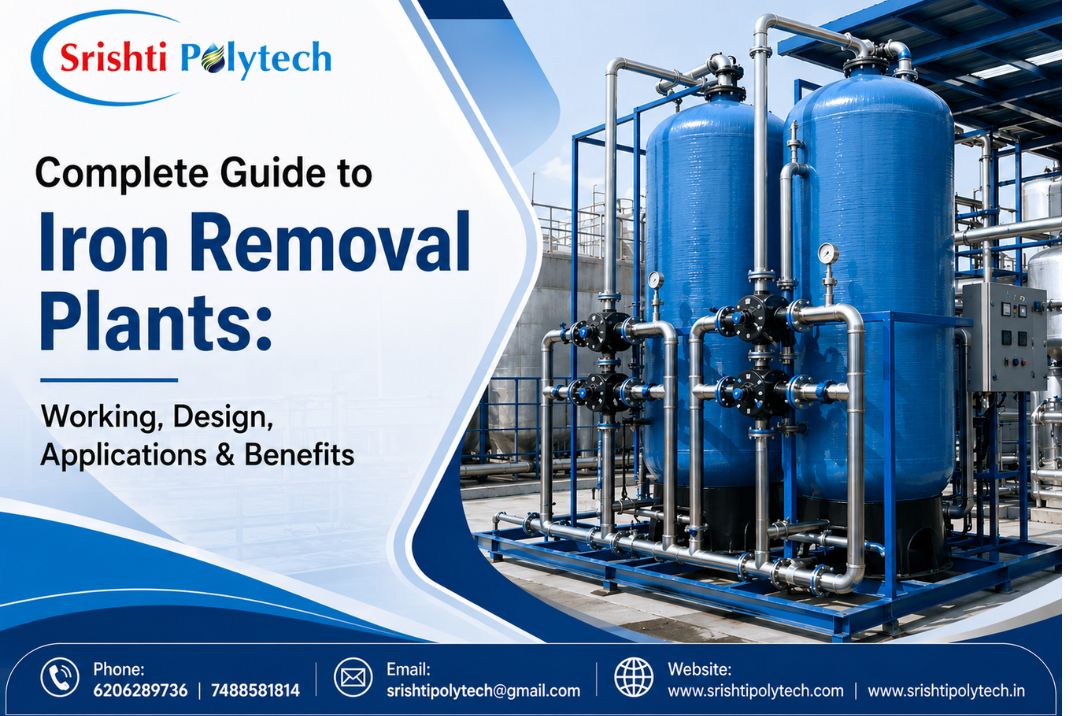
Jul 10, 2026
Complete Guide to Iron Removal Plants: Working, Design, Applications, and Benefits
Iron is one of the most common contaminants found in groundwater and borewell water across India. While small amounts of...
Reverse Osmosis Technology Explained: How It Removes Impurities....
Jul 08, 2026
uploads/blogs/blog_6a4e2a3ab71b1.jpg
Water is one of the most valuable natural resources, but not all water is safe to drink or use in industrial processes. It often contains dissolved salts, bacteria, viruses, heavy metals, chemicals, and suspended particles that can affect health, equipment, and manufacturing operations. This is where Reverse Osmosis (RO) technology plays a vital role.
Reverse Osmosis is one of the most advanced and widely used water purification technologies in the world. From homes and hospitals to pharmaceuticals, food processing, power plants, and manufacturing industries, RO systems provide clean, safe, and high-quality water by removing a wide range of contaminants.
In this comprehensive guide, we'll explain what Reverse Osmosis is, how it works, how it removes impurities, its key components, advantages, applications, maintenance requirements, and why it has become the preferred choice for modern water treatment.
Table of Contents
1. Introduction to Reverse Osmosis
2. What Is Reverse Osmosis?
3. Why Water Needs Purification
4. Principle Behind Reverse Osmosis
5. How Reverse Osmosis Removes Impurities
6. Step-by-Step RO Water Treatment Process
7. Types of Impurities Removed by RO
8. Major Components of an RO Plant
9. Advantages of Reverse Osmosis Technology
10. Industrial Applications of RO Plants
11. Factors Affecting RO Performance
12. Maintenance Tips
13. Common Myths About RO Water
14. Conclusion
What Is Reverse Osmosis?
Reverse Osmosis (RO) is a pressure-driven water purification process that removes dissolved salts, bacteria, viruses, heavy metals, organic contaminants, and other impurities by forcing water through a semi-permeable membrane.
The membrane allows only water molecules to pass while rejecting most dissolved and suspended contaminants.
Because of its high purification efficiency, RO technology is widely used for:
Drinking water purification
Industrial water treatment
Pharmaceutical manufacturing
Food & beverage processing
Hospitals
Laboratories
Boiler feed water
Commercial water treatment
Why Water Needs Purification
Raw water from rivers, lakes, borewells, and municipal supplies may contain:
High Total Dissolved Solids (TDS)
Calcium and magnesium (hardness)
Iron and manganese
Arsenic
Fluoride
Nitrates
Bacteria
Viruses
Organic chemicals
Pesticides
Suspended solids
These impurities can:
Affect human health
Damage industrial equipment
Cause scaling inside pipelines
Reduce boiler efficiency
Affect manufacturing quality
Increase maintenance costs
An RO plant effectively removes these contaminants, making water suitable for its intended use.
The Science Behind Reverse Osmosis
Osmosis is a natural process in which water moves through a semi-permeable membrane from a region of lower dissolved salt concentration to a region of higher dissolved salt concentration.
In Reverse Osmosis, external pressure greater than the natural osmotic pressure is applied to the concentrated side. This forces water molecules to move in the opposite direction through the membrane, leaving dissolved salts and other impurities behind.
The result is:
Permeate – purified water that passes through the membrane.
Reject (Concentrate) – water containing the rejected contaminants.
How Reverse Osmosis Removes Impurities
An RO system purifies water through multiple stages.
1. Pre-Filtration
Before water reaches the RO membrane, it passes through pre-treatment filters that remove larger contaminants and protect the membrane.
Typical pre-treatment includes:
Sand Filter
Activated Carbon Filter
Micron Cartridge Filter
Water Softener (when hardness is high)
These filters remove:
Dirt
Sand
Rust
Sediment
Chlorine
Organic matter
2. High-Pressure Pump
The feed water is pressurized using a high-pressure pump.
The pressure must be greater than the osmotic pressure so that water molecules can pass through the membrane.
Typical operating pressures:
Brackish Water RO: 8–20 bar
Seawater RO: 55–80 bar
3. Semi-Permeable Membrane
The membrane is the heart of an RO system.
It contains microscopic pores that allow water molecules to pass while rejecting:
Dissolved salts
Heavy metals
Bacteria
Viruses
Organic contaminants
Fluoride
Nitrates
Arsenic
The membrane typically removes 95–99% of dissolved impurities, depending on water quality and system design.
4. Permeate Collection
The purified water passing through the membrane is collected in a storage tank or sent directly to the application.
This water has:
Low TDS
No harmful bacteria
Reduced hardness
Improved taste and odor
High purity
5. Reject Water Discharge
The rejected impurities are flushed away through the reject line.
This continuous flushing prevents contaminants from accumulating on the membrane surface.
Major Components of an RO Plant
A typical industrial RO plant includes:
Raw Water Tank
Feed Pump
Multi Grade Sand Filter
Activated Carbon Filter
Water Softener (optional)
Micron Cartridge Filter
High Pressure Pump
RO Membrane Housing
RO Membrane
Pressure Gauges
Flow Meters
Conductivity/TDS Meter
Control Panel
Product Water Tank
Reject Water Line
Each component plays a critical role in ensuring efficient and reliable operation.
Advantages of Reverse Osmosis Technology
Reverse Osmosis offers several benefits:
Produces high-quality purified water
Removes dissolved salts and harmful contaminants
Improves taste, color, and odor
Reduces scaling in pipelines and boilers
Protects industrial equipment
Low operating costs after installation
Environmentally friendly
Suitable for residential, commercial, and industrial applications
Scalable for different capacities
Reliable and consistent water quality
Industrial Applications of RO Plants
Reverse Osmosis technology is widely used in:
Pharmaceutical industries
Food & beverage manufacturing
Textile industries
Chemical plants
Power plants
Hotels
Hospitals
Schools and universities
Commercial buildings
Bottled drinking water plants
Dairy industries
Electronics manufacturing
Automobile industries
Factors Affecting RO Plant Performance
Several factors influence the efficiency of an RO system:
Feed Water Quality
Higher contamination levels require more effective pre-treatment.
Operating Pressure
Adequate pressure is essential for efficient purification.
Water Temperature
Higher temperatures generally increase membrane permeability, while lower temperatures can reduce water production.
Membrane Condition
A clean membrane performs better than a fouled or damaged one.
Proper Pre-Treatment
Good pre-treatment extends membrane life and maintains system efficiency.
Maintenance Tips for Long-Term Performance
Regular maintenance helps ensure optimal performance:
Replace cartridge filters on schedule.
Clean membranes when fouling is detected.
Monitor TDS, pressure, and flow rates.
Inspect pumps and valves regularly.
Sanitize the system periodically.
Use quality spare parts and membranes.
Perform preventive maintenance to avoid downtime.
Common Myths About RO Water
Myth 1: RO removes all beneficial minerals.
RO reduces many dissolved minerals, but the need for mineral retention depends on the water source and intended use. Many systems can include remineralization if desired.
Myth 2: RO water is unsafe.
Properly maintained RO systems produce water that is widely used for drinking and industrial applications.
Myth 3: RO is only for salty water.
RO is effective for many types of source water, including borewell, municipal, and surface water, when designed appropriately.
Myth 4: RO plants require constant maintenance.
Routine maintenance is necessary, but with proper care, RO systems operate reliably for long periods.
Conclusion
Reverse Osmosis has transformed modern water purification by providing a reliable and efficient way to remove dissolved salts, microorganisms, heavy metals, and other contaminants. Whether used in homes, hospitals, industries, or commercial facilities, RO technology delivers high-quality water that supports health, productivity, and equipment longevity.
Selecting the right RO system, ensuring proper pre-treatment, and following regular maintenance practices are key to achieving long-term performance and consistent water quality.
About Srishti Polytech
Srishti Polytech is a trusted manufacturer and supplier of industrial water treatment solutions, offering customized RO Plants, Water Treatment Plants (WTP), Sewage Treatment Plants (STP), Effluent Treatment Plants (ETP), Water Softeners, Iron Removal Plants, and complete water purification systems for industrial and commercial applications across India.
Contact Us
📞 6206289736 | 7488581814
📧 srishtipolytech@gmail.com
🌐 www.srishtipolytech.com
Keywords
#Reverse Osmosis Technology# Reverse Osmosis Process# How RO Works
# RO Plant# Industrial RO Plant# Reverse Osmosis Water Treatment# RO Membrane# Water Purification Technology# Industrial Water Treatment# RO Water Treatment Plant# Water Filtration System# Commercial RO Plant
Water Treatment Solutions# RO Plant Manufacturer# Reverse Osmosis Explained
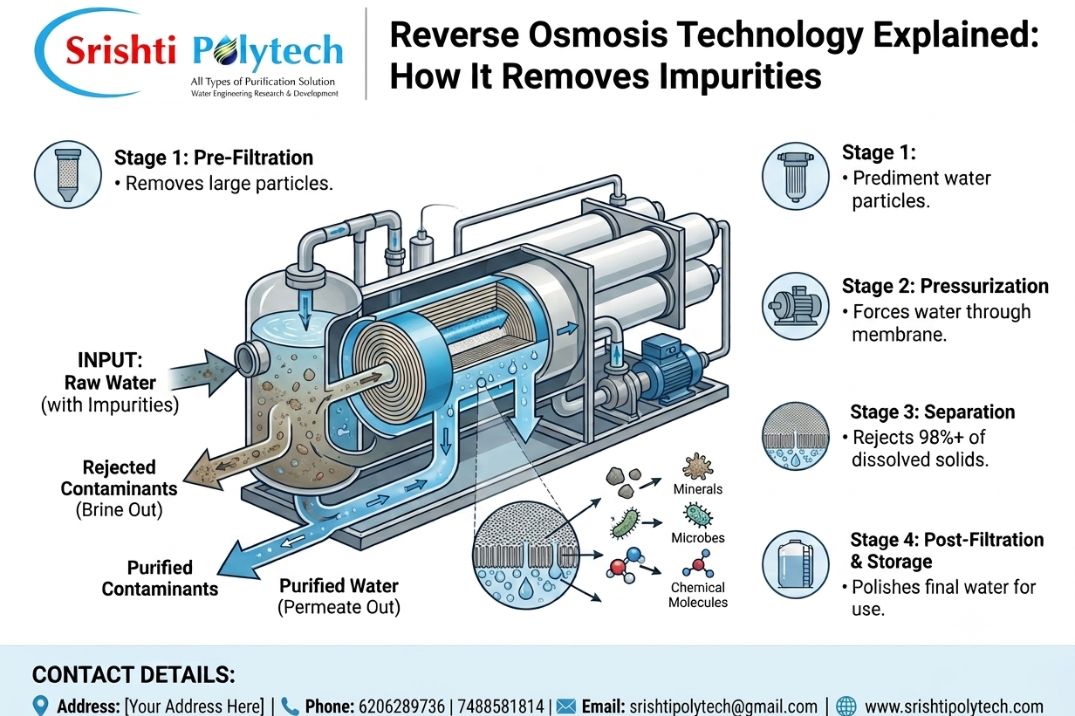
Jul 08, 2026
Reverse Osmosis Technology Explained: How It Removes Impurities....
Water is one of the most valuable natural resources, but not all water is safe to drink or use in...
Components of an Alkaline Water Plant Explained: A Complete Guide to Every Stage of the System.....
Jul 04, 2026
uploads/blogs/blog_6a48a00f7fed1.jpg
The demand for alkaline drinking water has grown significantly in recent years as consumers become more conscious of water quality, hydration, and healthy lifestyles. Businesses such as bottled water manufacturers, hospitals, hotels, gyms, corporate offices, and wellness centers are increasingly investing in Alkaline Water Plants to meet this growing demand.
An Alkaline Water Plant is more than just a Reverse Osmosis (RO) system. It is a complete water treatment solution that purifies raw water, removes harmful contaminants, and restores essential minerals to produce clean, safe, and alkaline drinking water with an optimized pH level.
In this blog, we'll explain each major component of an Alkaline Water Plant, its function, and why every stage is important for producing high-quality alkaline water.
- What Is an Alkaline Water Plant?
An Alkaline Water Plant is a water purification system that combines advanced filtration, Reverse Osmosis (RO), UV/Ozone disinfection, and mineral enrichment to produce purified water with a balanced alkaline pH.
Unlike a standard RO plant, an Alkaline Water Plant not only removes contaminants but also adds carefully selected minerals back into the water, improving both its taste and mineral content.
- Complete Flow of an Alkaline Water Plant
1. Raw Water Tank
⬇
2. Raw Water Pump
⬇
3. Multi Grade Sand Filter
⬇
4. Activated Carbon Filter
⬇
5. Water Softener (Optional)
⬇
6. Micron Cartridge Filter
⬇
7. High Pressure Pump
⬇
8. Reverse Osmosis Membrane
⬇
9. UV Sterilizer
⬇
10. Mineral Cartridge / Mineral Dosing System
⬇
11. pH Booster / Alkaline Filter
⬇
12. Ozone Generator
⬇
13. Product Water Storage Tank
⬇
14. Bottling / Distribution
1. Raw Water Storage Tank
The Raw Water Tank stores untreated water received from borewells, municipal supply, rivers, or other water sources.
Its purpose is to ensure a continuous supply of water to the treatment system even during fluctuations in the incoming water supply.
Benefits
* Maintains uninterrupted plant operation
* Provides stable water supply
* Allows sediment settlement before treatment
2. Raw Water Pump
The Raw Water Pump transfers water from the storage tank to the filtration units.
A properly selected pump ensures the required pressure and flow rate throughout the treatment process.
3. Multi Grade Sand Filter (MGF)
This is the first filtration stage.
The Multi Grade Sand Filter removes:
* Sand
* Mud
* Silt
* Suspended particles
* Visible impurities
Removing these particles protects downstream equipment from clogging and wear.
4. Activated Carbon Filter (ACF)
Activated Carbon plays a vital role in improving water quality.
It removes:
* Chlorine
* Bad odor
* Unpleasant taste
* Organic contaminants
* Color
This stage also protects the RO membrane from chlorine damage.
5. Water Softener Plant (Optional)
If the raw water contains high levels of calcium and magnesium, a Water Softener is installed before the RO system.
Its purpose is to:
* Remove hardness
* Prevent scaling
* Increase RO membrane life
* Improve system efficiency
This component is especially important for borewell water.
6. Micron Cartridge Filter
This is a fine filtration stage.
It removes particles as small as 5 or even 1 micron.
Its purpose is to provide additional protection to the RO membranes.
7. High Pressure Pump
Reverse Osmosis membranes require high pressure for efficient purification.
The High Pressure Pump:
* Increases water pressure
* Ensures consistent RO performance
* Maintains production capacity
8. Reverse Osmosis (RO) Membrane
This is the heart of the Alkaline Water Plant.
The RO membrane removes:
* Total Dissolved Solids (TDS)
* Heavy metals
* Bacteria
* Viruses
* Dissolved salts
* Harmful chemicals
* Fluoride
* Nitrates
After RO treatment, the water becomes extremely pure but also loses most of its natural minerals.
This is why mineral restoration becomes necessary.
9. UV Sterilizer
The UV System uses ultraviolet light to destroy microorganisms.
It eliminates:
* Bacteria
* Viruses
* Microbes
without adding chemicals.
10. Mineral Dosing System
One of the most important differences between a standard RO Plant and an Alkaline Water Plant is the Mineral Dosing System.
This unit adds essential minerals back into purified water.
Common minerals include:
* Calcium
* Magnesium
* Potassium
These minerals improve:
* Taste
* Drinking quality
* Mineral balance
11. Alkaline Filter / pH Booster
This is the defining component of the plant.
The Alkaline Filter increases the pH level of purified water.
Typical output pH ranges between **8.0 and 9.5**, depending on design and customer requirements.
Benefits include:
* Balanced mineral composition
* Improved taste
* Enhanced drinking water quality
12. Ozone Generator
Ozone is a powerful disinfectant.
Before storage or bottling, ozone is introduced into the water to eliminate any remaining microorganisms.
Benefits include:
* Additional microbial safety
* Increased shelf life
* Improved hygiene
This stage is particularly important in bottled drinking water plants.
13. Product Water Storage Tank
After purification, alkaline water is stored in a hygienic storage tank.
The tank is usually made of:
* Stainless Steel (SS304/SS316)
* Food-grade material
This ensures the water remains contamination-free before packaging or distribution.
14. Bottling or Distribution System
Depending on the application, treated alkaline water may be:
* Filled into bottles
* Filled into jars
* Supplied through pipelines
* Used in commercial facilities
* Distributed to drinking water stations
- Automation & Control Panel
Modern Alkaline Water Plants include advanced control systems featuring:
* PLC Control
* Automatic Operation
* Pressure Indicators
* Flow Meters
* TDS Monitoring
* pH Monitoring
* Level Sensors
* Auto Shut-off Protection
Automation improves efficiency while reducing manual intervention.
- Why Every Component Matters
Each component performs a specific function. If one stage is missing or underperforming, the overall quality of the treated water can be compromised. A well-designed Alkaline Water Plant ensures:
* Consistent water quality
* Balanced mineral content
* Reliable pH levels
* Safe and hygienic drinking water
* Longer equipment life
* Lower maintenance costs
- Applications of an Alkaline Water Plant
Alkaline Water Plants are widely used in:
* Packaged Drinking Water Plants
* Commercial Water Supply
* Hotels & Resorts
* Hospitals
* Corporate Offices
* Educational Institutions
* Restaurants
* Fitness Centers & Gyms
* Wellness Centers
* Residential Communities
- Why Choose Srishti Polytech?
At Srishti Polytech, we manufacture advanced Alkaline Water Plants designed for efficiency, reliability, and long-term performance. Every system is engineered using premium-quality components and modern purification technologies to ensure consistent production of safe, mineral-enriched alkaline drinking water.
Our services include:
* Customized Plant Design
* Manufacturing & Fabrication
* Installation & Commissioning
* Technical Consultation
* After-Sales Support
* Annual Maintenance Services (AMC)
Whether you need a compact commercial unit or a high-capacity industrial system, Srishti Polytech provides complete turnkey solutions tailored to your requirements.
- Conclusion
An Alkaline Water Plant is a carefully engineered system in which every component contributes to producing clean, safe, mineral-balanced, and high-quality drinking water. Understanding the role of each stage—from pre-filtration and RO purification to mineral dosing and pH enhancement—helps businesses choose the right system and ensure reliable long-term performance.
Investing in a high-quality Alkaline Water Plant not only improves water quality but also supports operational efficiency, customer satisfaction, and long-term business success.
- Contact Srishti Polytech
Srishti Polytech
OEM Manufacturer – Water & Wastewater Treatment Solutions
📞 Phone: +91 6206289736 | +91 7488581814
📧 Email: [srishtipolytech@gmail.com]
🌐 Website: [www.srishtipolytech.in] / [www.srishtipolytech.com]
- Keywords
#Alkaline Water Plant# Components of Alkaline Water Plant# Alkaline Water Plant Working# Mineral Water Plant Components# RO Alkaline Water System# pH Booster Filter# Mineral Dosing System# Alkaline Drinking Water# Water Treatment Plant# Commercial Alkaline Water Plant# Industrial Water Treatment# Water Purification Plant# Srishti Polytech
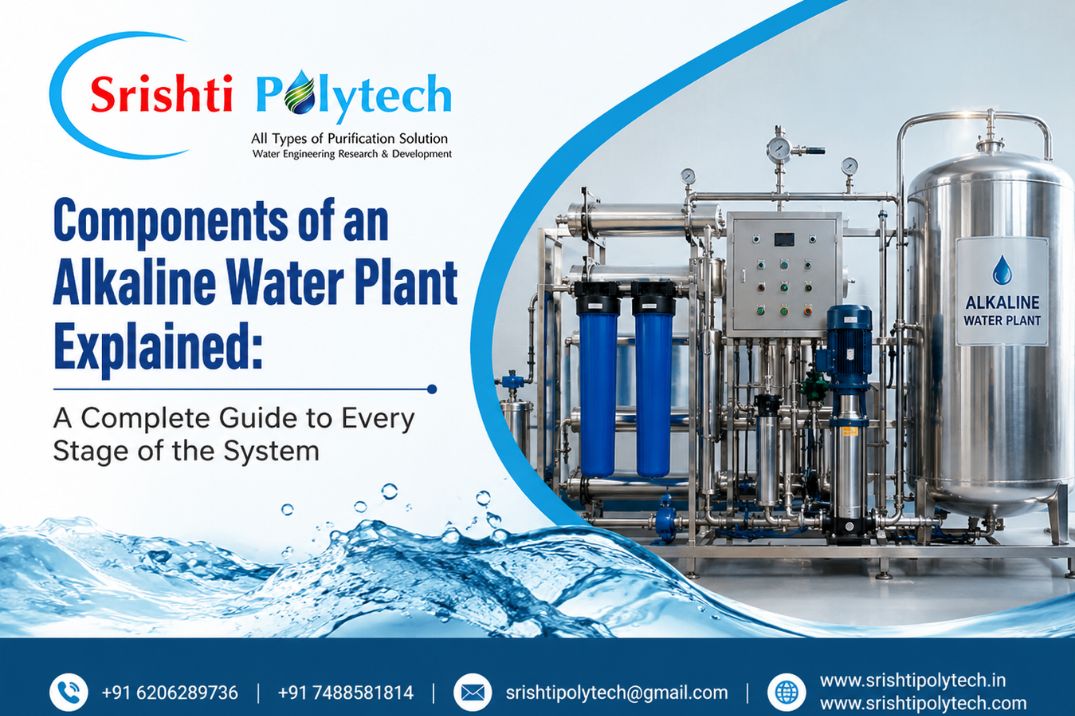
Jul 04, 2026
Components of an Alkaline Water Plant Explained: A Complete Guide to Every Stage of the System.....
The demand for alkaline drinking water has grown significantly in recent years as consumers become more conscious of water quality,...
Common Hard Water Problems and How a Water Softener Plant Solves Them.....
Jul 02, 2026
uploads/blogs/blog_6a45fc1915ecb.jpg
Water is one of the most important resources used in homes, commercial establishments, and industries. However, not all water is the same. One of the most common issues faced by businesses and households is hard water. While hard water may appear clean, it contains high concentrations of dissolved minerals such as calcium (Ca) and magnesium (Mg). These minerals can cause serious operational problems, increase maintenance costs, and reduce the efficiency of water-based equipment.
A Water Softener Plant is specifically designed to eliminate these hardness-causing minerals, providing soft water that improves equipment performance, extends machinery life, and reduces operating expenses.
In this blog, we'll discuss the common problems caused by hard water and explain how a Water Softener Plant offers an effective long-term solution.
- What Is Hard Water?
Hard water is water that contains excessive amounts of calcium and magnesium ions. These minerals naturally dissolve into groundwater as it passes through limestone, chalk, and other mineral-rich rocks.
Although hard water is generally safe for consumption, it can create numerous challenges for industrial processes, commercial facilities, and residential plumbing systems.
- Common Problems Caused by Hard Water
1. Scale Formation in Equipment
One of the biggest problems caused by hard water is the formation of scale deposits inside boilers, heat exchangers, pipelines, cooling towers, and water heaters.
Over time, these mineral deposits restrict water flow and reduce heat transfer efficiency, forcing equipment to consume more energy while delivering lower performance.
2. Higher Maintenance Costs
Hard water causes frequent scaling and clogging, resulting in regular cleaning, maintenance, and replacement of damaged components.
Industries often spend significant amounts on repairing equipment that could have been protected with proper water treatment.
3. Reduced Equipment Life
Continuous exposure to hard water damages pumps, valves, pipelines, RO membranes, and industrial machinery.
As scaling increases, equipment operates under higher stress, reducing its overall lifespan.
4. Increased Energy Consumption
Scale acts as an insulating layer inside boilers and heat exchangers.
Even a thin layer of scale can reduce heat transfer efficiency, causing equipment to consume more electricity or fuel to achieve the desired output.
This leads to higher operating costs.
5. Poor Performance of RO Plants
Reverse Osmosis systems perform best when supplied with properly pre-treated water.
Hard water causes scaling on RO membranes, reducing water recovery, lowering purification efficiency, and increasing membrane replacement costs.
That's why Water Softener Plants are commonly installed as a pre-treatment system before Industrial RO Plants.
6. Stains on Fixtures and Pipelines
Hard water leaves white deposits, stains, and mineral marks on taps, pipelines, sanitary fittings, storage tanks, and water fixtures.
These stains affect both appearance and functionality over time.
7. Reduced Soap and Detergent Efficiency
Hard water reacts with soap, producing less lather and requiring more detergent for cleaning.
Industries such as hotels, hospitals, laundries, and food processing units often experience higher chemical consumption due to hard water.
8. Production Quality Issues
Many manufacturing industries require soft water for consistent product quality.
Hard water can affect textile dyeing, food processing, pharmaceuticals, beverages, cosmetics, and chemical manufacturing by interfering with production processes.
- How Does a Water Softener Plant Solve These Problems?
A Water Softener Plant works using the Ion Exchange Process.
Inside the system is a special softening resin that contains sodium ions. As hard water passes through the resin bed, calcium and magnesium ions are exchanged with sodium ions.
The result is soft water that is free from hardness-causing minerals and suitable for industrial, commercial, and domestic applications.
- Benefits of Installing a Water Softener Plant
Installing a Water Softener Plant offers numerous advantages, including:
* Prevents scale formation in pipelines and equipment
* Improves boiler and cooling tower efficiency
* Protects RO membranes from scaling
* Reduces maintenance and repair costs
* Extends the life of industrial equipment
* Saves electricity and fuel consumption
* Improves water flow and operational efficiency
* Reduces detergent and chemical usage
* Enhances production quality
* Provides reliable long-term water treatment
- Industries That Benefit from Water Softener Plants
Water Softener Plants are widely used in:
* Manufacturing Industries
* Hotels & Resorts
* Hospitals
* Pharmaceutical Industries
* Food & Beverage Plants
* Textile Industries
* Commercial Buildings
* Residential Complexes
* Boiler Feed Systems
* Cooling Towers
* Laundry Units
* Educational Institutions
- Why Choose Srishti Polytech?
At Srishti Polytech, we manufacture high-quality Water Softener Plants designed to deliver reliable performance and long-term value. Our systems are engineered using premium components and advanced ion-exchange technology to ensure efficient hardness removal with minimal maintenance.
We provide complete turnkey solutions including:
* Water Quality Analysis
* Plant Design & Engineering
* Manufacturing
* Installation & Commissioning
* Technical Consultation
* After-Sales Support
* Customized Water Treatment Solutions
Whether your requirement is for industrial, commercial, or institutional applications, our experienced team delivers solutions tailored to your specific water treatment needs.
- Conclusion
Hard water may seem harmless, but its long-term effects can significantly increase maintenance costs, reduce equipment efficiency, and shorten the lifespan of valuable machinery. Investing in a Water Softener Plant is one of the smartest ways to protect your equipment, improve operational efficiency, and ensure a continuous supply of high-quality soft water.
If you're looking for a reliable and customized Water Softener Plant, Srishti Polytech offers advanced, cost-effective, and high-performance solutions designed to meet your exact requirements.
- Contact Srishti Polytech
Srishti Polytech
OEM Manufacturer – Water & Wastewater Treatment Solutions
📞 Phone: +91 6206289736 | +91 7488581814
📧 Email: [srishtipolytech@gmail.com]
🌐 Website:[www.srishtipolytech.in] / Website: [www.srishtipolytech.com]
Keywords
#Water Softener Plant# Industrial Water Softener Plant# Hard Water Problems# Hard Water Solution# Water Softening System# Water Treatment Plant# Industrial Water Treatment# Soft Water System# Boiler Water Softener# Cooling Tower Water Softener# RO Pre-Treatment# Water Softener Manufacturer# Water Softener Plant India# Water Treatment Solutions# Srishti Polytech
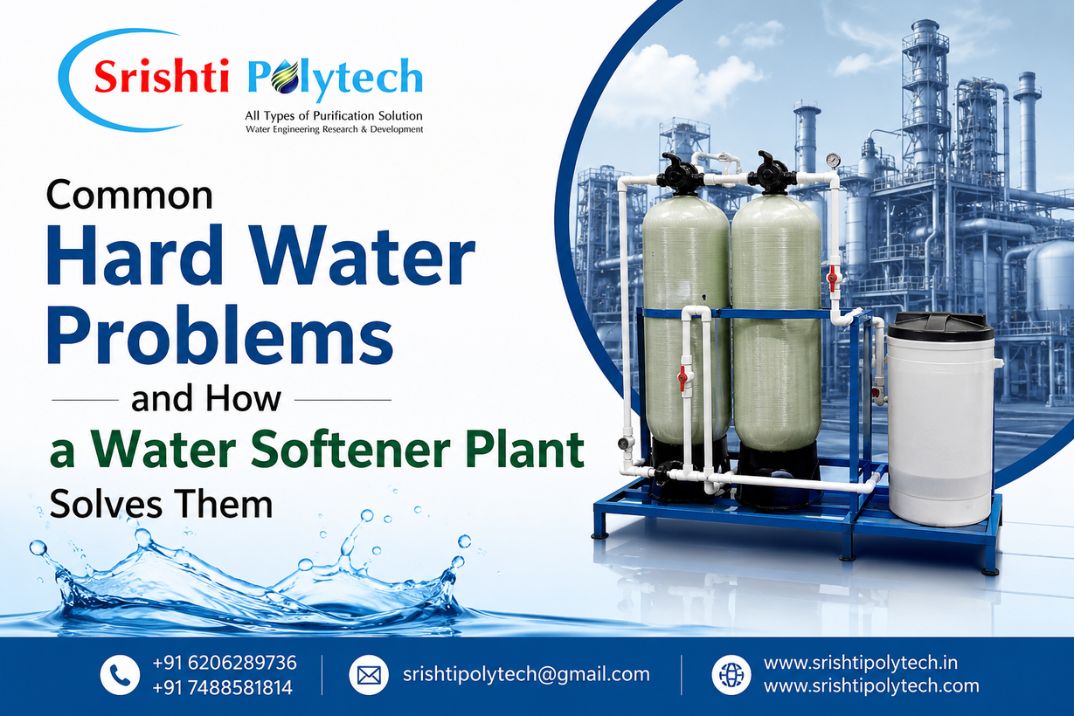
Jul 02, 2026
Common Hard Water Problems and How a Water Softener Plant Solves Them.....
Water is one of the most important resources used in homes, commercial establishments, and industries. However, not all water is...
How Does a Mineral Water Plant Work? Step-by-Step Process Explained
Jun 29, 2026
uploads/blogs/blog_6a42288a0fa49.jpg
Clean and safe drinking water is one of the most essential requirements for a healthy life. With increasing awareness about water quality and growing demand for packaged drinking water, Mineral Water Plants have become an important part of the water treatment industry. Whether it is a commercial packaged drinking water unit, a hotel, a hospital, an educational institution, or an industrial facility, a properly designed Mineral Water Plant ensures the production of hygienic, safe, and high-quality drinking water.
But have you ever wondered how a Mineral Water Plant actually works? How does raw groundwater or municipal water get transformed into crystal-clear, mineral-balanced drinking water?
Srishti Polytech explains the complete Mineral Water Plant process step by step—from raw water intake to final bottle filling—helping entrepreneurs, industries, consultants, and project owners understand how modern mineral water production works.
What is a Mineral Water Plant?
A Mineral Water Plant is a complete water purification system designed to remove suspended particles, dissolved impurities, harmful microorganisms, unpleasant odor, color, and unwanted chemicals while maintaining or restoring essential minerals required for safe drinking water.
Modern plants combine multiple treatment technologies such as filtration, activated carbon treatment, reverse osmosis, UV sterilization, ozone disinfection, and mineral dosing to ensure that the final water meets applicable quality standards.
Step 1: Raw Water Collection
Every Mineral Water Plant begins with a raw water source.
The water may come from:
Borewell Water
Groundwater
Municipal Water Supply
River Water (after suitable pretreatment)
Before designing the plant, the raw water is tested for parameters such as:
pH
TDS
Hardness
Iron
Fluoride
Turbidity
Bacteria
Heavy Metals
A proper water analysis helps engineers determine the most suitable treatment process.
Step 2: Raw Water Storage Tank
The collected water is stored in a Raw Water Storage Tank.
This tank ensures a continuous supply of water to the treatment system and helps stabilize flow fluctuations before purification begins.
Step 3: Raw Water Pump
A high-quality pump transfers water from the storage tank into the treatment line at the required pressure.
The pump maintains consistent flow throughout the plant.
Step 4: Multi Grade Sand Filter (MGF)
The first purification stage is usually the Multi Grade Sand Filter.
Its primary purpose is to remove:
Sand
Mud
Silt
Dust
Suspended solids
This protects downstream equipment and improves overall plant efficiency.
Step 5: Activated Carbon Filter (ACF)
After sand filtration, water enters the Activated Carbon Filter.
This stage removes:
Chlorine
Bad taste
Bad odor
Organic contaminants
Color-causing compounds
Activated carbon significantly improves the taste and appearance of drinking water.
Step 6: Water Softener (If Required)
If the source water contains excessive hardness, a Water Softener is installed before the RO system.
Using ion-exchange resin, it removes calcium and magnesium ions that cause scaling, helping protect RO membranes and improve system life.
Step 7: Micron Cartridge Filtration
Before entering the Reverse Osmosis unit, water passes through cartridge filters (typically 5 micron or 1 micron).
These filters remove fine suspended particles and protect the RO membranes from damage.
Step 8: Reverse Osmosis (RO) System
The Reverse Osmosis system is the heart of a Mineral Water Plant.
High-pressure pumps force water through semi-permeable membranes that remove:
Dissolved salts
Excess TDS
Fluoride
Heavy metals
Nitrates
Bacteria
Viruses
Harmful microorganisms
RO technology produces highly purified water suitable for drinking.
Step 9: Mineral Dosing
Since RO removes many naturally occurring minerals, controlled mineral dosing is often carried out to restore essential minerals and improve taste.
This step helps achieve balanced drinking water suitable for consumption.
Step 10: UV Sterilization
The purified water passes through an Ultraviolet (UV) Sterilizer.
UV light destroys bacteria, viruses, and microorganisms without adding chemicals, providing an additional layer of protection.
Step 11: Ozonation
Ozone treatment provides final disinfection before packaging.
It helps prevent microbial growth inside storage tanks and bottles while extending the shelf life of packaged drinking water.
Step 12: Treated Water Storage Tank
After purification and disinfection, the water is stored in a hygienic treated water tank made of food-grade stainless steel.
Proper storage maintains water quality before filling.
Step 13: Bottle Rinsing, Filling and Capping
The purified water is transferred to automatic or semi-automatic filling machines.
The process generally includes:
Bottle Washing
Bottle Rinsing
Water Filling
Cap Sealing
Labeling
Batch Coding
Packaging
Maintaining hygiene throughout this stage is essential for product quality.
Step 14: Quality Testing
Every batch should undergo quality testing before dispatch.
Common parameters include:
pH
TDS
Turbidity
Conductivity
Microbiological Analysis
Taste
Odor
Mineral Content
Routine testing ensures consistent product quality.
Benefits of a Modern Mineral Water Plant
A well-designed Mineral Water Plant offers several advantages:
Safe drinking water production
High purification efficiency
Consistent water quality
Compliance with industry standards
Improved operational reliability
Low maintenance with proper servicing
Suitable for commercial and industrial applications
Applications
Mineral Water Plants are widely used in:
Packaged Drinking Water Industries
Hotels & Resorts
Hospitals
Schools & Colleges
Restaurants
Corporate Offices
Industrial Facilities
Railway Stations
Airports
Commercial Buildings
Why Choose Srishti Polytech?
Srishti Polytech is an OEM manufacturer specializing in advanced water treatment solutions. We design and manufacture customized Mineral Water Plants using reliable components and modern purification technologies to meet commercial, industrial, and institutional requirements.
Our expertise includes:
Mineral Water Plants
Industrial RO Plants
Commercial RO Plants
Water Softener Plants
Iron Removal Plants
Sewage Treatment Plants (STP)
Effluent Treatment Plants (ETP)
Packaged Drinking Water Solutions
From system design and manufacturing to installation and after-sales support, our team delivers dependable solutions tailored to each project.
Conclusion
A Mineral Water Plant is much more than a simple filtration unit. It is a carefully engineered treatment system where every stage—from raw water intake and filtration to RO purification, mineral dosing, UV sterilization, ozonation, and hygienic filling—plays a vital role in producing safe and high-quality drinking water.
Understanding this complete process helps businesses invest in the right technology and maintain consistent product quality. By choosing a trusted manufacturer like Srishti Polytech, you gain a reliable partner capable of delivering efficient, customized, and long-lasting mineral water treatment solutions.
Contact Srishti Polytech
Srishti Polytech OEM Manufacturer – Water & Wastewater Treatment Solutions
📞 +91 6206289736 | +91 7488581814
📧 srishtipolytech@gmail.com
🌐 www.srishtipolytech.in
Keywords
#Mineral Water Plant#How Does a Mineral Water Plant Work#Mineral Water Plant Process# Mineral Water Plant Manufacturer#Packaged Drinking Water Plant#Mineral Water Production Process.
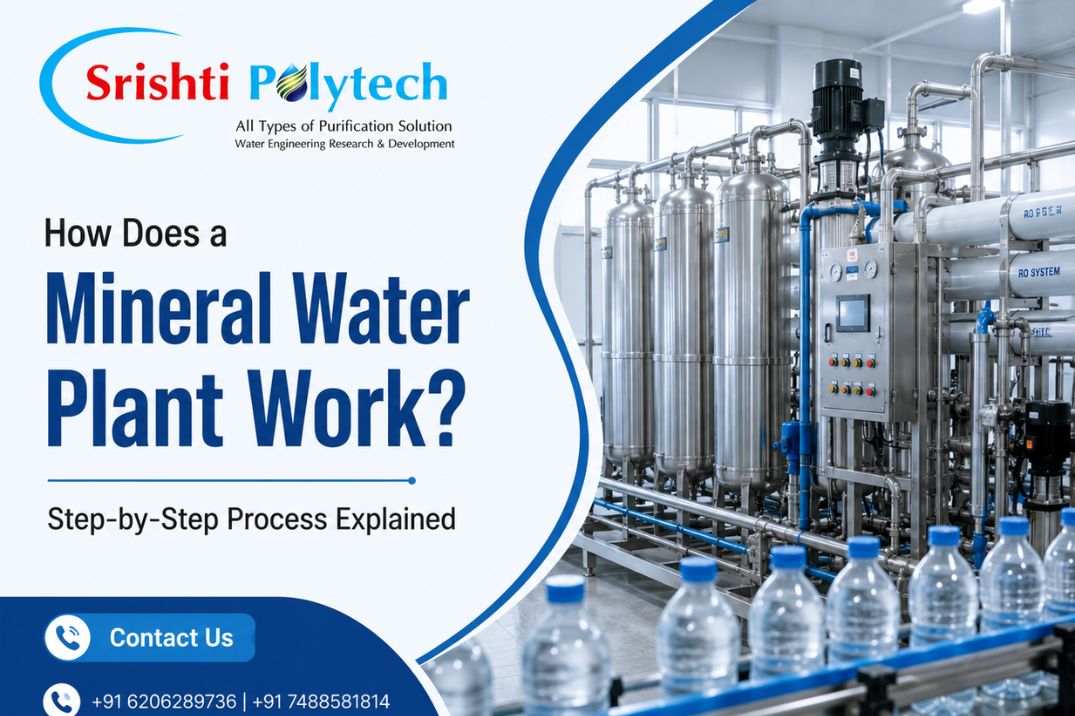
Jun 29, 2026
How Does a Mineral Water Plant Work? Step-by-Step Process Explained
Clean and safe drinking water is one of the most essential requirements for a healthy life. With increasing awareness about...
MBBR vs MBR Technology: Which STP Is Better?
Jun 27, 2026
uploads/blogs/blog_6a3f87584e495.jpg
As environmental regulations become stricter and the demand for wastewater recycling continues to grow, selecting the right Sewage Treatment Plant (STP) technology has become an important decision for industries, residential societies, hospitals, hotels, commercial buildings, educational institutions, and municipal projects.
Among the various sewage treatment technologies available today, Moving Bed Biofilm Reactor (MBBR) and Membrane Bio Reactor (MBR) are two of the most reliable and widely adopted systems. Both technologies are designed to reduce pollutants such as Biological Oxygen Demand (BOD), Chemical Oxygen Demand (COD), Total Suspended Solids (TSS), and harmful microorganisms from sewage. However, they differ in terms of treatment process, installation cost, maintenance requirements, water quality, and suitable applications.
This article by Srishti Polytech provides a practical comparison between MBBR and MBR technology to help project owners, consultants, builders, industries, and government organizations choose the most suitable STP solution.
- What is MBBR Technology?
Moving Bed Biofilm Reactor (MBBR) is a biological wastewater treatment technology that uses specially designed plastic carrier media inside the aeration tank. These floating carriers provide a large surface area for beneficial microorganisms to grow. As sewage passes through the reactor, the bacteria attached to the media consume organic pollutants and convert them into harmless substances.
Unlike conventional activated sludge systems, MBBR does not rely on sludge recirculation for treatment. The continuously moving bio-media ensures stable biological activity, making the process efficient and comparatively easy to operate.
Because of its reliability and lower operating cost, MBBR technology is widely used in residential apartments, hotels, commercial buildings, educational institutions, hospitals, industrial facilities, and municipal sewage treatment projects.
- What is MBR Technology?
Membrane Bio Reactor (MBR) is an advanced sewage treatment technology that combines biological treatment with membrane filtration. Instead of separating sludge through a conventional clarifier, MBR systems use ultrafiltration or microfiltration membranes to produce high-quality treated water.
These membranes effectively remove suspended solids, bacteria, and many microorganisms, resulting in cleaner water that can be reused for flushing, gardening, cooling towers, landscaping, and several industrial applications.
Although MBR systems require a higher initial investment, they are preferred where space is limited and superior treated water quality is essential.
- Understanding the Difference Between MBBR and MBR
Although both technologies are designed to treat sewage efficiently, their working principles are quite different.
In an MBBR system, biological treatment occurs on floating plastic media where microorganisms naturally form a biofilm. As wastewater flows through the reactor, these microorganisms consume biodegradable pollutants. After biological treatment, the water passes through a secondary clarifier where sludge settles before filtration and disinfection.
In contrast, an MBR system replaces the secondary clarifier with membrane filtration. The membranes physically separate treated water from sludge, producing water with significantly lower suspended solids and better clarity. This makes MBR particularly suitable for projects where treated water is intended for reuse.
- Treatment Efficiency
Both MBBR and MBR technologies provide effective sewage treatment when properly designed and operated. However, MBR generally delivers higher treatment efficiency because the membrane barrier removes even microscopic suspended particles.
MBBR systems are capable of achieving excellent reductions in BOD and COD, making them suitable for meeting most environmental discharge standards.
MBR systems, on the other hand, produce exceptionally clear treated water with very low turbidity and suspended solids, making them ideal for advanced water reuse applications.
- Installation Cost
One of the biggest differences between the two technologies is the initial investment.
MBBR systems are generally more economical because they use floating bio-media instead of membrane modules. Their simpler design makes them a cost-effective choice for residential societies, hotels, schools, commercial buildings, and many industrial projects.
MBR systems require membrane units, additional automation, and sophisticated instrumentation, increasing the capital cost. However, the higher investment may be justified where premium treated water quality is required.
- Operating and Maintenance
Maintenance plays an important role in the long-term performance of any sewage treatment plant.
MBBR technology is relatively simple to operate and requires periodic inspection of blowers, pumps, and bio-media. Routine maintenance is straightforward, making it suitable for facilities with limited technical manpower.
MBR systems require regular membrane cleaning and periodic membrane replacement to maintain filtration efficiency. Skilled operators are generally recommended for ensuring optimum system performance.
- Space Requirement
Available installation space is another important consideration while selecting an STP.
MBBR systems usually require a larger footprint because they include secondary clarification and additional filtration units.
MBR technology integrates biological treatment and membrane filtration into a compact arrangement, reducing the overall plant size. This makes MBR an excellent choice for hospitals, airports, commercial complexes, hotels, and urban developments where land availability is limited.
- Energy Consumption
Energy consumption directly affects operating expenses.
MBBR systems mainly consume electricity for aeration blowers and transfer pumps, making their overall power requirement relatively moderate.
MBR systems require additional energy for membrane filtration and cleaning, resulting in comparatively higher electricity consumption.
- Water Reuse Capability
Water reuse is becoming increasingly important due to growing water scarcity.
If the treated water is intended mainly for safe discharge or basic landscaping, an MBBR system generally provides satisfactory performance.
However, if the project requires high-quality recycled water for flushing systems, cooling towers, process water, or other non-potable applications, MBR technology is often the preferred choice due to its superior filtration performance.
- Applications of MBBR Technology
MBBR technology is widely used in:
* Residential Apartments
* Hotels & Resorts
* Schools & Colleges
* Commercial Buildings
* Shopping Malls
* Hospitals
* Industrial Units
* Housing Societies
* Municipal Sewage Treatment Plants
Its lower operating cost and reliable performance make it suitable for a wide range of projects.
- Applications of MBR Technology
MBR technology is commonly selected for:
* Pharmaceutical Industries
* Food Processing Industries
* Hospitals
* Airports
* IT Parks
* Premium Residential Projects
* Textile Industries
* Commercial Complexes
* Water Reuse Projects
Its compact design and excellent treated water quality make it ideal where treated water recovery is a priority.
- Which Technology Should You Choose?
The answer depends entirely on your project requirements.
If your objective is economical treatment with lower installation and maintenance costs, MBBR technology is generally the better choice.
If your project demands superior treated water quality, maximum water reuse, and limited installation space, MBR technology offers significant advantages despite its higher investment.
Before selecting either technology, factors such as daily sewage generation, future expansion, operating budget, maintenance capability, discharge standards, and water reuse objectives should be carefully evaluated.
Consulting an experienced OEM manufacturer can help ensure that the selected technology matches both operational and environmental requirements.
- Why Choose Srishti Polytech?
At Srishti Polytech, we specialize in manufacturing and supplying customized water and wastewater treatment solutions designed for residential, commercial, industrial, institutional, and government projects.
Our product range includes:
* Sewage Treatment Plants (STP)
* Effluent Treatment Plants (ETP)
* Industrial RO Plants
* Commercial RO Plants
* Water Softener Plants
* Iron Removal Plants
* Mineral Water Plants
* Drinking Water Purification Systems
* Mist Cannon Systems
* Wheel Washing Systems
* Dust Suppression Systems
From engineering and manufacturing to installation, commissioning, and after-sales support, our team is committed to delivering reliable, efficient, and cost-effective solutions that comply with environmental standards.
Conclusion
Both MBBR and MBR are proven sewage treatment technologies capable of delivering reliable wastewater treatment. Neither technology is universally better—the right choice depends on the project's technical requirements, budget, available space, maintenance capability, and treated water quality expectations.
MBBR remains one of the most economical and widely adopted technologies because of its simple operation, lower investment, and dependable performance. MBR, meanwhile, is ideal for projects where superior water quality and extensive water reuse are essential.
Choosing the appropriate STP technology not only improves operational efficiency but also helps organizations meet environmental regulations while supporting sustainable water management.
Contact Srishti Polytech
Srishti Polytech
OEM Manufacturer – Water & Wastewater Treatment Solutions
📞 +91 6206289736 | +91 7488581814
📧 [srishtipolytech@gmail.com]
🌐 [www.srishtipolytech.in] / [www.srishtipolytech.com]
Keywords
#MBBR vs MBR Technology#Sewage Treatment Plant#MBBR STP#MBR STP#STP Technology Comparison#Sewage Treatment Plant Manufacturer#STP for Residential Society#Industrial STP#Commercial Sewage Treatment Plant
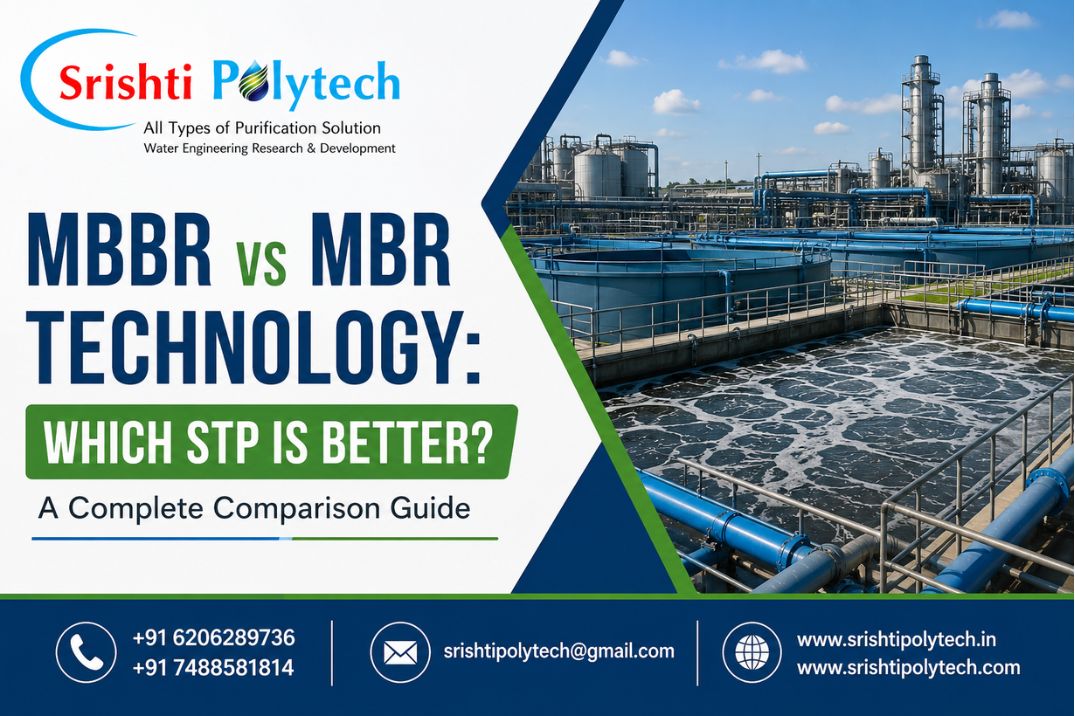
Jun 27, 2026
MBBR vs MBR Technology: Which STP Is Better?
As environmental regulations become stricter and the demand for wastewater recycling continues to grow, selecting the right Sewage Treatment Plant...
Iron Removal Plant vs Water Softener: What's the Difference?
Jun 24, 2026
uploads/blogs/blog_6a3b690e0e632.jpg
Water is one of the most valuable resources for industries, commercial establishments, institutions, healthcare facilities, hospitality businesses, and residential communities. However, the quality of water directly impacts equipment performance, operational efficiency, maintenance costs, and the lifespan of water-dependent systems.
Groundwater, especially borewell water, often contains excessive amounts of dissolved iron, calcium, magnesium, and other minerals. These impurities not only affect water quality but also create serious operational challenges such as rust formation, pipeline blockages, scale deposits, equipment corrosion, poor heat transfer, increased energy consumption, and frequent maintenance.
When industries face these issues, two common water treatment solutions are often considered: the Iron Removal Plant and the Water Softener Plant. Although both systems improve water quality, they are designed to solve completely different problems. Unfortunately, many industries mistakenly believe that these two plants perform the same function, which often leads to incorrect equipment selection and unnecessary operational expenses.
At Srishti Polytech, we frequently receive enquiries from customers asking questions such as:
* Should I install an Iron Removal Plant or a Water Softener?
* Can a Water Softener remove iron?
* Does an Iron Removal Plant also remove hardness?
* Is it necessary to install both systems together?
* Which solution is best for industrial borewell water?
This comprehensive guide explains everything you need to know about both systems, including their working principles, differences, industrial applications, advantages, limitations, and how to select the right solution for your specific water quality requirements.
Understanding the Need for Water Treatment
Every water source has a unique chemical composition. While surface water may contain suspended particles and organic matter, groundwater commonly contains dissolved minerals such as iron, calcium, magnesium, manganese, silica, and other contaminants.
Ignoring these impurities can lead to:
* Rust-colored water
* Scale formation inside pipelines
* Frequent pump failures
* Boiler inefficiency
* Cooling tower performance loss
* Reduced RO membrane life
* Poor product quality
* Higher maintenance costs
* Increased energy consumption
* Equipment breakdowns
Therefore, selecting the appropriate water treatment system is not just about improving water quality—it is also about protecting valuable industrial assets and ensuring uninterrupted operations.
What is an Iron Removal Plant?
An Iron Removal Plant (IRP) is a specialized water treatment system designed to remove dissolved iron from groundwater before it reaches downstream equipment or end users.
Iron contamination is one of the most common problems associated with borewell water across India. Although dissolved iron is often invisible when pumped from the ground, it reacts with oxygen upon exposure to air, forming reddish-brown particles that stain fixtures, damage pipelines, and affect water quality.
An Iron Removal Plant removes this dissolved iron through oxidation and filtration, producing clear and clean water suitable for industrial, commercial, and institutional applications.
Common Problems Caused by Excess Iron
Water containing high iron levels can create numerous operational and maintenance challenges.
Some of the most common issues include:
* Reddish or yellow-colored water
* Metallic taste
* Rust stains on sanitary fittings
* Brown deposits in storage tanks
* Pipeline choking
* Valve blockage
* Pump damage
* Reduced efficiency of Industrial RO Plants
* Frequent filter clogging
* Higher maintenance expenses
If left untreated, iron contamination can significantly reduce the lifespan of industrial water treatment equipment.
What is a Water Softener Plant?
A Water Softener Plant is specifically designed to remove hardness-causing minerals such as calcium and magnesium.
Unlike iron contamination, hardness does not change the color of water. Instead, it creates scale deposits inside boilers, cooling towers, heat exchangers, pipelines, and industrial process equipment.
Water Softeners operate using an ion-exchange process, where calcium and magnesium ions are exchanged with sodium ions, resulting in soft water that minimizes scaling and improves equipment efficiency.
Problems Caused by Hard Water
Hard water is responsible for numerous operational issues, including:
* Thick scale formation
* Reduced boiler efficiency
* Cooling tower fouling
* Heat exchanger blockage
* Increased energy consumption
* Frequent maintenance shutdowns
* Soap wastage
* Reduced equipment life
* Lower production efficiency
These problems often lead to higher operational costs and reduced productivity.
Iron Removal Plant vs Water Softener: Understanding the Real Difference
Although both systems are part of the water treatment process, they are designed for entirely different purposes.
An Iron Removal Plant is specifically engineered to eliminate dissolved iron from groundwater. It works by oxidizing dissolved iron into solid particles, which are then captured using specially designed filter media. This process improves the appearance, taste, and overall quality of water while protecting pipelines and equipment from rust-related damage.
A Water Softener Plant, on the other hand, focuses exclusively on removing hardness-causing minerals such as calcium and magnesium. Rather than using filtration, it employs ion-exchange resin technology that replaces hardness ions with sodium ions, producing soft water suitable for boilers, cooling towers, and industrial processing.
One of the most common misconceptions is that a Water Softener can remove high levels of iron. While it may tolerate trace amounts of iron, it is not intended for treating iron-rich water. Excess iron can foul the resin bed, reduce softening efficiency, increase regeneration frequency, and shorten the life of the resin.
Similarly, an Iron Removal Plant cannot eliminate water hardness. Even after iron has been removed, calcium and magnesium remain in the water. Therefore, if hardness is also present, a Water Softener Plant becomes essential.
The choice between these systems should always be based on a laboratory water analysis rather than assumptions. Installing the wrong system may solve one problem while leaving another untreated.
Can Both Systems Be Installed Together?
Yes. In fact, many industrial facilities require both systems.
Groundwater frequently contains both iron and hardness. In such cases, the recommended treatment sequence is:
Raw Water → Iron Removal Plant → Water Softener Plant → Industrial RO Plant (if required) → Storage Tank → Distribution
This arrangement protects downstream equipment, improves RO membrane life, reduces maintenance costs, and ensures consistent water quality.
Industrial Applications
Both systems are widely used across various industries, including:
* Manufacturing Industries
* Pharmaceutical Plants
* Food & Beverage Processing
* Hospitals
* Hotels
* Educational Institutions
* Commercial Buildings
* Textile Industries
* Dairy Plants
* Chemical Industries
* Power Plants
* Residential Townships
* Municipal Water Supply Projects
How to Choose the Right System?
The correct solution depends entirely on your source water quality.
Choose an Iron Removal Plant if your water contains:
* High iron concentration
* Metallic taste
* Rust-colored water
* Yellow or brown staining
* Iron deposits in pipelines
Choose a Water Softener Plant if your water contains:
* High hardness
* White scale deposits
* Boiler scaling
* Cooling tower fouling
* Poor soap performance
If your water contains both iron and hardness, installing both systems in the correct sequence will deliver the best results.
Why Water Testing is Essential
Before investing in any water treatment equipment, it is highly recommended to conduct a comprehensive water quality analysis.
A laboratory water test helps determine:
* Iron concentration
* Hardness
* pH
* TDS
* Manganese
* Silica
* Chlorides
* Alkalinity
* Turbidity
This analysis enables engineers to design the most suitable treatment solution for your application.
Why Choose Srishti Polytech?
At Srishti Polytech, we believe that every water source requires a customized treatment approach. As an OEM and engineering company, we design and manufacture advanced water treatment systems tailored to the specific requirements of industrial, commercial, and institutional clients.
Our experienced engineering team provides complete turnkey solutions—from water quality analysis and system design to manufacturing, installation, commissioning, operator training, and after-sales service.
Our Product Portfolio
* Iron Removal Plants
* Water Softener Plants
* Industrial RO Plants
* Mineral Water Plants
* Packaged Drinking Water Plants
* Effluent Treatment Plants (ETP)
* Sewage Treatment Plants (STP)
* Pressure Sand Filters
* Activated Carbon Filters
* Portable Water Purification Systems
* Water Coolers
* Annual Maintenance Contracts (AMC)
With a strong commitment to quality, innovation, and customer satisfaction, Srishti Polytech continues to deliver reliable and cost-effective water treatment solutions across multiple industries.
Conclusion
Although the Iron Removal Plant and the Water Softener Plant are often discussed together, they are designed to solve different water quality challenges. An Iron Removal Plant removes dissolved iron to eliminate staining, corrosion, and metallic taste, while a Water Softener Plant removes calcium and magnesium to prevent scale formation and improve equipment efficiency.
Understanding the composition of your source water is the first step toward selecting the right treatment solution. Investing in the correct system not only improves water quality but also protects valuable industrial equipment, reduces maintenance costs, and enhances overall operational performance.
At Srishti Polytech, we help industries choose the right water treatment technology based on scientific water analysis and practical engineering expertise. Whether you require an Iron Removal Plant, a Water Softener Plant, or a complete turnkey water treatment project, our team is committed to delivering solutions that ensure long-term reliability, efficiency, and sustainability.
Contact Srishti Polytech
Srishti Polytech
All Types of Purification Solution – Water Engineering Research & Development
📞 +91 6206289736 | +91 7488581814
📧 [srishtipolytech@gmail.com]
🌐 [www.srishtipolytech.in] / [www.srishtipolytech.com]
Keywords
#IronRemovalPlant #WaterSoftenerPlant #IronRemovalFilter #IndustrialWaterTreatment #WaterTreatmentSolutions #HardWaterTreatment #BorewellWater #IndustrialROPlant #WaterSoftening #IronInWater #WaterQuality #WaterEngineering #CommercialWaterTreatment #IndustrialWaterSolutions #WaterTreatmentCompany #ETP #STP #MineralWaterPlant #WaterPurification #SrishtiPolytech
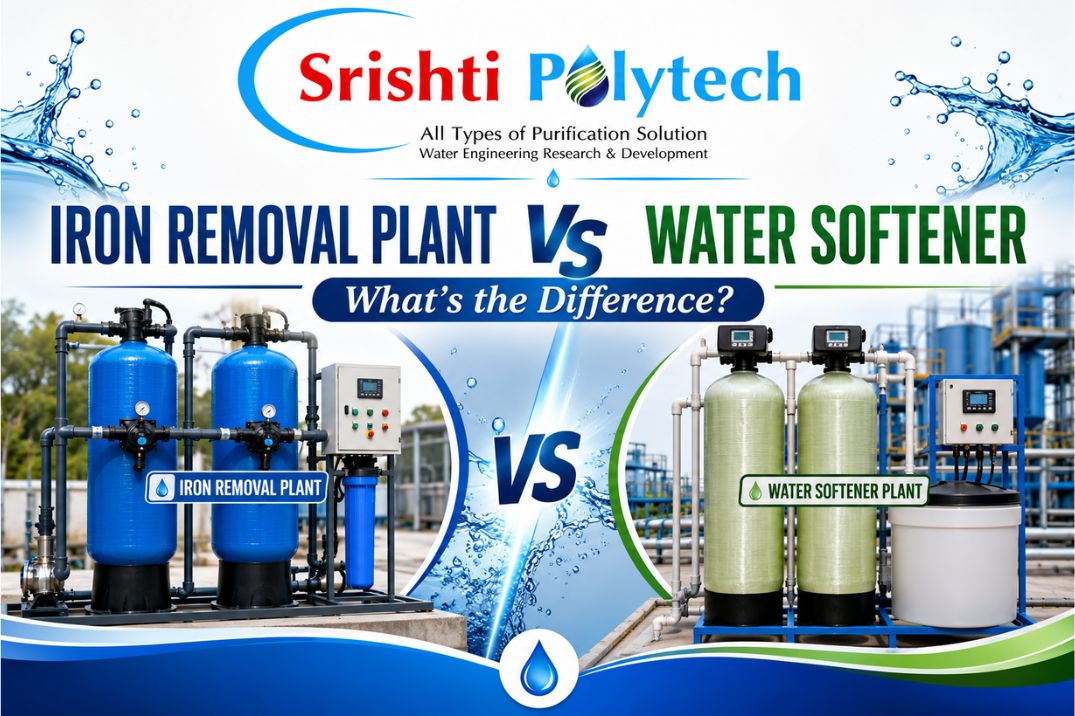
Jun 24, 2026
Iron Removal Plant vs Water Softener: What's the Difference?
Water is one of the most valuable resources for industries, commercial establishments, institutions, healthcare facilities, hospitality businesses, and residential communities....
Mineral Water Plant Troubleshooting: Common Problems and Solutions......
Jun 23, 2026
uploads/blogs/blog_6a3a66eb2511f.jpg
A Mineral Water Plant is a critical investment for businesses involved in packaged drinking water production. Whether supplying bottled water for commercial distribution, institutions, hospitality, or industrial applications, maintaining consistent water quality and uninterrupted production is essential. Even a well-designed mineral water plant can experience operational issues over time due to equipment wear, inadequate maintenance, raw water quality variations, or improper operation.
Problems such as reduced production capacity, high Total Dissolved Solids (TDS), membrane fouling, poor bottle filling accuracy, UV sterilizer failure, ozonation issues, and pump malfunctions can directly impact product quality, regulatory compliance, and operational costs. If these issues are not identified and resolved promptly, they may lead to production downtime, increased maintenance expenses, customer complaints, and financial losses.
At Srishti Polytech, we believe that understanding the root cause of common plant problems is the key to maintaining long-term efficiency and delivering high-quality packaged drinking water. This comprehensive guide explains the most common troubleshooting issues encountered in Mineral Water Plants, their possible causes, and practical solutions to ensure reliable plant performance.
Why Troubleshooting is Important in a Mineral Water Plant
Routine troubleshooting helps identify small issues before they become major operational failures. A systematic approach improves plant reliability, extends equipment life, maintains water quality, and reduces unplanned downtime.
Benefits of Proper Troubleshooting
* Improves production efficiency
* Ensures consistent water quality
* Reduces maintenance costs
* Extends equipment lifespan
* Minimizes production downtime
* Supports regulatory compliance
* Enhances customer satisfaction
* Prevents product rejection
Common Problems in a Mineral Water Plant and Their Solutions
1. Low Water Production
Possible Causes
* Clogged pre-filters
* RO membrane fouling
* Low raw water pressure
* High feed water TDS
* Pump performance issues
* Improper operating pressure
Solutions
* Replace clogged filter cartridges.
* Clean or replace RO membranes as required.
* Inspect feed pumps and operating pressure.
* Check raw water quality regularly.
* Perform scheduled membrane cleaning (CIP).
2. High TDS in Product Water
Possible Causes
* Damaged RO membranes
* Membrane scaling
* Membrane ageing
* Incorrect operating pressure
* Bypass valve leakage
Solutions
* Conduct membrane performance testing.
* Replace damaged membranes.
* Verify operating pressure settings.
* Inspect all valves for leakage.
* Perform chemical membrane cleaning.
3. Reduced RO Recovery
Possible Causes
* Fouled membranes
* High feed water hardness
* Improper reject water settings
* Scaling inside membranes
Solutions
* Optimize recovery settings.
* Install proper pretreatment systems.
* Monitor hardness levels.
* Carry out periodic membrane cleaning.
4. Frequent RO Membrane Fouling
Possible Causes
* Poor pretreatment
* High suspended solids
* Biological contamination
* Iron contamination
* Organic matter
Solutions
* Improve pretreatment quality.
* Replace multimedia filter media if required.
* Ensure regular backwashing.
* Install iron removal systems where necessary.
* Use antiscalant dosing.
5. UV Sterilizer Not Working Properly
Possible Causes
* Expired UV lamp
* Quartz sleeve scaling
* Electrical supply issues
* Dirty UV chamber
Solutions
* Replace UV lamp after recommended operating hours.
* Clean quartz sleeves regularly.
* Verify electrical connections.
* Inspect UV intensity periodically.
6. Ozonator Performance Issues
Possible Causes
* Faulty ozone generator
* Low oxygen supply
* Diffuser blockage
* Poor contact time
Solutions
* Inspect ozone generator.
* Clean ozone diffusers.
* Check oxygen concentrator performance.
* Maintain proper ozone contact tank operation.
7. Bottle Filling Problems
Possible Causes
* Incorrect filling calibration
* Air pressure fluctuations
* Filling valve blockage
* Pump instability
Solutions
* Recalibrate filling machine.
* Clean filling valves.
* Maintain constant operating pressure.
* Service filling pumps regularly.
8. Leakage from Pipelines
Possible Causes
* Loose pipe fittings
* Damaged gaskets
* High operating pressure
* Corrosion
Solutions
* Tighten fittings.
* Replace worn-out seals.
* Inspect pipelines regularly.
* Use high-quality SS pipelines.
9. Pump Failure
Possible Causes
* Dry running
* Motor overheating
* Bearing damage
* Voltage fluctuation
* Cavitation
Solutions
* Monitor water level.
* Inspect motor temperature.
* Lubricate bearings.
* Install voltage protection.
* Service pumps periodically.
10. Pressure Drop Across Filters
Possible Causes
* Filter media choking
* Cartridge blockage
* Improper backwashing
* Excess suspended solids
Solutions
* Replace cartridges.
* Backwash multimedia filters regularly.
* Replace filter media when required.
* Monitor inlet water quality.
11. Mineral Dosing Problems
Possible Causes
* Incorrect dosing settings
* Pump malfunction
* Blocked dosing line
* Low mineral solution level
Solutions
* Calibrate dosing pumps.
* Clean dosing pipelines.
* Check mineral solution tanks.
* Replace faulty dosing pumps.
12. Poor Taste or Odour in Water
Possible Causes
* Activated carbon exhaustion
* Biological contamination
* Improper sanitization
* Ozonation failure
Solutions
* Replace activated carbon media.
* Sanitize the complete system.
* Monitor ozone dosage.
* Perform regular microbiological testing.
Preventive Maintenance Tips
Preventive maintenance is the most effective way to reduce plant breakdowns and maintain consistent production.
Daily Checks
* Feed water pressure
* Product water quality
* TDS monitoring
* Pump operation
* Leak inspection
* Chemical dosing
Weekly Checks
* Filter backwashing
* UV system inspection
* Ozone generator inspection
* Pressure gauge calibration
* Electrical panel inspection
Monthly Checks
* RO membrane performance
* Mineral dosing calibration
* Pipeline inspection
* Pump servicing
* Valve inspection
Annual Maintenance
* Membrane replacement (if required)
* Filter media replacement
* UV lamp replacement
* Complete plant servicing
* Instrument calibration
- Why Choose Srishti Polytech?
At Srishti Polytech, we provide complete turnkey Mineral Water Plant solutions—from system design and manufacturing to installation, commissioning, maintenance, and technical support. Our goal is to ensure reliable operation, superior water quality, and long-term performance for every customer.
Our Expertise
* Customized Mineral Water Plants
* Industrial RO Systems
* SS & FRP Water Treatment Plants
* Water Softener Plants
* Iron Removal Filter Plants
* UV & Ozone Disinfection Systems
* Turnkey Project Execution
* AMC & Preventive Maintenance Services
* Technical Support & Operator Training
- Conclusion
Efficient troubleshooting is essential for maintaining the performance, reliability, and product quality of a Mineral Water Plant. Identifying operational issues early and implementing timely corrective actions can significantly reduce downtime, improve production efficiency, and extend the life of critical equipment.
By following a structured maintenance schedule and partnering with an experienced manufacturer, businesses can ensure uninterrupted production and consistently deliver safe, high-quality packaged drinking water.
At Srishti Polytech, we are committed to providing advanced mineral water treatment solutions backed by engineering expertise, quality manufacturing, and dependable after-sales support.
- Contact Srishti Polytech
Srishti Polytech
All Types of Purification Solution – Water Engineering Research & Development
📞 6206289736 | 7488581814
📧 [srishtipolytech@gmail.com]
🌐 [www.srishtipolytech.in] / [www.srishtipolytech.com]
Keywords
#MineralWaterPlant #MineralWaterPlantTroubleshooting #PackagedDrinkingWater #WaterTreatmentPlant #IndustrialROPlant #ROMaintenance #ROMembrane #WaterPurification #BottlingPlant #PackagedWater #IndustrialWaterTreatment #WaterEngineering #WaterTreatmentSolutions #WaterPlantMaintenance #UVSterilizer #Ozonator #SrishtiPolytech #WaterIndustry #IndustrialSolutions #CleanWater
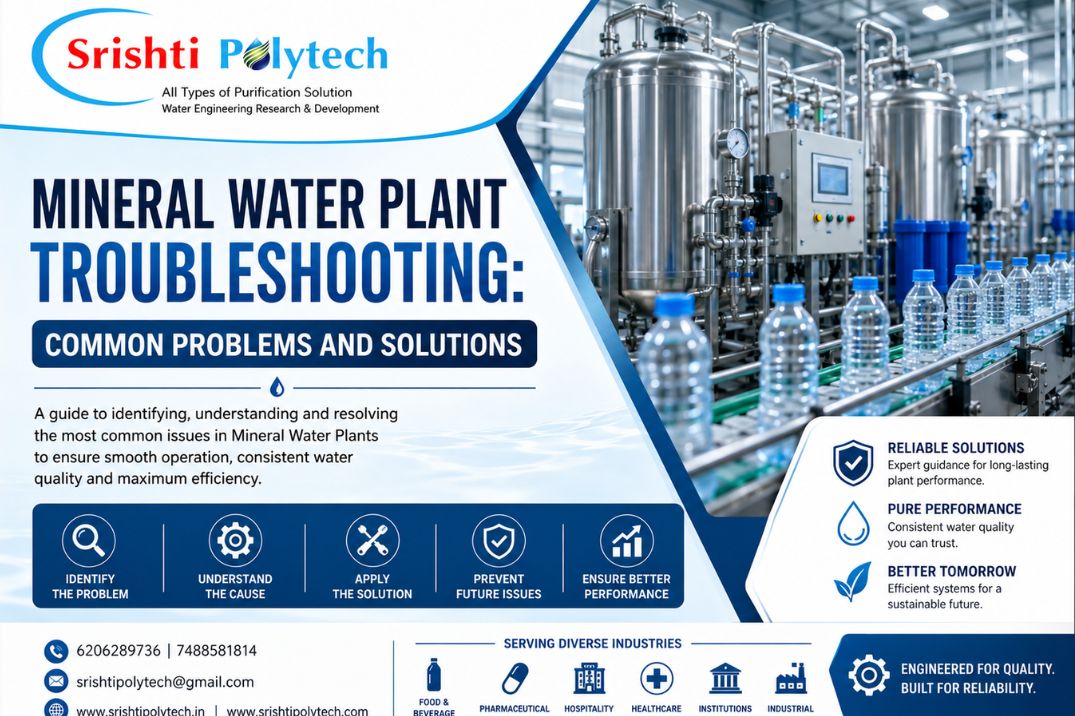
Jun 23, 2026
Mineral Water Plant Troubleshooting: Common Problems and Solutions......
A Mineral Water Plant is a critical investment for businesses involved in packaged drinking water production. Whether supplying bottled water...
Complete Guide to 20 KLD Effluent Treatment Plant: Working Process, Components, Benefits & Industrial Applications....
Jun 22, 2026
uploads/blogs/blog_6a38cb69bf04c.jpg
With rapid industrialization, wastewater management has become one of the most important responsibilities for industries across the globe. Every manufacturing process generates wastewater containing suspended solids, chemicals, oils, grease, heavy metals, organic matter, and other contaminants that cannot be discharged directly into the environment. Untreated industrial effluent not only pollutes natural water bodies but also violates environmental regulations laid down by pollution control authorities.
A 20 KLD (20,000 Litres Per Day) Effluent Treatment Plant (ETP) is an ideal wastewater treatment solution for small and medium-scale industries that generate approximately 20,000 litres of wastewater daily. It effectively treats industrial effluent, enabling safe discharge or reuse while ensuring compliance with environmental norms.
At Srishti Polytech, we specialize in designing, manufacturing, supplying, installing, and commissioning customized 20 KLD Effluent Treatment Plants for a wide range of industrial applications. Our advanced engineering solutions combine modern treatment technologies with reliable equipment to deliver high treatment efficiency, low operational costs, and long service life.
What is a 20 KLD Effluent Treatment Plant?
A 20 KLD Effluent Treatment Plant is a wastewater treatment system designed to process up to 20,000 litres of industrial wastewater per day. The primary objective of an ETP is to remove physical, chemical, and biological contaminants from industrial wastewater before it is safely discharged into the environment or reused within industrial operations.
Unlike domestic sewage, industrial wastewater varies significantly depending on the manufacturing process. Therefore, every 20 KLD ETP is carefully engineered according to the wastewater characteristics, pollution load, and discharge standards required by regulatory authorities.
Why Industries Need a 20 KLD ETP Plant
Industries today face increasing environmental regulations and rising water scarcity. Installing an efficient ETP offers numerous operational and environmental benefits, including:
* Compliance with Pollution Control Board guidelines
* Prevention of environmental pollution
* Safe disposal of industrial wastewater
* Water recycling and reuse opportunities
* Reduced freshwater consumption
* Improved corporate environmental responsibility
* Enhanced operational sustainability
* Better public image and regulatory compliance
Working Process of a 20 KLD Effluent Treatment Plant
A modern 20 KLD ETP operates through several treatment stages to ensure effective purification of industrial wastewater.
1. Collection Tank
Industrial wastewater from different production units is collected in the collection tank. Large particles and debris are screened out to protect downstream equipment.
2. Equalization Tank
Wastewater characteristics often fluctuate throughout the day. The equalization tank balances the flow rate, pH level, and pollutant concentration, ensuring stable treatment conditions.
3. pH Correction
Industrial wastewater may be highly acidic or alkaline. Chemical dosing systems automatically adjust the pH to an optimum level for efficient treatment.
4. Coagulation & Flocculation
Special treatment chemicals are added to destabilize suspended particles. These particles combine to form larger flocs, making them easier to remove during sedimentation.
5. Primary Clarifier
The heavier flocs settle at the bottom of the clarifier while cleaner water flows to the next treatment stage. The collected sludge is removed for further processing.
6. Biological Treatment
Microorganisms consume dissolved organic pollutants in the wastewater. Aeration blowers continuously supply oxygen, promoting biological degradation and reducing BOD and COD levels.
7. Secondary Clarification
Activated sludge settles in the secondary clarifier, separating treated water from biological solids. Part of the sludge is recycled, while excess sludge is removed.
8. Pressure Sand Filter
Remaining suspended solids are removed through a Pressure Sand Filter, improving water clarity.
9. Activated Carbon Filter
The Activated Carbon Filter removes colour, odour, organic compounds, and trace impurities, producing cleaner treated water.
10. Final Discharge or Reuse
The treated water can either be safely discharged according to environmental standards or reused for gardening, cooling towers, floor washing, flushing, or other industrial purposes.
Major Components of a 20 KLD ETP Plant
A complete 20 KLD Effluent Treatment Plant typically consists of:
* Collection Tank
* Bar Screen Chamber
* Equalization Tank
* Neutralization Tank
* Chemical Dosing System
* Flash Mixer
* Flocculator
* Primary Clarifier
* Aeration Tank
* Air Blowers
* Secondary Clarifier
* Sludge Holding Tank
* Sludge Dewatering System
* Pressure Sand Filter
* Activated Carbon Filter
* Pumps and Valves
* Electrical Control Panel (MCC)
* Flow Meter and Instrumentation
Industries Using 20 KLD ETP Plants
A 20 KLD ETP Plant is widely used in:
* Pharmaceutical Industries
* Textile Manufacturing Units
* Food Processing Industries
* Dairy Plants
* Chemical Industries
* Paint Manufacturing Units
* Paper Mills
* Automobile Industries
* Electroplating Industries
* Engineering Workshops
* Beverage Industries
* Plastic Manufacturing Units
Key Benefits of a 20 KLD Effluent Treatment Plant
1. Environmental Protection
Prevents contamination of rivers, lakes, and groundwater by treating industrial wastewater before discharge.
2. Regulatory Compliance
Helps industries comply with Pollution Control Board norms and environmental regulations.
3. Water Conservation
Supports water recycling and reuse, reducing dependence on freshwater sources.
4. Reduced Operating Costs
Reusing treated water lowers water procurement costs and improves operational efficiency.
5. Improved Corporate Image
Demonstrates commitment to sustainability and environmental responsibility.
6. Long Equipment Life
High-quality components ensure reliable performance with minimal maintenance.
Factors to Consider Before Installing a 20 KLD ETP Plant
Before selecting an ETP, industries should evaluate:
* Daily wastewater generation
* Nature of contaminants
* Required discharge standards
* Available installation space
* Power availability
* Sludge disposal requirements
* Automation level
* Future capacity expansion
* Maintenance requirements
* Budget and lifecycle costs
Why Choose Srishti Polytech?
At Srishti Polytech, we provide complete turnkey wastewater treatment solutions tailored to the unique needs of every client. Our expertise covers the entire project lifecycle—from initial consultation and process design to manufacturing, installation, commissioning, operator training, and after-sales service.
Our Strengths
* Customized ETP Solutions
* Experienced Design & Engineering Team
* High-Quality Components
* Advanced Treatment Technologies
* Turnkey Project Execution
* Timely Installation & Commissioning
* Comprehensive AMC & Technical Support
* Competitive Pricing
* PAN India Project Execution
* Commitment to Quality and Customer Satisfaction
Our goal is to help industries achieve efficient wastewater treatment while supporting sustainable environmental practices.
Conclusion
A 20 KLD Effluent Treatment Plant is a smart investment for industries looking to manage wastewater responsibly, meet environmental regulations, and reduce their overall water footprint. With the right design, advanced treatment technologies, and expert engineering, an ETP not only protects the environment but also enhances operational efficiency and supports long-term business sustainability.
If your industry is planning to install a 20 KLD ETP Plant, Srishti Polytech offers reliable, customized, and cost-effective solutions backed by technical expertise and dedicated customer support.
Contact Srishti Polytech
Srishti Polytech
All Types of Purification Solution – Water Engineering Research & Development
📞 6206289736 | 7488581814
📧 [srishtipolytech@gmail.com]
🌐 [www.srishtipolytech.in] / [www.srishtipolytech.com]
Keywords
#20KLDETP #EffluentTreatmentPlant #IndustrialWastewaterTreatment #ETPPlant #WastewaterTreatment #IndustrialWaterTreatment #WaterTreatmentPlant #ETPManufacturer #TurnkeyWaterProjects #WaterEngineering #EnvironmentalCompliance #WaterRecycling #PollutionControl #IndustrialSolutions #SrishtiPolytech #WastewaterManagement #IndustrialETP #WaterTreatmentSolutions #EnvironmentalEngineering #CleanWater
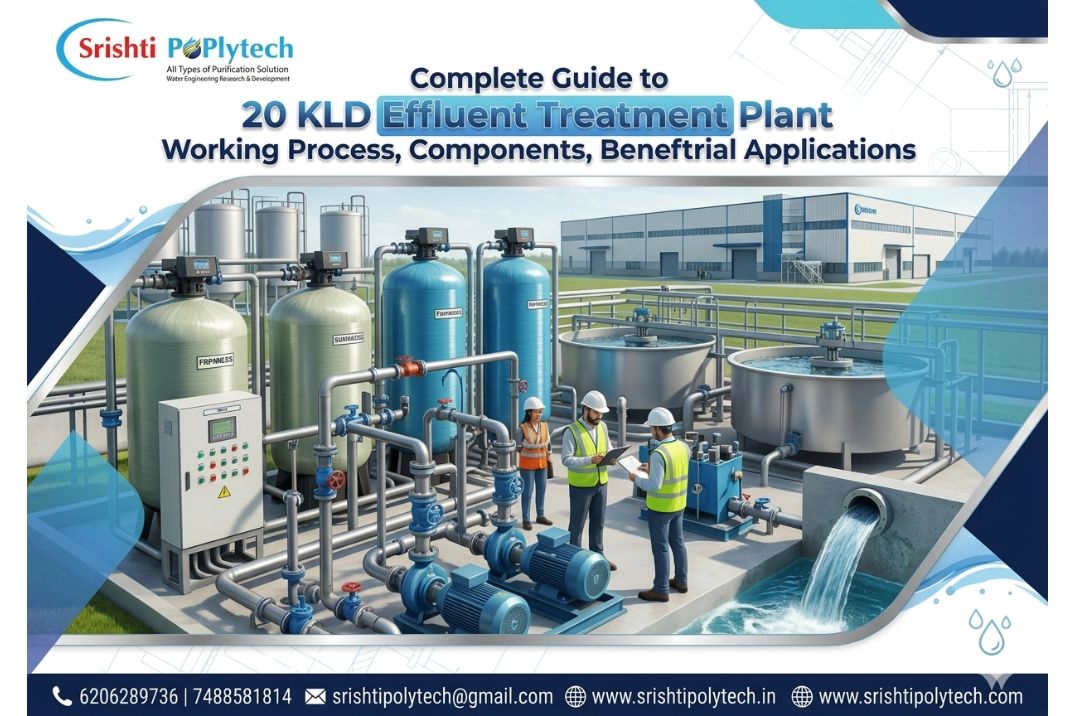
Jun 22, 2026
Complete Guide to 20 KLD Effluent Treatment Plant: Working Process, Components, Benefits & Industrial Applications....
With rapid industrialization, wastewater management has become one of the most important responsibilities for industries across the globe. Every manufacturing...
ETP/STP Tender Process Explained Step-by-Step
Jun 19, 2026
uploads/blogs/blog_6a34e0487d025.jpg
Effluent Treatment Plants (ETP) and Sewage Treatment Plants (STP) are essential infrastructure for industries, commercial establishments, municipalities, institutions, and residential developments. As environmental regulations become stricter, the demand for professionally designed wastewater treatment systems continues to grow.
Most large-scale ETP and STP installations are executed through a structured tendering process. Whether the project is initiated by a government department, municipal corporation, industrial organization, or private company, understanding the tender process is crucial for successful project execution.
This guide explains the complete ETP/STP tender process, from project planning to final commissioning, helping project owners, contractors, consultants, and manufacturers understand each stage.
What is an ETP/STP Tender?
A tender is an official invitation issued by a government department, municipal authority, PSU, private organization, or industrial company to invite qualified bidders for the design, supply, installation, testing, and commissioning of an Effluent Treatment Plant (ETP) or Sewage Treatment Plant (STP).
The tender process ensures transparency, fair competition, and the selection of the most suitable technical and commercial solution.
Step 1: Project Requirement Identification
The process begins by identifying the wastewater treatment requirements.
This includes:
* Type of wastewater
* Treatment capacity (KLD, MLD, or LPH)
* Available installation space
* Environmental discharge requirements
* Industry type
* Budget estimation
* Future expansion plans
A detailed assessment helps determine the appropriate treatment technology.
Step 2: Preparation of Tender Documents
The project owner prepares comprehensive tender documents containing:
* Scope of work
* Technical specifications
* Plant capacity
* Quality standards
* Equipment requirements
* Civil work details
* Electrical requirements
* Automation requirements
* Completion timeline
* Warranty conditions
* Eligibility criteria
* Payment terms
Clear tender documents reduce project risks and ensure smooth execution.
Step 3: Tender Publication
After approval, the tender is published through the appropriate procurement platform or official procurement channels.
The published notice generally includes:
* Project title
* Estimated value
* Bid submission deadline
* Eligibility requirements
* Tender document availability
* Contact information
Interested companies can then participate in the bidding process.
Step 4: Site Visit & Pre-Bid Meeting
Before submitting proposals, bidders may conduct a site inspection.
During this stage they evaluate:
* Site conditions
* Space availability
* Existing infrastructure
* Utility connections
* Civil requirements
* Installation challenges
Many projects also include a pre-bid meeting where bidders can seek clarifications regarding technical specifications and contractual requirements.
Step 5: Technical Proposal Submission
Qualified bidders prepare a detailed technical proposal covering:
* Process flow diagram
* Plant design
* Treatment technology
* Equipment specifications
* Instrumentation
* Automation system
* Electrical layout
* Civil requirements
* Compliance with tender specifications
The technical proposal demonstrates the bidder's engineering capability and project understanding.
Step 6: Commercial Bid Submission
Along with the technical proposal, bidders submit their commercial quotation.
The commercial bid generally includes:
* Equipment cost
* Installation charges
* Commissioning cost
* Transportation
* Civil work (if applicable)
* Taxes
* Annual Maintenance Cost (AMC)
* Delivery schedule
The quotation should align with the technical proposal and project scope.
Step 7: Technical Evaluation
The client evaluates all technical submissions.
Evaluation typically considers:
* Compliance with specifications
* Equipment quality
* Engineering capability
* Similar project experience
* Manufacturing facilities
* Certifications
* Service support
* Warranty terms
Only technically qualified bidders proceed to the financial evaluation stage.
Step 8: Financial Evaluation
Commercial bids are opened for technically qualified bidders.
The client compares:
* Total project cost
* Value for money
* Quality of equipment
* Long-term operating cost
* Energy efficiency
* Maintenance requirements
The objective is to select the most technically suitable and commercially competitive solution—not simply the lowest-priced offer.
Step 9: Award of Contract
Once the evaluation is complete, the successful bidder receives the Letter of Award (LOA) or Purchase Order (PO).
The contract outlines:
* Project scope
* Delivery schedule
* Payment milestones
* Installation timeline
* Performance guarantees
* Warranty obligations
* Technical commitments
Step 10: Manufacturing & Procurement
After contract award, manufacturing begins.
Major activities include:
* Equipment fabrication
* Quality inspections
* Procurement of pumps, blowers, valves, instruments, and control panels
* Factory testing
* Documentation preparation
Strict quality control ensures reliable plant performance.
Step 11: Installation & Commissioning
The installation phase includes:
* Civil foundation preparation
* Mechanical installation
* Piping
* Electrical wiring
* Instrumentation
* Control panel installation
* Trial operation
* Performance testing
Commissioning verifies that the plant operates according to the approved design and performance requirements.
Step 12: Training & Handover
After successful commissioning, the supplier provides:
* Operator training
* Operation manuals
* Maintenance guidelines
* Performance reports
* Warranty documents
The project is then officially handed over to the client.
- Common Documents Required for ETP/STP Tenders
Typical tender submissions may include:
* Company Profile
* GST Registration
* PAN
* MSME Registration (if applicable)
* Experience Certificates
* Work Completion Certificates
* Financial Statements
* Technical Data Sheets
* Product Catalogues
* Quality Certifications (if applicable)
* Authorization Letters
* Compliance Statements
The exact documentation requirements depend on the tender conditions.
- Tips for Successful Tender Participation
* Read the tender document thoroughly.
* Understand all technical specifications before bidding.
* Submit complete documentation.
* Ensure your proposal is technically compliant.
* Maintain realistic pricing.
* Highlight relevant project experience.
* Offer reliable after-sales support.
* Meet submission deadlines.
- Why Choose Srishti Polytech?
At Srishti Polytech, we specialize in delivering complete water and wastewater treatment solutions for industrial, commercial, municipal, and institutional projects.
Our expertise includes:
* Effluent Treatment Plants (ETP)
* Sewage Treatment Plants (STP)
* Industrial RO Plants
* Commercial RO Plants
* Mineral Water Plants
* Water Softener Plants
* Iron Removal Plants
* Septage Treatment Plants
* Water Recycling Systems
* Wheel Washing Systems
* Dust Suppression Systems
* Turnkey Water Treatment Projects
From design and manufacturing to installation and commissioning, our experienced team delivers customized solutions focused on quality, efficiency, and long-term performance.
Conclusion
Understanding the ETP/STP tender process helps project owners and bidders achieve smoother project execution and better outcomes. A well-planned tender ensures transparency, technical excellence, and cost-effective implementation while supporting environmental compliance.
Whether you are planning a new wastewater treatment project or participating in an upcoming tender, choosing an experienced engineering partner can make a significant difference.
Contact Srishti Polytech
📞 Phone:
6206289736 | 7488581814
📧 Email:
[srishtipolytech@gmail.com]
🌐 Website:
[www.srishtipolytech.in] / [www.srishtipolytech.com]
Srishti Polytech – Delivering Reliable Water & Wastewater Treatment Solutions with Engineering Excellence.
Keywords
#ETP #STP #ETPTender #STPTender #WastewaterTreatment #EffluentTreatmentPlant #SewageTreatmentPlant #IndustrialWaterTreatment #GovernmentTender #TenderProcess #WaterTreatmentPlant #IndustrialProjects #EnvironmentalCompliance #TurnkeyProjects #WaterEngineering #WastewaterManagement #IndustrialSolutions #WaterTreatmentSolutions #SrishtiPolytech #TenderGuide
Jun 19, 2026
ETP/STP Tender Process Explained Step-by-Step
Effluent Treatment Plants (ETP) and Sewage Treatment Plants (STP) are essential infrastructure for industries, commercial establishments, municipalities, institutions, and residential...
Water Cooler vs Water Dispenser: Which One is Better?
Jun 17, 2026
uploads/blogs/blog_6a3267acafa88.png
In today's fast-paced world, access to clean and chilled drinking water is no longer a luxury—it's a necessity. Whether you're managing a manufacturing facility, corporate office, educational institution, hospital, or commercial establishment, selecting the right drinking water solution plays an important role in ensuring employee health, customer satisfaction, and operational efficiency.
Two of the most common options available are Water Coolers and Water Dispensers. Although both provide drinking water, they are designed for entirely different purposes.
So, which one is better? The answer depends on your usage, the number of users, and your environment.
-Let's understand the differences in detail.
Understanding a Water Cooler
A Water Cooler is a high-capacity cooling unit designed to supply chilled drinking water continuously throughout the day. These systems are commonly connected to a purified water source such as an RO Plant or overhead water storage tank.
Most commercial water coolers are manufactured using food-grade stainless steel, making them durable, hygienic, and suitable for heavy-duty usage.
They are widely installed in:
Manufacturing Industries
Schools & Colleges
Hospitals
Hotels
Shopping Malls
Railway Stations
Corporate Offices
Government Buildings
These units are specifically engineered for locations where hundreds of people require drinking water every day.
Understanding a Water Dispenser
A Water Dispenser is a compact drinking water appliance generally used in homes or small offices. Most dispensers work with 20-litre bottled water jars and provide cold, normal, and sometimes hot water.
They are ideal for places where daily water consumption is relatively low.
Common applications include:
Homes
Small Offices
Reception Areas
Clinics
Retail Stores
Cabins
While dispensers offer convenience and portability, they are not designed for high-volume commercial use.
Why Industries Prefer Water Coolers
Industrial environments demand reliable and uninterrupted access to drinking water. Employees working in factories, warehouses, mines, construction sites, and production units require a continuous supply of chilled water, especially during hot weather.
A commercial stainless steel water cooler offers:
Continuous Cooling
Unlike dispensers that rely on bottled water, water coolers provide a constant flow of chilled water throughout the day.
Higher Capacity
Commercial water coolers are available in capacities ranging from 20 litres to over 500 litres, making them suitable for serving large workforces.
Better Hygiene
Since they connect directly to purified water systems, there is no need for repeated bottle handling, reducing the chances of contamination.
Long Service Life
Stainless steel construction ensures corrosion resistance, durability, and easy cleaning.
Lower Operating Cost
Although the initial investment is higher, operating costs are significantly lower than purchasing bottled water repeatedly.
When Should You Choose a Water Dispenser?
A water dispenser is the right option if:
Your office has fewer than 20–30 employees.
You need a portable water solution.
There is no direct purified water connection available.
Water consumption is relatively low.
You require both hot and cold water for beverages.
For small businesses and homes, dispensers provide a practical and economical solution.
Advantages of Commercial Water Coolers
1. Heavy-Duty Performance
Designed for continuous operation without affecting cooling efficiency.
2. Hygienic Drinking Water
Food-grade stainless steel storage tanks help maintain water quality.
3. Energy Efficient
Modern commercial water coolers consume less electricity while delivering high cooling performance.
4. Low Maintenance
Routine cleaning and periodic servicing are usually sufficient for long-term performance.
5. Cost Effective
Ideal for organizations with large daily water requirements.
Advantages of Water Dispensers
Compact design
Easy installation
Portable
Hot and cold water options
Suitable for homes and cabins
No plumbing required
Which One Is Better for Your Business?
The answer depends on your daily water consumption.
Choose a Water Cooler if:
You operate a factory or manufacturing unit.
You have more than 30–40 users daily.
Continuous chilled water is required.
You already have an RO Plant.
You want a long-term, cost-effective solution.
Choose a Water Dispenser if:
You have a small office.
Daily water usage is low.
You rely on bottled drinking water.
You need a portable unit.
You want hot and cold water functionality.
Things to Consider Before Buying
Before investing in either system, evaluate the following:
Number of daily users
Water consumption requirements
Available installation space
Water source availability
Electricity consumption
Maintenance requirements
Build quality
Warranty and after-sales support
Making the right choice ensures better performance, lower operating costs, and long-term reliability.
Final Verdict
While both water coolers and water dispensers serve the purpose of providing drinking water, they are designed for different environments.
If your requirement is high-capacity, continuous, hygienic, and cost-effective drinking water, a commercial stainless steel water cooler is the clear winner. It is the preferred choice for industries, schools, hospitals, offices, and commercial facilities where reliability and durability matter most.
On the other hand, if your needs are limited to a small office or home with fewer users, a water dispenser offers convenience, portability, and ease of use.
Choosing the right solution ultimately depends on your daily water demand, available infrastructure, and long-term operational goals.
Why Choose Srishti Polytech?
At Srishti Polytech, we provide high-quality stainless steel water coolers engineered for commercial and industrial applications. Our products are designed for durability, hygiene, energy efficiency, and dependable performance, making them suitable for factories, educational institutions, healthcare facilities, and corporate workplaces.
Whether you need a compact unit for a small office or a high-capacity solution for an industrial facility, our team can help you select the right system for your requirements.
Contact Us
🌐 Website: www.srishtipolytech.in
📧 Email: info@srishtipolytech.in
📞 Phone: +91-7903594940
Srishti Polytech – Delivering Reliable Drinking Water Solutions for Every Business.
#WaterCooler
#WaterDispenser
#WaterCoolerVsWaterDispenser
#CommercialWaterCooler
#IndustrialWaterCooler
#StainlessSteelWaterCooler
#DrinkingWaterSolutions
#WaterCoolingSystem
#CommercialWaterSolutions
#IndustrialSolutions
Jun 17, 2026
Water Cooler vs Water Dispenser: Which One is Better?
In today's fast-paced world, access to clean and chilled drinking water is no longer a luxury—it's a necessity. Whether you're...
Top Industries That Need Mist Cannon Systems for Dust Control
Jun 16, 2026
uploads/blogs/blog_6a312d0190805.jpg
Industrial dust is more than just a workplace nuisance—it poses significant challenges to employee health, equipment performance, environmental compliance, and operational efficiency. Industries such as construction, mining, cement manufacturing, and material handling generate large volumes of airborne dust every day. Without effective dust suppression, these particles can affect productivity, reduce air quality, and create safety hazards.
A **Mist Cannon System** has become one of the most effective and environmentally responsible solutions for controlling airborne dust. By producing ultra-fine water droplets that bind with dust particles, mist cannons help prevent dust from spreading while maintaining cleaner and safer working environments.
In this article, we explore the top industries that benefit from Mist Cannon Systems and why investing in advanced dust suppression technology is essential for sustainable industrial operations.
1. Construction Sites
Construction activities generate dust during excavation, demolition, drilling, earthmoving, and material transportation. Airborne dust not only affects workers but also nearby communities.
A Mist Cannon System helps suppress dust across large construction areas, improving visibility and maintaining cleaner surroundings.
2. Mining Industries
Mining operations produce continuous dust during blasting, crushing, loading, and transportation of minerals. High dust concentrations can impact both worker safety and machinery performance.
Mist Cannon Systems effectively capture airborne dust particles before they spread throughout the mining site.
3. Stone Crusher Plants
Stone crushing generates extremely fine dust that can affect plant operations and the surrounding environment.
Installing a Mist Cannon System significantly reduces dust emissions around crushers, conveyors, and stockyards.
4. Cement Manufacturing Plants
Raw material handling, clinker processing, and cement transportation produce large quantities of dust.
Mist Cannon technology provides efficient dust suppression while supporting cleaner production environments.
5. Coal Handling Plants
Coal unloading, conveyor transfer points, and storage yards continuously release coal dust into the atmosphere.
Mist Cannon Systems minimize airborne coal particles and improve air quality throughout the facility.
6. Steel & Metal Industries
Steel plants generate dust during material handling, slag processing, and manufacturing operations.
A professionally designed Mist Cannon helps control suspended dust without interrupting production activities.
7. Demolition Projects
Building demolition releases enormous amounts of concrete, brick, and silica dust.
High-pressure mist systems suppress dust instantly, making demolition work safer for workers and surrounding communities.
8. Waste Management Facilities
Waste processing and recycling centers often generate airborne particles during sorting and material movement.
Mist Cannon Systems help reduce dust while improving workplace hygiene.
9. Ports & Bulk Material Handling
Loading and unloading materials such as coal, limestone, fly ash, clinker, and iron ore create continuous dust emissions.
Mist Cannon Systems are widely used in ports to control dust around conveyors, storage yards, and loading zones.
10. Power Plants
Coal-fired and material handling areas within power plants require efficient dust suppression to improve operational safety and environmental performance.
Mist Cannons provide reliable dust control across large industrial areas.
# Benefits of Installing a Mist Cannon System
• Effective airborne dust suppression
• Improved workplace safety
• Better air quality
• Reduced environmental pollution
• Supports regulatory compliance
• Lower maintenance requirements
• Enhanced equipment performance
• Sustainable industrial operations
# Why Choose Srishti Polytech?
At **Srishti Polytech**, we specialize in manufacturing advanced **Mist Cannon Systems** designed for efficient dust suppression across diverse industrial applications. Our solutions are engineered for durability, high performance, and reliable operation, helping businesses create cleaner, safer, and more sustainable work environments.
Whether you operate a construction site, mining project, cement plant, steel facility, or material handling unit, our customized dust suppression solutions are designed to meet your operational requirements.
# Conclusion
Dust control is no longer just an environmental responsibility—it is an essential part of modern industrial management. Industries that invest in advanced Mist Cannon Systems benefit from cleaner operations, improved worker safety, greater equipment reliability, and better environmental performance.
Choosing the right dust suppression solution is an investment in operational excellence and long-term sustainability. With innovative engineering and dependable technology, **Srishti Polytech** continues to support industries in building cleaner and more efficient workplaces.
Get in Touch with Srishti Polytech
Looking for a reliable **Mist Cannon System** for your construction site, mining project, cement plant, or industrial facility?
**Srishti Polytech** offers advanced dust suppression solutions engineered to deliver efficient performance, long-term reliability, and customized solutions for a wide range of industrial applications. Our experienced team is committed to helping businesses create cleaner, safer, and more sustainable work environments.
Contact Us
📞 6206289736 | 7488581814
🌐 Website:
[www.srishtipolytech.in]
[www.srishtipolytech.com]
📧 Email:
[srishtipolytech@gmail.com]
📍Address:
Pandey Niwas, Gopal Nagar, Manaitand, Dhanbad, Jharkhand – 826001
#MistCannon #DustSuppression #IndustrialDustControl #ConstructionIndustry #MiningIndustry #StoneCrusher #CementPlant #CoalHandlingPlant #SteelIndustry #WasteManagement #AirPollutionControl #EnvironmentalProtection #IndustrialSolutions #EngineeringExcellence #CleanAir #DustControl #IndustrialEngineering #WaterMistSystem #SrishtiPolytech
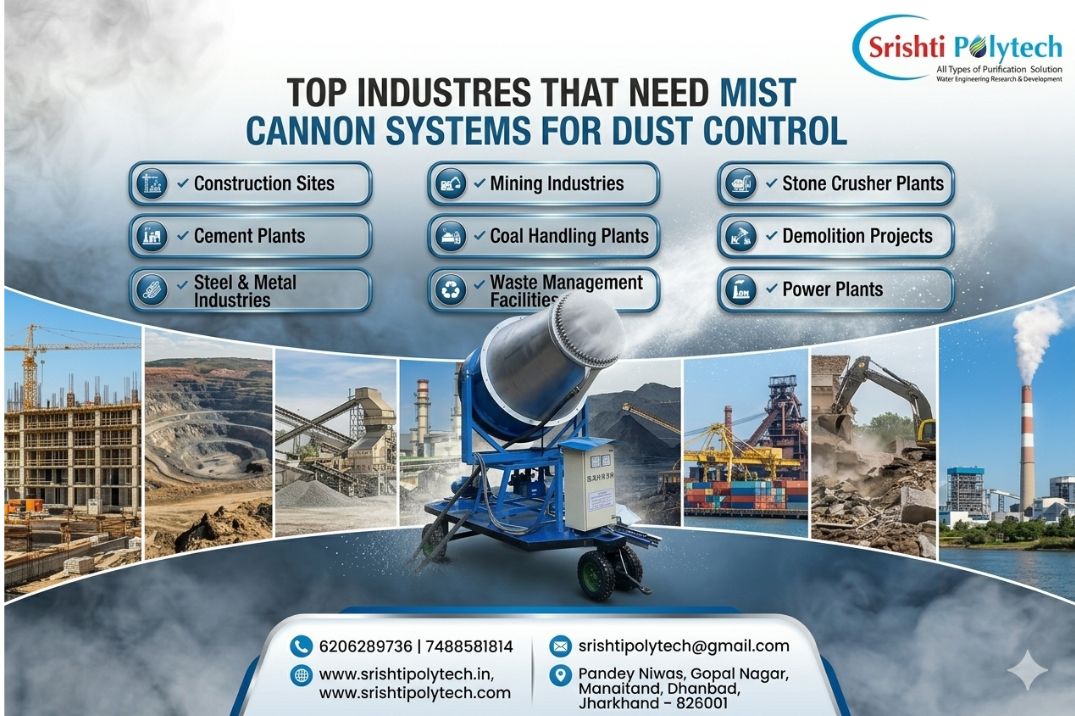
Jun 16, 2026
Top Industries That Need Mist Cannon Systems for Dust Control
Industrial dust is more than just a workplace nuisance—it poses significant challenges to employee health, equipment performance, environmental compliance, and...
A Complete Guide to Industrial Vehicle Wheel Washing Systems
Jun 08, 2026
uploads/blogs/blog_6a2675a05e4a1.jpg
Construction sites, mining operations, industrial facilities, and infrastructure projects generate large amounts of dust, mud, and debris. Heavy vehicles moving in and out of these sites often carry contaminated material on their tires and undercarriages, causing road pollution, environmental concerns, and safety hazards.
An Industrial Vehicle Wheel Wash System is a specialized cleaning solution designed to remove mud, dust, and debris from vehicle wheels and undercarriages before they leave a site. These systems play a vital role in maintaining clean roads, improving environmental compliance, and supporting sustainable industrial operations.
At Srishti Polytech, we provide advanced wheel wash solutions engineered to meet the requirements of construction, mining, manufacturing, and infrastructure industries.
⚫What Is an Industrial Vehicle Wheel Wash System?
A Wheel Wash System is an automated cleaning system installed at site exits to wash vehicle tires, wheels, and undercarriages using high-pressure water jets.
The primary objective is to prevent mud, dust, soil, and debris from being transported onto public roads and surrounding environments.
By ensuring that vehicles leave the site clean, wheel wash systems help organizations maintain operational efficiency while minimizing environmental impact.
⚫Why Is a Wheel Wash System Important?
-Many industrial sites face challenges such as:
* Mud accumulation on public roads
* Dust pollution caused by moving vehicles
* Environmental compliance issues
* Increased road cleaning expenses
* Negative impact on community relations
* Safety risks due to slippery road conditions
A wheel wash system addresses these issues effectively by cleaning vehicles before they exit the facility.
⚫How Does a Wheel Wash System Work?
The operation process is simple yet highly effective:
1. Vehicle Entry
Heavy vehicles enter the wash platform at a controlled speed.
2. Sensor Activation
Sensors detect vehicle presence and automatically activate the cleaning system.
3. High-Pressure Cleaning
Multiple spray nozzles direct high-pressure water jets toward the tires, wheels, and undercarriage.
4. Mud and Debris Removal
Accumulated mud, dust, and debris are washed away efficiently.
5. Water Recycling Process
Many modern systems include sedimentation and filtration mechanisms that allow water reuse, reducing overall water consumption.
6. Clean Vehicle Exit
The vehicle exits the system with significantly reduced contaminants, helping maintain cleaner roads and site surroundings.
⚫Key Components of a Wheel Wash System
A typical industrial wheel wash system consists of:
-Wash Platform
Heavy-duty structure designed to support industrial vehicles.
-High-Pressure Nozzles
Strategically positioned for effective cleaning coverage.
-Water Storage Tank
Stores water required for continuous operation.
-Filtration Unit
Removes debris and sediment from wash water.
-Recycling System
Allows treated water to be reused.
-Control Panel
Manages system operation and automation.
-Sensors and Automation Controls
Enable automatic start and stop functions.
⚫Major Benefits of Wheel Wash Systems
-Improved Environmental Compliance
Many regulatory authorities require industries to minimize road contamination and dust pollution. Wheel wash systems help organizations meet environmental standards effectively.
-Reduced Road Pollution
Cleaner vehicle tires mean less mud and debris reaching public roads.
-Better Dust Control
Removing dust and soil from vehicles significantly reduces airborne particulate matter.
-Enhanced Workplace Safety
Cleaner site exits help prevent accidents caused by mud accumulation and slippery surfaces.
-Lower Road Maintenance Costs
Organizations spend less on road cleaning and maintenance activities.
-Improved Corporate Image
A clean and environmentally responsible operation reflects positively on clients, authorities, and local communities.
-Sustainable Operations
Modern systems use water recycling technology to reduce freshwater consumption.
⚫Industries That Use Wheel Wash Systems
-Construction Sites
Large infrastructure projects generate significant mud and dust.
-Mining Operations
Mining trucks often carry soil and debris outside the site.
-Cement Plants
Dust control is critical for operational and environmental reasons.
-Quarry Operations
Vehicle movement creates substantial dust pollution.
-Steel Plants
Industrial waste and particulate matter require effective management.
-Power Plants
Vehicle cleanliness supports environmental compliance initiatives.
-Waste Management Facilities
Wheel wash systems help reduce contamination transfer.
⚫Factors to Consider Before Buying a Wheel Wash System
-Vehicle Type
Determine the size and weight of vehicles using the system.
-Traffic Volume
Select a system capable of handling daily vehicle movement efficiently.
-Water Recycling Capability
Look for solutions that minimize water consumption.
-Cleaning Efficiency
Ensure complete wheel and undercarriage coverage.
-Maintenance Requirements
Choose a system designed for easy servicing.
-Automation Features
Automated operation improves efficiency and reduces labor costs.
-Site Conditions
Consider available space, drainage requirements, and environmental conditions.
⚫Why Choose Srishti Polytech?
At Srishti Polytech, we understand that every industrial site has unique requirements. Our wheel wash systems are designed to deliver reliable performance, efficient cleaning, and long-term operational value.
Our solutions offer:
* Customized System Design
* High-Quality Industrial Components
* Efficient Water Management
* Durable Construction
* Technical Expertise
* Reliable After-Sales Support
We help industries create cleaner, safer, and more environmentally responsible operations.
⚫Conclusion
Industrial Vehicle Wheel Wash Systems have become an essential component of modern industrial infrastructure. By preventing mud, dust, and debris from leaving the site, these systems contribute to cleaner roads, safer workplaces, improved environmental compliance, and sustainable operations.
Whether you operate a construction site, mining project, cement plant, or industrial facility, investing in a high-quality wheel wash system can provide significant long-term benefits.
Srishti Polytech is committed to delivering innovative environmental and industrial solutions that help businesses maintain efficiency while protecting the environment.
⚫Contact Us
Srishti Polytech
All Types of Purification Solution
📞 +91 7488581814 | +91 6206289736
📧 [srishtipolytech@gmail.com]
🌐 [www.srishtipolytech.in] / [www.srishtipolytech.com]
📍 Pandey Niwas, Gopal Nagar, Manaitand, Dhanbad, Jharkhand – 826001
⚫Keywords
Industrial Vehicle Wheel Wash System, Wheel Wash System, Automatic Wheel Wash System, Construction Site Wheel Wash, Mining Wheel Wash System, Dust Control Solution, Road Pollution Control, Vehicle Cleaning System, Industrial Dust Management, Wheel Cleaning Equipment, Mud Removal System, Environmental Compliance, Construction Equipment Cleaning, Sustainable Industrial Solutions, Srishti Polytech.
Jun 08, 2026
A Complete Guide to Industrial Vehicle Wheel Washing Systems
Construction sites, mining operations, industrial facilities, and infrastructure projects generate large amounts of dust, mud, and debris. Heavy vehicles moving...
How Sludge Removal Plants Improve Wastewater Treatment Efficiency....
Jun 01, 2026
uploads/blogs/blog_6a1d412a4f8d8.jpg
"Accumulated sludge can reduce treatment capacity, increase operating costs, and compromise effluent quality, making sludge removal plants an indispensable component of modern wastewater treatment facilities."
Wastewater treatment is a critical component of modern industrial and municipal operations. Industries generate large volumes of wastewater containing suspended solids, organic matter, chemicals, oils, grease, and various contaminants. During the treatment process, these impurities are separated from the water and accumulate as sludge.
While many industries focus primarily on water treatment technologies, sludge management is often overlooked. However, sludge is one of the most significant by-products of wastewater treatment, and its improper handling can severely impact plant performance, increase operating costs, and create environmental compliance challenges.
This is where Sludge Removal Plants play a vital role. By efficiently collecting, transporting, dewatering, and managing sludge, these systems help wastewater treatment facilities operate more effectively and sustainably.
A well-designed sludge removal system not only improves wastewater treatment efficiency but also reduces operational costs, minimizes environmental risks, and ensures regulatory compliance.
⚫Understanding Sludge in Wastewater Treatment
Sludge is a semi-solid waste generated during the treatment of wastewater. It consists of:
1. Suspended solids
2. Organic matter
3. Biological residues
4. Chemical precipitates
5. Oils and grease
6. Heavy metals and contaminants
As wastewater passes through various treatment stages, pollutants are removed from the water and concentrated into sludge.
In a typical wastewater treatment facility, sludge may account for only a small percentage of the total wastewater volume, but it often represents a significant portion of the operating and disposal costs.
Without proper sludge management, treatment systems can quickly become inefficient and difficult to operate.
⚫ What is a Sludge Removal Plant?
A Sludge Removal Plant is a specialized system designed to collect, transfer, thicken, dewater, and dispose of sludge generated during wastewater treatment processes.
The primary objective is to reduce sludge volume and moisture content while ensuring safe handling and disposal.
-Typical components include:
1. Sludge Collection System
2. Sludge Pumps
3. Sludge Holding Tanks
4. Thickening Units
5. Filter Presses
6. Screw Presses
7. Belt Presses
8. Centrifuges
9. Conveyors
10. Sludge Drying Systems
These systems work together to transform liquid sludge into a manageable and cost-effective form for disposal or reuse.
⚫ Why Sludge Management is Critical in Wastewater Treatment
Many industries invest heavily in wastewater treatment equipment but underestimate the importance of sludge handling.
-Poor sludge management can lead to:
1. Reduced treatment efficiency
2. Overflow problems
3. Increased maintenance requirements
4. Higher disposal costs
5. Environmental violations
6. Equipment failures
7. Unpleasant odors
8. Reduced treatment capacity
Effective sludge removal ensures that treatment systems continue to operate at their designed performance levels.
⚫ How Sludge Removal Plants Improve Wastewater Treatment Efficiency
1. Prevents Accumulation of Solids in Treatment Units
One of the most important functions of a sludge removal plant is preventing excessive sludge accumulation.
-When sludge remains inside treatment tanks for extended periods:
1. Tank volume decreases
2. Flow patterns become disturbed
3. Treatment efficiency declines
4. Equipment performance deteriorates
Regular sludge removal keeps treatment units operating at optimum capacity.
-This results in:
1. Better settling performance
2. Improved biological activity
3. Higher contaminant removal efficiency
2. Enhances Biological Treatment Performance
Biological treatment processes depend on microorganisms that break down organic pollutants.
-Excess sludge can disrupt this balance by:
1. Reducing oxygen transfer efficiency
2. Increasing organic loading
3. Creating dead zones within reactors
Efficient sludge removal maintains ideal operating conditions for microbial growth.
-Benefits include:
1. Faster organic matter degradation
2. Better BOD removal
3. Improved COD reduction
4. More stable treatment performance
This directly enhances overall wastewater treatment efficiency.
3. Improves Clarifier Performance
Clarifiers are designed to separate solids from treated water.
-When sludge accumulates excessively:
1. Settling becomes inefficient
2. Sludge blankets rise
3. Solids carry over into treated water
4. Effluent quality declines
A sludge removal plant continuously removes settled solids from clarifiers.
-This ensures:
1. Better sludge settling
2. Clearer treated water
3. Higher treatment consistency
4. Improved regulatory compliance
4. Increases Hydraulic Capacity
Accumulated sludge occupies valuable treatment volume.
-As sludge builds up:
1. Tank capacity decreases
2. Hydraulic retention time is reduced
3. Treatment effectiveness suffers
Regular sludge removal restores available treatment volume.
-This allows plants to:
1. Process higher wastewater flows
2. Handle peak loads efficiently
3. Maintain stable operations
As a result, wastewater treatment facilities achieve greater throughput without requiring costly infrastructure expansion.
5. Reduces Equipment Wear and Maintenance
Sludge can be highly abrasive and corrosive.
-When sludge is not removed effectively, it can damage:
1. Pumps
2. Valves
3. Pipelines
4. Mixers
5. Aeration equipment
A dedicated sludge removal system minimizes sludge-related wear and tear.
-Benefits include:
1. Reduced maintenance costs
2. Lower repair expenses
3. Increased equipment lifespan
4. Improved system reliability
6. Improves Dewatering Efficiency
Sludge dewatering is one of the most expensive stages of wastewater treatment.
-A well-designed sludge removal plant improves the performance of:
1. Filter Presses
2. Belt Presses
3. Screw Presses
4. Centrifuges
-Proper sludge conditioning and handling result in:
1. Higher solids concentration
2. Lower moisture content
3. Reduced sludge volume
This significantly lowers disposal costs.
7. Reduces Disposal Costs
Transportation and disposal costs are typically based on sludge volume and weight.
Wet sludge is expensive to transport because it contains large amounts of water.
-Efficient sludge removal and dewatering:
1. Reduce sludge volume
2. Lower transportation requirements
3. Minimize landfill charges
4. Improve disposal economics
Many facilities achieve substantial annual savings through improved sludge management.
8. Supports Environmental Compliance
Environmental regulations are becoming increasingly stringent.
-Improper sludge handling can lead to:
1. Groundwater contamination
2. Surface water pollution
3. Odor complaints
4. Regulatory penalties
-Sludge removal plants help organizations:
1. Meet pollution control requirements
2. Comply with environmental standards
3. Reduce environmental risks
This protects both the environment and the company's reputation.
9. Improves Overall Plant Reliability
Treatment plants operate most effectively when all process units function as designed.
-Excess sludge can cause:
1. Process disruptions
2. Unexpected shutdowns
3. Treatment failures
A reliable sludge removal system ensures continuous operation.
-Benefits include:
1. Stable treatment performance
2. Reduced downtime
3. Improved operational control
4. Greater plant reliability
⚫Cost Savings Achieved Through Sludge Removal Plants
Many organizations initially view sludge management systems as an operational expense.
In reality, they generate significant long-term savings.
Reduced Energy Costs
Efficient sludge management improves process performance and reduces energy consumption.
* Lower Maintenance Expenses
Cleaner equipment experiences fewer breakdowns and requires less maintenance.
* Reduced Disposal Charges
Dewatered sludge is significantly cheaper to transport and dispose of.
* Increased Equipment Life
Lower wear and tear extends the lifespan of pumps, mixers, and treatment units.
* Improved Productivity
Fewer operational interruptions translate into higher plant efficiency and production output.
⚫Industries That Benefit from Sludge Removal Plants
Sludge removal systems are widely used in:
* Textile Industries
Handling dye-containing sludge and treatment residues.
* Pharmaceutical Industries
Managing biological and chemical sludge.
* Food & Beverage Industries
Treating organic waste and processing residues.
* Chemical Industries
Managing hazardous and non-hazardous sludge.
*Municipal STPs
Processing sewage sludge efficiently.
* ETP Facilities
Handling industrial wastewater treatment sludge.
* Power Plants
Managing treatment and cooling water sludge.
* Mining Operations
Treating mineral-rich sludge and wastewater.
⚫ Future of Sludge Management
Modern sludge removal plants are becoming increasingly automated.
Emerging technologies include:
1. Automated sludge monitoring systems
2. Smart dewatering controls
3. AI-based process optimization
4. Energy-efficient sludge handling equipment
5. Sludge-to-energy recovery systems
These innovations are helping industries improve sustainability while reducing operating costs.
⚫ Conclusion
Sludge management is one of the most critical yet often underestimated aspects of wastewater treatment. While wastewater treatment systems focus on removing contaminants from water, the resulting sludge must also be managed efficiently to maintain optimal plant performance.
A Sludge Removal Plant improves wastewater treatment efficiency by preventing sludge accumulation, enhancing biological treatment, increasing hydraulic capacity, improving dewatering performance, reducing maintenance requirements, and lowering disposal costs.
As industries face growing environmental responsibilities and rising operational costs, investing in an efficient sludge removal system is becoming a necessity rather than an option.
Organizations that prioritize effective sludge management benefit from improved treatment efficiency, lower operating costs, enhanced regulatory compliance, and long-term operational sustainability.
⚫ About Srishti Polytech
Srishti Polytech is a trusted OEM specializing in advanced water treatment and environmental engineering solutions. We provide customized Sludge Removal Plants, ETPs, STPs, RO Plants, Water Softener Plants, and complete wastewater treatment systems designed to maximize efficiency, reduce operating costs, and ensure sustainable environmental compliance.
* Product
1. Water Treatment Plants
-Reverse Osmosis (RO) Plant
-Industrial RO Plant
-Commercial RO Plant
-Mineral Water Plant
-Packaged Drinking Water Plant
-Water Softener Plant
-Alkaline Water Plant
2. Wastewater Treatment Systems
-Effluent Treatment Plant (ETP)
-Sewage Treatment Plant (STP)
-Sludge Removal Plant
-Wastewater Recycling Plant
3. Construction & Environmental Equipment
-Wheel Washing System
⚫ Keywords:
#SludgeRemovalPlant #SludgeManagement #WastewaterTreatment #IndustrialWastewater #ETPPlant #STPPlant #SludgeDewatering #WaterTreatmentPlant #EnvironmentalEngineering #IndustrialWaterTreatment #WasteManagement #SrishtiPolytech
⚫ Contact:
📞 6206289736 / 7488581814
📧 [srishtipolytech@gmail.com]
🌐 [www.srishtipolytech.in]
Jun 01, 2026
How Sludge Removal Plants Improve Wastewater Treatment Efficiency....
"Accumulated sludge can reduce treatment capacity, increase operating costs, and compromise effluent quality, making sludge removal plants an indispensable component...
Why Every Industry Needs a Water Softener Plant: Benefits, Working Principle, and Cost Savings
Jun 01, 2026
uploads/blogs/blog_6a1d348b252d0.jpg
Water is one of the most critical resources in industrial operations. Whether it is used in boilers, cooling towers, manufacturing processes, washing systems, or utility applications, water quality directly impacts operational efficiency and equipment performance. One of the most common challenges faced by industries is hard water.
Hard water contains high concentrations of calcium and magnesium minerals. While these minerals are harmless for human consumption, they can cause severe problems in industrial systems, including scale formation, reduced heat transfer efficiency, increased maintenance costs, and premature equipment failure.
This is where a Water Softener Plant becomes an essential component of industrial water treatment. By removing hardness-causing minerals, water softeners help industries improve efficiency, reduce operational expenses, and extend the life of critical equipment.
In today's competitive industrial environment, investing in a water softener plant is not just a water treatment decision—it is a strategic business decision that delivers long-term cost savings and operational reliability.
⚫Understanding Hard Water
Hard water contains dissolved salts of calcium (Ca²⁺) and magnesium (Mg²⁺). These minerals enter water naturally as it passes through limestone, chalk, and other mineral-rich geological formations.
Industrial facilities often use groundwater, borewell water, or municipal water supplies that contain significant hardness levels.
-Common indicators of hard water include:
1. White scale deposits on pipes and equipment
2. Reduced efficiency of boilers and heat exchangers
3. Increased soap and chemical consumption
4. Frequent maintenance requirements
5. Blocked pipelines and valves
6. Reduced lifespan of industrial machinery
Over time, even a small amount of hardness can result in substantial operational losses.
⚫What is a Water Softener Plant?
A Water Softener Plant is a water treatment system designed to remove hardness-causing calcium and magnesium ions through the process of ion exchange.
The system produces soft water suitable for industrial applications by replacing hardness ions with sodium ions.
-A typical industrial water softener consists of:
1. FRP or MS pressure vessel
2. Ion exchange resin
3. Multiport control valve
4. Brine tank
5. Distribution system
6. Regeneration arrangement
The result is a continuous supply of soft water that protects industrial equipment from scaling and performance degradation.
⚫Working Principle of a Water Softener Plant
The core technology behind a water softener plant is Ion Exchange.
Step 1: Hard Water Enters the System
Raw water containing calcium and magnesium enters the softener vessel.
Step 2: Ion Exchange Process
Inside the vessel, water passes through a bed of cation exchange resin.
The resin is charged with sodium ions.
As hard water flows through the resin:
1. Calcium ions are captured by the resin.
2. Magnesium ions are captured by the resin.
3. Sodium ions are released into the water.
This exchange effectively removes hardness from the water.
Step 3: Soft Water Output
The treated water exits the system as soft water and is supplied to industrial processes.
Step 4: Regeneration Cycle
Over time, the resin becomes saturated with calcium and magnesium.
The resin is regenerated using a concentrated salt (brine) solution.
The regeneration process restores the resin's sodium content, making it ready for the next cycle.
This cycle enables continuous and efficient operation of the water softening system.
⚫Major Benefits of Water Softener Plants for Industries
1. Prevents Scale Formation
Scale deposits are one of the biggest threats to industrial equipment.
Hard water causes mineral buildup inside:
1. Boilers
2. Heat exchangers
3. Cooling towers
4. Pipelines
5. Condensers
Even a thin layer of scale can significantly reduce heat transfer efficiency.
Soft water eliminates this problem by preventing mineral deposits from forming.
2. Improves Boiler Efficiency
Boilers are particularly sensitive to hard water.
Scale acts as an insulating layer that forces boilers to consume more fuel to achieve the same output.
Benefits include:
1. Improved heat transfer
2. Lower fuel consumption
3. Stable steam generation
4. Increased operational efficiency
This translates directly into reduced energy costs.
3. Extends Equipment Life
Industrial machinery represents a major capital investment.
Hard water accelerates:
1. Corrosion
2. Scale formation
3. Component wear
4. System blockages
Water softening significantly extends the lifespan of:
1. Boilers
2. Chillers
3. Cooling towers
4. Pumps
5. Valves
6. Process equipment
Longer equipment life means reduced replacement costs and improved ROI.
4. Reduces Maintenance Costs
Scale buildup requires frequent cleaning, chemical treatment, and maintenance.
Industries using hard water often experience:
1. Unplanned shutdowns
2. Frequent repairs
3. Increased labor costs
4. Production interruptions
A water softener plant minimizes these issues and reduces maintenance expenditure.
5. Lowers Energy Consumption
Energy efficiency is a major concern for modern industries.
When scale forms inside heat transfer equipment, more energy is required to achieve desired operating conditions.
Soft water improves:
1. Heat transfer efficiency
2. Equipment performance
3. Energy utilization
This leads to substantial savings on electricity and fuel bills.
6. Improves Production Efficiency
Many manufacturing processes require consistent water quality.
Hard water can affect:
1. Product quality
2. Process consistency
3. Chemical reactions
4. Cleaning efficiency
Soft water provides a stable and reliable water source that supports efficient production operations.
⚫Cost Savings Achieved Through Water Softening
Many industries initially view water softeners as an expense.
In reality, they are a cost-saving investment.
- Savings from Reduced Fuel Consumption
Boilers and heaters operate more efficiently with soft water.
This reduces:
1. Coal consumption
2. Gas usage
3. Diesel usage
4. Electricity costs
-Savings from Lower Maintenance
Industries save money through:
1. Fewer repairs
2. Reduced downtime
3. Less chemical cleaning
4. Lower labor costs
-Savings from Increased Equipment Life
Extended equipment life delays expensive capital replacements and upgrades.
-Savings from Improved Productivity
Reduced breakdowns mean:
1. Higher production uptime
2. Better resource utilization
3. Increased profitability
Over the life of the plant, these savings often exceed the initial investment several times over.
⚫Industries That Require Water Softener Plants
Water softening systems are widely used across industries, including:
* Food & Beverage Industry
Ensures process water quality and protects equipment.
* Pharmaceutical Industry
Supports reliable water treatment systems and production processes.
* Textile Industry
Improves dyeing and finishing quality.
* Power Plants
Protects boilers and steam generation systems.
* Hotels & Hospitality
Prevents scaling in laundry and hot water systems.
* Hospitals
Provides soft water for critical operations and utilities.
* Chemical Industry
Maintains process efficiency and equipment reliability.
* Manufacturing Plants
Protects production infrastructure and utility systems.
⚫Choosing the Right Water Softener Plant
Before selecting a system, industries should evaluate:
1. Raw water hardness
2. Daily water consumption
3. Flow rate requirements
4. Regeneration frequency
5. Space availability
6. Automation level
7. Future expansion plans
A properly designed system ensures maximum performance and cost savings.
⚫Conclusion
Hard water may seem like a minor issue, but its impact on industrial operations can be substantial. Scale formation, reduced equipment efficiency, increased maintenance costs, and higher energy consumption all contribute to operational losses.
A Water Softener Plant offers a practical and highly cost-effective solution by removing hardness-causing minerals before they can damage equipment and processes.
From improving boiler efficiency and reducing maintenance costs to extending equipment life and enhancing production reliability, water softening provides measurable benefits across virtually every industrial sector.
For industries seeking long-term operational efficiency, reduced expenses, and improved equipment performance, investing in a water softener plant is not merely an option—it is a necessity.
⚫About Srishti Polytech
Srishti Polytech is a trusted OEM specializing in advanced water treatment and environmental engineering solutions. We provide customized Water Softener Plants, RO Plants, DM Plants, ETP, STP, and industrial water treatment systems designed to improve efficiency, reduce operating costs, and ensure sustainable water management.
⚫ Keyword
#WaterSoftenerPlant #IndustrialWaterTreatment #WaterSofteningSystem #HardWaterSolution #BoilerEfficiency #IndustrialWaterManagement #WaterTreatmentPlant #IndustrialAutomation #EnergySaving #SrishtiPolytech
⚫ Contact :
📞 6206289736 / 7488581814
📧 [srishtipolytech@gmail.com]
🌐 [www.srishtipolytech.in]
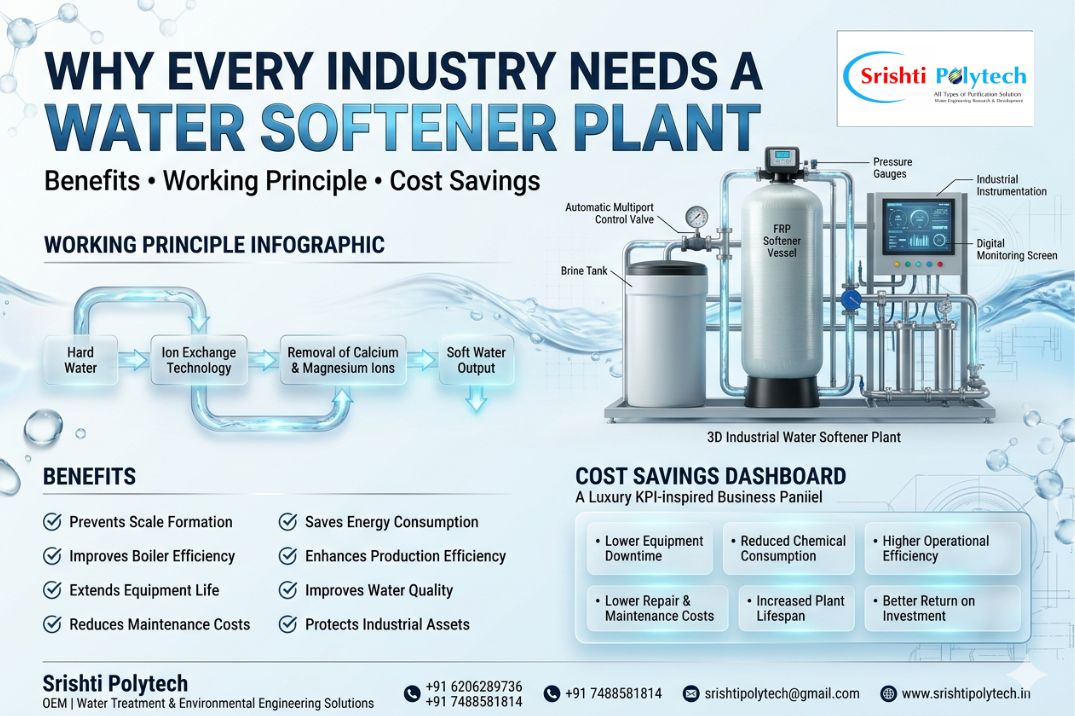
Jun 01, 2026
Why Every Industry Needs a Water Softener Plant: Benefits, Working Principle, and Cost Savings
Water is one of the most critical resources in industrial operations. Whether it is used in boilers, cooling towers, manufacturing...
Why Alkaline Water Plants Are Becoming the Preferred Choice for Businesses...?
May 30, 2026
uploads/blogs/blog_6a1ac33d363ba.jpg
"Businesses that invest in better water quality invest in better experiences, stronger trust, and a healthier future."
In today's competitive business environment, providing high-quality drinking water is no longer just a facility—it's a reflection of an organization's commitment to health, wellness, and customer satisfaction. As awareness about water quality continues to grow, many businesses are moving beyond conventional RO systems and embracing advanced Alkaline Water Plants.
From corporate offices and hotels to hospitals, educational institutions, and commercial establishments, alkaline water solutions are rapidly becoming the preferred choice for organizations seeking premium drinking water systems.
But what is driving this shift? Let's explore why alkaline water plants are gaining popularity among modern businesses.
⚫ Understanding Alkaline Water
Alkaline water is water with a higher pH level than regular drinking water.
Typically:
* Regular drinking water has a pH around 6.5–7.5
* Alkaline water generally has a pH between 8 and 9.5
Advanced alkaline water plants use specialized mineral enhancement technology to improve water quality after purification.
The goal is to provide clean, purified water while maintaining a balanced mineral profile.
⚫ What is an Alkaline Water Plant?
An Alkaline Water Plant is an advanced water purification system that combines traditional filtration and RO technology with alkaline enhancement processes.
The system generally includes:
* Pre-filtration
* Activated carbon filtration
* Reverse Osmosis (RO)
* UV/UF purification
* Mineral enhancement stage
* Alkaline cartridge or alkaline media
The result is purified water with improved mineral balance and optimized pH levels.
⚫ Why Businesses Are Upgrading from RO Systems
1. Growing Demand for Premium Drinking Water
Customers, employees, and visitors increasingly expect better-quality drinking water.
Businesses today understand that providing premium water facilities contributes to:
* Better customer experience
* Improved employee satisfaction
* Enhanced workplace wellness
As a result, alkaline water plants are becoming an attractive upgrade.
2. Enhanced Brand Image
Modern consumers appreciate businesses that invest in quality infrastructure and employee well-being.
Providing alkaline drinking water can help organizations project an image of:
* Innovation
* Quality
* Professionalism
* Customer care
This is especially important for:
* Hotels
* Corporate offices
* Healthcare facilities
* Educational institutions
3. Advanced Water Treatment Technology
Traditional RO systems focus primarily on purification.
Alkaline water plants go a step further by incorporating advanced mineral balancing technology after purification.
Businesses seeking upgraded water treatment solutions often prefer systems that provide both purification and enhanced water quality.
4. Increasing Health and Wellness Awareness
The global focus on health and wellness has significantly influenced purchasing decisions.
Employees, customers, and visitors are becoming more conscious about:
* Drinking water quality
* Water purification methods
* Mineral content in water
This growing awareness has contributed to the popularity of alkaline water solutions.
5. Ideal for Commercial and Institutional Use
Alkaline water plants are increasingly being installed in:
* Corporate Offices
Providing high-quality drinking water for employees and guests.
* Hotels & Resorts
Enhancing guest experience through premium water services.
* Hospitals
Supporting high standards of water quality.
* Educational Institutions
Providing clean and advanced drinking water facilities.
*Commercial Buildings
Improving amenities and occupant satisfaction.
6. Better Customer Experience
In service-oriented industries, every detail matters.
Offering premium drinking water demonstrates attention to quality and customer comfort.
Businesses often view alkaline water systems as a value-added facility that differentiates them from competitors.
7. Future-Ready Water Infrastructure
Organizations are increasingly investing in modern and sustainable infrastructure.
Alkaline water plants represent a forward-thinking approach to water management and demonstrate a commitment to adopting advanced technologies.
⚫Key Features of Modern Alkaline Water Plants
Modern systems typically offer:
- Multi-stage purification
- Mineral enhancement technology
- Alkaline pH balancing
- High-capacity operation
-Energy-efficient performance
- Automated controls
- Low maintenance requirements
- Consistent water quality
⚫ Industries Benefiting from Alkaline Water Plants
1. Hospitality Sector
Hotels, resorts, and restaurants seeking premium customer experiences.
2. Corporate Offices
Organizations focused on employee welfare.
3. Healthcare Facilities
Hospitals and clinics requiring reliable water quality.
4. Educational Institutions
Schools, colleges, and universities.
5. Manufacturing Industries
Providing quality drinking water for workforce facilities.
⚫ Factors to Consider Before Installing an Alkaline Water Plant
Before selecting a system, businesses should evaluate:
* Daily water consumption requirements
* Water quality parameters
* Installation space availability
* Maintenance support
* Operating costs
* Future expansion needs
Choosing the right capacity and technology ensures long-term performance and efficiency.
⚫ The Future of Alkaline Water Technology
The demand for premium drinking water is expected to continue growing.
Future alkaline water systems are likely to feature:
* Smart monitoring
* IoT integration
* Remote diagnostics
* Improved energy efficiency
* Advanced mineral balancing technologies
Businesses investing in modern water infrastructure today will be better positioned to meet future expectations.
⚫ Conclusion
As organizations continue to prioritize employee well-being, customer satisfaction, and premium facility management, alkaline water plants are becoming an increasingly attractive choice.
By combining advanced purification with enhanced water quality, these systems offer businesses a modern solution that aligns with evolving expectations and technological advancements.
The shift from traditional water purification systems to alkaline water plants reflects a broader trend toward smarter, higher-quality, and future-ready water solutions.
⚫ Keywords
#AlkalineWaterPlant
#AlkalineWaterSystem
#CommercialWaterSolutions
#DrinkingWaterTechnology
#WaterPurificationPlant
#IndustrialWaterTreatment
#CorporateWellness
#PremiumDrinkingWater
#WaterTreatmentSolutions
#AlkalineWaterIndia
#BusinessWaterSolutions
#WaterQualityManagement
#CommercialROPlant
#WaterTechnology
#SrishtiPolytech
⚫ About Srishti Polytech
Srishti Polytech provides advanced water treatment solutions for industrial, commercial, and institutional applications.
Our Solutions:
* Alkaline Water Plants
* Industrial RO Plants
* Water Treatment Plants (WTP)
* ETP Plants
* STP Plants
* Water Softener Systems
* Water Coolers
* AMC & CAMC Services
⚫ Contact Details
📞 62026289736 | 7488581814
🌐 [www.srishtipolytech.com](http://www.srishtipolytech.com)
📧 [srishtipolytech@gmail.com](mailto:srishtipolytech@gmail.com)
May 30, 2026
Why Alkaline Water Plants Are Becoming the Preferred Choice for Businesses...?
"Businesses that invest in better water quality invest in better experiences, stronger trust, and a healthier future." In today's competitive...
What is a Wheel Washing System and Why is it Important for Construction Sites?....
May 30, 2026
uploads/blogs/blog_6a1a9b0bc664d.jpg
"In modern construction projects, maintaining clean roads and controlling dust pollution is just as important as completing the project itself—making Wheel Washing Systems an essential part of responsible site management."
Modern construction projects are transforming cities, highways, industrial zones, and infrastructure across the country. However, along with development comes a significant challenge—dust, mud, and debris generated by construction activities.
Heavy trucks and construction vehicles frequently move in and out of project sites carrying soil, sand, cement, and other materials. As these vehicles travel onto public roads, mud and dust attached to their tires can create environmental pollution, road safety concerns, and compliance issues.
To address this problem, construction companies are increasingly adopting Wheel Washing Systems. These systems help maintain cleaner roads, reduce dust pollution, and support environmental compliance.
⚫ What is a Wheel Washing System?
A Wheel Washing System is an automated cleaning solution designed to wash the wheels, tires, and underbody of trucks and heavy vehicles before they exit a construction or industrial site.
The system uses high-pressure water jets to remove:
* Mud
* Soil
* Dust
* Sand
* Construction debris
* Sludge
from vehicle wheels and undercarriages.
By preventing contaminants from being carried onto public roads, wheel washing systems help maintain a cleaner and safer environment.
⚫ How Does a Wheel Washing System Work?
The operation of a wheel washing system is simple yet highly effective.
Step 1: Vehicle Entry
The vehicle enters the washing platform at a controlled speed.
Step 2: Automatic Detection
Sensors detect the vehicle and activate the washing process.
Step 3: High-Pressure Cleaning
Strategically positioned nozzles spray high-pressure water to clean the tires, wheels, and underbody.
Step 4: Debris Collection
Mud and debris are collected in a sedimentation tank.
Step 5: Water Recycling
Many advanced systems recycle water, reducing wastage and operating costs.
Step 6: Clean Exit
The cleaned vehicle exits the system and proceeds onto public roads.
⚫ Why is a Wheel Washing System Important for Construction Sites?
1. Controls Dust Pollution
Construction activities generate large amounts of dust that can spread into surrounding areas.
Excessive dust can:
* Affect air quality
* Cause respiratory issues
* Create visibility problems
* Lead to complaints from nearby communities
A wheel washing system significantly reduces the amount of dust leaving the site.
2. Keeps Public Roads Clean
Mud carried by vehicle tires often accumulates on nearby roads.
This can result in:
* Dirty road surfaces
* Traffic disruptions
* Increased municipal cleaning costs
Wheel washing systems help keep roads clean and presentable.
3. Improves Road Safety
Mud and debris on roads can create slippery conditions and increase accident risks.
Cleaner roads contribute to:
* Better vehicle traction
* Safer driving conditions
* Reduced accident potential
4. Supports Environmental Compliance
Many construction projects are required to follow environmental regulations regarding dust and pollution control.
Installing a wheel washing system helps companies:
* Meet environmental standards
* Reduce pollution risks
* Avoid penalties and fines
5. Enhances Professional Image
A clean and well-managed site reflects positively on the construction company.
Clients, government authorities, and local communities often view environmentally responsible companies more favorably.
⚫ Key Benefits of Wheel Washing Systems
* Efficient Cleaning
Automated systems provide consistent and reliable cleaning performance.
* Reduced Manual Labour
The process is largely automated, minimizing labour requirements.
*Water Recycling
Modern systems reuse water, reducing operational costs.
* Fast Operation
Vehicles can be cleaned quickly without disrupting project schedules.
* Long-Term Cost Savings
Preventing environmental violations and reducing road cleaning costs can result in significant savings.
⚫Industries That Use Wheel Washing Systems
Although commonly associated with construction sites, wheel washing systems are also widely used in:
* Mining operations
* Cement plants
* Quarry sites
* Infrastructure projects
* Waste management facilities
* Industrial manufacturing plants
* Landfills
Any industry where vehicles carry mud, dust, or debris can benefit from wheel washing technology.
⚫ Choosing the Right Wheel Washing System
Before selecting a system, consider:
* Vehicle Volume
How many trucks enter and exit the site daily?
* Vehicle Size
The dimensions and weight of vehicles affect system design.
* Site Conditions
Mud levels and traffic intensity influence cleaning requirements.
* Water Availability
Water recycling capabilities can reduce consumption.
* Automation Requirements
Fully automated systems improve efficiency and reduce labour costs.
⚫ The Future of Wheel Washing Systems
As environmental regulations become stricter, wheel washing technology continues to evolve.
Modern systems now include:
* Smart sensors
* Automated controls
* Water recycling technology
* Energy-efficient operation
* Remote monitoring capabilities
These advancements improve performance while supporting sustainable construction practices.
⚫ Conclusion
A Wheel Washing System is more than just a cleaning solution—it is an essential tool for environmental protection, road safety, and regulatory compliance.
By removing mud, dust, and debris from construction vehicles before they leave a site, these systems help maintain cleaner roads, improve public safety, and demonstrate environmental responsibility.
As construction and infrastructure projects continue to expand, wheel washing systems will play an increasingly important role in creating cleaner, safer, and more sustainable work environments.
⚫About Srishti Polytech
Srishti Polytech provides advanced industrial and environmental solutions, including Wheel Washing Systems, Water Treatment Plants, RO Plants, ETP Plants, STP Plants, Water Softeners, Water Coolers, and AMC/CAMC Services.
⚫Contact Details
📞 62026289736 | 7488581814
🌐 [www.srishtipolytech.com](http://www.srishtipolytech.com)
📧 [srishtipolytech@gmail.com](mailto:srishtipolytech@gmail.com)
May 30, 2026
What is a Wheel Washing System and Why is it Important for Construction Sites?....
"In modern construction projects, maintaining clean roads and controlling dust pollution is just as important as completing the project itself—making...
How Water Treatment Plants Help Industries Save Money.....
May 29, 2026
uploads/blogs/blog_6a197ec8a583a.jpg
“Smart Water Treatment Systems are not just environmental solutions — they are powerful cost-saving investments that help industries reduce expenses, improve efficiency, and maximize long-term profitability.”
In modern industries, water is not just a utility — it is a critical operational resource. From manufacturing and processing to cooling and cleaning, industries consume massive quantities of water every day. However, rising water costs, strict environmental regulations, and wastewater disposal challenges are pushing industries to adopt smarter water management solutions.
This is where Water Treatment Plants (WTPs) become extremely valuable. A properly designed water treatment system not only ensures clean and safe water for industrial operations but also helps companies significantly reduce operational costs, improve efficiency, and increase long-term profitability.
Today, industries are realizing that investing in water treatment is not an expense — it is a strategic financial advantage.
⚫ What is a Water Treatment Plant?
A Water Treatment Plant (WTP) is a system designed to remove impurities, suspended solids, chemicals, dissolved salts, bacteria, and contaminants from raw water or wastewater to make it suitable for industrial use or reuse.
* Depending on industrial requirements, treatment systems may include:
-Filtration Systems
-Reverse Osmosis (RO)
-Softening Plants
-Demineralization (DM) Plants
-Effluent Treatment Plants (ETP)
-Sewage Treatment Plants (STP)
* Why Industries Need Water Treatment Plants
Industries require high-quality water for:
-Boiler operations
-Cooling towers
-Manufacturing processes
-Product washing
-Chemical processing
-Food & beverage production
-Pharmaceutical applications
Untreated water can damage machinery, reduce efficiency, increase maintenance costs, and lead to production losses.
⚫How Water Treatment Plants Save Money
1. Reduction in Water Consumption
One of the biggest advantages of water treatment systems is water recycling and reuse.
How It Helps:
Treated wastewater can be reused in cooling, cleaning, and processing.
Reduces dependency on freshwater sources.
Lowers water procurement costs.
* Financial Impact:
Industries can reduce water consumption costs by up to 60–90% through recycling systems.
2. Lower Equipment Maintenance Costs
Untreated water contains:
-Hardness minerals
-Suspended solids
-Corrosive chemicals
-Biological contaminants
These impurities cause:
-Scaling
-Corrosion
-Pipeline blockage
-Equipment wear
Water Treatment Prevents:
-Boiler scaling
-Cooling tower corrosion
-Membrane fouling
-Pump damage
Result:
Reduced maintenance expenses and fewer equipment breakdowns.
3. Increased Equipment Lifespan
Industrial machinery is expensive. Poor-quality water shortens the lifespan of:
-Boilers
-Heat exchangers
-Pumps
-Cooling towers
-RO membranes
A water treatment plant protects these assets by supplying treated water with controlled chemistry.
⚫Benefits:
-Longer machinery life
-Reduced replacement cost
-Higher return on investment (ROI)
4. Energy Savings
Scaling and fouling inside boilers and heat exchangers reduce heat transfer efficiency.
Even a small layer of scale can significantly increase energy consumption.
-Water Treatment Improves:
-Boiler efficiency
-Heat transfer rate
-Cooling efficiency
* Result:
Lower electricity and fuel consumption.
Industries can save substantial energy costs annually through proper water treatment.
5. Reduced Downtime and Production Loss
Unexpected machinery failure due to poor water quality can stop production completely.
* Common Problems:
-Boiler tube failure
-Chiller blockage
-Pump breakdown
-Membrane choking
* Water Treatment Helps By:
-Maintaining stable water quality
-Preventing process interruption
-Reducing emergency shutdowns
* Financial Benefit:
Continuous production means higher profitability.
6. Lower Chemical Consumption
Properly treated water requires fewer operational chemicals.
Reduced Usage Of:
-Anti-scalants
-Corrosion inhibitors
-Cleaning chemicals
-Boiler chemicals
* Result:
Lower chemical purchasing cost and better process efficiency.
7. Compliance with Environmental Regulations
Industries that discharge untreated wastewater may face:
-Heavy penalties
-Legal action
-Plant shutdown notices
Water treatment systems ensure compliance with:
-Pollution Control Board norms
-Environmental standards
-Industrial discharge limits
* Financial Advantage:
Avoidance of fines, legal expenses, and operational disruptions.
8. Wastewater Reuse and Recovery
Modern treatment systems recover valuable resources from wastewater.
Examples:
-Water recovery through RO systems
-Chemical recovery in process industries
* Result:
Reduced raw material and water procurement costs.
9. Reduced Dependency on Water Tankers
Many industries purchase tanker water during shortages.
A recycling-based treatment plant minimizes this dependency.
* Benefits:
-Stable water availability
-Reduced tanker expenses
-Better operational continuity
10. Improved Product Quality
In industries like:
-Pharmaceuticals
-Food & Beverage
-Textile
-Electronics
Water quality directly affects final product quality.
-Treated Water Ensures:
-Better product consistency
-Reduced rejection rates
-Lower production waste
⚫Financial Impact:
Higher customer satisfaction and reduced material loss.
* Future of Industrial Water Management
As water scarcity increases globally, industries will increasingly rely on:
-Water recycling
-Wastewater recovery
-Sustainable treatment technologies
Companies investing in efficient water treatment today will gain both financial and environmental advantages in the future.
⚫ Conclusion
Water Treatment Plants are no longer optional for industries — they are essential for reducing costs, improving operational efficiency, protecting equipment, and ensuring environmental compliance.
From lowering water bills and maintenance costs to improving production quality and reducing downtime, water treatment systems provide long-term financial benefits that far exceed the initial investment.
Industries that adopt advanced water treatment technologies not only save money but also build a sustainable and environmentally responsible future.
⚫ Srishti Polytech – Industrial Water Treatment Experts
At Srishti Polytech, we provide complete industrial water and wastewater treatment solutions designed to improve efficiency and reduce operational costs.
⚫ Contact Details
📞 +91 6206289736
📞 +91 7488581814
📧 srishtipolytech@gmail.com
🌐 www.srishtipolytech.in
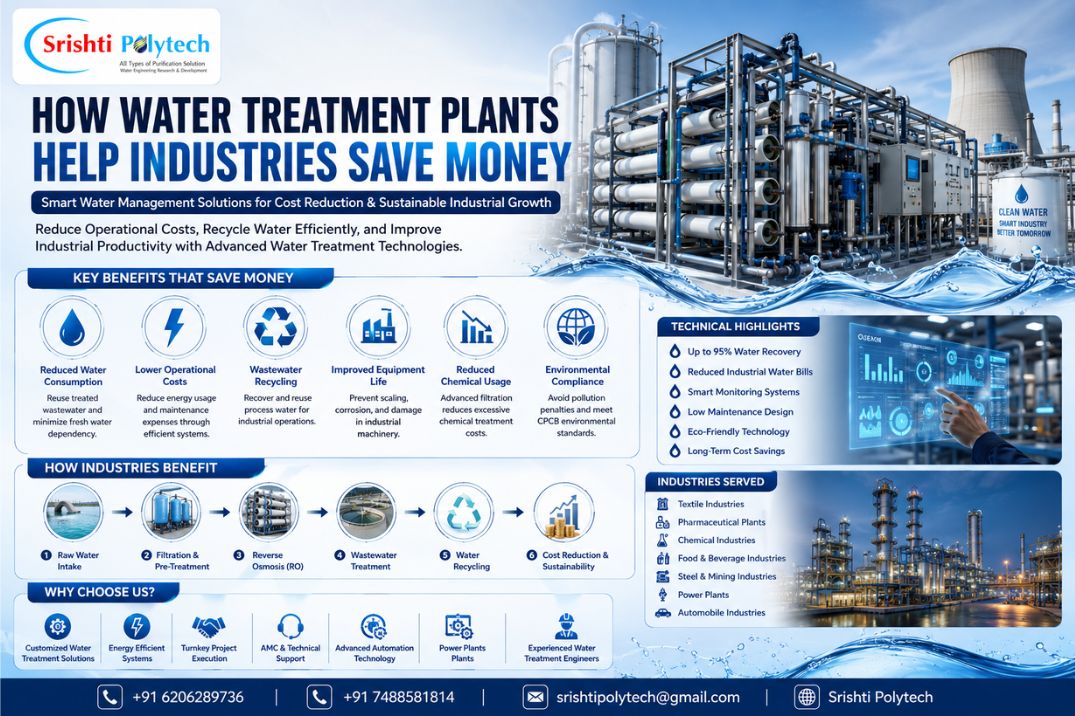
May 29, 2026
How Water Treatment Plants Help Industries Save Money.....
“Smart Water Treatment Systems are not just environmental solutions — they are powerful cost-saving investments that help industries reduce expenses,...
What is AMC/CAMC in Water Purifier Systems? 💧
May 28, 2026
uploads/blogs/blog_6a182a20e0edd.jpg
💧 “Smart maintenance plans like AMC and CAMC help water purification systems perform efficiently, safely, and reliably throughout the year.”
Water purification systems have become an essential part of homes, industries, hospitals, schools, hotels, factories, laboratories, and commercial spaces. Whether it is a Domestic RO System, Industrial RO Plant, Water Cooler, Softener Plant, STP, or ETP, regular maintenance is necessary for smooth performance and long equipment life.
This is where AMC (Annual Maintenance Contract) and CAMC (Comprehensive Annual Maintenance Contract) play an important role.
Many customers install a water purifier system but ignore regular servicing, which eventually leads to:
-Poor water quality
-High maintenance cost
-Membrane damage
-Pump failure
-Leakage issues
-Increased electricity consumption
⚫ we will deeply understand:
-What AMC/CAMC means
-Difference between AMC and CAMC
-Benefits
-Services included
-Why maintenance contracts are important
-How industries save money through AMC services
⚫What is AMC in Water Purifier Systems?
-AMC Full Form:
Annual Maintenance Contract
-AMC is a service agreement between the customer and the service provider for regular maintenance and servicing of the water purification system.
⚫ Under AMC, the company provides:
-Scheduled servicing
-System inspection
-Cleaning
-Minor repairs
-Technical support
However, major spare parts are usually charged separately.
⚫ What is CAMC in Water Purifier Systems?
- CAMC Full Form:
Comprehensive Annual Maintenance Contract
CAMC is an advanced maintenance contract where both:
-servicing
-spare part replacement
are included in a single package.
⚫It covers:
-Regular maintenance
-Breakdown support
-Replacement of damaged components
-Filter replacement
-Pump servicing
-Membrane replacement (depending on agreement)
* CAMC provides complete peace of mind to customers.
⚫Why AMC/CAMC is Important for Water Purifier Systems
Water treatment systems continuously process raw water containing:
-TDS
-Hardness
-Iron
-Fluoride
-Suspended solids
-Chemicals
-Bacteria
⚫ Without regular maintenance:
-Filters choke
-Membranes foul
-Pumps overload
-Flow rate decreases
-Water quality deteriorates
AMC/CAMC ensures the system operates efficiently throughout the year.
⚫ Benefits of AMC/CAMC Services
1. Improved Water Quality
Regular servicing keeps:
-filters clean
-membranes active
-UV systems functional
This ensures safe and pure water.
2. Increased Equipment Life
Routine maintenance reduces wear and tear on:
-pumps
-membranes
-valves
-electrical components
This increases overall system lifespan.
3. Reduced Breakdown Risk
Preventive maintenance identifies problems before major failures occur.
This minimizes:
-downtime
-emergency repair cost
-operational disruption
4. Cost Savings
Many companies ignore maintenance to save money, but neglected systems create expensive repairs later.
AMC/CAMC helps:
-reduce operational cost
-avoid sudden failures
-improve energy efficiency
5. Better System Efficiency
A properly maintained RO plant consumes:
-less electricity
-less chemicals
-less water wastage
This improves plant performance.
Services Included in AMC/CAMC
Typical AMC Services
⚫Inspection
-Electrical inspection
-Pump checking
-Pressure monitoring
⚫ Cleaning
-Filter cleaning
-Tank cleaning
-Pipeline flushing
⚫ Testing
-TDS testing
-Flow rate monitoring
-Water quality analysis
⚫ Servicing
-Valve adjustment
-Leak fixing
-Minor troubleshooting
Typical CAMC Services
⚫ CAMC includes everything in AMC plus:
-Filter replacement
-Carbon replacement
-Membrane replacement
-Pump repair
-Electrical component servicing
-Solenoid valve replacement
-Sensor replacement
Systems Covered Under AMC/CAMC
AMC/CAMC services are available for:
⚫Domestic Systems
-Home RO
-UV systems
-Water dispensers
⚫Commercial Systems
-Water coolers
-Commercial RO plants
-Hotels & restaurant systems
⚫ Industrial Systems
-Industrial RO plants
-DM plants
-Softener plants
-ETP plants
-STP plants
-Ultrafiltration systems
⚫ Common Problems Without AMC/CAMC
Companies that avoid maintenance contracts often face:
- Membrane choking
-Pump burnout
-Bad taste & odor
- Low water flow
- Leakage issues
- High TDS levels
- Frequent breakdowns
- Increased electricity bills
⚫ How AMC/CAMC Improves Business Operations
For industries, water treatment systems directly impact:
-production quality
-machinery life
-operational efficiency
⚫Regular maintenance:
-improves plant reliability
-minimizes downtime
-supports compliance standards
⚫ Choosing the Right AMC/CAMC Provider
Before selecting a service provider, check:
- Technical expertise
- OEM support
- Response time
- Availability of spare parts
- Service history
- Customer reviews
- Trained technicians
⚫Future of Smart AMC/CAMC Services
Modern water treatment maintenance now includes:
-IoT monitoring
-Online diagnostics
-Predictive maintenance
-Remote system alerts
-Smart automation support
This helps industries monitor systems in real-time.
⚫Conclusion
AMC and CAMC services are not just maintenance packages — they are long-term investments in system reliability, water quality, and operational efficiency.
Whether it is a domestic RO purifier or a large industrial water treatment plant, regular servicing is essential for uninterrupted performance and equipment protection.
Companies and homeowners who invest in professional AMC/CAMC services experience:
-better water quality
-lower maintenance cost
-fewer breakdowns
-longer equipment life
As water purification technology continues to evolve, smart maintenance solutions will become even more important for industries and commercial users.
⚫Keywords
#AMC
#CAMC
#WaterPurifierAMC
#ROPlantMaintenance
#IndustrialROPlant
#WaterTreatmentServices
#WaterPurifierService
#ROAMCService
#CommercialROPlant
#IndustrialWaterTreatment
#WaterTreatmentPlant
#ROMaintenance
#WaterCoolerService
#SoftenerPlant
#ROPlantAMC
#ETPPlantMaintenance
#STPPlantService
#PreventiveMaintenance
#WaterPurificationSystem
#SrishtiPolytech
⚫ About Srishti Polytech
Srishti Polytech is a trusted OEM manufacturer and supplier of advanced water purification and water treatment solutions in India.
⚫ We provide:
-Industrial RO Plants
-Domestic RO Systems
-Water Coolers
-Softener Plants
-ETP Plants
-STP Plants
-WTP Systems
-AMC & CAMC Services
-Water Treatment Project Solutions
⚫Contact Details
📞 62026289736 | 7488581814
🌐 Srishti Polytech
📧 srishtipolytech@gmail.com
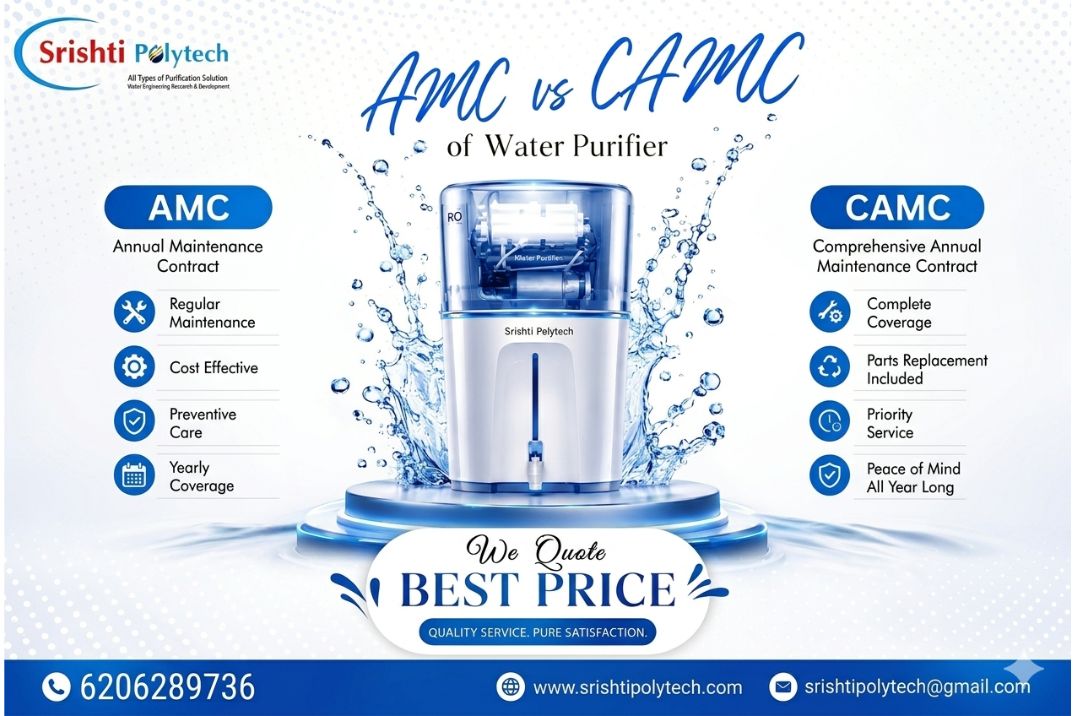
May 28, 2026
What is AMC/CAMC in Water Purifier Systems? 💧
💧 “Smart maintenance plans like AMC and CAMC help water purification systems perform efficiently, safely, and reliably throughout the year.”...
End-to-End Water Treatment Project Solutions......
May 27, 2026
uploads/blogs/blog_6a17e48a74307.png
Clean water is no longer just a necessity — it is the backbone of sustainable industries and healthy communities. End-to-End Water Treatment Project Solutions provide complete systems from water purification to wastewater management under one integrated approach.
━━━━━━━━━━━━━━━━━━━━━━━━━━━━━━━━━━━━━━━━
The Ultimate Guide to End-to-End Water Treatment Project Solutions
Water is the lifeblood of industry. Whether it is the precise formulation required for a pharmaceutical batch, the high-purity steam needed for power generation, or the massive volumes of safe drinking water required for communities, water quality is non-negotiable.
Yet, many businesses treat water management as a series of disconnected purchases—a filter here, a chemical dosing pump there. The result? Frequent breakdowns, soaring operational costs, and compliance headaches.
The real solution lies in End-to-End Water Treatment Project Solutions. Let’s explore what an end-to-end approach actually means, why it is a game-changer for your business, and how the right execution transforms water from an operational liability into a competitive advantage.
What Exactly is an "End-to-End" Water Treatment Solution?
An end-to-end solution means a single, dedicated partner handles your entire water cycle—from the raw water entering your facility to the safe disposal or reuse of treated wastewater. Instead of dealing with multiple vendors, fabricators, and consultants, you get a seamless, integrated blueprint.
Here is how a professional turnkey project unfolds:
1. Raw Water Analysis & Feasibility Study
No two water sources are identical. The process begins in the laboratory, analyzing your raw water source (borewell, river, municipal, or industrial heavy effluent) for Total Dissolved Solids (TDS), heavy metals, microbial contamination, and organic load.
The Goal: Designing a system tailored precisely to your raw water profile and desired output quality.
2. Bespoke Engineering & System Design
Once the data is in, process engineers design the optimal treatment train. This isn’t a one-size-fits-all product catalogue; it is custom engineering. It determines whether your plant needs a heavy-duty Stainless Steel Reverse Osmosis (RO) system, specialized Ultrafiltration (UF), or advanced Ion Exchange softeners.
The Goal: Maximum recovery rates with minimal energy footprint.
3. Precision Manufacturing & Assembly
High-performance projects require high-performance hardware. From rugged Stainless Steel (SS 304/316) pressure vessels and skid frames to high-pressure pumps and precision multi-port valves, every component is assembled under strict quality control standards.
The Goal: Structural durability that withstands harsh industrial environments.
4. Flawless On-Site Commissioning & Integration
A brilliant design on paper must perform in the field. Professional technicians manage the entire mechanical piping, electrical panel integration, PLC programming, and hydraulic testing on-site to ensure the plant performs at its rated capacity (whether it's 500 LPH or 50 KLD).
The Goal: Seamless integration into your existing factory utilities with zero downtime.
5. Operation, Maintenance & Lifecycle Support
The project doesn't end when the switches are turned on. Comprehensive end-to-end solutions include operator training, preventive maintenance schedules, and rapid spare parts availability (membranes, dosing chemicals, filter media).
The Goal: Preventing unexpected shutdowns through proactive care.
⚫ Moving Beyond Pure Water: Effluent and Sewage Management
A true end-to-end partner doesn't just give you clean water; they manage your waste responsibly. With tightening environmental regulations and pollution control board norms, handling discharge is critical.
Sewage Treatment Plants (STP): Utilizing advanced technologies like MBBR (Moving Bed Biofilm Reactor) or MBR (Membrane Bioreactor) to treat domestic and commercial wastewater, making it perfect for gardening, flushing, and cooling towers. (Keywords: Compact STP solutions, commercial wastewater recycling)
Effluent Treatment Plants (ETP): Custom-built to neutralize complex chemical and industrial waste, ensuring your facility meets all regulatory discharge norms or achieves Zero Liquid Discharge (ZLD). (Keywords: Industrial ETP manufacturing, Zero Liquid Discharge plant)
💡 Extra Value Points: Future-Proofing Your Water Infrastructure
To make your water treatment setup truly world-class, consider these modern enhancements during the project design phase:
IoT-Enabled Smart Monitoring: Modern water plants don't require constant manual supervision. Integrating IoT sensors allows you to monitor TDS flow rates, pressure drops, and pump health in real-time right from a smartphone or central control room.
Energy Recovery Devices (ERD): For large-scale RO plants, installing energy recovery systems can cut electricity consumption significantly by repurposing the hydraulic pressure of the reject water stream.
Sustainable Water Footprint: Focus on maximizing permeate (purified water) recovery. Designing a system that safely reuses reject water for non-critical applications like floor washing or flushing slashes your raw water dependency.
⚫ Conclusion:
Investing in an industrial water treatment plant is not just an equipment purchase—it is an investment in your operational continuity, product quality, and regulatory peace of mind. By choosing a comprehensive, end-to-end solution, you eliminate technical guesswork and secure an engineered system designed to perform for years to come.
Are you looking to install a new water treatment system or upgrade your existing infrastructure? Partner with an expert who understands every step of the process.
⚫ Target SEO Keywords
#End-to-end water treatment project solutions
#Turnkey industrial RO plant manufacturer
#Effluent and Sewage Treatment Plant solutions
#Commercial water purification systems
#Zero Liquid Discharge ZLD project execution
#Custom water treatment plant engineering
⚫Contact Us Today for Complete Water Treatment Solutions
📞 62026289736 | 7488581814
🌐 www.srishtipolytech.com
📧 srishtipolytech@gmail.com
May 27, 2026
End-to-End Water Treatment Project Solutions......
Clean water is no longer just a necessity — it is the backbone of sustainable industries and healthy communities. End-to-End...
Innovative Water Treatment Technologies for India 🚰
May 26, 2026
uploads/blogs/blog_6a17e556b4d5f.png
"India isn't just searching for clean water anymore; we are inventing it. Welcome to the era of smart, decentralized, and futuristic water tech."
━━━━━━━━━━━━━━━━━━━━━━━━━━━━━━━━━━━━━━━━
The Liquid Gold Rush: How India is Hacking the Future of Clean Water
Imagine trying to satisfy the thirst of 1.4 billion people when your groundwater is retreating, your rivers are heavily stressed, and the climate refuses to play by the old rules. Traditional water treatment—relying on massive, power-hungry plants and rigid pipelines—is no longer enough to save the day.
India isn't just looking for more water; it is completely redefining how we treat it. From the labs of premier institutes like the IITs to decentralized villages, a quiet tech revolution is turning the tide.
Here are the groundbreaking, innovative water technologies reshaping India's liquid landscape.
1. Nanotechnology: Fighting Arsenic at the Atomic Scale
In parts of West Bengal, Bihar, and Uttar Pradesh, groundwater is quietly laced with arsenic and fluoride—invisible poisons affecting millions. Traditional filters struggle with these dissolved toxins without wasting massive amounts of water or generating excessive chemical sludge.
Enter AMRIT (Anion and Metal Removal by Indian Technology), a brilliant breakthrough pioneered out of IIT Madras.
Using world-class engineered nanomaterials, this technology acts like a hyper-specific molecular magnet. It cleanly captures arsenic, iron, and fluoride ions without needing electricity. Look at how compact these regional deployment units are—they operate entirely on gravity and raw water pressure. Best of all, it delivers safe drinking water for a mere 2 to 4 paise per liter, transforming public health across remote pockets of the country.
2. Solar-Powered Water ATMs & Decentralized Micro-Grids
Historically, if a rural village had no stable grid electricity, advanced water purification like Reverse Osmosis (RO) or Ultrafiltration (UF) was a pipe dream. Today, we are decoupling water security from the power grid entirely.
Companies and local startups are deploying self-sustaining, modular Solar Water Kiosks across rural regions.
The Ripple Effect: By shifting to decentralized solar water infrastructure, communities drastically reduce transmission losses, eliminate electricity bills, and bypass the volatile grid—ensuring uninterrupted access even during heavy monsoons or peak summer blackouts.
3. The Digital Twin: AI and IoT at the Valve
Water infrastructure used to be reactive: you only fixed a plant or a pipeline after it broke or contaminated a supply. Now, India is injecting artificial intelligence into the system.
Modern treatment facilities across Indian industrial zones and smart cities are integrating IoT sensors and Digital Twins. A Digital Twin is a real-time virtual replica of the entire physical water treatment plant.
⚫ Predictive Maintenance: AI models analyze data from hundreds of flow, pressure, and chemical sensors to predict exactly when a membrane will clog or a pump will fail.
⚫ Precision Dosing: Instead of dumping a static amount of chlorine or coagulants into fluctuating raw water, IoT-driven automation adjusts chemical dosing in real time, slicing chemical waste and cutting energy consumption by 15–20%.
4. Total Circularity: Zero Liquid Discharge (ZLD)
With the Central Pollution Control Board (CPCB) tightening environmental mandates, Indian industries can no longer treat wastewater as a disposable liability. They are turning to Zero Liquid Discharge (ZLD) and Minimal Liquid Discharge (MLD) architectures.
⚫ The Verdict: A Smarter, Decentralized Tomorrow
India’s water crisis is massive, but the solution isn't just building bigger concrete pipes. The true innovation lies in making water infrastructure smaller, smarter, and decentralized. By fusing nanotechnology, renewable solar energy, and AI-driven automation, India is proving that securing clean water doesn't have to cost the Earth.
The future of water isn't about finding a brand-new source; it's about perfectly curating, protecting, and recycling every single drop we already have.
⚫ Keywords
#Water Technology India #Sustainable Infrastructure #Solar Water ATMs #IIT Madras AMRIT #Zero Liquid Discharge #Green Tech India #Wastewater Management
📞 6206289736 / 7488581814
📧 srishtipolytech@gmail.com
🌐 www.srishtipolytech.in
May 26, 2026
Innovative Water Treatment Technologies for India 🚰
"India isn't just searching for clean water anymore; we are inventing it. Welcome to the era of smart, decentralized, and...
Why Industries Trust Srishti Polytech for Water Treatment Solutions ?💧
May 26, 2026
uploads/blogs/blog_6a153b8a70a2b.png
“Clean Water is Not Just a Requirement — It’s the Foundation of Every Successful Industry.”
In today’s industrial world, clean and properly treated water is essential for smooth operations, product quality, equipment safety, and environmental compliance. Industries across India are rapidly adopting advanced water treatment systems to meet growing operational and environmental demands.
Srishti Polytech has emerged as a trusted name in the field of water treatment solutions by delivering reliable, efficient, and customized systems for industrial, commercial, and government projects. From RO Plants and Water Treatment Systems to STP and ETP solutions, the company provides complete end-to-end support for modern water purification needs.
🔹Customized Solutions for Every Industry
Different industries face different water challenges. A pharmaceutical company, food processing unit, hospital, hotel, or manufacturing plant all require specific water treatment systems based on water quality and operational requirements.
Srishti Polytech focuses on designing customized solutions based on:
1. Water TDS level
2. Water usage capacity
3. Industrial process requirements
4. Space availability
5. Budget and operational goals
This customized engineering approach makes the systems more efficient, cost-effective, and long-lasting.
🔹 Complete Water Treatment Solutions Under One Roof
Industries prefer working with experienced companies that can provide multiple water treatment solutions from a single source. Srishti Polytech offers a complete range of systems including:
1. Industrial RO Plants
2. Commercial RO Systems
3. STP (Sewage Treatment Plants)
4. ETP (Effluent Treatment Plants)
5. Water Softening Systems
6. Iron Removal Plants
7. Filtration Systems
8. Customized Water Treatment Solutions
- This complete solution approach helps industries reduce operational complexity while ensuring reliable performance.
🔹Advanced Technology & Quality Components
Modern industries require high-performance systems that can operate continuously with minimal downtime. Srishti Polytech uses advanced purification technologies and quality components to ensure durability and efficiency.
⚙️ Key technologies include:
1. Reverse Osmosis (RO)
2. Multi-Grade Filtration
3. Activated Carbon Filtration
4. UV & UF Systems
5. Water Softening Technology
6. Iron Removal Technology
These systems help industries maintain water quality standards while improving operational efficiency.
🔹 Reliable Tender & Project Execution Services
One of the major reasons industries trust Srishti Polytech is its capability to handle complete water treatment projects and tender-based work professionally.
🔹 The company provides:
1. Project planning
2. Technical consultation
3. Equipment supply
4. Installation support
5. System commissioning
6. Maintenance services
From small commercial setups to large industrial water treatment projects, Srishti Polytech ensures smooth project execution with quality standards and technical expertise.
🔹 Focus on Quality, Service & Customer Satisfaction
Water treatment systems require proper technical support and long-term reliability. Srishti Polytech is committed to delivering:
1. High-quality systems
2. Professional engineering support
3. Timely project completion
4. Efficient after-sales service
5. Customer-focused solutions
This strong service approach helps build long-term trust with clients across various sectors.
🔹 Conclusion
Choosing the right water treatment partner is essential for long-term operational success. With advanced technology, customized engineering, reliable project execution, and strong customer support, Srishti Polytech continues to be a trusted partner for industries looking for efficient and reliable water treatment solutions.
Whether it is an Industrial RO Plant, STP, ETP, or complete turnkey water purification project, Srishti Polytech delivers smart and sustainable solutions tailored to modern industrial needs.
“Visit Srishti Polytech to explore advanced water treatment solutions.”
🔹 SEO Keywords
#Water Treatment Solutions #Industrial RO Plant #STP Plant #ETP Plant #Water Treatment Company in India #Industrial Water Purification #Water Treatment Tender Services #Commercial RO Plant #Water Treatment Project Solutions #Srishti Polytech
📞 6206289736 / 7488581814
📧 srishtipolytech@gmail.com
🌐 www.srishtipolytech.in
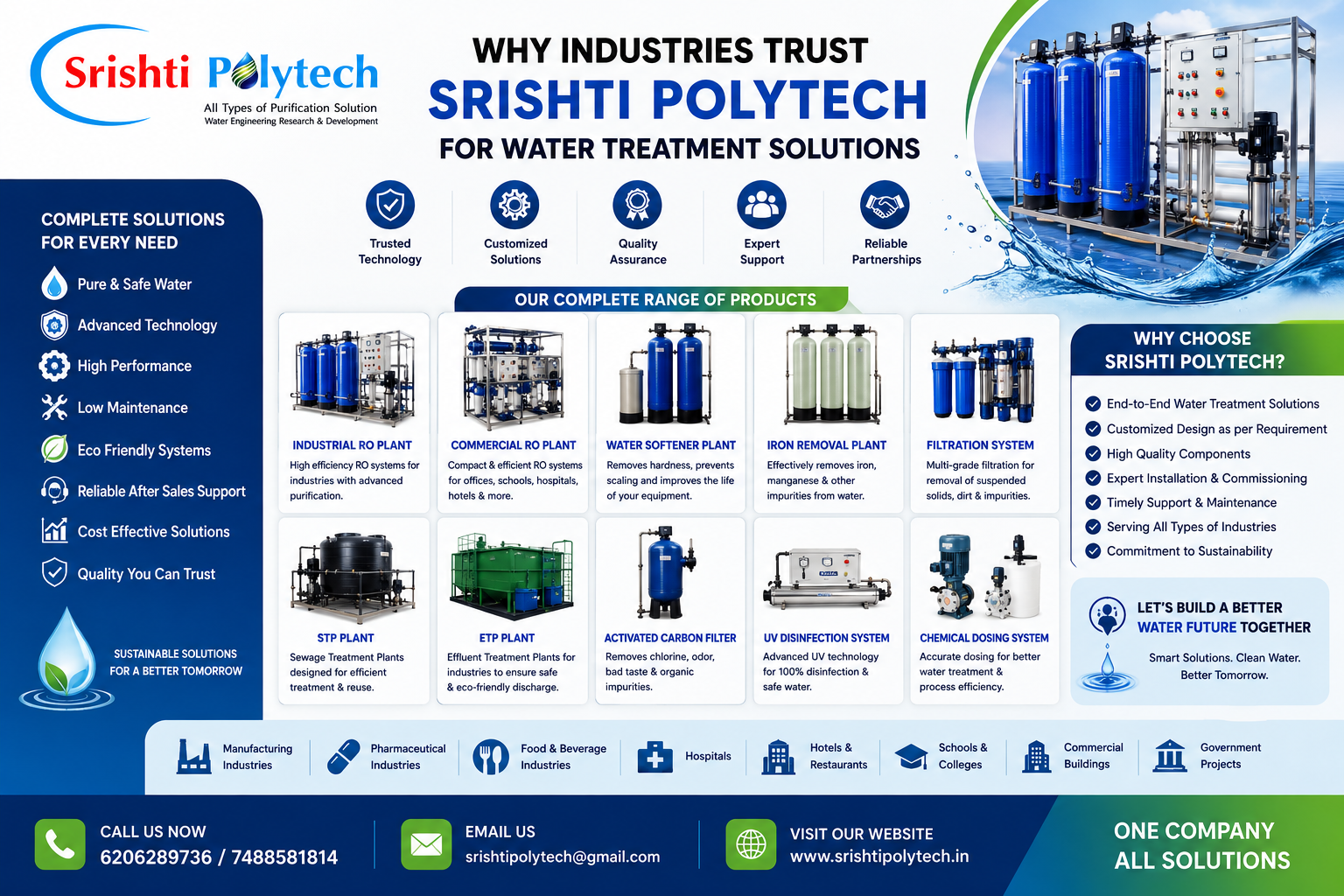
May 26, 2026
Why Industries Trust Srishti Polytech for Water Treatment Solutions ?💧
“Clean Water is Not Just a Requirement — It’s the Foundation of Every Successful Industry.” In today’s industrial world, clean...
Commercial RO Plant vs Domestic RO Plant – Which One Is Right for You?
May 25, 2026
uploads/blogs/blog_6a17e66ae08c1.png
Clean and safe drinking water has become essential for homes, offices, industries, hospitals, schools, and commercial spaces. Reverse Osmosis (RO) systems are one of the most effective solutions for water purification. However, many people get confused when choosing between a Domestic RO Plant and a Commercial RO Plant.
At Srishti Polytech, we provide advanced RO water treatment solutions for residential, commercial, and industrial applications. In this guide, we explain the major differences between Commercial RO Plants and Domestic RO Systems to help you choose the right water purification solution.
* What is a Domestic RO Plant?
A Domestic RO Plant is a compact water purification system designed for household use. These systems are commonly installed in kitchens and are suitable for small families.
* Features of Domestic RO Systems
1. Compact design
2. Easy kitchen installation
3. Suitable for drinking and cooking water
4. Lower water purification capacity
5. Affordable maintenance cost
* Common Applications
1. Homes
2. Apartments
3. Small households
-Domestic RO systems generally purify around 10–25 liters of water per hour, making them ideal for daily family usage.
* What is a Commercial RO Plant?
A Commercial RO Plant is a high-capacity water purification system designed for places where large amounts of purified water are required continuously.
These systems are built using heavy-duty membranes, pumps, and filtration units for long-term performance.
* Features of Commercial RO Plants
1. High purification capacity
2. Continuous water supply
3. Advanced filtration technology
4. Durable industrial-grade components
5. Suitable for high TDS water treatment
* Common Applications
1. Schools
2. Hospitals
3. Hotels
4. Restaurants
5. Offices
6. Factories
7. Commercial buildings
- Commercial RO plants can range from 50 LPH to several thousand LPH depending on water requirements.
* Commercial RO Plant vs Domestic RO Plant
Feature Domestic RO Plant Vs Commercial RO Plant
Usage- Home use Commercial & industrial use
Capacity- 10–25 LPH 50–5000+ LPH
Size- Compact Large setup
Installation- Kitchen wall-mounted Dedicated installation area
Water Demand- Low High
Maintenance- Simple Professional servicing required
Cost- Lower Higher
Users Supported- Small family Multiple users
* Which RO System Should You Choose?
- Choose a Domestic RO Plant If:
1. You need purified water for home use
2. Your family size is small
3. Daily water consumption is limited
4. You want a compact and affordable solution
- Choose a Commercial RO Plant If:
1. You require continuous purified water supply
2. Multiple people use the system daily
3. Water demand is high
4. You run a business, school, hospital, or factory
* Why Choose Srishti Polytech?
Srishti Polytech is a trusted manufacturer of water treatment solutions in India. We provide:
1. Industrial RO Plants
2. Commercial RO Systems
3. Water Treatment Plants
4. STP & ETP Solutions
5. Customized purification systems
- Our team offers complete support including system design, installation, maintenance, and technical assistance.
* Conclusion
Both Domestic RO Plants and Commercial RO Plants play an important role in water purification. The right choice depends on your daily water requirement, usage type, and budget.
If you are looking for reliable and customized RO water treatment solutions, Srishti Polytech can help you choose the perfect system for your home, business, or industry.
📞 6206289736 / 7488581814
📧 srishtipolytech@gmail.com
* Keywords
Commercial RO Plant, Domestic RO Plant, Industrial RO Plant, RO Water Purifier, Commercial Water Purification System, RO Plant Manufacturer, Industrial Water Treatment, Commercial RO System, Water Purification Solutions, RO Plant for Industries
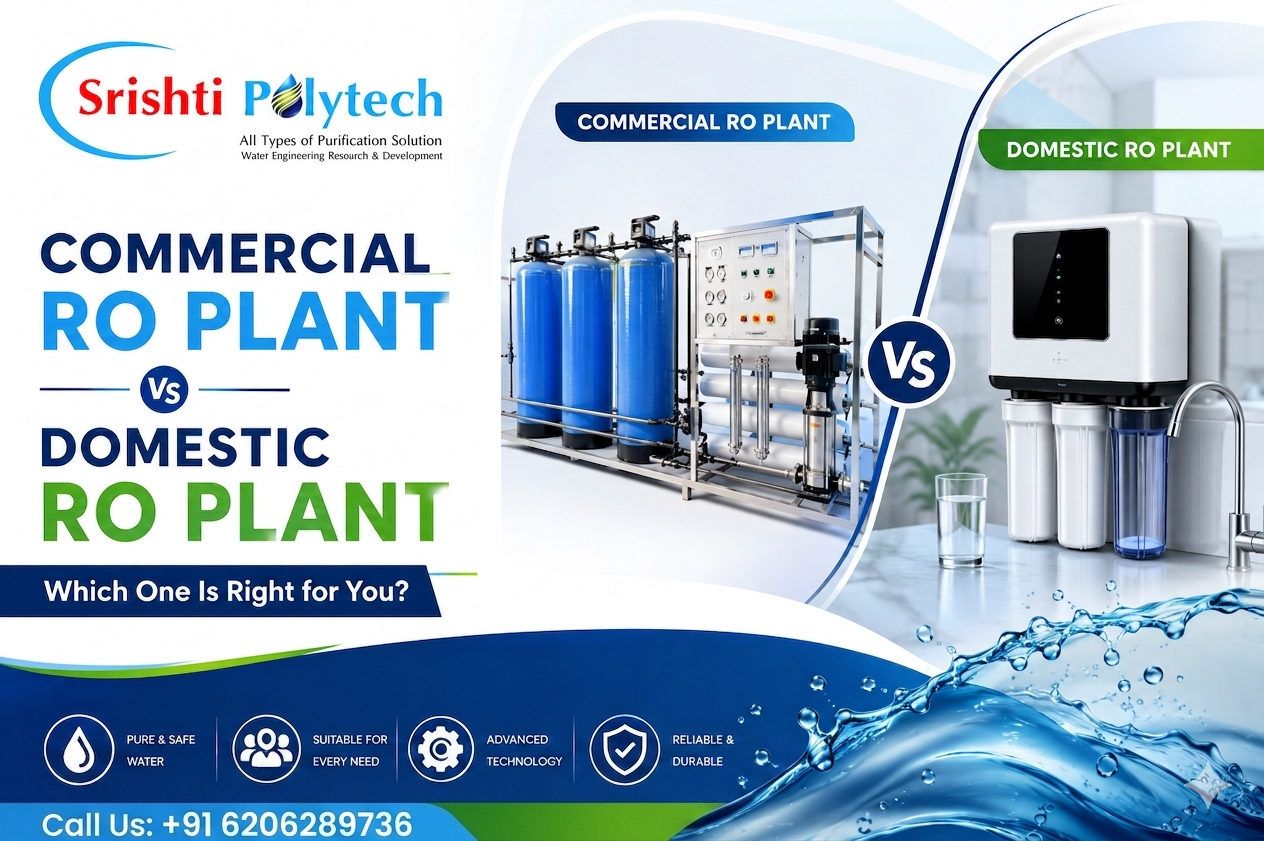
May 25, 2026
Commercial RO Plant vs Domestic RO Plant – Which One Is Right for You?
Clean and safe drinking water has become essential for homes, offices, industries, hospitals, schools, and commercial spaces. Reverse Osmosis (RO)...
How to remove iron from borewell water ?
May 25, 2026
uploads/blogs/blog_6a13e41486b45.png
Borewell water is widely used in homes, industries, schools, hospitals, and commercial facilities across India. However, untreated borewell water often contains high TDS, iron, hardness, bad odor, bacteria, and other harmful impurities that can affect both health and machinery.
At Srishti Polytech, we provide advanced borewell water treatment solutions including RO Plants, Iron Removal Systems, Water Softeners, and Filtration Units designed for residential, commercial, and industrial applications.
With the right water treatment system, borewell water can be made safe, clean, and suitable for drinking as well as industrial use.
*Common Problems in Borewell Water
1. High TDS
2. Iron content
3. Hardness
4. Salty taste
5. Yellow water
6. Bad smell
* Our Borewell Water Treatment Solutions
1. RO Plant
2. Iron Removal Plant
3. Sand Filter
4. Carbon Filter
5. Water Softener
6. UV System
* Benefits of Water Treatment
1. Safe drinking water
2. Better appliance life
3. Reduced scaling
4. Improved taste & odor
5. Industries & Applications
* Why Choose Srishti Polytech
1. OEM Manufacturer
2. Customized systems
3. Installation support
4. Service support
* Focus Keywords
1. Borewell Water Treatment
2. Iron Removal from Borewell Water
3. Iron Removal Plant
4. Borewell Water Filter
5. Iron Removal Filter
6. Water Treatment Solutions
7. Borewell Water Purification
8. Iron Free Water
* Conclusion
Contact Srishti Polytech today for reliable borewell water treatment solutions customized for your needs.
📞 6206289736 / 7488581814
📧 srishtipolytech@gmail.com
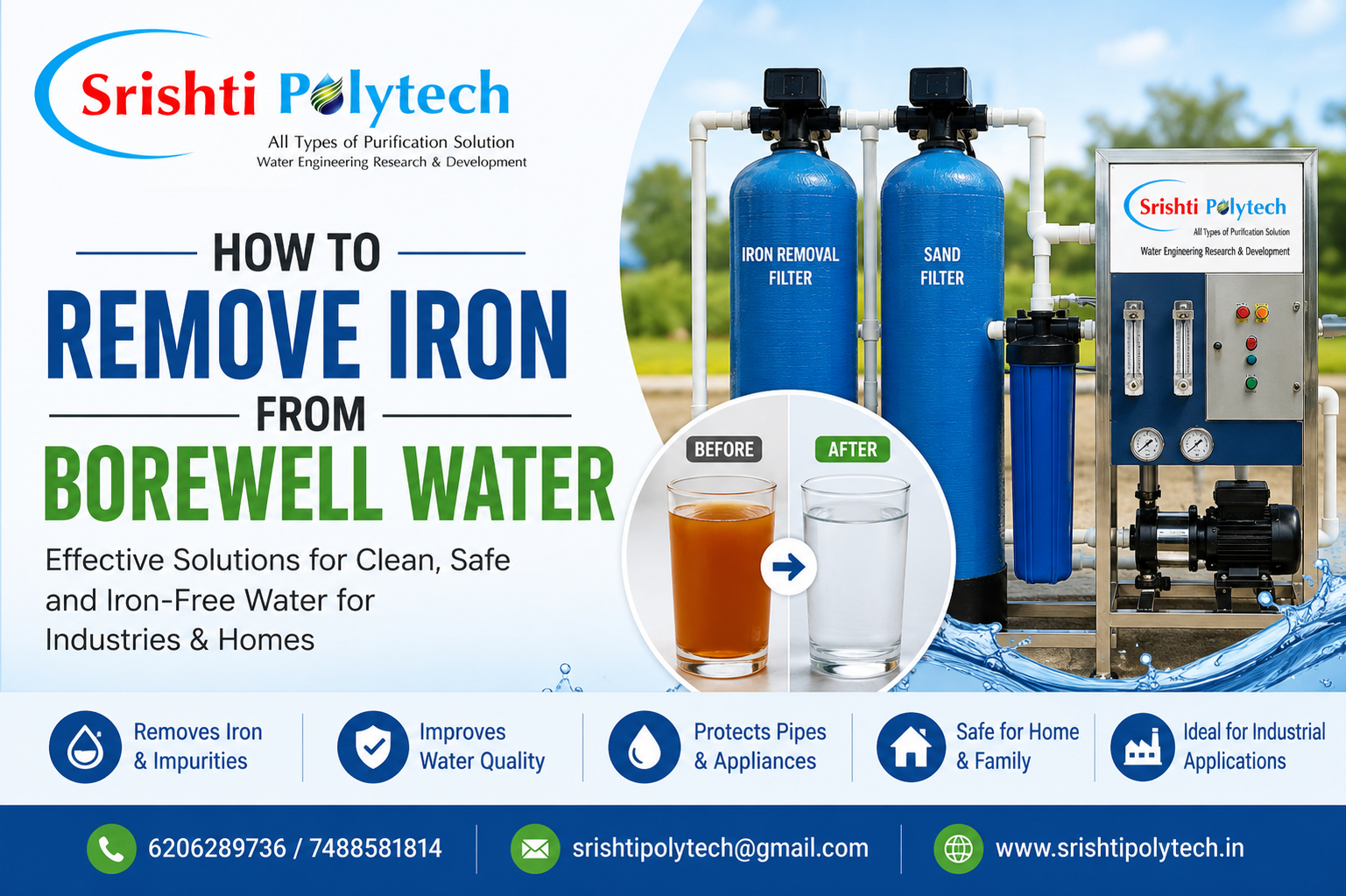
May 25, 2026
How to remove iron from borewell water ?
Borewell water is widely used in homes, industries, schools, hospitals, and commercial facilities across India. However, untreated borewell water often...
RO Plant Business in India: Cost, Profit, License & Setup Guide (2026)
May 04, 2026
uploads/blogs/blog_6a14047e01277.png
Starting an RO (Reverse Osmosis) plant business in India is one of the most profitable opportunities in today’s water-scarce environment. With increasing demand for clean drinking water in cities, towns, and rural areas, the RO water business offers low investment with high recurring income.
In this guide, we’ll break down everything you need to know—cost, profit, licenses, and step-by-step setup.
🚀 Why Start an RO Plant Business in 2026?
Rising demand for safe drinking water
Growing urban & semi-urban population
Affordable technology and maintenance
Recurring revenue model (daily water sales)
👉 Whether you target households, offices, or supply jars (20L), the demand is consistent year-round.
💰 RO Plant Setup Cost in India
The cost depends on plant capacity, quality of components, and automation level.
🔹 Small Scale (500 LPH – 1000 LPH)
Plant Cost: ₹80,000 – ₹2,50,000
Tank & Storage: ₹30,000 – ₹70,000
Installation: ₹15,000 – ₹40,000
👉 Total Investment: ₹1.5 – ₹3.5 lakh
🔹 Medium Scale (2000 LPH – 5000 LPH)
Plant Cost: ₹3 – ₹8 lakh
Borewell / Water Source Setup: ₹50,000 – ₹2 lakh
Building & Civil Work: ₹1 – ₹3 lakh
👉 Total Investment: ₹5 – ₹12 lakh
🔹 Commercial Mineral Water Plant
Fully Automatic Plant: ₹10 – ₹25 lakh
Bottling Machine + Packaging: ₹5 – ₹15 lakh
👉 Total Investment: ₹15 – ₹40 lakh
📈 Profit in RO Water Business
Profit depends on your distribution model.
Example (1000 LPH Plant)
Daily Production: 8,000 liters
Selling Price: ₹0.30 – ₹1 per liter
Daily Revenue: ₹2,400 – ₹8,000
👉 Monthly Profit: ₹50,000 – ₹2,00,000 (after expenses)
📄 Required Licenses in India
To run a legal RO water business, you need:
BIS Certification (for packaged drinking water)
FSSAI License
GST Registration
Pollution Control Board NOC
Local Municipal Approval
👉 Without proper licensing, you may face penalties or shutdown.
⚙️ Step-by-Step Setup Process
1. Market Research
Identify demand in your area (homes, shops, offices).
2. Water Source Testing
Check TDS, hardness, and contaminants.
3. Select Plant Capacity
Choose 500 LPH, 1000 LPH, or higher based on demand.
4. Installation & Commissioning
Set up plant, tanks, pipelines, and electricals.
5. Packaging & Distribution
20L jar supply
Bottled water
Bulk supply
6. Marketing & Sales
Local distributors
Shops & offices
Online presence
⚙️ Additional Equipment Needed
UV Sterilizer
Ozonator
Storage tanks
Jar washing machine
TDS controller
🔧 Maintenance Cost
Membrane replacement (1–2 years): ₹8,000 – ₹25,000
Electricity: ₹5,000 – ₹15,000/month
Labor: ₹8,000 – ₹20,000/month
👉 Proper maintenance ensures long-term profit.
🏆 Why Choose Srishti Polytech?
ISO Certified Manufacturer
10,000+ Successful Installations
Customized RO, ETP, STP Solutions
Complete Setup Support (Design → Installation → AMC)
Service across Jharkhand, Bihar, West Bengal & PAN India
👉 We don’t just sell machines—we help you start and grow your water business.
📊 ROI (Return on Investment)
Break-even Period: 6 to 12 months
High recurring demand ensures stable income
📢 Final Thoughts
The RO plant business in India is a low-risk, high-demand opportunity. With the right setup, proper licensing, and reliable equipment, you can build a sustainable and profitable business.
📞 Start Your RO Business Today
Looking to set up your own RO plant?
👉 Contact Srishti Polytech for:
Free consultation
Cost estimation
Complete plant setup
May 04, 2026
RO Plant Business in India: Cost, Profit, License & Setup Guide (2026)
Starting an RO (Reverse Osmosis) plant business in India is one of the most profitable opportunities in today’s water-scarce environment....
Why Water Treatment Solutions Are Critical for India’s Future
Apr 25, 2026
uploads/blogs/blog_6a141b6c117fe.png
Water is the backbone of every industry, household, and community. Yet, across India, access to clean and safe water is becoming increasingly challenging. With rising pollution, groundwater depletion, and industrial demand, the need for advanced water treatment solutions has never been more urgent.
At Srishti Polytech, we understand these challenges and are committed to delivering reliable and efficient water treatment systems tailored to modern needs.
The Growing Water Crisis in India
India is facing a dual challenge—declining water availability and deteriorating water quality. Many regions depend heavily on groundwater, which is often contaminated with harmful chemicals, bacteria, and dissolved solids.
Some major concerns include:
High TDS (Total Dissolved Solids) levels
Presence of heavy metals like iron and arsenic
Industrial wastewater contamination
Lack of proper filtration systems in rural and semi-urban areas
Without proper treatment, this water is unsafe for drinking and industrial use.
What is a Water Treatment System?
A water treatment system is designed to remove impurities, harmful chemicals, and contaminants from water, making it safe for consumption or industrial use.
Common systems include:
Reverse Osmosis (RO) Plants
Water Softening Systems
Iron Removal Plants
Ultrafiltration (UF) Systems
Industrial Effluent Treatment Plants (ETP)
Each system is designed based on water quality and usage requirements.
Why Industries Need Water Treatment
Industries rely heavily on water for operations such as cooling, cleaning, and manufacturing. Untreated water can:
Damage machinery
Reduce efficiency
Increase maintenance costs
Affect product quality
Installing a proper water treatment system ensures:
Longer equipment lifespan
Reduced operational costs
Compliance with environmental regulations
Role of RO Plants in Clean Water Supply
Reverse Osmosis (RO) technology is one of the most effective methods for purifying water. It removes dissolved salts, bacteria, and harmful contaminants, making water safe and suitable for various applications.
RO plants are widely used in:
Commercial buildings
Hospitals
Schools and colleges
Industrial units
Packaged drinking water plants
Future of Water: Innovation & Sustainability
The future of water treatment lies in innovation. Technologies like:
Atmospheric Water Generators (AWG)
Smart monitoring systems
Energy-efficient filtration units
are transforming how we access and manage water.
Sustainable water solutions not only help conserve resources but also ensure long-term availability for future generations.
Why Choose Srishti Polytech?
At Srishti Polytech, we offer:
Customized water treatment solutions
High-quality RO plants and filtration systems
Installation, maintenance, and repair services
Cost-effective and energy-efficient designs
Our goal is simple: to provide clean, safe, and reliable water solutions across India.
Conclusion
Water is not just a resource—it is a necessity for life and growth. Investing in the right water treatment system today ensures a healthier tomorrow.
If you are looking for expert guidance or planning to install a water treatment system, Srishti Polytech is here to help.
Apr 25, 2026
Why Water Treatment Solutions Are Critical for India’s Future
Water is the backbone of every industry, household, and community. Yet, across India, access to clean and safe water is...
Atmospheric Water Generation (AWG): The Future of Water Supply in Water-Scarce Regions
Apr 13, 2026
uploads/blogs/blog_6a15403f33112.jpg
Introduction
Water scarcity is becoming one of the biggest challenges of the 21st century. With groundwater depletion and unpredictable rainfall, industries and communities are looking for innovative solutions. One such breakthrough technology is Atmospheric Water Generation (AWG) — a system that produces clean drinking water directly from air.
💧 What is Atmospheric Water Generation (AWG)?
Atmospheric Water Generation is a technology that extracts moisture from the air and converts it into potable water. Using condensation techniques, AWG systems mimic the natural process of dew formation, ensuring a sustainable and independent water source.
⚙️ How Does AWG Work?
The AWG system works in simple steps:
Air Intake: Ambient air is drawn into the system
Cooling Process: Air is cooled to condense moisture
Water Collection: Condensed water is collected
Filtration & Purification: Multi-stage filtration ensures safe drinking water
Storage: Clean water is stored for use
🚀 Key Benefits of AWG Systems
✔ Water Independence: No dependency on groundwater or pipelines
✔ Eco-Friendly: Reduces water extraction and environmental stress
✔ Portable & Scalable: Suitable for remote areas, industries, and defense
✔ Low Maintenance: Minimal operational complexity
✔ Safe Drinking Water: Advanced purification ensures high-quality output
🏭 Industrial Applications
AWG systems are rapidly gaining popularity across various sectors:
Construction Sites – Reliable water supply in remote locations
Railways & Infrastructure Projects – Continuous drinking water availability
Defense & Border Areas – Critical for isolated regions
Disaster Relief Zones – Immediate water generation during emergencies
Commercial Buildings – Sustainable water solution
🌱 Why AWG is the Future
With increasing climate challenges, AWG offers a decentralized and sustainable solution. Unlike traditional water sources, it is not affected by droughts or contamination. As technology advances, AWG systems are becoming more energy-efficient and cost-effective, making them a viable long-term investment.
🏢 Srishti Polytech’s Vision
At Srishti Polytech, we are committed to delivering innovative water solutions. Our focus on advanced technologies like AWG aligns with our mission to provide sustainable and reliable water systems for industries and communities across India.
📌 Conclusion
Atmospheric Water Generation is not just a technology—it is a step towards water security and sustainability. As industries move towards greener solutions, AWG stands out as a revolutionary approach to meet future water demands.
Apr 13, 2026
Atmospheric Water Generation (AWG): The Future of Water Supply in Water-Scarce Regions
Introduction Water scarcity is becoming one of the biggest challenges of the 21st century. With groundwater depletion and unpredictable rainfall,...
💧 The Future of Water Treatment: Smart & Sustainable Solutions
Apr 08, 2026
uploads/blogs/blog_6a1544b502e63.jpg
In today’s rapidly evolving world, access to clean and safe water is becoming increasingly critical. Industries, municipalities, and communities are facing growing challenges related to water scarcity, contamination, and environmental compliance. At Srishti Polytech, we believe the future lies in smart and sustainable water treatment solutions.
🌍 Why Modern Water Treatment Matters
Water is not just a resource—it is the backbone of life and industry. With increasing industrialization and urban expansion, untreated wastewater and inefficient systems can lead to:
Environmental pollution
Health hazards
Regulatory penalties
Resource wastage
Modern water treatment technologies help mitigate these risks while ensuring optimal water usage.
⚙️ Smart Water Treatment Technologies
The next generation of water treatment systems is driven by innovation and automation. Some key advancements include:
1. Automated RO Systems
Reverse Osmosis (RO) plants now come with advanced monitoring systems that ensure:
Consistent water quality
Reduced human intervention
Energy efficiency
2. IoT-Based Monitoring
Real-time monitoring allows operators to:
Track system performance
Detect faults early
Optimize maintenance schedules
3. Energy-Efficient Components
Modern plants use:
Low-energy membranes
Efficient pumps
Smart controls
This reduces operational costs and environmental impact.
♻️ Sustainability in Water Treatment
Sustainability is no longer optional—it’s essential. Today’s systems focus on:
Water Recycling & Reuse
Zero Liquid Discharge (ZLD) solutions
Sludge Management Optimization
Reduced Chemical Usage
At Srishti Polytech, we are committed to designing systems that not only treat water but also preserve it for future generations.
🚀 Our Vision at Srishti Polytech
As an OEM, Srishti Polytech is continuously working on innovative solutions such as:
Atmospheric Water Generation (AWG)
Advanced industrial RO plants
Customized water treatment systems
Our goal is to deliver reliable, cost-effective, and future-ready solutions to our clients across industries.
📌 Conclusion
The future of water treatment lies in combining technology, sustainability, and efficiency. Organizations that invest in modern systems today will not only reduce costs but also contribute to a cleaner and greener planet.
If you're looking for cutting-edge water treatment solutions, Srishti Polytech is your trusted partner.
✅ Stay tuned for more insights and innovations in water treatment!
Apr 08, 2026
💧 The Future of Water Treatment: Smart & Sustainable Solutions
In today’s rapidly evolving world, access to clean and safe water is becoming increasingly critical. Industries, municipalities, and communities are...
💧 The Future of Water Treatment: Smart & Sustainable Solutions
Apr 02, 2026
uploads/blogs/blog_6a15471cdccf6.jpg
Water is one of the most valuable resources on our planet, yet its availability is becoming increasingly uncertain. Industries, municipalities, and even households are facing challenges related to water quality and scarcity. At Srishti Polytech, we believe the future lies in smart, sustainable, and efficient water treatment solutions.
🌍 Why Modern Water Treatment Matters
With rapid industrialization and urban growth, untreated wastewater and contaminated water sources are major concerns. Advanced water treatment systems are no longer optional—they are essential for:
Ensuring safe drinking water
Supporting industrial processes
Protecting the environment
Reducing water wastage
⚙️ Smart Technologies Transforming Water Treatment
Modern systems are now integrating technology to improve efficiency and reduce operational costs:
Automated RO Systems – Real-time monitoring and minimal manual intervention
IoT-Enabled Plants – Remote tracking of performance and maintenance needs
Energy-Efficient Pumps & Motors – Lower power consumption and operational cost
Advanced Filtration Media – Better impurity removal and longer life
These innovations help organizations achieve better performance while maintaining sustainability goals.
♻️ Sustainable Practices for a Better Tomorrow
Sustainability is at the core of modern water solutions. Key practices include:
Recycling and reusing wastewater
Sludge management and safe disposal
Rainwater harvesting integration
Reducing chemical usage in treatment
At Srishti Polytech, we focus on eco-friendly designs that not only treat water but also conserve it.
🚀 Our Commitment
Srishti Polytech is dedicated to delivering reliable, cost-effective, and innovative water treatment solutions. From RO plants to ETP/STP systems, we ensure every project meets high-quality standards and customer requirements.
📌 Conclusion
The future of water treatment is intelligent, efficient, and sustainable. By adopting advanced technologies and responsible practices, industries and communities can secure a cleaner and safer water future.
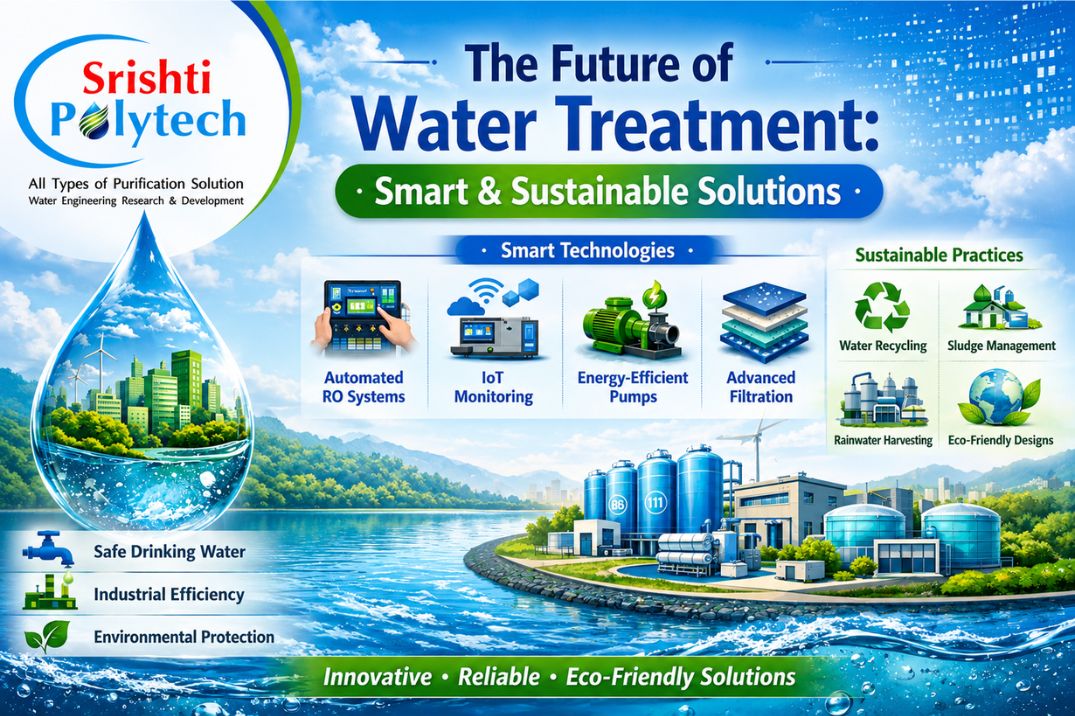
Apr 02, 2026
💧 The Future of Water Treatment: Smart & Sustainable Solutions
Water is one of the most valuable resources on our planet, yet its availability is becoming increasingly uncertain. Industries, municipalities,...
The Importance of Water Treatment Solutions in Modern Industry
Mar 25, 2026
uploads/blogs/blog_6a154adf916a1.jpg
In today’s rapidly industrializing world, water is one of the most valuable resources. Industries depend heavily on water for production, processing, cooling, and cleaning. However, the increasing demand for water has made efficient water management and treatment more critical than ever. This is where advanced water treatment solutions play a vital role.
Why Water Treatment is Essential
Industrial processes generate wastewater containing harmful chemicals, heavy metals, and contaminants. If discharged untreated, this wastewater can cause severe environmental damage and health hazards. Proper water treatment ensures:
Safe disposal of industrial waste
Compliance with environmental regulations
Conservation of natural water resources
Reuse of treated water for industrial purposes
Types of Water Treatment Systems
At Srishti Polytech, we specialize in providing advanced water treatment solutions tailored to industrial needs:
1. Effluent Treatment Plants (ETP)
ETPs are designed to treat industrial wastewater before it is released into the environment. They remove toxic substances, ensuring compliance with pollution control norms.
2. Sewage Treatment Plants (STP)
STPs handle domestic wastewater from residential and commercial spaces, making it reusable for gardening, flushing, and other non-potable uses.
3. Reverse Osmosis (RO) Systems
RO systems are highly effective in removing dissolved salts, impurities, and contaminants, providing clean and safe water for industrial and drinking purposes.
4. Demineralization (DM) Plants
DM plants remove mineral salts from water, making it suitable for boilers and other industrial applications where high-purity water is required.
Benefits of Advanced Water Treatment
Cost Savings: Reusing treated water reduces dependency on fresh water sources.
Environmental Protection: Minimizes pollution and conserves ecosystems.
Regulatory Compliance: Helps industries meet government norms.
Operational Efficiency: Improves equipment lifespan and performance.
Future of Water Treatment
With growing concerns over water scarcity, technologies like Atmospheric Water Generation (AWG) and smart water management systems are shaping the future. Industries are now focusing on sustainable practices to reduce water footprint and enhance efficiency.
Conclusion
Water treatment is no longer optional—it is a necessity for sustainable industrial growth. Investing in the right treatment solutions not only protects the environment but also improves operational efficiency and long-term profitability.
At Srishti Polytech, we are committed to delivering reliable, efficient, and innovative water treatment solutions to meet the evolving needs of industries.
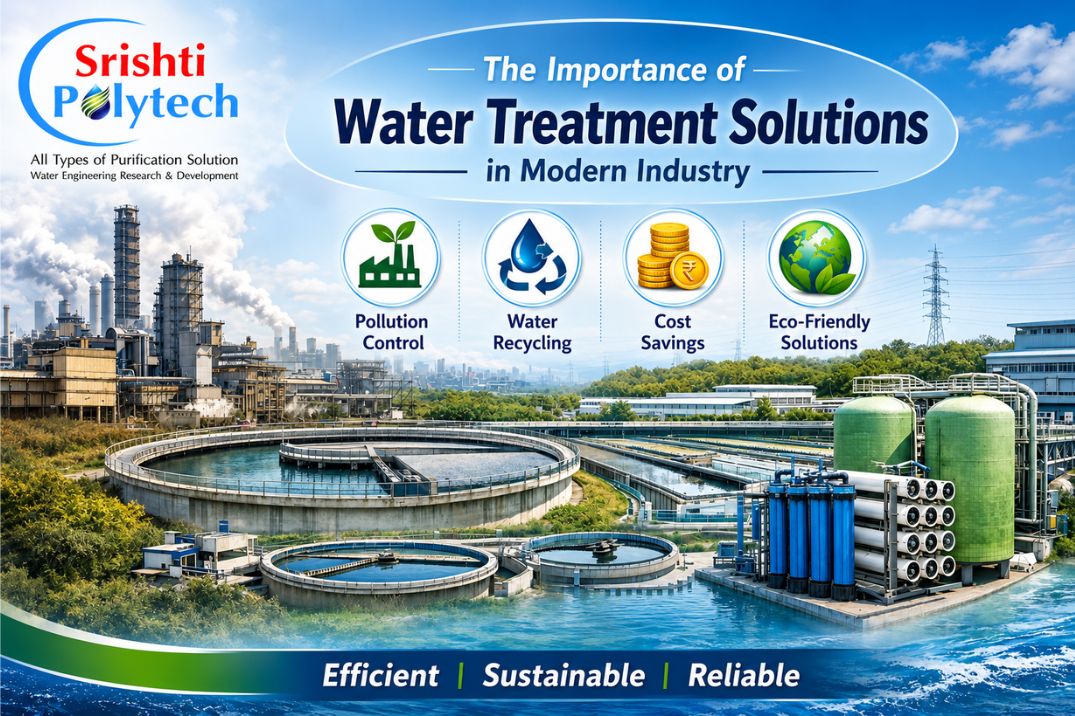
Mar 25, 2026
The Importance of Water Treatment Solutions in Modern Industry
In today’s rapidly industrializing world, water is one of the most valuable resources. Industries depend heavily on water for production,...
💧 Demineralization (DM): The Backbone of High-Purity Water Systems
Mar 20, 2026
uploads/blogs/blog_6a154e9adfe24.jpg
Water is a critical resource in industrial operations, but not all water is suitable for high-performance applications. Industries such as power plants, pharmaceuticals, and chemical manufacturing require water that is free from dissolved salts and minerals. This is where **Demineralization (DM)** plays a vital role.
---
## 🔍 What is Demineralization?
Demineralization is the process of removing dissolved minerals such as calcium, magnesium, sodium, chlorides, and sulphates from water. The result is highly purified water that ensures efficient and safe industrial operations.
Unlike regular filtration systems, DM technology eliminates both positively and negatively charged ions, producing water of the highest purity.
---
## ⚙️ How Does a DM Plant Work?
A typical DM plant operates on the principle of **Ion Exchange Technology**:
### 1. Cation Exchange Process
In this stage, water passes through a cation resin that replaces all positively charged ions (like calcium and magnesium) with hydrogen ions (H⁺).
### 2. Anion Exchange Process
Next, water flows through an anion resin that removes negatively charged ions (like chlorides and sulphates) and replaces them with hydroxide ions (OH⁻).
### Final Output:
Hydrogen (H⁺) and hydroxide (OH⁻) combine to form pure water (H₂O), free from dissolved salts.
---
## 🔄 Types of Demineralization Systems
* **Two-Bed DM Plant**: Separate cation and anion units; widely used in industries
* **Mixed-Bed DM Plant**: Provides ultra-pure water with superior quality
* **RO + DM System**: Combines Reverse Osmosis with DM for enhanced efficiency and reduced operational cost
---
## 🏭 Applications of DM Water
Demineralized water is essential in:
* Boiler feed systems
* Power generation plants
* Pharmaceutical manufacturing
* Chemical processing industries
* Electronics and semiconductor industries
---
## ⚠️ Why is DM Water Important?
Using untreated or partially treated water can lead to:
* Scaling in boilers and heat exchangers
* Corrosion in pipelines and equipment
* Reduced efficiency and increased maintenance costs
* Poor product quality
DM water helps prevent these issues, ensuring long-term reliability and performance.
---
## 📊 DM Water vs RO Water
| Feature | DM Water | RO Water |
| --------------- | --------------------- | ----------- |
| Purity Level | Very High | Moderate |
| Mineral Content | Nearly Zero | Low |
| Industrial Use | Critical Applications | General Use |
| Cost | Higher | Lower |
---
## 🌱 Conclusion
Demineralization is not just a treatment process—it is a necessity for industries that demand precision, efficiency, and durability. Investing in a well-designed DM plant ensures consistent water quality, protects equipment, and enhances overall productivity.
At **Srishti Polytech**, we specialize in designing and delivering advanced water treatment solutions tailored to your industrial needs.
---
## 📢 Get in Touch
Looking for a customized DM plant for your industry?
Visit: [www.srishtipolytech.com](http://www.srishtipolytech.com)
Contact us today for expert consultation and turnkey solutions.
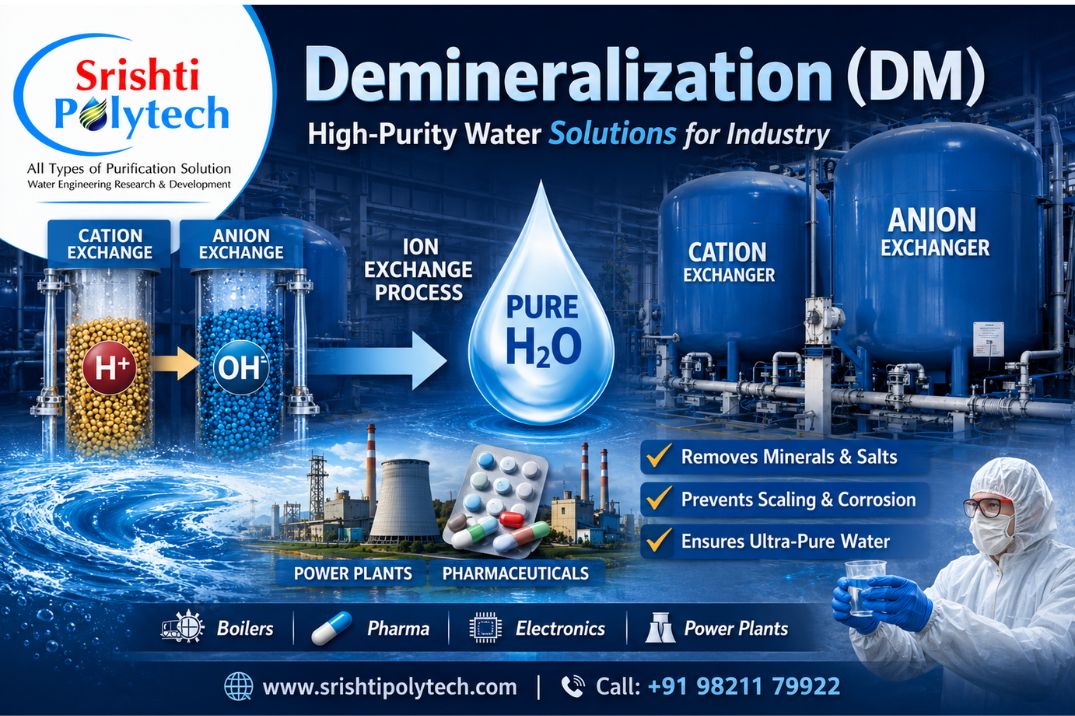
Mar 20, 2026
💧 Demineralization (DM): The Backbone of High-Purity Water Systems
Water is a critical resource in industrial operations, but not all water is suitable for high-performance applications. Industries such as...
What is Sludge Management and Why It Matters in Wastewater Treatment
Mar 19, 2026
uploads/blogs/blog_6a1550fd05000.jpg
Wastewater treatment is not just about cleaning water—it also involves handling the by-products generated during the process. One of the most critical by-products is **sludge**. Proper sludge management is essential for ensuring efficient plant operation, environmental safety, and regulatory compliance.
## What is Sludge?
Sludge is the semi-solid material that is produced during the treatment of wastewater in systems like Effluent Treatment Plants (ETP) and Sewage Treatment Plants (STP). It contains organic matter, microorganisms, chemicals, and suspended solids removed from the water.
If not managed properly, sludge can become a major environmental and operational problem.
## What is Sludge Management?
Sludge management refers to the complete process of handling sludge—from its generation to its final disposal or reuse. It includes several steps:
### 1. Sludge Thickening
This process reduces the water content in sludge, making it more concentrated and easier to handle.
### 2. Sludge Dewatering
Using equipment like filter presses, centrifuges, or drying beds, excess water is removed to reduce volume and weight.
### 3. Sludge Stabilization
Biological or chemical processes are used to reduce odor, pathogens, and organic content.
### 4. Sludge Disposal or Reuse
Treated sludge can be:
* Safely disposed of in landfills
* Used as fertilizer (if non-toxic)
* Incinerated for energy recovery
## Why Sludge Management Matters
### ✔️ Environmental Protection
Improper sludge disposal can contaminate soil, groundwater, and nearby water bodies.
### ✔️ Regulatory Compliance
Pollution Control Boards in India have strict norms regarding sludge disposal. Non-compliance can lead to penalties or shutdowns.
### ✔️ Cost Efficiency
Efficient sludge handling reduces transportation and disposal costs.
### ✔️ Improved Plant Performance
Proper sludge removal ensures smooth operation of ETP/STP systems and prevents system clogging or inefficiency.
### ✔️ Resource Recovery
With advanced technologies, sludge can be converted into useful products like biogas or organic manure.
## Challenges in Sludge Management
* High moisture content
* Odor issues
* Handling and transportation costs
* Disposal restrictions
* Need for specialized equipment
## How Srishti Polytech Can Help
At **Srishti Polytech**, we provide complete wastewater treatment solutions, including efficient sludge management systems. Our designs focus on:
* Advanced dewatering technologies
* Compact and cost-effective solutions
* Compliance with environmental standards
* Easy operation and low maintenance
We ensure that your treatment plant operates efficiently while minimizing environmental impact.
## Conclusion
Sludge management is a crucial part of wastewater treatment that should never be overlooked. Proper handling not only protects the environment but also improves operational efficiency and reduces costs.
Investing in the right sludge management system is a smart step toward sustainable and responsible industrial operations.
---
*For customized sludge management solutions, contact Srishti Polytech today:*
🌐 [www.srishtipolytech.in](http://www.srishtipolytech.in)
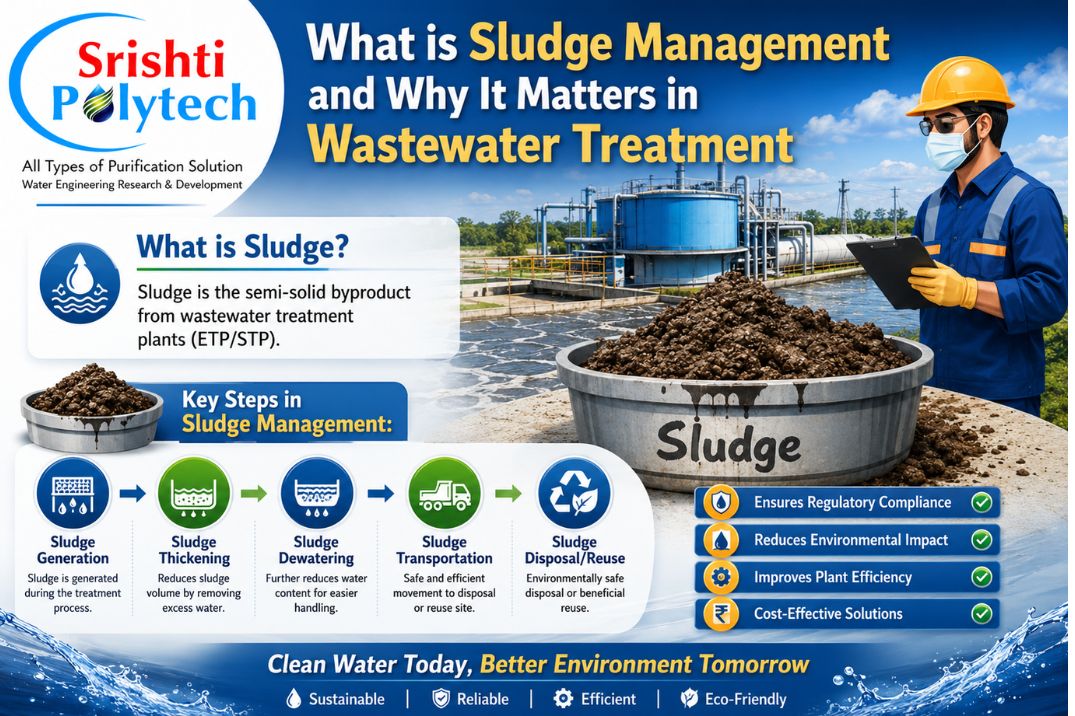
Mar 19, 2026
What is Sludge Management and Why It Matters in Wastewater Treatment
Wastewater treatment is not just about cleaning water—it also involves handling the by-products generated during the process. One of the...
How to Select the Right Capacity of an Effluent Treatment Plant (ETP)
Mar 16, 2026
uploads/blogs/blog_6a1555145e725.jpg
Selecting the correct capacity of an Effluent Treatment Plant (ETP) is one of the most important decisions for any industry. If the capacity is too small, the plant may fail to treat wastewater effectively. If it is too large, it increases unnecessary investment and operating costs.
Proper capacity selection ensures efficient wastewater treatment, regulatory compliance, and long-term operational reliability.
1. Calculate Total Wastewater Generation
The first step is to determine how much wastewater your industry produces daily.
Capacity of an ETP is generally measured in KLD (Kiloliters per Day).
Formula:
Daily Wastewater = Total Water Consumption − Water Used in Products
Example:
Total water used = 120 KLD
Water used in production = 40 KLD
Wastewater generated = 80 KLD
In this case, the ETP should be designed for 80–100 KLD capacity to handle peak loads.
2. Identify Industry Type
Different industries produce different types and quantities of effluent.
Examples:
Textile Industry – High chemical and dye content
Pharmaceutical Industry – High organic load
Food Processing Industry – High biodegradable waste
Chemical Industry – Toxic pollutants
Each industry requires different treatment processes and plant capacity design.
3. Consider Peak Flow Conditions
Industrial wastewater generation is not always constant.
During peak production hours, wastewater flow can increase significantly.
Therefore, engineers usually design the ETP with 20–30% extra capacity to handle sudden increases.
Example:
If wastewater generation = 100 KLD
Recommended ETP capacity = 120–130 KLD
4. Check Pollution Load (BOD, COD, TSS)
Apart from quantity, wastewater quality also affects capacity selection.
Important parameters include:
BOD (Biochemical Oxygen Demand)
COD (Chemical Oxygen Demand)
TSS (Total Suspended Solids)
pH level
Oil and grease content
Higher pollution loads require larger treatment systems and additional treatment stages.
5. Future Expansion of Industry
Industries often expand production after a few years. Installing a slightly larger capacity ETP prevents costly upgrades later.
Experts usually recommend designing the plant for 25–40% future expansion.
6. Government Discharge Standards
Industries must follow environmental regulations before releasing treated water.
The ETP must be designed to meet discharge standards set by pollution control authorities for:
BOD levels
COD levels
Suspended solids
Toxic substances
Proper design ensures compliance and avoids legal penalties.
7. Consult an Experienced ETP Manufacturer
Selecting the right capacity requires technical expertise. A professional manufacturer can analyze:
wastewater characteristics
industry type
required treatment technology
regulatory standards
to design the most efficient ETP system.
Conclusion
Choosing the right capacity of an Effluent Treatment Plant is essential for efficient wastewater management. By analyzing wastewater generation, pollution load, peak flow, and future expansion plans, industries can ensure reliable and cost-effective treatment.
Working with an experienced wastewater treatment company helps design customized ETP systems that meet both operational and environmental requirements.
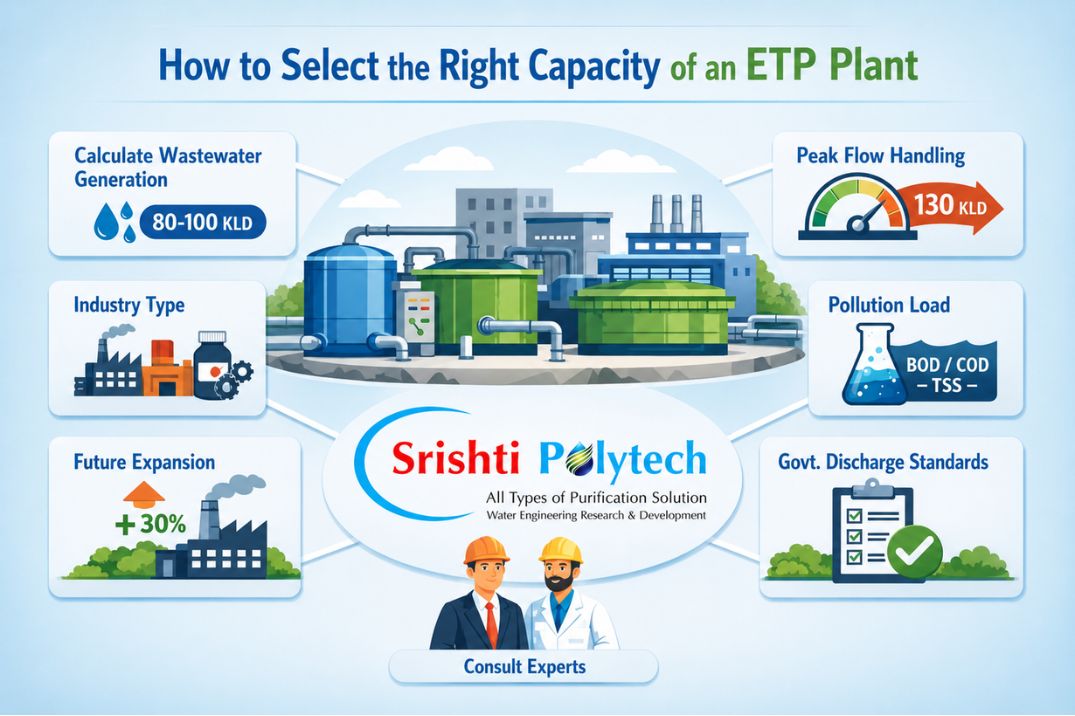
Mar 16, 2026
How to Select the Right Capacity of an Effluent Treatment Plant (ETP)
Selecting the correct capacity of an Effluent Treatment Plant (ETP) is one of the most important decisions for any industry....
Top 5 Industries That Need Effluent Treatment Plants
Mar 13, 2026
uploads/blogs/blog_6a155685aa66c.jpg
Introduction
Industrial activities generate large amounts of wastewater containing chemicals, oils, heavy metals, and suspended solids. If this wastewater is discharged without proper treatment, it can severely damage the environment and violate pollution control regulations.
An Effluent Treatment Plant (ETP) is designed to treat industrial wastewater and remove harmful contaminants before discharge or reuse. Many industries rely on ETP systems to ensure environmental compliance and sustainable operations.
At Srishti Polytech, we design and supply efficient wastewater treatment systems for different industrial sectors.
1. Textile Industry
The textile industry is one of the largest consumers of water. Processes such as dyeing, bleaching, and washing produce wastewater containing dyes, chemicals, and toxic compounds.
Why ETP is needed:
Removes dyes and color pollutants
Treats chemical contaminants
Prevents water pollution
Without an ETP, textile wastewater can heavily contaminate nearby water bodies.
2. Pharmaceutical Industry
Pharmaceutical manufacturing generates wastewater containing complex organic compounds, solvents, and active pharmaceutical ingredients.
Importance of ETP:
Removes hazardous chemicals
Ensures regulatory compliance
Protects groundwater quality
ETP systems help pharmaceutical plants manage wastewater safely and responsibly.
3. Food and Beverage Industry
Food processing industries generate wastewater rich in organic matter, oils, fats, and suspended solids.
Role of ETP:
Reduces biological oxygen demand (BOD)
Removes grease and organic waste
Makes water suitable for safe disposal or reuse
Proper treatment helps maintain hygiene and environmental standards.
4. Chemical Manufacturing Industry
Chemical plants produce wastewater containing acids, alkalis, toxic substances, and heavy metals.
Benefits of ETP:
Neutralizes hazardous chemicals
Removes toxic pollutants
Ensures safe discharge
ETP systems are essential for chemical industries to prevent environmental damage.
5. Paper and Pulp Industry
Paper manufacturing requires large volumes of water and produces wastewater containing lignin, bleaching chemicals, and suspended solids.
Why ETP is essential:
Reduces suspended solids
Removes bleaching chemicals
Minimizes environmental impact
Effluent treatment ensures that wastewater from paper mills meets environmental standards.
Conclusion
Effluent Treatment Plants are critical for industries that generate large volumes of wastewater. They help remove harmful pollutants, protect natural water resources, and ensure compliance with environmental regulations.
Industries looking for reliable wastewater treatment solutions can rely on Srishti Polytech for advanced and customized ETP, STP, and RO plant systems designed for efficient performance and long-term sustainability.
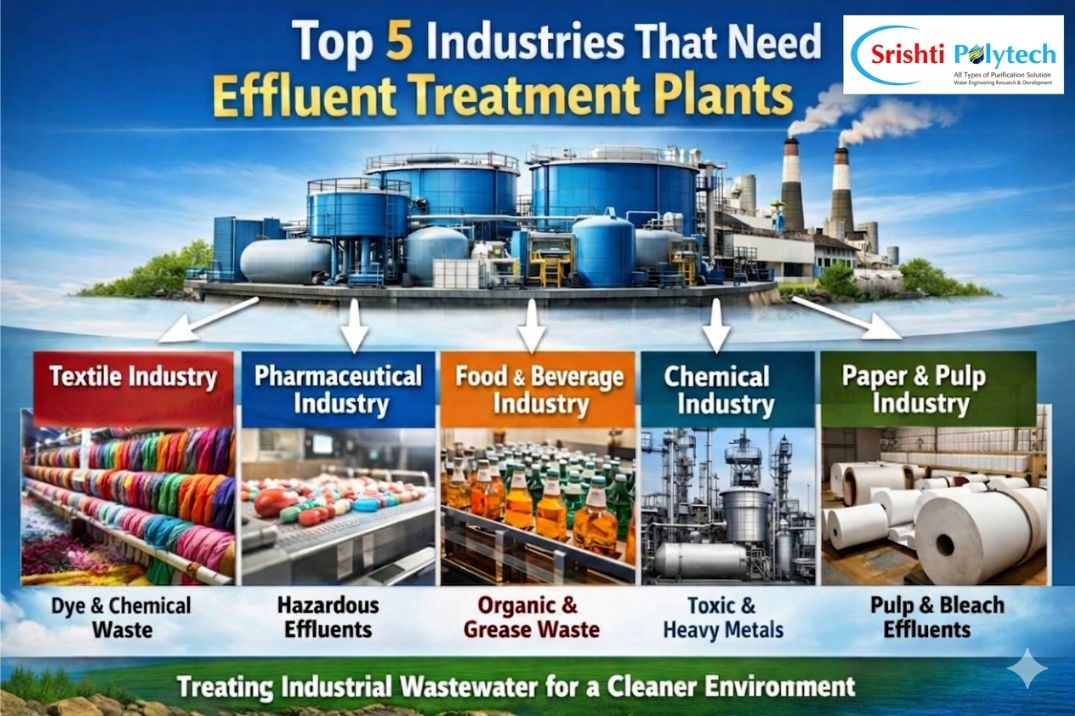
Mar 13, 2026
Top 5 Industries That Need Effluent Treatment Plants
Introduction Industrial activities generate large amounts of wastewater containing chemicals, oils, heavy metals, and suspended solids. If this wastewater is...
How to Choose the Right Industrial RO Plant for Your Industry in 2026
Mar 11, 2026
uploads/blogs/blog_69b1216174dc7.jpg
Water is one of the most important resources for industries such as manufacturing, pharmaceuticals, food processing, hospitals, and hospitality. However, untreated water often contains dissolved salts, heavy metals, chemicals, and harmful contaminants that can damage equipment and affect product quality.
An Industrial RO Plant is one of the most effective water purification systems used by industries to remove impurities and produce high-quality purified water. Reverse Osmosis (RO) technology can remove up to 99% of dissolved solids, bacteria, and other contaminants from water.
If you are planning to install an RO plant for your factory, commercial building, or institution, choosing the right system is essential. In this guide, we will explain how to select the best Industrial RO Plant for your industry in 2026.
What is an Industrial RO Plant?
An Industrial Reverse Osmosis (RO) Plant is a water treatment system designed to remove dissolved salts, chemicals, and impurities from water using a semi-permeable membrane.
In this process, high pressure forces water through the RO membrane, which allows only pure water molecules to pass while blocking contaminants such as:
Dissolved salts
Heavy metals
Bacteria and viruses
Chemicals
Total Dissolved Solids (TDS)
The result is high-quality purified water suitable for industrial processes and commercial applications.
Industries That Require Industrial RO Plants
Industrial RO Plants are widely used across multiple sectors that require clean and safe water.
Manufacturing Industries
Factories require purified water for cooling systems, boilers, and production processes. RO plants help maintain equipment efficiency and reduce scaling.
Hospitals and Healthcare Facilities
Hospitals require high-quality water for laboratories, sterilization processes, and medical equipment.
Food and Beverage Industry
Clean water is essential in food production to maintain hygiene and meet quality standards.
Pharmaceutical Industry
Pharmaceutical companies require highly purified water for drug production and laboratory processes.
Hotels and Hospitality
Hotels use RO systems to provide safe drinking water and improve water quality for kitchens and guest facilities.
How to Choose the Right Capacity of an Industrial RO Plant
One of the most important factors when selecting an RO system is determining the correct capacity based on your water consumption.
Common industrial RO capacities include:
250 LPH RO Plant – Suitable for small businesses and restaurants
500 LPH RO Plant – Ideal for small factories and institutions
1000 LPH RO Plant – Suitable for hospitals, hotels, and medium industries
2000–5000 LPH RO Plant – Used in large manufacturing plants
10,000+ LPH RO Plant – Designed for large industrial operations
Before installing a system, it is important to analyze:
Daily water consumption
Raw water quality
Required output water quality
A professional water treatment company can help conduct a water analysis to determine the right plant capacity.
Key Components of an Industrial RO Plant
A typical industrial RO system consists of several important components that work together to purify water.
Pre-Treatment System
Pre-treatment filters remove suspended particles, chlorine, and sediments before water enters the RO membrane.
RO Membrane
The RO membrane is the heart of the system. It removes dissolved salts, bacteria, and harmful chemicals from water.
High Pressure Pump
The pump provides the pressure required to push water through the membrane.
Control Panel
The control panel manages the entire system operation including pressure, flow rate, and automatic shutoff.
Storage Tank
Purified water is stored in a tank for further industrial use.
Benefits of Installing an Industrial RO Plant
Installing an industrial RO plant provides several advantages for industries and commercial facilities.
High Purification Efficiency
RO technology can remove up to 99% of impurities and dissolved solids from water.
Improved Product Quality
Purified water improves product consistency in industries such as food processing and pharmaceuticals.
Reduced Maintenance Cost
Using purified water prevents scaling and corrosion in industrial equipment, reducing maintenance costs.
Environmentally Friendly
RO systems help recycle and reuse water, supporting sustainable water management.
Reliable Water Supply
Industries can maintain a consistent supply of purified water regardless of the raw water source.
Factors to Consider Before Buying an Industrial RO Plant
Before selecting an RO plant, consider the following factors:
Water Quality Analysis
Testing the raw water source helps determine the required treatment process.
Plant Capacity
Choose a plant that meets your current needs and allows future expansion.
Energy Consumption
Energy-efficient RO systems can significantly reduce operational costs.
Maintenance Requirements
Regular maintenance and membrane replacement are essential for long-term performance.
Manufacturer Experience
Choosing a reliable and experienced manufacturer ensures quality equipment and long-term support.
Why Choose a Reliable OEM Manufacturer
Working with an OEM (Original Equipment Manufacturer) provides several advantages.
Customized RO plant design
High-quality components
Professional installation
Reliable after-sales service
Long-term technical support
An experienced water treatment company can design and install a system tailored to your industry’s needs.
Industrial RO Plant Installation by Srishti Polytech
Srishti Polytech specializes in manufacturing and supplying high-quality water treatment solutions including:
Industrial RO Plants
Sewage Treatment Plants (STP)
Effluent Treatment Plants (ETP)
Water Softener Systems
Our systems are designed for industries, hospitals, commercial buildings, and government projects. We focus on efficient design, reliable performance, and long-term durability.
Conclusion
Clean and purified water is essential for industrial productivity, equipment safety, and product quality. Installing the right Industrial RO Plant ensures efficient water treatment while reducing operational costs and environmental impact.
Before selecting a system, always analyze your water quality, consumption requirements, and long-term operational needs.
If you are planning to install an Industrial RO Plant for your industry, choosing a reliable manufacturer and supplier is the key to achieving long-term performance and efficiency.
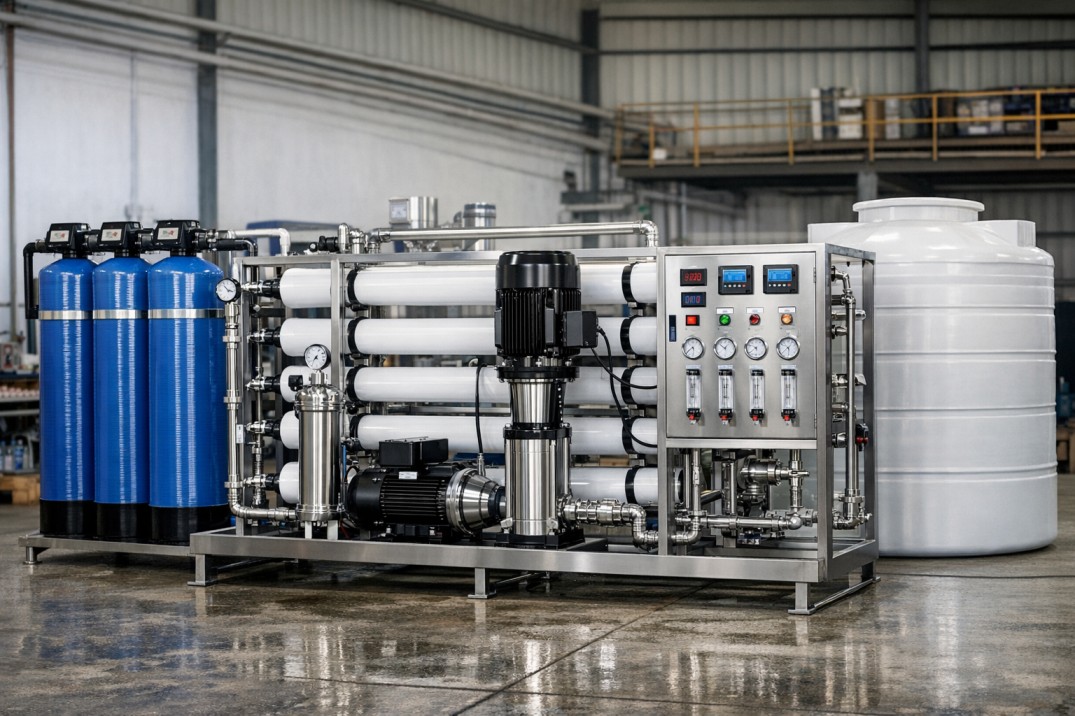
Mar 11, 2026
How to Choose the Right Industrial RO Plant for Your Industry in 2026
Water is one of the most important resources for industries such as manufacturing, pharmaceuticals, food processing, hospitals, and hospitality. However,...
How Reverse Osmosis (RO) Technology Works in Industrial Water Treatment
Mar 09, 2026
uploads/blogs/blog_6a156af2a2501.jpg
Water purification has become essential for industries, commercial facilities, and municipalities. With increasing concerns about water quality and environmental regulations, Reverse Osmosis (RO) technology has become one of the most reliable solutions for water treatment.
Srishti Polytech provides advanced industrial RO systems designed to remove impurities, reduce Total Dissolved Solids (TDS), and deliver high-quality purified water for multiple industrial applications.
What is Reverse Osmosis?
Reverse Osmosis (RO) is an advanced water purification process that removes dissolved salts, chemicals, heavy metals, bacteria, and other impurities from water.
The technology uses a semi-permeable membrane that allows only pure water molecules to pass through while blocking contaminants.
This process helps produce clean, safe, and high-quality water suitable for industrial and commercial use.
Principle Behind Reverse Osmosis
The working principle of RO is based on pressure-driven filtration.
Normally, water flows naturally from a low concentration solution to a high concentration solution through a membrane. This natural process is known as osmosis.
In Reverse Osmosis, external pressure is applied to reverse this natural flow. The pressure forces water through the membrane, leaving salts and impurities behind.
Main Components of an RO Plant
An industrial RO plant typically includes the following components:
1. Pre-Treatment System
Before entering the RO membrane, water passes through filters such as sand filters and activated carbon filters to remove sediments, chlorine, and suspended particles.
2. High-Pressure Pump
A high-pressure pump forces the water through the RO membrane to separate pure water from dissolved salts and contaminants.
3. RO Membrane
The RO membrane is the core component of the system. It blocks impurities and allows purified water to pass through.
4. Post-Treatment System
Additional filtration or UV disinfection may be used after the RO process to further improve water quality.
5. Reject Water Outlet
The contaminants removed by the membrane are discharged as reject water.
Step-by-Step RO Process
Raw water enters the pre-treatment system.
Filters remove suspended particles and impurities.
A high-pressure pump pushes water through the RO membrane.
The membrane separates purified water from dissolved contaminants.
Clean water is collected in a storage tank.
Rejected impurities are discharged as wastewater.
Advantages of Reverse Osmosis Systems
RO technology offers several important benefits:
Removes up to 99% of dissolved salts and contaminants
Produces high-quality purified water
Reduces harmful chemicals and heavy metals
Improves taste, odor, and safety of water
Suitable for industrial and commercial applications
Industrial Applications of RO Plants
RO plants are widely used in many industries, including:
Pharmaceutical industries
Food and beverage manufacturing
Power plants
Chemical processing units
Hospitals and laboratories
These industries require purified water to maintain product quality and operational efficiency.
Why Choose Srishti Polytech for RO Plants?
Srishti Polytech specializes in designing and manufacturing high-performance water treatment solutions including:
Industrial RO Plants
Effluent Treatment Plants (ETP)
Sewage Treatment Plants (STP)
Water Recycling Systems
With advanced engineering and reliable components, the company delivers customized solutions that meet industrial water treatment requirements.
Conclusion
Reverse Osmosis technology plays a crucial role in modern water purification systems. By effectively removing dissolved impurities and contaminants, RO plants help industries maintain water quality, reduce operational costs, and support sustainable water management.
With advanced systems from Srishti Polytech, businesses can ensure reliable and efficient water treatment solutions for long-term use.
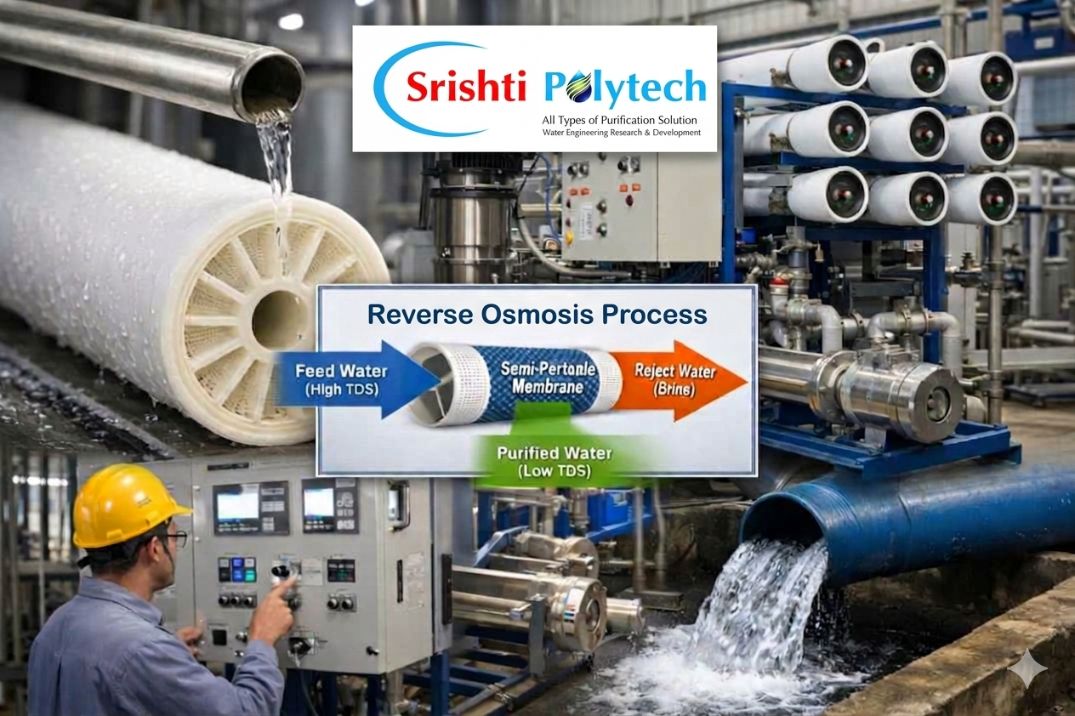
Mar 09, 2026
How Reverse Osmosis (RO) Technology Works in Industrial Water Treatment
Water purification has become essential for industries, commercial facilities, and municipalities. With increasing concerns about water quality and environmental regulations,...
RO Plant Maintenance: How to Increase Membrane Life
Mar 07, 2026
uploads/blogs/blog_69aba9926c747.jpg
For industries, hospitals, schools, and commercial buildings, an RO (Reverse Osmosis) plant is essential for providing safe and purified water. However, many users face one common problem — RO membrane failure or reduced performance. Proper maintenance can significantly extend the life of the membrane and keep the plant running efficiently.
Companies like Srishti Polytech recommend regular maintenance practices to ensure long-term performance of industrial RO systems.
1️⃣ Regular Pre-Filter Replacement
RO membranes are very sensitive to dirt and particles. Pre-filters protect the membrane by removing suspended solids.
Maintenance tips:
Replace sediment filters every 1–3 months
Check pressure drop across filters
Avoid running the plant with clogged filters
This prevents membrane fouling, one of the biggest reasons for membrane damage.
2️⃣ Maintain Proper Feed Water Quality
Feed water quality directly affects membrane life.
Important parameters to monitor:
TDS (Total Dissolved Solids)
pH level
Hardness
Iron content
If these parameters exceed safe limits, the membrane may scale or clog quickly.
3️⃣ Use Anti-Scalant Chemicals
Hard water minerals like calcium and magnesium cause scaling on RO membranes.
Solution:
Dose anti-scalant chemicals
Maintain proper chemical dosing levels
Monitor scaling index regularly
This prevents mineral deposits on the membrane surface.
4️⃣ Regular Membrane Cleaning (CIP)
Over time, membranes accumulate:
Dirt
Biological growth
Mineral deposits
Perform CIP (Clean-in-Place) cleaning every 3–6 months depending on water quality.
Cleaning helps:
Restore water flow
Improve rejection rate
Extend membrane life
5️⃣ Monitor Operating Pressure
Incorrect pressure can damage membranes.
Common problems:
High pressure → membrane damage
Low pressure → poor filtration
Operators should monitor:
Feed pressure
Reject pressure
Permeate flow rate
6️⃣ Prevent Biological Growth
Bacteria and algae growth inside the RO system can clog membranes.
Prevention methods:
Periodic chlorination
Proper disinfection
Maintain clean storage tanks
7️⃣ Maintain Proper Recovery Rate
Running the plant at too high recovery increases scaling risk.
Recommended recovery levels:
Industrial RO plants: 50–75%
Depends on feed water quality
Balanced recovery improves membrane life and efficiency.
8️⃣ Regular System Inspection
Routine inspection helps detect problems early.
Check:
Pump performance
Leakage
Pressure gauges
Flow meters
Professional servicing by experienced manufacturers such as Srishti Polytech ensures optimal plant performance.
Signs Your RO Membrane Needs Maintenance
Watch for these warning signs:
Reduced water production
Increase in TDS in output water
High pressure drop in the system
Frequent filter clogging
Ignoring these issues may lead to membrane replacement, which is costly.
Conclusion
RO membranes are the heart of any RO plant. With proper maintenance, a membrane can last 2–3 years or even longer. Regular filter replacement, chemical dosing, and periodic cleaning are essential for maintaining efficiency and reducing operational costs.
If you are planning to install or maintain an industrial RO system, consulting experts like Srishti Polytech can help ensure reliable performance and long-term savings.
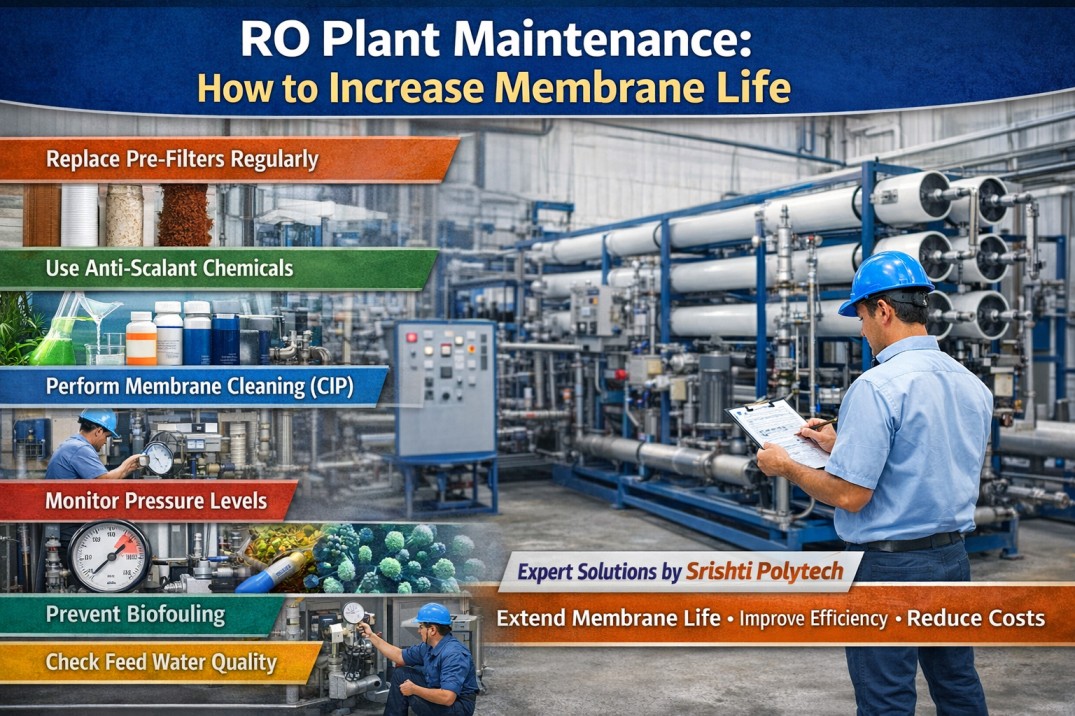
Mar 07, 2026
RO Plant Maintenance: How to Increase Membrane Life
For industries, hospitals, schools, and commercial buildings, an RO (Reverse Osmosis) plant is essential for providing safe and purified water....
🌊 Future of Water Technology in India – 2026 & Beyond
Mar 02, 2026
uploads/blogs/blog_69a52765a4652.jpg
India is entering a critical phase in water management. With rapid industrialization, urban expansion, and climate change pressures, the demand for advanced water treatment solutions is rising sharply. From smart RO systems to Zero Liquid Discharge plants, water technology is evolving faster than ever.
Let’s explore what 2026 and beyond looks like for India’s water sector.
1️⃣ Smart & Automated Water Treatment Systems
Traditional water plants are being replaced with:
IoT-enabled monitoring systems
Real-time TDS and flow tracking
Automated chemical dosing
Remote fault detection
Industries are adopting automation to reduce downtime and improve operational efficiency. Smart RO plants with PLC control panels will become the industry standard.
2️⃣ Zero Liquid Discharge (ZLD) Becoming Mandatory
Environmental regulations are becoming stricter under the guidelines of the Central Pollution Control Board.
Industries like:
Textile
Pharmaceuticals
Chemicals
Mining
are increasingly required to implement ZLD systems.
By 2026, ZLD will not just be an option — it will be a compliance necessity.
3️⃣ Rise of Atmospheric Water Generation (AWG)
Water scarcity in many Indian states is pushing innovation toward Atmospheric Water Generators.
AWG technology:
Extracts water from air humidity
Works in remote & drought-prone areas
Useful for defense, mining & rural applications
With climate change impacting groundwater levels, AWG is expected to grow rapidly.
4️⃣ Industrial Water Recycling & Reuse
Industries are shifting focus from water disposal to water recovery.
Future trends include:
Advanced membrane filtration
MBR (Membrane Bio-Reactor) systems
High-recovery RO systems
Treated water reuse in cooling towers & boilers
This reduces:
Freshwater dependency
Operating costs
Environmental impact
5️⃣ Integration with National Water Missions
Government initiatives like the National Water Mission aim to improve water use efficiency by 20%.
This will accelerate:
Installation of STPs & ETPs
Smart metering systems
Municipal wastewater reuse projects
6️⃣ Sustainable & Energy-Efficient RO Technology
The next generation of RO plants will focus on:
Low energy membranes
Solar-powered water treatment systems
Energy recovery devices
Reduced chemical consumption
Energy-efficient plants will become a competitive advantage for OEM manufacturers.
7️⃣ Data-Driven Water Management
AI & Data Analytics will help industries:
Predict membrane fouling
Monitor plant performance
Optimize chemical dosing
Reduce maintenance cost
Predictive maintenance will replace reactive servicing.
🚀 What This Means for Industries in 2026 & Beyond
Industries that adopt advanced water technology early will benefit from:
✔ Regulatory compliance
✔ Reduced operational cost
✔ Improved sustainability profile
✔ Better tender eligibility
✔ Stronger brand reputation
💧 Role of OEM Manufacturers Like Srishti Polytech
As an OEM, Srishti Polytech can lead this transformation by offering:
Custom-built RO & ETP solutions
Automation-ready systems
ZLD-ready plant design
Future-focused innovation like AWG
The future of water technology in India is not just about treatment — it is about intelligent, sustainable, and circular water management.
Mar 02, 2026
🌊 Future of Water Technology in India – 2026 & Beyond
India is entering a critical phase in water management. With rapid industrialization, urban expansion, and climate change pressures, the demand...
True Cost of Ignoring Wastewater Treatment
Feb 24, 2026
uploads/blogs/blog_699d290f39e71.jpg
In many industries, wastewater treatment is often viewed as a regulatory obligation rather than a strategic investment. As a result, businesses delay installing an Effluent Treatment Plant (ETP) or operate inefficient systems — until serious consequences arise.
What appears to be a cost-saving decision can silently drain profits, damage assets, and threaten business continuity.
Let’s uncover the real financial and operational costs of ignoring wastewater treatment.
🚨 1️⃣ Regulatory Penalties & Legal Risks
Non-compliance with discharge norms set by authorities such as the Central Pollution Control Board (CPCB) and State Pollution Control Boards (SPCB) can lead to:
✔ Heavy fines
✔ Legal notices
✔ Plant shutdown orders
✔ Cancellation of licenses
✔ Criminal liability in severe cases
A single violation can cost far more than installing a compliant treatment system.
💸 2️⃣ Hidden Financial Losses
Untreated or poorly treated wastewater leads to:
• Damage to pipelines & equipment
• Corrosion of machinery
• Frequent maintenance expenses
• Production interruptions
• Increased chemical consumption
These recurring losses accumulate quickly and often go unnoticed in monthly accounts.
🏭 3️⃣ Equipment Damage & Reduced Asset Life
Wastewater containing chemicals, oils, heavy metals, or high TDS can:
❌ Corrode heat exchangers
❌ Damage cooling towers
❌ Reduce boiler efficiency
❌ Block membranes & filters
Replacing industrial equipment is exponentially more expensive than preventing damage.
⛔ 4️⃣ Operational Downtime
Regulatory intervention or system failure may cause:
⚠ Sudden production stoppage
⚠ Contractual penalties
⚠ Supply chain disruption
⚠ Revenue loss
Downtime is one of the most expensive risks industries underestimate.
🌍 5️⃣ Environmental & Reputation Damage
Environmental violations can lead to:
• Negative publicity
• Loss of client trust
• Disqualification from tenders
• Investor concerns
Today, sustainability directly impacts brand credibility.
📉 6️⃣ Missed Opportunities for Water Reuse
Without proper treatment, industries lose the ability to:
✔ Recycle water
✔ Implement Zero Liquid Discharge (ZLD)
✔ Reduce freshwater dependency
✔ Cut water procurement costs
Treated water is a reusable resource — untreated water is a liability.
✅ Wastewater Treatment is Not an Expense — It’s Protection
A well-designed Effluent Treatment Plant (ETP):
✔ Ensures regulatory compliance
✔ Protects equipment
✔ Reduces long-term operating costs
✔ Enables water reuse
✔ Safeguards business continuity
🏆 How Srishti Polytech Helps
As an OEM specializing in water & wastewater solutions, Srishti Polytech provides:
✔ Custom-designed ETP systems
✔ ZLD solutions
✔ Industrial RO plants
✔ Turnkey installation
✔ AMC & support
We focus on compliance, efficiency, and ROI — not just installation.
📞 Need Expert Guidance?
If your industry generates wastewater, delaying treatment could be costing you more than you realize.
👉 Contact Srishti Polytech today for a consultation.
Feb 24, 2026
True Cost of Ignoring Wastewater Treatment
In many industries, wastewater treatment is often viewed as a regulatory obligation rather than a strategic investment. As a result,...
Hidden Costs of Ignoring Wastewater Treatment
Feb 20, 2026
uploads/blogs/blog_6997f53832848.jpg
5 Hidden Costs of Ignoring Wastewater Treatment
Many industries still view wastewater treatment as a regulatory obligation rather than a strategic investment. However, delaying or neglecting proper treatment can silently increase operational costs, damage infrastructure, and even disrupt business continuity.
Let’s explore the five hidden costs businesses often underestimate.
1️⃣ Regulatory Penalties & Legal Risks
Failure to comply with effluent discharge norms can result in:
Heavy environmental fines
Plant shutdown notices
Legal proceedings
Suspension or cancellation of licenses
Regulatory bodies like the Central Pollution Control Board (CPCB) and State Pollution Control Boards actively monitor industrial discharge quality.
👉 Hidden Cost: Penalties and production losses frequently exceed the cost of installing an Effluent Treatment Plant (ETP) or Sewage Treatment Plant (STP).
2️⃣ Equipment Damage & Corrosion
Untreated wastewater may contain:
High TDS
Aggressive chemicals
Oils & grease
Acids / alkalis
These contaminants accelerate:
Pipeline corrosion
Pump & valve failures
Heat exchanger damage
Boiler scaling
👉 Hidden Cost: Increased maintenance, unexpected breakdowns, and expensive replacements.
3️⃣ Rising Operational Expenses
Ignoring wastewater treatment often leads to:
Excess freshwater consumption
Higher chemical dosing
Downtime due to scaling & fouling
Energy inefficiencies
👉 Hidden Cost: Inflated utility bills and water wastage.
4️⃣ Loss of Business Opportunities
Today’s clients, audits, and government tenders increasingly demand:
Environmental compliance
Sustainability reporting
Proper effluent management
Without adequate treatment systems, companies risk:
Rejected bids
Lost contracts
Reduced brand credibility
👉 Hidden Cost: Revenue loss that never appears directly on financial statements.
5️⃣ Environmental & Reputation Damage
Poor wastewater management contributes to:
Soil contamination
Groundwater pollution
Community complaints
Negative publicity
👉 Hidden Cost: Long-term reputation damage and erosion of stakeholder trust.
🚨 Cost vs Consequence
Ignoring Treatment Installing Treatment
Fines & shutdown risk Regulatory compliance
Equipment failures Extended asset life
High water bills Water reuse savings
Reputation damage Strong ESG profile
✅ Smart Industries Treat Wastewater as an Asset
With systems such as:
✔ Effluent Treatment Plants (ETP)
✔ Sewage Treatment Plants (STP)
✔ Zero Liquid Discharge (ZLD)
✔ Water Recycling Units
Industries can:
Reuse treated water
Reduce operating costs
Maintain regulatory compliance
Strengthen sustainability metrics
💡 Final Takeaway
Wastewater treatment is not an expense — it is a risk mitigation and cost optimization strategy.
Delaying investment often results in compounding hidden losses that impact profitability, compliance, and brand reputation.
Feb 20, 2026
Hidden Costs of Ignoring Wastewater Treatment
5 Hidden Costs of Ignoring Wastewater Treatment Many industries still view wastewater treatment as a regulatory obligation rather than a...
Effluent Treatment Plant (ETP) & Pollution Norms
Feb 18, 2026
uploads/blogs/blog_699594d4f255e.jpg
Industrial growth brings responsibility. Industries generating wastewater must comply with environmental regulations established by the Central Pollution Control Board (CPCB) and respective State Pollution Control Board (SPCB) authorities. Non-compliance can result in heavy penalties, plant shutdowns, and reputational damage.
An Effluent Treatment Plant (ETP) plays a crucial role in helping industries treat contaminated water before discharge or reuse, ensuring adherence to pollution control norms.
What is an Effluent Treatment Plant (ETP)?
An Effluent Treatment Plant (ETP) is a system designed to treat industrial wastewater by removing:
Suspended solids
Oils & grease
Toxic chemicals
Heavy metals
Organic & inorganic pollutants
The treated water can then be safely discharged or reused for non-potable applications.
Why Pollution Control Norms Matter
Environmental authorities mandate wastewater quality limits for parameters such as:
pH level
BOD (Biochemical Oxygen Demand)
COD (Chemical Oxygen Demand)
TSS (Total Suspended Solids)
Oil & Grease
Heavy metals
Failing to meet these standards can lead to:
❌ Legal notices
❌ Financial penalties
❌ Production stoppage
❌ Environmental harm
How an ETP Ensures Compliance
1️⃣ Removal of Harmful Contaminants
ETPs eliminate pollutants through multi-stage treatment:
Primary treatment (settling & separation)
Secondary treatment (biological processes)
Tertiary treatment (advanced filtration/disinfection)
This ensures discharge water meets CPCB/SPCB limits.
2️⃣ Control of BOD & COD Levels
Biological treatment units reduce organic load, controlling BOD/COD, which are critical compliance indicators.
3️⃣ Neutralization of pH
Chemical dosing systems adjust acidic or alkaline wastewater to permissible pH ranges.
4️⃣ Heavy Metal & Toxic Chemical Reduction
Specialized treatment processes remove hazardous substances commonly found in:
Electroplating industries
Chemical plants
Pharmaceutical manufacturing
5️⃣ Safe Water Discharge or Reuse
Treated water can be:
✔ Discharged safely
✔ Recycled for cooling/process use
✔ Used for gardening/flushing
Industries That Require ETPs
Effluent Treatment Plants are essential for:
Textile industries
Pharmaceuticals
Food processing
Electroplating units
Chemical manufacturing
Paper & pulp mills
Benefits Beyond Compliance
✅ Avoid Regulatory Penalties
Proper treatment prevents fines and legal complications.
✅ Environmental Protection
Reduces soil & groundwater contamination.
✅ Water Recycling & Cost Savings
Reusing treated water reduces freshwater consumption.
✅ Improved Brand Image
Demonstrates environmental responsibility.
Choosing the Right ETP Solution
When selecting an ETP, consider:
✔ Industry-specific wastewater characteristics
✔ Required discharge standards
✔ Plant capacity (KLD/MLD)
✔ Automation level
✔ Maintenance & AMC support
Why Work with Srishti Polytech
Srishti Polytech provides:
Custom-designed Effluent Treatment Plants
Turnkey installation
Pollution compliance-ready systems
AMC & technical support
Solutions across Dhanbad & Jharkhand
Conclusion
An Effluent Treatment Plant (ETP) is not just a regulatory requirement—it is an operational safeguard. It ensures environmental compliance, reduces risks, and promotes sustainable industrial practices.

Feb 18, 2026
Effluent Treatment Plant (ETP) & Pollution Norms
Industrial growth brings responsibility. Industries generating wastewater must comply with environmental regulations established by the Central Pollution Control Board (CPCB)...
How an Iron Removal Plant Improves Borewell Water Quality
Feb 17, 2026
uploads/blogs/blog_6993f79b2823d.jpg
Borewell water is a primary water source for homes, apartments, and industries across India. While it is often abundant, it commonly contains excess iron, leading to unpleasant taste, staining, and long-term plumbing damage. Installing an Iron Removal Plant (IRP) is one of the most effective ways to restore water quality and make borewell water safe and usable.
### Why Iron in Borewell Water is a Problem
High iron concentration in groundwater can cause:
Reddish-brown stains on sinks, tiles, and clothes
Metallic taste & odor
Clogging of pipes & fixtures
Damage to RO membranes & appliances
Bacterial growth (iron bacteria)
Even when not harmful to health at low levels, iron severely affects water usability and aesthetics.
### What is an Iron Removal Plant (IRP)?
An Iron Removal Plant is a specialized water treatment system designed to remove:
✔ Dissolved iron (ferrous iron)
✔ Suspended iron particles
✔ Manganese (often present with iron)
✔ Turbidity & color issues
It transforms discolored, metallic-tasting water into clear, odor-free water.
### How an Iron Removal Plant Works
Most IRP systems operate in three stages:
1️⃣ Oxidation
Dissolved iron (invisible) is converted into solid particles using:
Aeration
Chemical dosing
Catalytic media
2️⃣ Filtration
Oxidized iron particles are trapped using:
Manganese dioxide media
Multi-grade sand filters
Activated media beds
3️⃣ Backwashing
Periodic cleaning flushes out accumulated iron sludge, ensuring long-term efficiency.
### Key Benefits of Installing an IRP
✅ Crystal Clear Water
Removes yellow/brown discoloration
✅ Improved Taste & Odor
Eliminates metallic smell
✅ Protects Plumbing & Appliances
Prevents pipe blockage & scaling
✅ Extends RO System Life
Reduces membrane fouling
✅ Health & Hygiene Support
Reduces bacterial risks
### Where Iron Removal Plants are Essential
Residential borewells
Apartments & housing societies
Hotels & hospitals
Industries using groundwater
Pre-treatment before RO / Softener
### Signs You Need an Iron Removal Plant
⚠ Water turns brown after storage
⚠ Rust stains on bathroom fittings
⚠ Metallic taste
⚠ Frequent RO membrane failure
⚠ Slime deposits (iron bacteria)
### Choosing the Right Iron Removal System
Consider:
✔ Iron concentration (ppm)
✔ Daily water consumption
✔ Pressure & flow rate
✔ Automatic vs manual backwash
✔ Integration with existing WTP / RO
Professional water testing is highly recommended.
Conclusion
An Iron Removal Plant is a smart investment for anyone relying on borewell water. It not only improves water clarity and taste but also protects plumbing infrastructure and downstream purification systems. Clean, iron-free water enhances comfort, hygiene, and equipment lifespan.
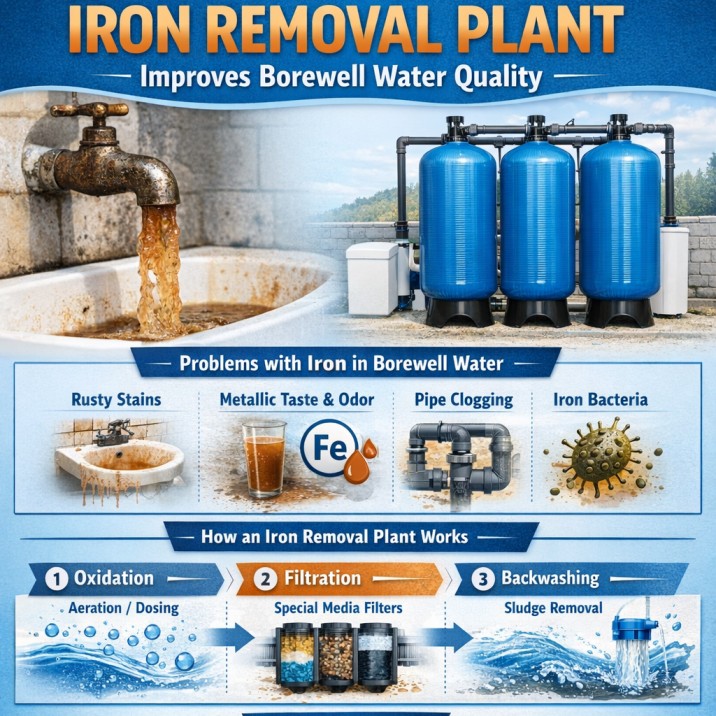
Feb 17, 2026
How an Iron Removal Plant Improves Borewell Water Quality
Borewell water is a primary water source for homes, apartments, and industries across India. While it is often abundant, it...
Zero Liquid Discharge (ZLD): Is It Right for Your Industry?
Feb 13, 2026
uploads/blogs/blog_698eae5540c30.jpg
A Zero Liquid Discharge system is a comprehensive wastewater treatment approach that:
✔ Recovers reusable water
✔ Converts dissolved solids into solid waste
✔ Prevents any liquid effluent discharge
Instead of releasing treated water into drains, ZLD recycles it back into operations.
How Does a ZLD Plant Work?
A typical ZLD process flow includes:
Pre-treatment / Effluent Treatment Plant (ETP)
Removal of suspended solids, oil, organics
Membrane Separation
UF / RO systems recover clean water
Concentrates reject stream
Evaporation / Crystallization
Thermal evaporation of brine
Salt recovery / solid waste formation
Water Reuse
Recovered water reused in cooling, boilers, washing
Industries That Commonly Use ZLD
ZLD is particularly valuable where:
Water consumption is high
Effluent discharge norms are strict
Raw water cost is rising
Typical sectors:
✔ Power plants
✔ Textile & dyeing units
✔ Pharmaceuticals
✔ Chemicals & petrochemicals
✔ Food & beverage processing
✔ Tanneries
✔ Electronics & semiconductor
Benefits of a ZLD System
1. Regulatory Compliance
Meets stringent pollution control board norms.
2. Maximum Water Recovery
Up to 95–99% water reuse possible.
3. Reduced Freshwater Dependency
Critical in water-scarce regions.
4. Environmental Protection
Prevents contamination of soil & water bodies.
5. Long-Term Cost Control
Savings on water procurement & discharge penalties.
Challenges to Consider
While ZLD offers major advantages, it’s not a universal fit.
⚠ High Capital Investment
Includes RO + evaporator + crystallizer.
⚠ Energy Intensive
Thermal evaporation consumes power/steam.
⚠ Operational Complexity
Requires skilled operation & maintenance.
⚠ Brine/Salt Disposal
Recovered solids must be handled responsibly.
When Does ZLD Make Financial Sense?
A ZLD plant becomes viable when:
✔ Discharge penalties are high
✔ Water costs are rising
✔ Freshwater availability is limited
✔ Regulatory pressure is strict
✔ Effluent volumes are large
Key Questions Before Investing in ZLD
Ask yourself:
1️⃣ What is your daily wastewater generation?
2️⃣ What are your discharge compliance risks?
3️⃣ How expensive is fresh/raw water?
4️⃣ Do you have energy capacity for evaporation?
5️⃣ Can recovered water be reused internally?
Alternatives to Full ZLD
If full ZLD seems excessive:
✔ High-recovery RO systems
✔ Partial recycle & reuse
✔ Advanced ETP with tertiary treatment
✔ Evaporator-only concentration
Expert Recommendation
ZLD is not just a treatment system — it’s a strategic sustainability decision.
It’s ideal for industries facing:
✔ Severe water scarcity
✔ Strict environmental regulations
✔ Large-scale wastewater discharge
But smaller operations may benefit from optimized recycling solutions instead of full ZLD.
Conclusion
A Zero Liquid Discharge system can transform wastewater from a liability into a resource — but only when aligned with technical feasibility, compliance needs, and ROI considerations.
Careful evaluation is essential.
Need Help Deciding?
At Srishti Polytech, we design:
✅ ZLD plants
✅ Effluent Treatment Plants (ETP)
✅ RO-based water recovery systems
✅ Customized recycle & reuse solutions
📞 Contact us for a feasibility assessment tailored to your industry.
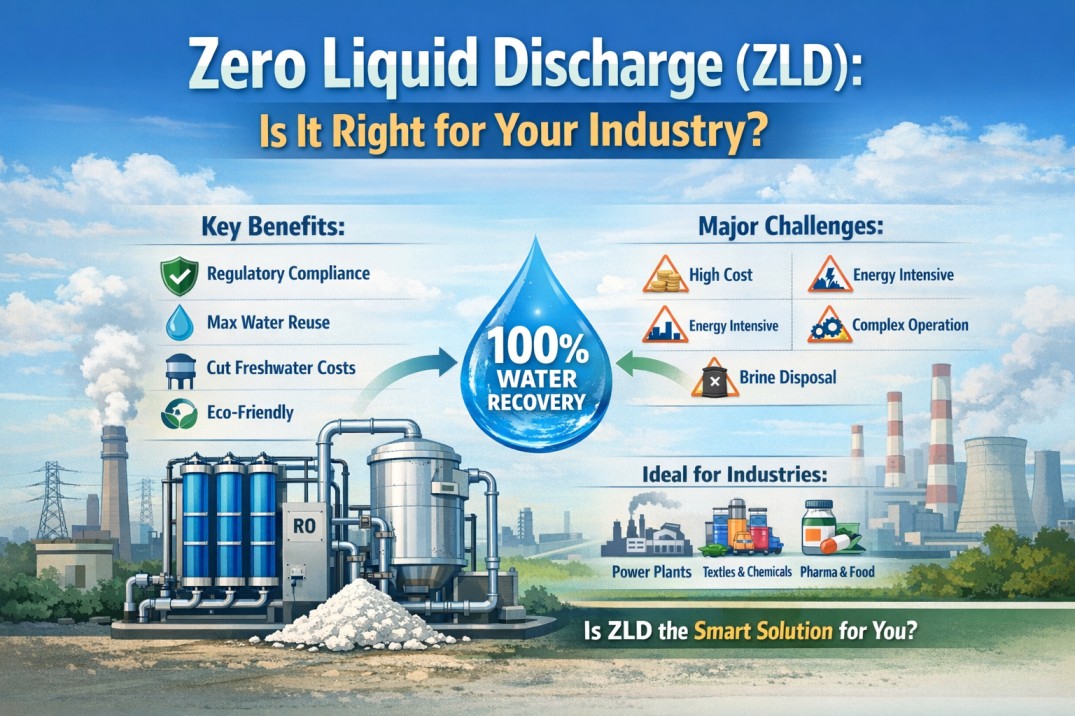
Feb 13, 2026
Zero Liquid Discharge (ZLD): Is It Right for Your Industry?
A Zero Liquid Discharge system is a comprehensive wastewater treatment approach that: ✔ Recovers reusable water ✔ Converts dissolved solids...
Why TDS Matters in Industrial Water Treatment | TDS Control Guide
Feb 11, 2026
uploads/blogs/blog_698c1c5aee708.jpg
What is TDS (Total Dissolved Solids)?
Total Dissolved Solids (TDS) refers to the concentration of dissolved substances present in water, including:
✔ Minerals (calcium, magnesium, sodium)
✔ Salts
✔ Metals
✔ Organic matter
TDS is typically measured in ppm (parts per million) and directly indicates water quality.
Why TDS is Important in Industrial Water Treatment
In industrial water treatment, TDS plays a crucial role in:
🔹 1. Equipment Protection
High TDS water can cause:
❌ Scaling in boilers
❌ Fouling of heat exchangers
❌ Membrane clogging in RO plants
❌ Corrosion in pipelines
Result: Reduced efficiency & costly downtime.
🔹 2. RO Plant Performance
An industrial RO plant is designed to reduce TDS, but:
Extremely high TDS → Faster membrane fouling
Poor pretreatment → Reduced rejection rate
Uncontrolled TDS → Higher operating cost
👉 Proper TDS control improves RO plant lifespan.
🔹 3. Product Quality
Industries requiring controlled TDS:
✔ Pharmaceuticals
✔ Food & Beverage
✔ Textiles
✔ Electronics
✔ Chemical manufacturing
High TDS can affect:
Taste
Chemical reactions
Surface finish
Process stability
🔹 4. Boiler & Cooling System Efficiency
High TDS leads to:
❌ Scale formation
❌ Heat transfer loss
❌ Increased fuel consumption
👉 Maintaining optimal TDS reduces energy waste.
Problems Caused by High TDS Water
Issue Industrial Impact
Scaling Reduced heat transfer
Corrosion Equipment damage
Membrane Fouling RO failure
Product Defects Quality rejection
Increased Chemical Usage Higher costs
Ideal TDS Levels for Industrial Use
Different applications require different TDS ranges:
Boiler Feed Water: Very low TDS
Cooling Towers: Controlled TDS cycles
Process Water: Application specific
Drinking / Packaged Water: As per standards
How to Control TDS in Industrial Water
✅ 1. Reverse Osmosis (RO Plant)
Best for TDS reduction and desalination.
✅ 2. Deionization (DI System)
For ultra-pure water applications.
✅ 3. Water Softener
Prevents scaling but does not reduce TDS significantly.
✅ 4. Proper Pretreatment
Sand filter, carbon filter, antiscalant dosing.
Why Industries Must Monitor TDS Regularly
Continuous monitoring helps:
✔ Prevent membrane damage
✔ Maintain compliance
✔ Optimize chemical dosing
✔ Improve plant efficiency
👉 Ignoring TDS = Increased operational cost
Conclusion
TDS in industrial water is not just a number — it directly affects:
✔ Equipment life
✔ Energy consumption
✔ RO plant performance
✔ Final product quality
Investing in the right industrial water treatment solution ensures:
✅ Lower maintenance costs
✅ Higher efficiency
✅ Consistent water quality
Need Help with High TDS Water?
If your industry faces:
❌ Scaling issues
❌ RO membrane failures
❌ Poor water quality
👉 A properly designed Industrial RO Plant / Water Treatment System can solve it.
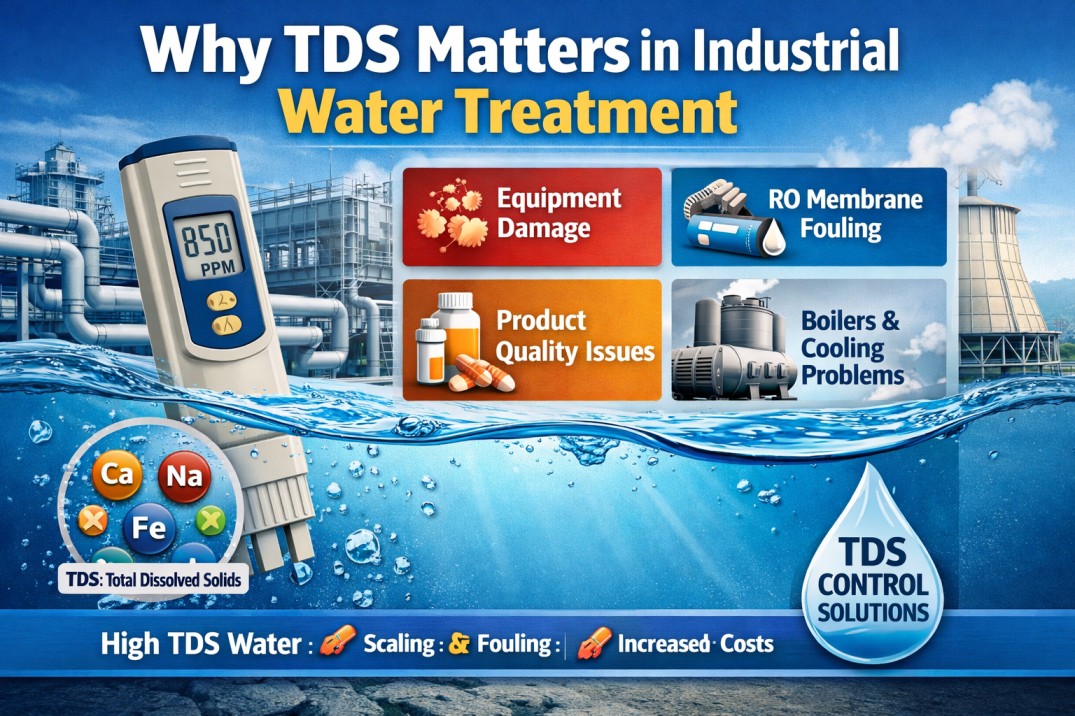
Feb 11, 2026
Why TDS Matters in Industrial Water Treatment | TDS Control Guide
What is TDS (Total Dissolved Solids)? Total Dissolved Solids (TDS) refers to the concentration of dissolved substances present in water,...
How Proper RO Plant Maintenance Ensures Long-Term System Performance
Feb 10, 2026
uploads/blogs/blog_698ac352cf263.jpg
An RO (Reverse Osmosis) plant is a long-term investment for industries, commercial buildings, hospitals, and institutions. However, without proper RO plant maintenance, even the best-designed system can suffer from reduced performance, high operating costs, and frequent breakdowns.
Regular maintenance not only improves water quality but also extends membrane life, reduces downtime, and lowers overall costs. In this blog, Srishti Polytech, a trusted RO plant manufacturer in India, shares a complete RO plant maintenance checklist to ensure long-term, trouble-free performance.
Why RO Plant Maintenance Is Critical
Proper RO plant servicing helps to:
Maintain consistent water quality
Prevent membrane fouling and scaling
Reduce power and chemical consumption
Avoid sudden system failures
Increase RO membrane life
Meet industry and regulatory standards
Neglecting maintenance often leads to low recovery, high TDS in permeate, increased rejection rates, and expensive replacements.
RO Plant Maintenance Checklist (Step-by-Step)
1️⃣ Daily RO Plant Maintenance Checklist
✔ Check raw water pressure and flow rate
✔ Monitor inlet and outlet TDS values
✔ Inspect pressure drop across filters
✔ Check pump noise, vibration, and leakage
✔ Ensure no leakage in piping and fittings
✔ Verify electrical panel indicators
👉 Tip: Sudden pressure or TDS variation is an early sign of membrane fouling.
2️⃣ Pre-Treatment System Maintenance
Pre-treatment is the backbone of industrial RO plant maintenance.
✔ Clean or backwash Multigrade Filter (MGF)
✔ Backwash Activated Carbon Filter (ACF) regularly
✔ Check media condition (sand, gravel, carbon)
✔ Inspect softener resin and salt level
✔ Verify iron and turbidity levels
🔴 Poor pre-treatment is the number one cause of RO membrane failure.
3️⃣ Cartridge Filter Maintenance
✔ Inspect cartridge filters daily
✔ Replace cartridges when pressure drop increases
✔ Typical replacement cycle: 7–30 days (depends on feed water quality)
Using clogged cartridge filters leads to membrane damage and pump overload.
4️⃣ RO Membrane Maintenance Checklist
✔ Monitor permeate flow and salt rejection
✔ Check differential pressure across membranes
✔ Perform chemical cleaning (CIP) when required
✔ Avoid chlorine exposure to membranes
✔ Use recommended antiscalant dosing
📌 RO membrane cleaning should be done when:
Permeate flow drops by 10–15%
Pressure drop increases by 15–20%
Salt rejection decreases
5️⃣ Chemical Dosing System Maintenance
✔ Check antiscalant dosing pump operation
✔ Ensure correct chemical concentration
✔ Inspect dosing lines and NRVs
✔ Calibrate dosing pumps periodically
Incorrect dosing causes scaling, fouling, and membrane choking.
6️⃣ High-Pressure Pump Maintenance
✔ Check pump alignment and vibration
✔ Inspect mechanical seals and bearings
✔ Lubricate as per manufacturer guidelines
✔ Monitor motor current and temperature
Regular pump maintenance ensures energy efficiency and system stability.
7️⃣ Electrical & Control Panel Inspection
✔ Check contactors, relays, and wiring
✔ Inspect overload and short-circuit protection
✔ Test pressure switches and sensors
✔ Ensure proper earthing
Electrical issues are a major reason for unexpected RO plant shutdowns.
8️⃣ RO Plant Cleaning & Sanitization
✔ Sanitize RO system periodically
✔ Flush membranes after long shutdowns
✔ Prevent biofouling in storage tanks
✔ Maintain hygienic permeate pipelines
Sanitization is especially critical for drinking water, hospitals, and food industries.
9️⃣ Record Keeping & Performance Log
✔ Maintain daily log sheets
✔ Record pressure, flow, TDS, and recovery
✔ Track filter replacement and CIP history
✔ Analyze trends to predict failures
Good documentation improves preventive maintenance planning.
Recommended RO Plant Maintenance Schedule
Component Maintenance Frequency
Pre-filters Daily / Weekly
Cartridge filters 7–30 days
RO membranes 6–12 months (cleaning)
Pumps & motors Monthly
Electrical panel Quarterly
Full system audit Annually
Importance of RO Plant AMC (Annual Maintenance Contract)
Opting for a professional RO Plant AMC ensures:
Scheduled preventive maintenance
Priority breakdown support
Reduced operating cost
Longer equipment life
Consistent water quality
Srishti Polytech offers customized RO plant AMC services for industrial and commercial clients across India.
Why Choose Srishti Polytech for RO Plant Maintenance?
✔ OEM manufacturer support
✔ Experienced service engineers
✔ Genuine spare parts & membranes
✔ Customized maintenance plans
✔ Fast response & technical expertise
As a trusted RO plant manufacturer and service provider, we design and maintain systems for industries, hospitals, hotels, railways, and institutions.
Conclusion
A well-maintained RO plant delivers consistent performance, high-quality water, and long-term cost savings. Following this RO plant maintenance checklist and partnering with an experienced OEM like Srishti Polytech ensures your system operates at peak efficiency for years.
Call to Action (CTA)
📞 Need RO Plant Maintenance or AMC?
🌐 Visit: www.srishtipolytech.com
📧 Contact us for industrial RO plant servicing, upgrades, and AMC solutions.
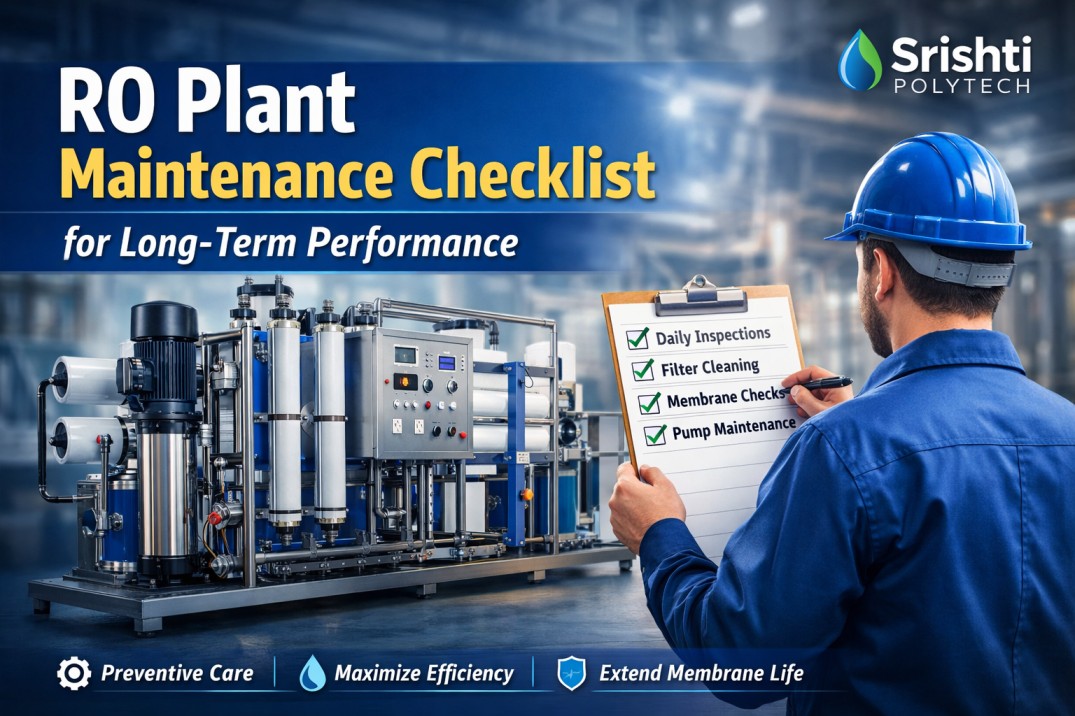
Feb 10, 2026
How Proper RO Plant Maintenance Ensures Long-Term System Performance
An RO (Reverse Osmosis) plant is a long-term investment for industries, commercial buildings, hospitals, and institutions. However, without proper RO...
Iron Removal Plant – Working Principle, Benefits & Applications | Srishti Polytech
Feb 07, 2026
uploads/blogs/blog_6986d49cf0ab6.jpg
Iron Removal Plant: Working Principle, Benefits & Applications
Groundwater contamination with excess iron is a common problem across many regions in India. High iron content causes reddish-brown stains, metallic taste, pipeline choking, and damage to industrial equipment. An Iron Removal Plant (IRP) is an effective water treatment solution designed to remove dissolved and suspended iron from water, making it safe for domestic, commercial, and industrial use.
What Is an Iron Removal Plant?
An Iron Removal Plant is a water treatment system that removes iron (Fe²⁺ / Fe³⁺) from groundwater using oxidation, filtration, and adsorption processes. It improves water quality by eliminating iron particles, odor, discoloration, and turbidity.
Iron removal systems are widely used in:
Drinking water treatment
Industrial water supply
Rural and municipal water schemes
Pre-treatment for RO plants
Working Principle of an Iron Removal Plant
The working of an iron removal plant involves multiple stages:
1. Oxidation
Dissolved ferrous iron (Fe²⁺) is oxidized into ferric iron (Fe³⁺) using:
Aeration
Chlorination
Chemical oxidants (as per water quality)
Oxidized iron converts into insoluble iron particles.
2. Filtration
The oxidized iron particles are removed by passing water through a pressure filter containing specialized media such as:
Manganese dioxide
Birm media
Sand and gravel layers
3. Backwashing
Accumulated iron sludge is flushed out through periodic backwashing, ensuring consistent performance and long filter life.
Benefits of an Iron Removal Plant
✅ Removes excess iron effectively from groundwater
✅ Improves taste, color, and odor of water
✅ Prevents staining of pipelines, tanks, and fixtures
✅ Protects RO membranes and industrial equipment
✅ Low operating and maintenance cost
✅ Environment-friendly and chemical-efficient solution
Applications of Iron Removal Plants
Iron removal plants are used across multiple sectors:
🏭 Industrial Applications
Textile and dyeing industries
Food and beverage processing units
Pharmaceutical manufacturing
Boiler feed and cooling water treatment
🏘️ Domestic & Commercial Use
Residential apartments and housing societies
Hotels, hospitals, and schools
Commercial complexes and offices
🚰 Municipal & Rural Water Supply
Panchayat water supply schemes
Government drinking water projects
Community water treatment systems
Iron Removal Plant Capacity & Customization
Iron removal plants are available in various capacities, ranging from:
Small domestic units
Commercial systems (500–10,000 LPH)
Large industrial plants (customized flow rates)
Systems can be designed in FRP, MS, or SS vessels based on application, budget, and site conditions.
Why Choose Srishti Polytech for Iron Removal Plants?
Srishti Polytech is a trusted Iron Removal Plant manufacturer and supplier in India, offering:
Customized system design
High-quality filtration media
CPCB-compliant solutions
Installation and after-sales support
Cost-effective and durable plants
We provide complete solutions from design to commissioning for industrial and drinking water applications.
Conclusion
An Iron Removal Plant is an essential water treatment solution for areas affected by high iron content in groundwater. With proper design and filtration technology, it ensures clean, safe, and iron-free water for long-term use. Choosing the right manufacturer ensures efficiency, durability, and compliance with water quality standards.
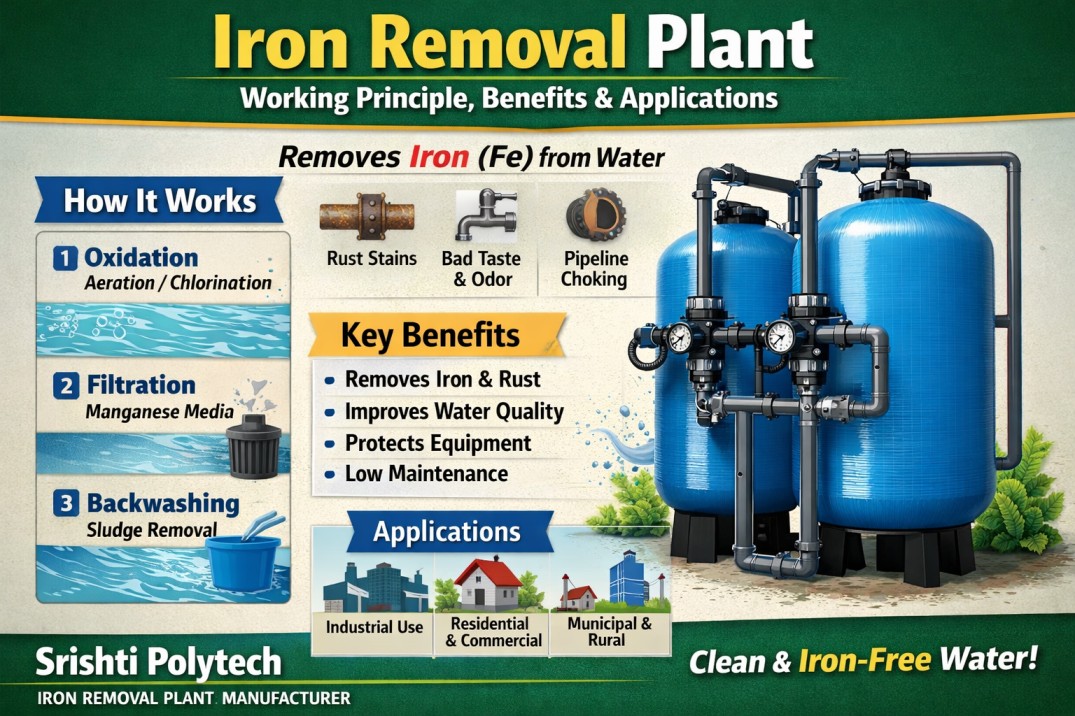
Feb 07, 2026
Iron Removal Plant – Working Principle, Benefits & Applications | Srishti Polytech
Iron Removal Plant: Working Principle, Benefits & Applications Groundwater contamination with excess iron is a common problem across many regions...
FRP vs SS RO Plant: Which Material Is Best for Your Application?
Feb 05, 2026
uploads/blogs/blog_698440cdcf98a.jpg
Choosing the right RO plant material is one of the most important decisions while setting up an industrial or commercial reverse osmosis system. The two most commonly used materials are FRP (Fiber Reinforced Plastic) and SS (Stainless Steel).
Each has its own advantages, limitations, and ideal applications. In this blog, we’ll compare FRP vs SS RO plants in detail to help you select the best option for your industry.
What Is an FRP RO Plant?
An FRP RO plant uses Fiber Reinforced Plastic for pressure vessels, pipelines, and structural components. FRP is lightweight, corrosion-resistant, and cost-effective, making it widely popular in industrial water treatment.
Key Features of FRP RO Plants
High corrosion resistance
Lightweight and easy to install
Lower initial cost
Ideal for high TDS and chemical environments
What Is an SS RO Plant?
An SS RO plant is fabricated using Stainless Steel (SS 304 or SS 316). These plants are known for their durability, hygiene, and premium finish, making them suitable for food-grade and pharmaceutical applications.
Key Features of SS RO Plants
Excellent mechanical strength
Hygienic and easy to sanitize
Long service life
High aesthetic and professional appearance
FRP vs SS RO Plant – Detailed Comparison
Parameter FRP RO Plant SS RO Plant
Material Fiber Reinforced Plastic Stainless Steel (304 / 316)
Corrosion Resistance Excellent Very good (SS 316 best)
Initial Cost Low High
Weight Lightweight Heavy
Maintenance Low Moderate
Chemical Compatibility Very high Limited for strong acids
Hygiene Moderate Excellent
Appearance Industrial Premium
Life Span 10–15 years 15–25 years
Best For Industrial & utility water Food, pharma & hospitals
When to Choose an FRP RO Plant?
An FRP RO plant is the best choice when:
Feed water has high TDS, iron, or chemical content
Budget is a key concern
Application is industrial or utility-based
Corrosion resistance is more important than appearance
Ideal Applications
Power plants
Mining industries
Steel and cement plants
Textile industries
Boiler feed water systems
Effluent recycling plants
When to Choose an SS RO Plant?
An SS RO plant is recommended when:
Water quality must meet hygienic standards
The system is exposed to public or regulated environments
Long-term durability is required
Cleanability and aesthetics matter
Ideal Applications
Pharmaceutical industries
Food & beverage plants
Bottling plants
Hospitals & laboratories
Electronics & semiconductor industries
FRP vs SS RO Plant: Cost Comparison
FRP RO Plant: 25–40% cheaper than SS systems
SS RO Plant: Higher upfront cost but longer lifespan
💡 For industries with tight budgets and harsh water conditions, FRP offers better ROI. For regulated sectors, SS is a compliance-driven choice.
Which Is Better – FRP or SS RO Plant?
There is no single “best” material—the right choice depends on:
Water chemistry
Industry standards
Budget
Hygiene requirements
Operating environment
Quick Recommendation
Industrial & utility water → ✅ FRP RO Plant
Food, pharma & healthcare → ✅ SS RO Plant
Why Choose Srishti Polytech?
At Srishti Polytech, we manufacture and supply both FRP and SS RO plants tailored to your application.
What We Offer
OEM-manufactured RO systems
Capacity range: 100 LPH to 1,00,000 LPH
Custom design as per water analysis
Compliance with BIS & industry standards
PAN India supply and service support
📞 Need help selecting FRP or SS RO plant? Our experts will guide you with the right technical recommendation.
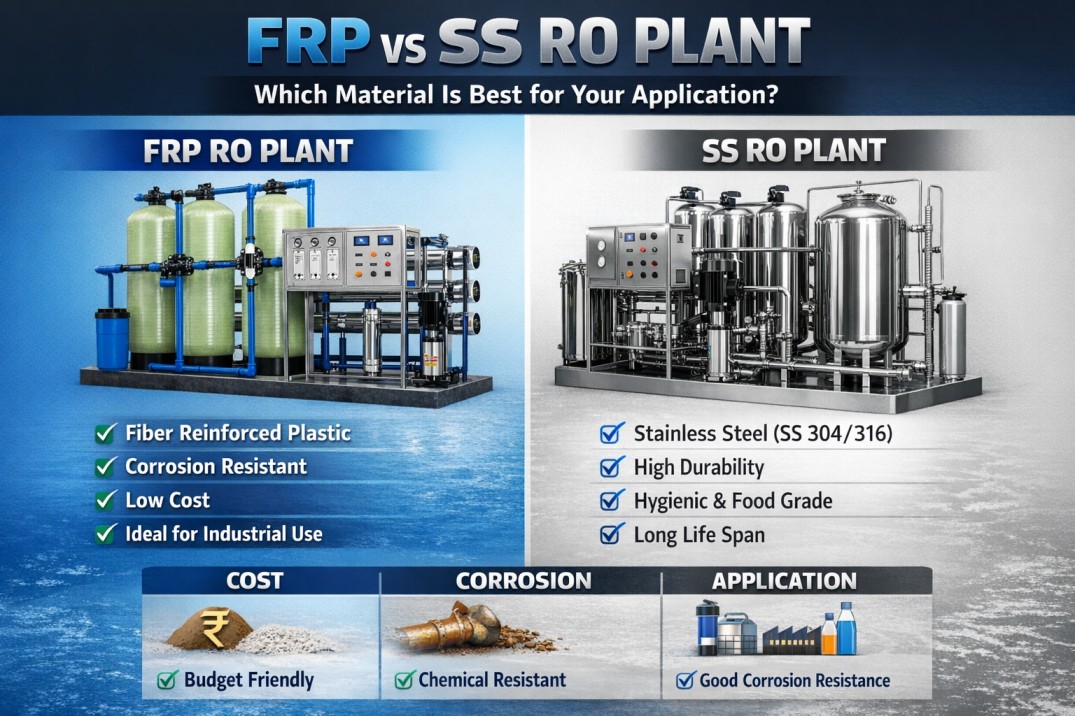
Feb 05, 2026
FRP vs SS RO Plant: Which Material Is Best for Your Application?
Choosing the right RO plant material is one of the most important decisions while setting up an industrial or commercial...
Effluent Treatment Plant (ETP): Complete Guide by Srishti Polytech
Feb 04, 2026
uploads/blogs/blog_6983198ab866b.jpg
Introduction to Effluent Treatment Plant (ETP)
With rapid industrial growth, wastewater treatment has become a critical requirement for industries across India. An Effluent Treatment Plant (ETP) is designed to treat industrial wastewater and make it safe for discharge or reuse, as per Pollution Control Board (PCB) norms.
At Srishti Polytech, we specialize in designing, manufacturing, supplying, and installing customized Effluent Treatment Plants for various industries, ensuring environmental compliance and sustainable water management.
What is an Effluent Treatment Plant?
An Effluent Treatment Plant (ETP) is a system used to treat wastewater generated from industrial processes such as:
• Chemical industries
• Pharmaceutical industries
• Food & beverage units
• Textile and dyeing industries
• Hospitals and laboratories
• Hotels and commercial facilities
The primary goal of an ETP is to remove harmful pollutants, reduce BOD, COD, TSS, oil & grease, and ensure treated water meets CPCB / SPCB discharge standards.
Importance of Effluent Treatment Plant
Installing an ETP system is not just a regulatory requirement—it is a responsible step toward environmental protection.
Key Benefits of ETP:
• Compliance with Pollution Control Board norms
• Reduction in environmental pollution
• Water recycling and reuse
• Cost savings on fresh water consumption
• Improved corporate environmental responsibility
Effluent Treatment Plant Process Flow
A standard Effluent Treatment Plant process consists of the following stages:
1. Preliminary Treatment
• Screening chamber
• Oil & grease trap
• Equalization tank
2. Primary Treatment
• pH correction (acid/alkali dosing)
• Coagulation and flocculation
• Primary clarifier for sludge removal
3. Secondary (Biological) Treatment
• Aeration tank (Activated Sludge Process / MBBR)
• Secondary clarifier
• Reduction of BOD and COD
4. Tertiary Treatment
• Pressure Sand Filter (PSF)
• Activated Carbon Filter (ACF)
• Advanced filtration / disinfection
5. Sludge Treatment
• Sludge thickener
• Filter press / sludge dewatering system
Types of Effluent Treatment Plants We Offer
At Srishti Polytech, we provide customized ETP solutions based on industry type and wastewater characteristics:
• Chemical ETP Plant
• Pharmaceutical ETP Plant
• Textile ETP Plant
• Food Processing ETP Plant
• Hospital Effluent Treatment Plant
• CETP (Common Effluent Treatment Plant)
Why Choose Srishti Polytech for Effluent Treatment Plant?
Srishti Polytech is a trusted name in water and wastewater treatment solutions with years of industry experience.
Our Key Strengths:
• Customized ETP design as per client requirement
• Use of high-quality MS / SS / FRP materials
• Energy-efficient and low-maintenance systems
• End-to-end solutions: design, supply, installation & commissioning
• AMC and operational support
Proprietor: Raj Kumar Pandey
Firm Name: Srishti Polytech
ETP Capacity Available
We design and manufacture Effluent Treatment Plants from:
• 5 KLD
• 10 KLD
• 25 KLD
• 50 KLD
• 100 KLD
• 200 KLD and above
All plants are designed as per CPCB & SPCB guidelines.
Effluent Treatment Plant Cost in India
The cost of an Effluent Treatment Plant depends on:
• Effluent characteristics (BOD, COD, pH, TDS)
• Treatment capacity (KLD)
• Process technology
• Automation level
• Material of construction
For the best ETP price in India, contact Srishti Polytech for a customized quotation.
Applications of Effluent Treatment Plant
• Industrial wastewater treatment
• Zero Liquid Discharge (ZLD) systems
• Water reuse for gardening, cooling, and flushing
• Environmental compliance for industries
Conclusion
An Effluent Treatment Plant (ETP) is essential for industries aiming for sustainable growth and legal compliance. With rising environmental regulations, choosing the right ETP manufacturer and supplier is crucial.
Srishti Polytech, under the leadership of Raj Kumar Pandey, delivers reliable, efficient, and cost-effective Effluent Treatment Plant solutions across India.
Contact us today to get expert guidance and the best ETP solution for your industry.
Feb 04, 2026
Effluent Treatment Plant (ETP): Complete Guide by Srishti Polytech
Introduction to Effluent Treatment Plant (ETP) With rapid industrial growth, wastewater treatment has become a critical requirement for industries across...
Complete Guide to Water Treatment Plants in India
Feb 03, 2026
uploads/blogs/blog_698195151be73.png
Introduction
Water treatment plants play a critical role in ensuring safe drinking water, compliant industrial discharge, and sustainable water management across India. With rising water scarcity, stricter pollution control norms, and rapid industrialization, water treatment systems such as RO, STP, ETP, Softener, and ZLD have become essential for municipalities, industries, hospitals, hotels, and commercial facilities.
This guide explains types of water treatment plants, processes, applications, regulations, costs, and selection tips—with an India-specific lens.
What is a Water Treatment Plant?
A Water Treatment Plant (WTP) is a system designed to remove physical, chemical, and biological contaminants from raw water or wastewater to make it suitable for drinking, industrial use, reuse, or safe discharge as per regulatory standards.
Types of Water Treatment Plants in India
1. Drinking Water Treatment Plant (DWTP)
Purpose: Make raw water potable.
Typical Process:
Coagulation & Flocculation
Sedimentation
Filtration (Sand/Activated Carbon)
Disinfection (Chlorination/UV/Ozone)
Applications: Municipal water supply, housing societies, institutions.
2. Reverse Osmosis (RO) Plant
Purpose: Remove dissolved salts (TDS), heavy metals, and pathogens.
Process Flow:
Pretreatment → High-pressure RO membranes → Posttreatment
Applications:
Industrial process water
Commercial drinking water
Bottling plants
Hospitals & dialysis centers
Common Capacities: 250 LPH to 1,00,000+ LPH
3. Effluent Treatment Plant (ETP)
Purpose: Treat industrial wastewater before discharge or reuse.
Industries Covered: Textile, pharma, chemicals, food & beverage, tanneries.
Process Stages:
Primary: Screening, equalization, pH correction
Secondary: Biological treatment (Aeration, MBBR)
Tertiary: Filtration, RO, disinfection
4. Sewage Treatment Plant (STP)
Purpose: Treat domestic sewage from buildings and campuses.
Common Technologies:
MBBR
SBR
MBR
ASP
Reuse: Gardening, flushing, cooling towers.
5. Water Softener Plant
Purpose: Remove hardness (Calcium & Magnesium).
Benefits:
Prevents scaling
Improves RO life
Reduces energy consumption
Applications: Boilers, cooling towers, hotels, laundries.
6. Zero Liquid Discharge (ZLD) System
Purpose: Ensure no wastewater discharge.
Includes: ETP + RO + MEE/ATFD
Mandatory For: Highly polluting industries in many Indian states.
Key Components of a Water Treatment Plant
Raw Water Pump
Pressure Sand Filter (PSF)
Activated Carbon Filter (ACF)
Dosing Systems (Antiscalant, Chlorine, pH)
RO Membranes & Pressure Vessels
Control Panel & Instrumentation
Treated Water Storage Tank
Water Treatment Regulations in India
Regulatory Bodies:
Central Pollution Control Board (CPCB)
State Pollution Control Boards (SPCBs)
BIS (IS 10500: Drinking Water Standards)
Compliance Areas:
Effluent discharge norms
Consent to Establish (CTE)
Consent to Operate (CTO)
Environmental Clearance (EC)
Cost of Water Treatment Plants in India (Indicative)
| Plant Type | Capacity | Approx. Cost (INR)
| RO Plant | 1000 LPH | 2 – 4 Lakhs |
| STP | 50 KLD | 6 – 10 Lakhs |
| ETP | 50 KLD | 8 – 15 Lakhs |
| Softener | 1000 LPH | 1 – 2 Lakhs |
Costs vary based on water quality, automation, and materials (FRP/SS).
How to Choose the Right Water Treatment Plant
1. Analyze raw water quality (TDS, hardness, iron, bacteria)
2. Define treated water usage (drinking, reuse, discharge)
3. Select capacity with future expansion in mind
4. Ensure compliance with CPCB/SPCB norms
5. Choose a reliable OEM manufacturer with service support
Why Choose an OEM Manufacturer in India?
Custom-built systems
Better pricing
Faster service & spares
Tender & GeM compatibility
Companies like Srishti Polytech design and manufacture customized water treatment plants for industrial and commercial applications across India.
Future of Water Treatment in India
Atmospheric Water Generation (AWG)
Smart RO systems with IoT
Water reuse & recycling
Energy-efficient membranes
Conclusion
Water treatment plants are no longer optional—they are essential infrastructure for sustainable growth in India. Selecting the right technology, capacity, and OEM partner ensures long-term compliance, cost savings, and environmental responsibility.
Looking for a customized Water Treatment Plant?
Contact Srishti Polytech for RO, STP, ETP, Softener & ZLD solutions across India.
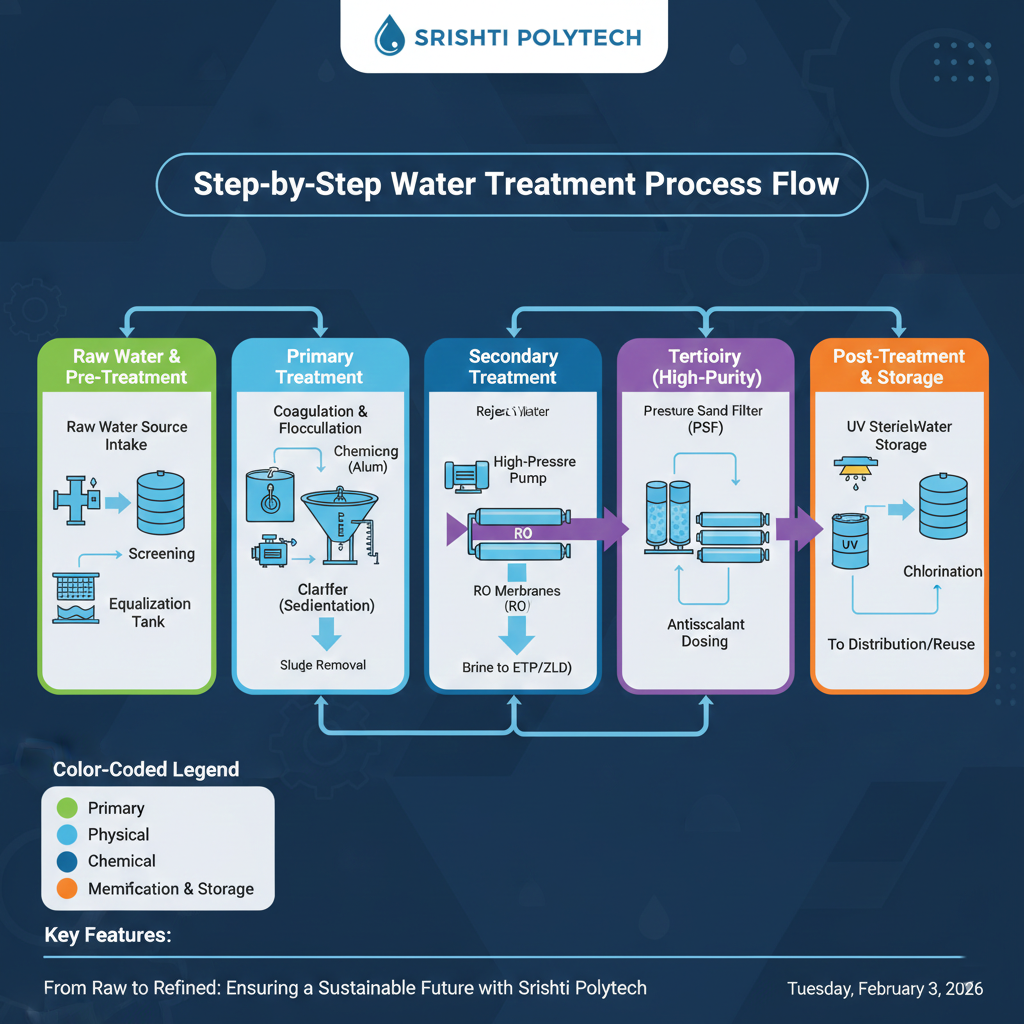
Feb 03, 2026
Complete Guide to Water Treatment Plants in India
Introduction Water treatment plants play a critical role in ensuring safe drinking water, compliant industrial discharge, and sustainable water management...
What is an RO Plant?
Feb 02, 2026
uploads/blogs/blog_69804c597d52e.png
What is an RO Plant?
Working, Components & Applications (Industrial + Commercial)
Clean and safe water is a critical requirement for industries, businesses, and institutions. One of the most widely used water purification technologies today is the RO (Reverse Osmosis) Plant. From factories and hospitals to hotels and schools, RO plants ensure consistent water quality by removing dissolved impurities, salts, and contaminants.
In this blog, we’ll explain what an RO plant is, how it works, its main components, and its industrial & commercial applications.
What is an RO Plant?
An RO Plant (Reverse Osmosis Plant) is a water purification system that removes dissolved salts, heavy metals, bacteria, viruses, and other impurities from water by using a semi-permeable membrane.
RO technology works on the principle of reverse osmosis, where pressure is applied to force water through a membrane, allowing only pure water to pass while rejecting contaminants.
RO plants are commonly used for:
* Drinking water purification
* Industrial process water
* Boiler & cooling applications
* Medical and pharmaceutical use
How Does an RO Plant Work?
The working of an RO plant happens in multiple stages to ensure high-quality purified water.
Step-by-Step RO Plant Working Process:
1. Raw Water Feed
* Water from borewell, tanker, or municipal supply enters the system.
2. Pre-Treatment Stage
* Suspended solids, dirt, chlorine, and organic matter are removed to protect the RO membrane.
3. High-Pressure Pump
* Increases water pressure to push it through the RO membrane.
4. RO Membrane Separation
* Pure water passes through the membrane.
* Dissolved salts and impurities are rejected as reject/brine water.
5. Post-Treatment
* pH correction, UV disinfection, or mineral dosing (if required).
6. Treated Water Storage
* Purified water is collected in a storage tank for usage.
Main Components of an RO Plant
An RO plant consists of several critical components that ensure efficient operation:
1. Raw Water Pump
Transfers feed water to the pre-treatment section.
2. Pre-Treatment System
Includes:
* Sand Filter (removes suspended particles)
* Activated Carbon Filter (removes chlorine, odor, color)
* Micron Cartridge Filters (fine filtration)
3. High-Pressure Pump
Provides required pressure to push water through RO membranes.
4. RO Membrane
The heart of the system. Removes:
* TDS (Total Dissolved Solids)
* Heavy metals
* Salts & chemicals
* Bacteria & viruses
5. Membrane Housing
Protects and holds RO membranes safely.
6. Control Panel
Manages system operation, pressure, flow, and safety interlocks.
7. Post-Treatment System
* pH correction dosing
* UV sterilizer (optional)
* Mineral dosing (for drinking water)
8. Product & Reject Water Lines
Separates purified water from reject water.
Industrial Applications of RO Plants
Industrial RO plants are designed for high capacity and heavy-duty usage.
Common Industrial Applications:
* Manufacturing Units
* Boilers & Cooling Towers
* Pharmaceutical & Chemical Industries
* Textile & Dyeing Industries
* Food & Beverage Processing
* Bottling & Packaged Drinking Water Plants
* Power Plants
* Mining & Heavy Industries
Industrial RO plants typically range from 500 LPH to 1,00,000+ LPH, depending on requirement.
Commercial Applications of RO Plants
Commercial RO plants focus on safe drinking water and moderate capacity.
Common Commercial Applications:
* Hospitals & Dialysis Centers
* Hotels & Restaurants
* Schools, Colleges & Hostels
* Offices & Corporate Buildings
* Shopping Malls
* Railway Stations & Airports
* Water ATMs
Commercial RO plants usually range from 250 LPH to 2000 LPH.
Benefits of Using an RO Plant
✔ Removes up to 99% dissolved impurities
✔ Improves taste, odor, and clarity of water
✔ Protects industrial equipment from scaling
✔ Reduces maintenance and operating costs
✔ Ensures compliance with water quality standards
✔ Customizable for industrial and commercial needs
Choosing the Right RO Plant Capacity
Selecting the correct RO plant depends on:
* Raw water TDS level
* Daily water consumption
* Industrial or drinking water usage
* Recovery percentage required
👉 Common capacities:
* 250 / 500 LPH – Commercial use
* 1000 / 2000 LPH – Hospitals, hotels, small industries
* 5000 LPH & above – Large industries
Why Choose Srishti Polytech for RO Plants?
Srishti Polytech is a trusted OEM manufacturer and supplier of RO plants for industrial and commercial applications.
What We Offer:
* Custom-designed RO plants
* High-quality membranes & pumps
* Robust SS/MS skid construction
* Energy-efficient systems
* After-sales service & AMC support
Conclusion
An RO plant is an essential solution for industries and commercial establishments facing water quality challenges. By understanding its working, components, and applications, businesses can make informed decisions for reliable and safe water treatment.
If you are planning to install an Industrial or Commercial RO Plant, Srishti Polytech can provide a tailor-made solution to meet your exact requirements.
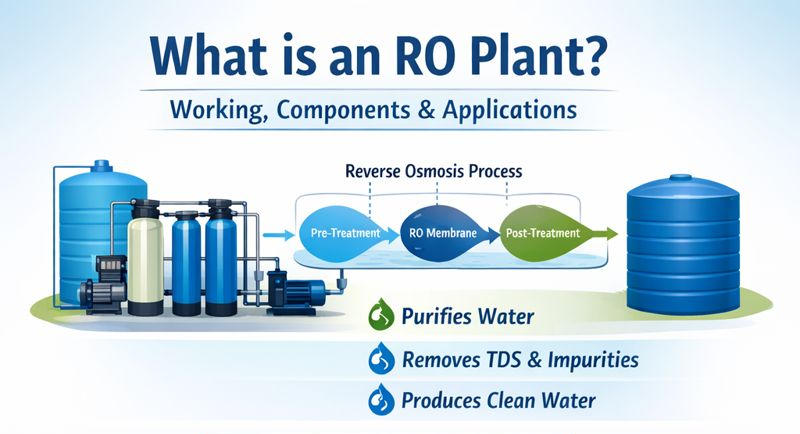
Feb 02, 2026
What is an RO Plant?
What is an RO Plant? Working, Components & Applications (Industrial + Commercial) Clean and safe water is a critical requirement...
Effluent Cum Sewage Treatment Plant at Central Hospital Dhori – Srishti Polytech
Jan 12, 2026
uploads/blogs/blog_6964ab7ce9598.jpeg
Effective wastewater management is essential for hospitals and public infrastructure to protect public health and the environment. Srishti Polytech, a leading water treatment solution provider in India, has successfully designed, installed, and commissioned a 20 KLD Sewage Treatment Plant (STP) at Regional Hospital, Dhori Area, Jharkhand.
This project reflects Srishti Polytech’s commitment to delivering reliable, eco-friendly, and regulatory-compliant water treatment solutions for healthcare institutions.
Project Overview
The 20 KLD STP at Central Hospital Dhori has been developed to treat hospital sewage efficiently, ensuring safe disposal and reuse of treated water. Hospital wastewater requires specialized treatment due to the presence of organic waste, chemicals, and pathogens.
Project Details
Location: Central Hospital, Dhori Area, Jharkhand
Capacity: 20 KLD (Kilo Liters per Day)
Plant Type: Effluent Cum Sewage Treatment Plant (STP)
Application: Hospital wastewater treatment
Execution: Complete turnkey solution by Srishti Polytech
Importance of Sewage Treatment in Hospitals
Hospital wastewater, if untreated, can cause serious environmental and health hazards. A properly designed STP helps in:
Preventing groundwater and soil contamination
Meeting pollution control board guidelines
Improving sanitation and hygiene standards
Reducing environmental impact
Supporting water reuse for non-potable purposes
STP Process & Technology
The 20 KLD STP installed at Dhori Hospital uses a well-engineered treatment process to ensure consistent output quality.
Treatment Stages
1️⃣ Preliminary Treatment
Screening to remove solid waste
Grit removal to protect downstream equipment
2️⃣ Primary Treatment
Flow equalization
Settling of suspended solids
3️⃣ Secondary (Biological) Treatment
Effective reduction of BOD & COD
Biological breakdown of organic pollutants
4️⃣ Tertiary Treatment
Filtration and disinfection
Treated water suitable for reuse or safe discharge
Environmental Benefits
The installation of this STP delivers multiple environmental and social benefits:
🌱 Protection of natural water resources
💧 Water conservation through reuse
🏥 Cleaner and safer hospital surroundings
🌍 Contribution to sustainable development goals
Inauguration & Project Significance
The inauguration of the 20 KLD Sewage Treatment Plant at Central Hospital Dhori highlights the growing focus on sustainable infrastructure in public healthcare facilities. The project stands as a model for efficient wastewater management in hospitals across Jharkhand.
Why Choose Srishti Polytech?
Srishti Polytech is a trusted name in water and wastewater treatment solutions, offering customized systems for hospitals, industries, and government institutions.
Our Key Strengths
✔ Expertise in STP, ETP & RO Plants
✔ Turnkey project execution
✔ Robust design and quality fabrication
✔ Compliance with CPCB & SPCB norms
✔ Reliable after-sales support
✔ Proven track record in Jharkhand & PAN India
Applications of Our Water Treatment Solutions
Hospitals & medical institutions
Residential apartments & townships
Hotels & commercial buildings
Industrial units
Government and municipal projects
Conclusion
The 20 KLD Sewage Treatment Plant at Central Hospital Dhori demonstrates how efficient wastewater treatment can support environmental protection and public health. Through this project, Srishti Polytech continues to strengthen its position as a reliable water solution partner in India.
For STP, ETP, RO plants, and complete water management solutions, Srishti Polytech delivers performance you can trust.
Contact Srishti Polytech
🌐 Website: www.srishtipolytech.com
📍 Service Area: Jharkhand | Dhanbad | Bokaro | Ranchi | PAN India
💧 Solutions: STP | ETP | RO Plant | Industrial Water Treatment
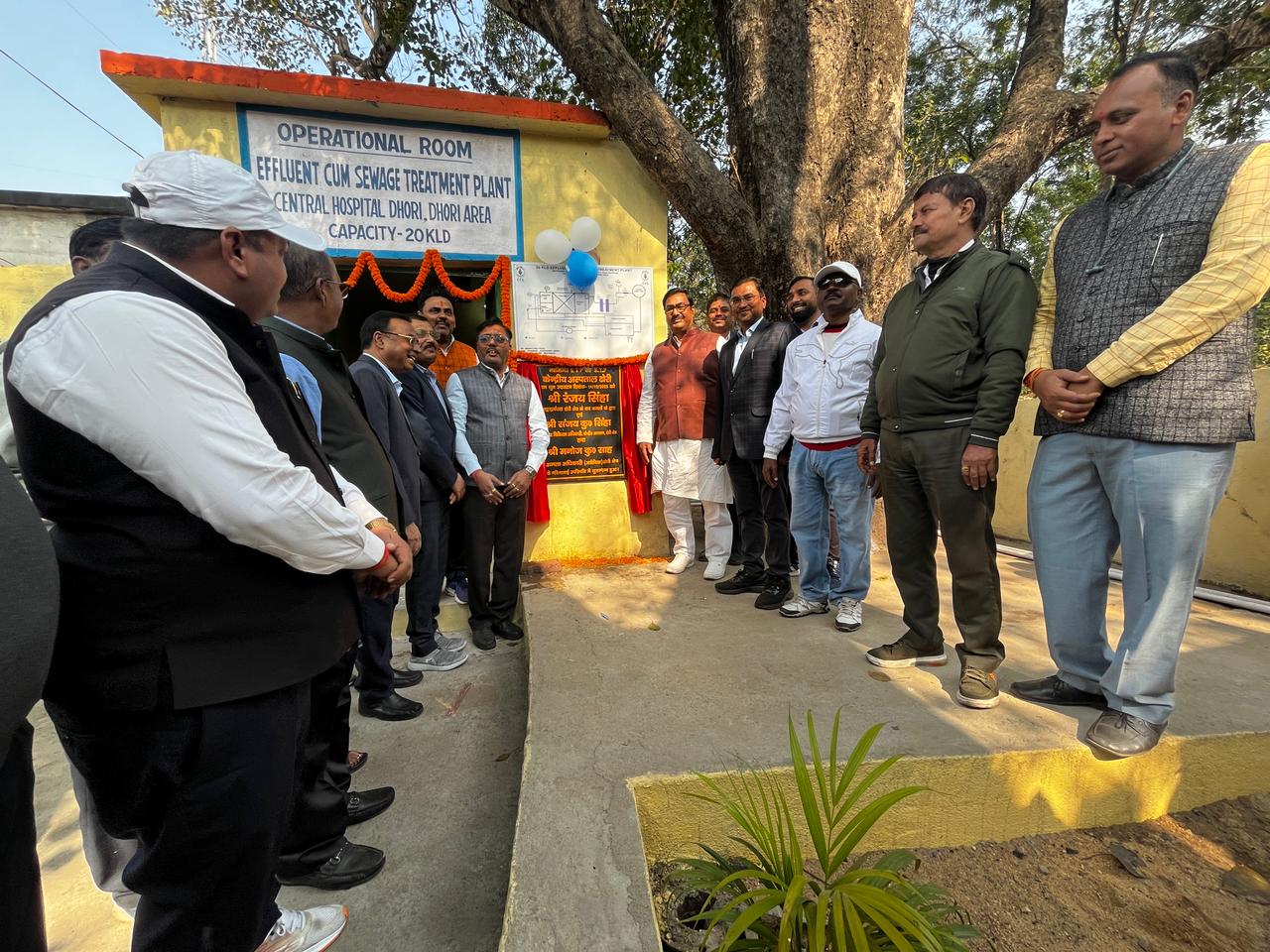
Jan 12, 2026
Effluent Cum Sewage Treatment Plant at Central Hospital Dhori – Srishti Polytech
Effective wastewater management is essential for hospitals and public infrastructure to protect public health and the environment. Srishti Polytech, a...
RO + UV Water Purification Project at IIT (ISM) Dhanbad
Dec 29, 2025
uploads/blogs/blog_69524b89e63ef.png
Government Institutional Drinking Water Solution by Srishti Polytech
Srishti Polytech, a Dhanbad-based OEM and trusted water treatment solution provider, successfully executed a RO + UV potable water purification system project at IIT (ISM) Dhanbad through the Online CPP e-Procurement Portal (Central Public Procurement Portal – CPPP). This project reflects our capability to deliver government-compliant drinking water solutions for premier educational institutions in India.
Project Overview
IIT (ISM) Dhanbad, an Institute of National Importance, requires reliable and hygienic drinking water infrastructure to serve students, faculty, and staff. Under this project, Srishti Polytech supplied and commissioned a Potable Water Purification System with Inbuilt Water Cooler, designed specifically for institutional and continuous usage.
The entire procurement and execution process was carried out through the Online CPP e-Procurement system, ensuring transparency, compliance, and adherence to Government of India procurement norms.
Scope of Work
As part of this CPP e-procurement project, Srishti Polytech was responsible for:
Supply of RO + UV based potable water purification system
OEM-manufactured equipment with verified specifications
SS304 stainless steel body and storage tank for hygiene and durability
Installation, testing, and demonstration
Documentation and handover as per institutional and CPP guidelines
Execution Through Online CPP e-Procurement Portal
This project was executed through the Central Public Procurement Portal (CPPP), highlighting Srishti Polytech’s strong understanding of government tendering processes and compliance requirements. Our ability to meet technical specifications, delivery timelines, and service obligations makes us a reliable partner for CPP-based government projects.
Importance of the Project for IIT (ISM) Dhanbad
The installed RO + UV water purification system ensures:
Safe and hygienic drinking water for campus users
Reduced dependency on packaged drinking water
Compliance with government health and safety norms
Sustainable and cost-effective water management
Such projects contribute directly to improving campus infrastructure and student welfare.
Why Government Institutions Choose Srishti Polytech
OEM manufacturing with strict quality control
Proven experience in CPP and government projects
Compliance with IS standards and procurement norms
Strong service presence in Jharkhand and Eastern India
Timely installation and responsive after-sales support
Conclusion
The successful completion of the RO + UV water purification project at IIT (ISM) Dhanbad through Online CPP e-Procurement reinforces Srishti Polytech’s position as a trusted government water treatment solution provider. We remain committed to supporting educational institutions and public sector organizations with reliable, compliant, and efficient drinking water solutions.
For government tenders, institutional projects, and water treatment solutions, visit: 👉 www.srishtipolytech.com | www.srishtipolytech.in
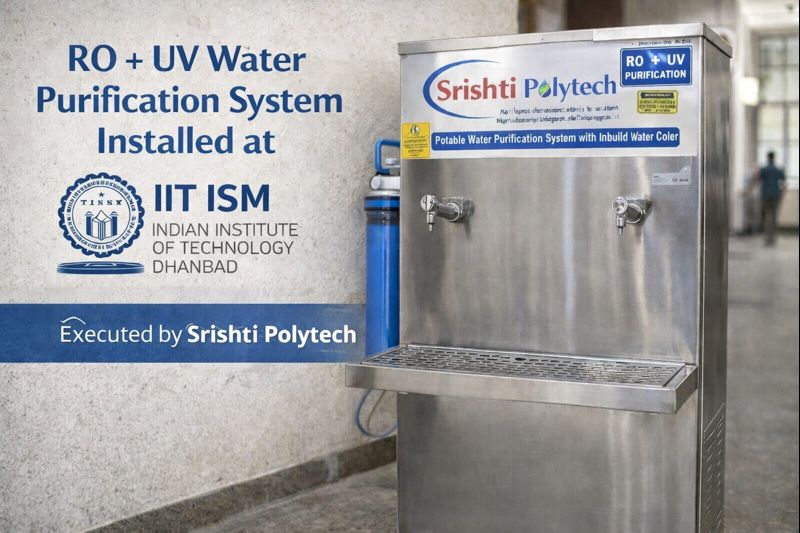
Dec 29, 2025
RO + UV Water Purification Project at IIT (ISM) Dhanbad
Government Institutional Drinking Water Solution by Srishti Polytech Srishti Polytech, a Dhanbad-based OEM and trusted water treatment solution provider, successfully...
Government Water Treatment & ETP Projects | Srishti Polytech
Dec 29, 2025
uploads/blogs/blog_69520123e9dfa.png
Our Journey in Government Water Treatment Projects
Srishti Polytech: Delivering Reliable Water Treatment Solutions Across Eastern India
Clean water and responsible wastewater management are critical for sustainable development. Srishti Polytech, based in Dhanbad, Jharkhand, has been on a focused journey to support government and public sector organisations with water treatment solutions, Effluent Treatment Plants (ETP), and Operation & Maintenance (O&M) services. Over the years, we have successfully partnered with multiple government bodies and PSUs through platforms like GeM, CCL, CPP, and IRPES, delivering dependable and compliant solutions across Jharkhand, Odisha, West Bengal, and Bihar.
Our Journey: From Manufacturing to Government Projects
Srishti Polytech began as an OEM (Original Equipment Manufacturer) with a clear vision: to design, manufacture, and execute water treatment systems that meet Indian standards and real-world site conditions. What started with RO plants and water treatment equipment soon expanded into large-scale ETP projects, industrial water treatment, and annual operation & maintenance contracts for government institutions.
Our growth has been driven by:
Strong in-house technical expertise
Compliance with government norms and tender requirements
Timely execution and transparent communication
Long-term performance through structured O&M services
Government & PSU Projects We Serve
Srishti Polytech actively works with central and state government departments, PSUs, hospitals, educational institutions, and industrial units. Our experience includes projects executed through:
GeM (Government e-Marketplace)
We are a registered and active supplier on GeM, providing water treatment plants, ETP systems, spares, and O&M services as per tender specifications and timelines.
CCL (Central Coalfields Limited)
In mining-intensive regions, wastewater and effluent management is crucial. We support CCL with customized ETP solutions and maintenance services designed for high-load and challenging site conditions.
CPP (Captive Power Plants)
For CPP units, we deliver water and effluent treatment systems that ensure compliance with pollution control norms while maintaining operational efficiency.
IRPES & Other Engineering Systems
Through IRPES and allied platforms, we contribute to government engineering and infrastructure projects by supplying reliable treatment systems and long-term support.
Core Services Offered by Srishti Polytech
Effluent Treatment Plants (ETP)
We design, manufacture, install, and commission ETP plants for hospitals, industries, mining units, and government facilities. Our ETP solutions are tailored to meet CPCB and SPCB norms, ensuring safe discharge and reuse of treated water.
Operation & Maintenance (O&M)
A water treatment system is only as good as its operation. Our O&M services ensure:
Consistent performance
Reduced downtime
Optimised chemical and power consumption
Extended plant life
We offer AMC and comprehensive O&M contracts for government and PSU clients.
Turnkey Water Treatment Solutions
From site survey and design to installation and handover, we provide end-to-end water treatment solutions backed by documentation, training, and after-sales support.
Regional Presence: Four Key States
Jharkhand
With our base in Dhanbad, Jharkhand remains a core focus area. We actively serve mining regions, hospitals, and government institutions with ETP and water treatment solutions.
Odisha
In Odisha, we support healthcare facilities, industrial units, and government departments with compliant and efficient water treatment systems.
West Bengal
Our projects in West Bengal include water and wastewater treatment plants for public sector units and infrastructure-related facilities.
Bihar
In Bihar, we contribute to improving water quality and wastewater management through customised treatment solutions and reliable O&M services.
Why Government Bodies Trust Srishti Polytech
OEM capability with quality-controlled manufacturing
Proven experience in government and PSU projects
Compliance with tender, safety, and environmental norms
Prompt service support and transparent reporting
Focus on sustainability and long-term performance
Looking Ahead
As water scarcity and environmental regulations continue to grow in importance, Srishti Polytech remains committed to supporting government initiatives with innovative and dependable water treatment solutions. Our future roadmap includes advanced treatment technologies, improved automation, and sustainable water reuse systems for public infrastructure projects.
Partner with Srishti Polytech for trusted government water treatment solutions across Jharkhand, Odisha, West Bengal, and Bihar.
For enquiries and project discussions, visit www.srishtipolytech.com.
#SrishtiPolytech #GovernmentProjects #WaterTreatment #ETPPlant #OandMServices #GeM #CCL #CPP #IRPES #Jharkhand #Odisha #WestBengal #Bihar
Dec 29, 2025
Government Water Treatment & ETP Projects | Srishti Polytech
Our Journey in Government Water Treatment Projects Srishti Polytech: Delivering Reliable Water Treatment Solutions Across Eastern India Clean water and...
10 KLD ETP Plant at Bolani Hospital, Odisha | Srishti Polytech
Dec 24, 2025
uploads/blogs/blog_694b9e96b0431.png
Srishti Polytech successfully installed a 10 KLD Effluent Treatment Plant at Bolani Hospital, Odisha, ensuring safe and compliant hospital wastewater treatment as per CPCB norms.
Srishti Polytech has successfully designed, supplied, installed, and commissioned a 10 KLD Effluent Treatment Plant (ETP) at Bolani Hospital, Odisha, ensuring safe and eco-friendly treatment of hospital wastewater in compliance with CPCB and SPCB norms.
The 10 KLD ETP plant is specially engineered to treat hospital effluent, which contains organic load, chemicals, detergents, and biological contaminants. The system efficiently removes BOD, COD, TSS, oil & grease, and pathogens, making the treated water suitable for safe discharge or reuse for non-potable applications.
Key Features of the 10 KLD ETP Plant
Compact and space-saving design suitable for hospital premises
Automated chemical dosing system for consistent performance
High-efficiency Primary, Secondary, and Tertiary Treatment Process
Low power consumption and easy operation
Minimal maintenance with long service life
Designed as per CPCB / SPCB hospital wastewater guidelines
Process Flow of Hospital ETP
The installed hospital effluent treatment plant includes:
Collection & Equalization Tank
Chemical Dosing (Acid, Alkali, Coagulant, Flocculant)
Primary Clarification
Pressure Sand Filter (PSF)
Activated Carbon Filter (ACF)
Sludge Handling System
This 10 KLD ETP system ensures reliable performance and supports environmental sustainability by reducing pollution load and protecting nearby water bodies.
Trusted ETP Manufacturer in Odisha
With this successful installation at Bolani Hospital, Srishti Polytech reinforces its position as a leading ETP plant manufacturer and supplier in Odisha and Eastern India. Our customized wastewater treatment solutions are widely used in hospitals, industries, hotels, institutions, and commercial establishments.
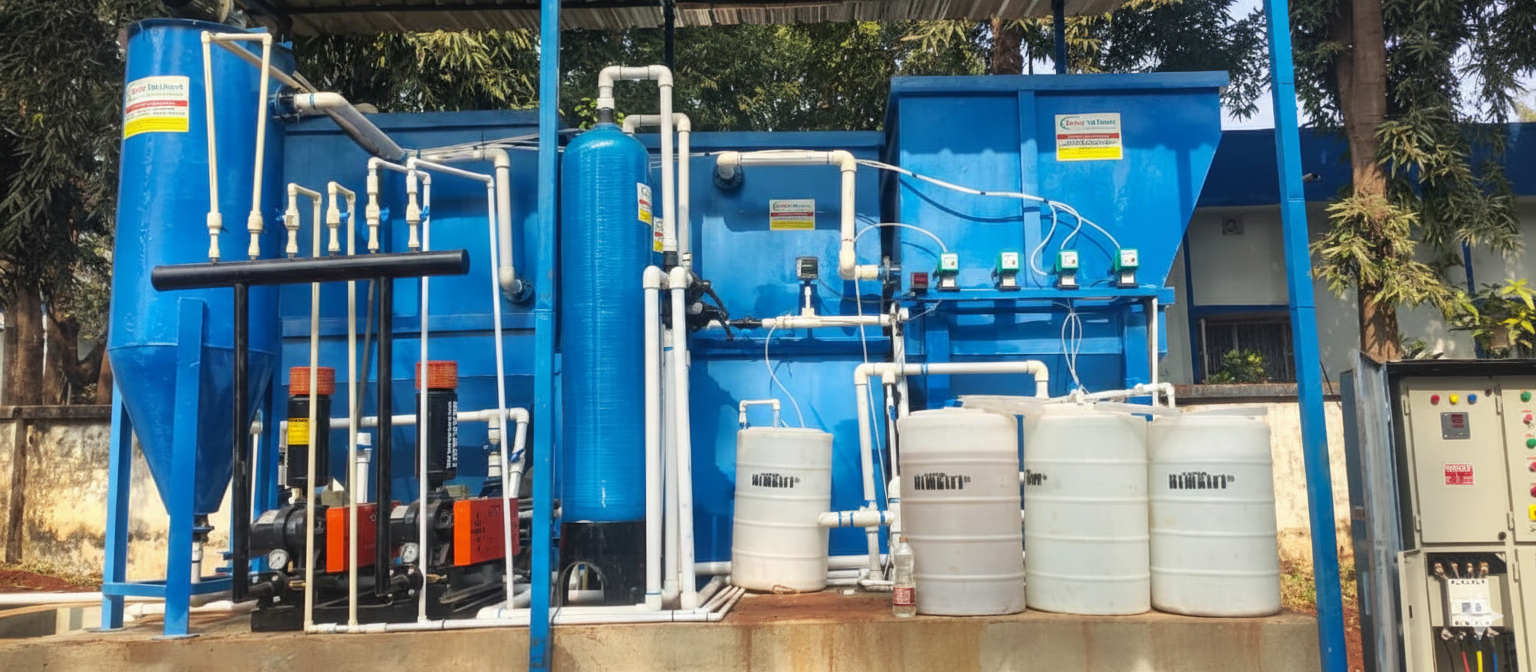
Dec 24, 2025
10 KLD ETP Plant at Bolani Hospital, Odisha | Srishti Polytech
Srishti Polytech successfully installed a 10 KLD Effluent Treatment Plant at Bolani Hospital, Odisha, ensuring safe and compliant hospital wastewater...